Understanding OAuth2 Authorization Server Metadata (RFC 8414)
An examination of RFC 8414 regarding OAuth2 authorization server metadata, covering discovery mechanisms and configuration endpoints for secure integration.
Understanding OAuth2 Authorization Server Metadata (RFC 8414)
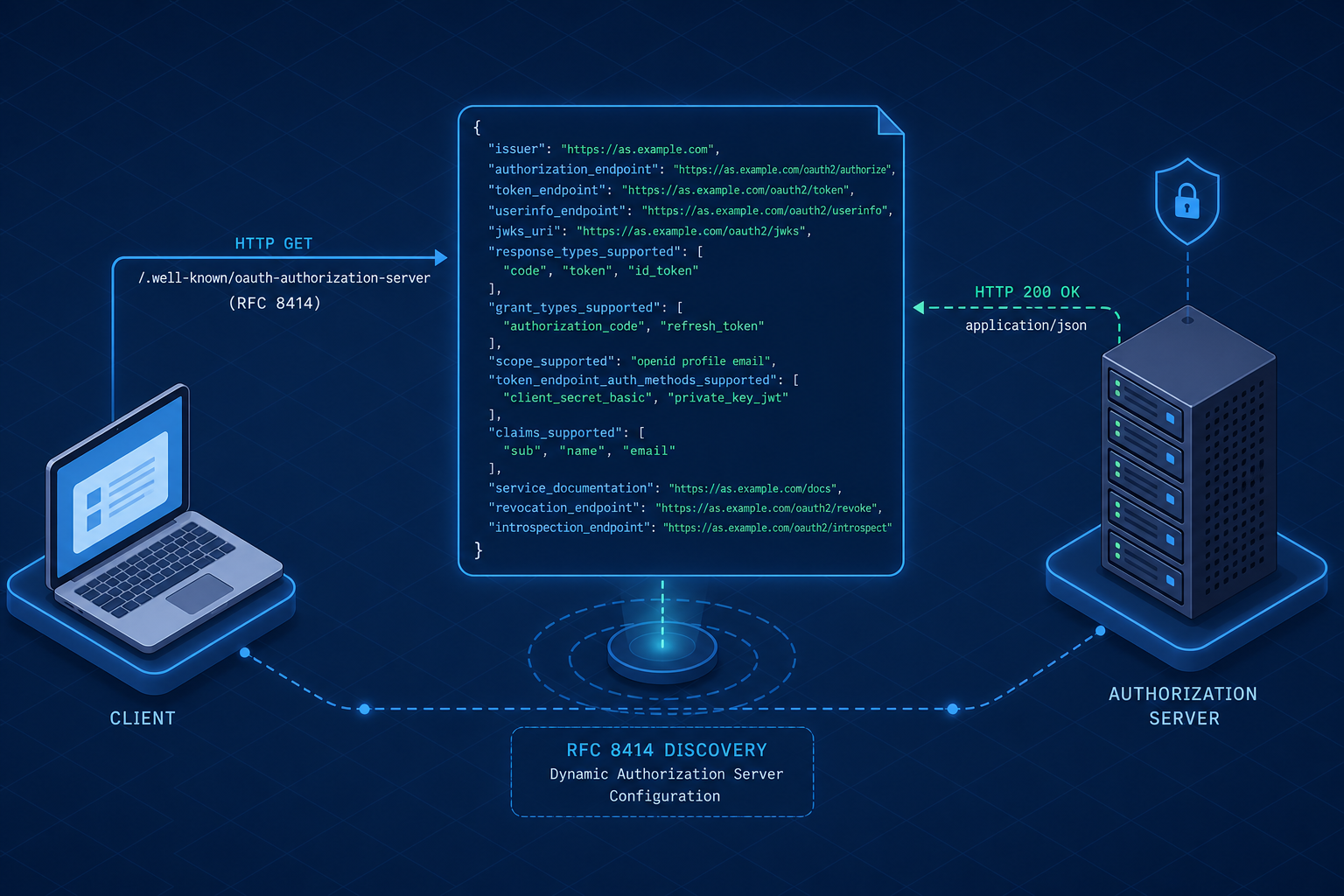
Before standardizing metadata discovery, integrating with an OAuth2 provider was brittle. Developers manually inspected documentation to find base URLs and hardcoded paths for authorization, token retrieval, and user info. If a provider changed their API version or endpoint structure, every client application required a code update. RFC 8414 solves this by introducing a deterministic discovery mechanism where the client queries a single, well-defined URI to retrieve the full configuration of the authorization server.
The core mechanism relies on a standard HTTP GET request to the path /.well-known/oauth-authorization-server relative to the authorization server's issuer URI. Consider a client attempting to connect to an identity provider with the issuer https://auth.example.com. The client constructs the URL https://auth.example.com/.well-known/oauth-authorization-server and sends a request. The server responds with a JSON object containing a dictionary of named endpoints and capabilities. This response is not a static file but a dynamic representation of the server's current state. If the server rotates its signing keys or disables a deprecated grant type, the client picks up these changes immediately on the next discovery call, eliminating the need for redeployment.
The Discovery Mechanism and JSON Structure
RFC 8414 replaces manual configuration with a standardized HTTP GET request to a well-known URI, allowing clients to dynamically discover endpoints, supported scopes, and cryptographic keys without hardcoding provider-specific URLs. The client constructs the URL based on the issuer and sends a request. The server responds with a JSON object containing a dictionary of named endpoints and capabilities.
GET /.well-known/oauth-authorization-server
Host: auth.example.com

HTTP/1.1 200 OK
Content-Type: application/json

{
  "issuer": "https://auth.example.com",
  "authorization_endpoint": "https://auth.example.com/oauth2/v1/authorize",
  "token_endpoint": "https://auth.example.com/oauth2/v1/token",
  "registration_endpoint": "https://auth.example.com/oauth2/v1/register",
  "scopes_supported": ["openid", "profile", "email"],
  "response_types_supported": ["code", "id_token", "code id_token"],
  "grant_types_supported": ["authorization_code", "client_credentials"],
  "jwks_uri": "https://auth.example.com/oauth2/v1/jwks",
  "subject_types_supported": ["public"]
}
This response is not a static file but a dynamic representation of the server's current state. If the server rotates its signing keys or disables a deprecated grant type, the client picks up these changes immediately on the next discovery call, eliminating the need for redeployment.
Core Endpoint Resolution
The most critical field in this payload is authorization_endpoint. In the manual configuration era, a developer might have assumed the endpoint was /login or /saml. RFC 8414 explicitly tells the client exactly where to send the user agent for the initial authorization request. The client uses this URL to construct the authorization request, appending parameters like client_id, redirect_uri, response_type, and scope. Without this metadata, the client would be sending requests to arbitrary paths, likely resulting in 404 errors or security failures if the path required specific headers or query parameters not known in advance.
Following the authorization phase, the client receives an authorization code. To exchange this code for an access token, the client needs the token_endpoint. This field defines the specific URL where the POST request for token exchange occurs. Crucially, the metadata also dictates the supported grant types via grant_types_supported. If the list includes authorization_code but excludes implicit, the client knows it must implement the PKCE (Proof Key for Code Exchange) flow. This prevents the client from attempting a flow that the server has explicitly disabled, which is a common security hardening measure against cross-site request forgery (CSRF) and token leakage in public clients.
Security and Algorithm Negotiation
Security in this ecosystem relies heavily on the jwks_uri field. This URL points to the JSON Web Key Set, a collection of public keys used by the authorization server to sign ID tokens and access tokens. When the client receives an ID token (a JWT) after a successful login, it cannot trust the token without verifying its signature. The client fetches the keys from the jwks_uri and uses the kid (Key ID) header within the JWT to select the correct public key. This mechanism ensures that even if the authorization server rotates its private signing keys, the client can seamlessly update its verification logic by fetching the new public keys from the metadata endpoint, maintaining a chain of trust without manual intervention.
While RFC 8414 defines the core OAuth2 metadata, it often operates in tandem with OpenID Connect (OIDC). OIDC adds specific requirements on top of OAuth2, such as requesting user profile information. The scopes_supported array in the RFC 8414 response typically includes openid. If this scope is present, the client knows it can proceed with the OpenID Connect discovery flow. However, specific endpoints like userinfo_endpoint, introspection_endpoint, and revocation_endpoint are not fields defined in RFC 8414 itself; they are defined exclusively in the OpenID Connect Discovery specification. Consequently, these fields will be absent from a pure RFC 8414 response. The client must check the response for these extensions to determine if it can perform user profile lookups or token introspection directly. If the userinfo_endpoint is missing from the metadata, the client should not attempt to query it, preventing potential security misconfigurations where a client tries to access a non-existent or unauthorized resource.
One subtle but important tradeoff is the handling of the registration_endpoint. If this field is present, the client can dynamically register itself with the authorization server without prior out-of-band configuration. This is useful for "bring your own client" scenarios or multi-tenant SaaS applications where each tenant needs a unique client ID. However, relying on dynamic registration introduces complexity. The client must handle the secure storage of the newly generated client_secret and potentially manage the client_uri and logo_uri fields returned during registration. If the environment is highly constrained or the client is a simple device, static registration via a configuration file might still be preferred over dynamic discovery.
The response_types_supported array further constrains the client's behavior. A server might support code (Authorization Code Flow) and id_token (Implicit Flow), but the presence of code id_token indicates support for the hybrid flow. A client implementing a Single Page Application (SPA) must strictly adhere to the types listed here. If the server only lists code and id_token but not code id_token, the SPA cannot use the hybrid flow to get both an ID token and an access token in a single redirect. This forces the developer to choose a flow that aligns with the server's security posture. Attempting to use a response type not in this list will result in an immediate rejection from the authorization server, usually with an invalid_request error.
START_IMAGE_BLOG : oauth2-authorization-server-metadata-rfc-8414-inline-2-response-types : oauth2-authorization-server-metadata-rfc-8414-inline-2-response-types.png : Conceptual diagram comparing authorization code flow, implicit flow, and hybrid flow with checkmarks and crosses indicating server support based on response_types_supported array. Flat design, technical schematic style. ##END_IMAGE_BLOG
Finally, the issuer field in the response serves as the anchor for all other URLs. The client should validate that the issuer in the metadata response matches the issuer it originally queried. This prevents a man-in-the-middle attack where an attacker redirects the discovery request to a malicious server returning valid-looking metadata. The client must ensure the authorization_endpoint, token_endpoint, and jwks_uri are all under the same trusted issuer domain or a pre-approved list of subdomains. This validation ensures that the configuration endpoints are genuinely owned by the identity provider and not spoofed by a third party.
Conclusion
In summary, RFC 8414 transforms OAuth2 integration from a manual, error-prone mapping exercise into a dynamic, self-describing protocol. By fetching the metadata, the client gains a complete map of the server's capabilities, endpoints, and security constraints. This reduces the attack surface by enforcing strict adherence to supported grant types and response modes, while simultaneously improving maintainability by allowing automatic updates to endpoints and keys. The mechanism ensures that the client and server remain synchronized on the rules of engagement, making the integration more robust against configuration drift and security missteps.
Common Pitfalls
- Ignoring Issuer Validation: Failing to validate that the
issuerin the metadata response matches the expected domain allows attackers to redirect discovery requests to malicious servers. - Assuming
userinfo_endpointExists in RFC 8414: Developers often incorrectly expectuserinfo_endpointto be present in standard OAuth2 metadata; this field is exclusive to OpenID Connect Discovery and will be missing from pure RFC 8414 responses. - Failing to Handle Key Rotation: Not implementing logic to refresh the
jwks_uricache can lead to authentication failures immediately after the authorization server rotates its signing keys.
Practical Takeaways
- Treat Metadata as Dynamic: Never cache the discovery response indefinitely; re-fetch it frequently or upon detecting a change in the
jwks_urito stay synchronized with server updates. - Strictly Adhere to Supported Lists: Only use grant types, response types, and scopes explicitly listed in the metadata; do not attempt flows that the server has not advertised.
- Distinguish Specs Clearly: Always differentiate between what RFC 8414 provides (OAuth2 endpoints) and what OpenID Connect Discovery adds (OIDC-specific endpoints) to avoid implementation errors.
FAQ
Q: Is userinfo_endpoint part of RFC 8414?
A: No, userinfo_endpoint is not defined in RFC 8414. It is a field specific to the OpenID Connect Discovery specification. Its presence indicates the server supports OIDC, not just OAuth2.
Q: How do I handle key rotation without downtime?
A: Implement a caching strategy for the jwks_uri that allows for background refresh. When a token fails signature verification due to a missing key, trigger an immediate fetch of the updated JWKS.
Q: Can I use a custom discovery endpoint instead of /.well-known/oauth-authorization-server?
A: While RFC 8414 standardizes the /.well-known path, some legacy systems may use custom paths. However, for new integrations, always prioritize the standard well-known URI to ensure compatibility with automated tooling and libraries.
Related posts
Implementing and Validating Discovery in Your Client
A technical walkthrough for backend developers on implementing OAuth 2.1 discovery, issuer validation, and strict discovery document validation using OpenIDConnectConfigurationRetriever.
Understanding OAuth2 Multiple Response Types: A Technical Guide
An examination of OAuth2 response types including hybrid flow, OIDC response types, and authorization server configurations for beginners.
Decoding client_secret_basic Default in RFC 8414
An examination of the token_endpoint_auth_methods_supported metadata field in RFC 8414 and why client_secret_basic remains the default authentication method.