Implementing Consent Management with OIDC: GDPR and Privacy Compliance
This article covers implementing consent management using OpenID Connect to ensure GDPR and privacy compliance.
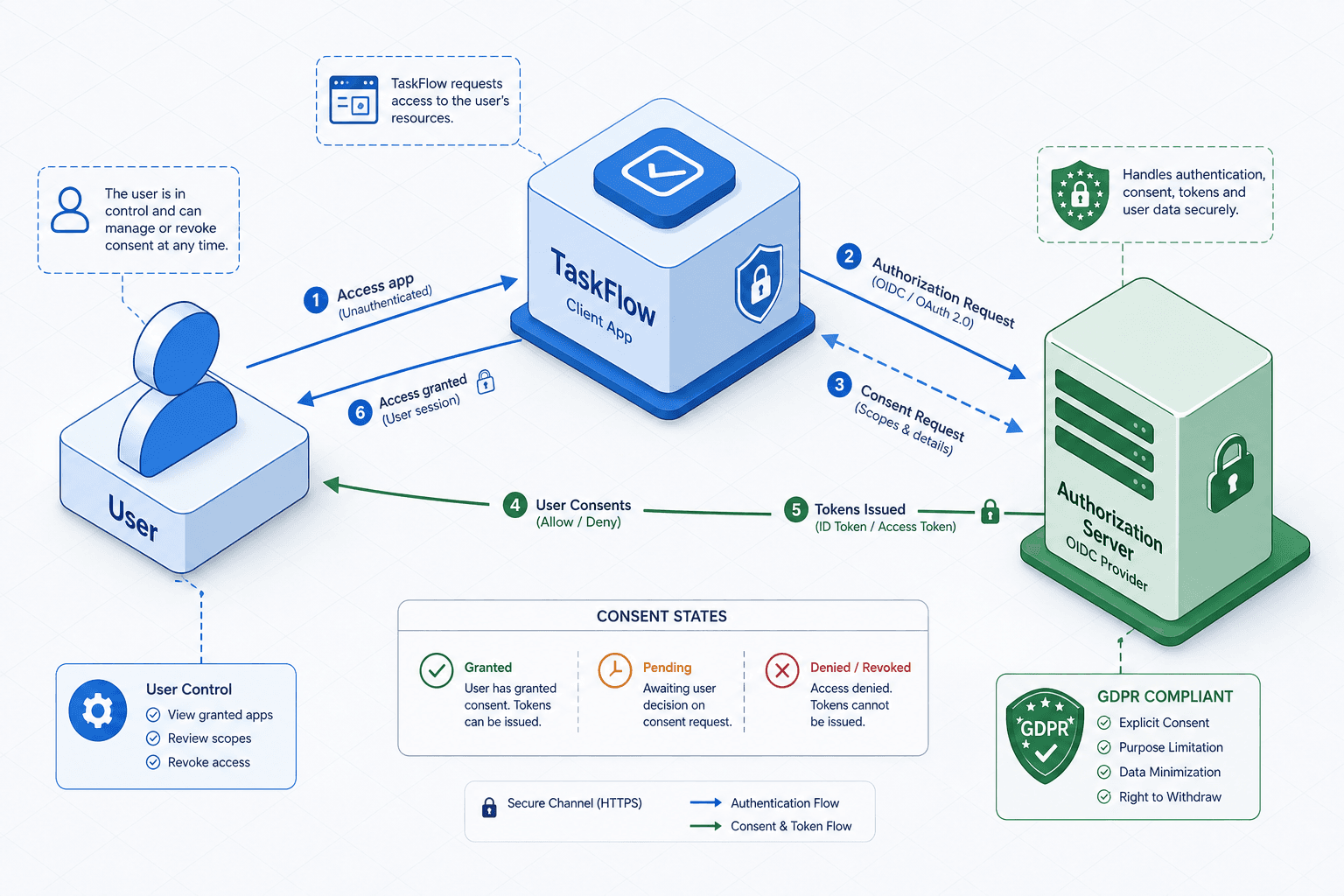
OpenID Connect (OIDC) is often misunderstood as a drop-in solution for privacy compliance. It is not. The protocol provides the plumbing for identity verification, but GDPR Article 7 demands a specific behavioral state: consent must be specific, informed, unambiguous, and revocable. Implementing this requires treating the OAuth2 authorization flow not as a simple authentication handshake, but as a state machine where the issuance of an Access Token is contingent upon a persistent, granular consent record.
The Mechanism of Scope as Consent
In a standard OIDC flow, the client requests a set of scopes via the scope parameter in the Authorization Request. For example, a client might request openid profile email. Under strict GDPR interpretation, requesting email is not merely a technical parameter; it is a request for personal data. The mechanism here is that the scope string defines the boundary of the data the user is being asked to authorize.
Consider a scenario involving two actors: User Alice and Client App "TaskFlow". TaskFlow needs Alice's email to send notifications (essential) but also wants to access her work calendar for analytics (non-essential). If TaskFlow requests openid profile email calendar, it lumps essential and non-essential data into a single bucket. This violates the "specificity" requirement.
The compliant mechanism requires the client to request only the minimal scopes necessary for the immediate transaction. The Authorization Server (AS) must then present these distinct scopes to the user. If the AS receives a request for calendar, it must render a UI that explicitly lists "Work Calendar Access" as a distinct item, separate from "Email Address." The user must toggle these independently.
For a comprehensive OpenID Connect implementation, the system should also provide a consent dashboard where users can view and manage their permissions across all connected applications, ensuring transparency beyond the initial login prompt.
GET /authorize?
  client_id=taskflow&
  redirect_uri=https://taskflow.app/callback&
  response_type=code&
  scope=openid%20profile%20email%20calendar&
  state=xyz123
Here, the scope parameter is the data payload. The AS does not automatically grant this. It pauses the flow and redirects to a consent screen. The consent screen is not a generic "I agree" checkbox. It is a structured form where calendar and email are distinct checkboxes. If Alice checks email but leaves calendar unchecked, the AS records a consent state where email is granted but calendar is denied.

The Consent UI & State Machine
The critical failure point in many OIDC implementations is the lack of persistence in the consent decision. The mechanism for compliance is the creation of a consent_id (often mapped to the JWT jti claim) that binds the user's decision to a specific client and specific scopes.
When Alice visits the consent screen, the AS generates a unique consent_id. This ID is stored in the database with the following schema:
consent_id: UUIDuser_id: Alice's IDclient_id: TaskFlow's IDgranted_scopes:["openid", "profile", "email"]denied_scopes:["calendar"]timestamp: Current timeip_address: Source IP
This record is the "legal artifact." Without this record, the AS cannot issue a valid token. The flow proceeds as follows:
- Alice submits the form selecting
emailonly. - The AS creates the
consent_idrecord. - The AS redirects Alice back to the
redirect_uriwith anauthorization_code. - TaskFlow exchanges this code for tokens.
Crucially, if Alice has previously granted consent for email but not calendar, the AS compares the new request scopes against the existing granted scopes. If the new request includes only existing granted scopes, it proceeds directly to token issuance. If it includes any new scope not in the existing record, it triggers the UI. If it includes a scope previously denied, it must re-ask for consent and cannot auto-grant.
This mechanism ensures that consent is not implicit. Every token issuance is backed by a database row that can be audited. If a regulator asks, "Did Alice consent to calendar access?", the AS can query the consent_id table. If the calendar scope is absent from the granted_scopes array for that consent_id, the answer is definitively no.
Token Enforcement & Data Flow
The token is the mechanism of enforcement. An Access Token is a self-contained assertion of authority. In a compliant implementation, the token's payload (the JWT) must reflect the exact scope of the consent granted.
When TaskFlow exchanges the authorization_code for an access_token, the AS constructs the JWT. The scope claim in this token is not optional; it is the map of what the token allows.
{
  "iss": "https://auth.example.com",
  "sub": "alice_id_123",
  "aud": "taskflow",
  "exp": 1678886400,
  "iat": 1678882800,
  "scope": "openid profile email",
  "jti": "consent_uuid_abc"
}
Notice that calendar is missing from the scope claim. This is the mechanism that protects data at rest and in transit. When TaskFlow calls an API to fetch user data, the API does not trust the client's request blindly. It validates the scope claim.
Consider the API endpoint /api/v1/users/me/calendar. The API middleware performs the following check:
- Verify the JWT signature.
- Parse the
scopeclaim. - Check if
calendarexists in thescopelist. - If
calendaris not present, return403 Forbidden.
This ensures that even if a malicious actor intercepts the token, they cannot access data outside the scope of the original consent. The token acts as a "consent manifest," limiting the data flow strictly to what Alice approved. This strict enforcement is the core of user data protection in an OIDC ecosystem.
Revocation & Right to be Forgotten
GDPR Article 17 grants users the "right to be forgotten," which in the context of OIDC means the ability to revoke consent and have data deleted. The mechanism for this is the Token Revocation Endpoint.
When Alice decides she no longer wants TaskFlow to access her email, she triggers a revocation. The client or the user interface calls the revocation endpoint:
POST /revoke
Content-Type: application/x-www-form-urlencoded

token=eyJhbGciOiJSUzI1NiIsInR5cCI...
token_type_hint=access_token
client_id=taskflow
client_secret=YOUR_CLIENT_SECRET
Note: The token_type_hint parameter is optional. The client_secret field indicates that this method requires a confidential client.
The AS receives this request and performs a two-step mechanism:
- Immediate Invalidity: The AS marks the
jti(which corresponds to theconsent_id) as revoked in its database. Any subsequent use of this token is rejected immediately, regardless of itsexptime. To do this, the AS must map the incomingjticlaim to its internalconsent_idrecord via a lookup, rather than assuming they are identical values stored together. - Consent Record Update: The AS updates the consent record to mark the specific scopes as revoked.
It is vital to distinguish between the technical act of revocation (invalidating the token at the AS) and the compliance act of deletion (triggering a notification to the client to delete data). The AS does not directly delete client data; it invalidates the token and optionally sends a notification to the client.
The client must then receive this signal and delete Alice's email data from their local storage. This creates a dependency chain: Consent -> Token -> Data Access. Breaking the consent link (revocation) must break the data access link (token invalidation) and the data retention link (deletion workflow).

If the AS does not implement this revocation mechanism, the token remains valid indefinitely, violating the "revocable" requirement of GDPR Article 7(3). The mechanism must ensure that the user's decision is technically enforceable, not just a policy statement. This technical rigor is essential for achieving regulatory compliance.
Common Pitfalls
When implementing OIDC consent, several pitfalls can undermine your GDPR strategy:
- Implicit Consent via "Bundled" Scopes: Requesting all scopes at once and presenting a single "I Agree" checkbox fails the specificity requirement. Users must be able to accept email access while denying calendar access.
- Assuming
jtiEquivalence: Developers often assume thejtiin the token is the same as the internalconsent_idwithout a database lookup. If the mapping logic is flawed, revocation may fail to invalidate the correct consent record. - Ignoring Denied Scopes on Re-authentication: If a user previously denied a scope (e.g.,
location), the system should not silently proceed if the client requests it again later. The system must re-prompt the user for consent on any denied scope, rather than assuming silence implies agreement.
Practical Takeaways
To navigate these complexities, keep these mental models in mind:
- Scope is a Contract, Not a Parameter: Treat the
scopestring as a legal contract defining the boundary of data access, not just a technical argument for an API call. - Consent is Stateful: Never treat consent as a transient flag. It must be a persistent record (
consent_id) that survives session boundaries and can be audited. - Revocation is a Chain Reaction: Revoking a token is only step one. A compliant system must also trigger the downstream deletion of data, closing the loop on the "Right to be Forgotten."
FAQ
Q: Can I reuse an existing consent_id if a user requests the same scope again?
A: Yes, but only if the scope was previously granted. If the scope was previously denied, you must re-prompt the user for consent; you cannot reuse the negative decision.
Q: Does the Authorization Server delete user data when a token is revoked? A: No. The AS only invalidates the token and updates its own consent records. The responsibility for deleting user data from the client application's storage lies with the client, triggered by the revocation notification.
Q: Is token_type_hint required in the revocation request?
A: No, it is optional. However, providing it can help the AS validate the token type faster. The client_secret is required only for confidential clients.
Conclusion
Implementing consent management with OIDC is not about adding a checkbox to a login page. It is about architecting a system where the scope parameter, the consent_id database record, and the access_token payload are tightly coupled. The scope defines the request, the consent_id records the explicit user decision, and the token enforces the limit on data flow.
By treating the authorization flow as a state machine that requires explicit, granular consent for every scope, and by ensuring that tokens strictly reflect that consent, you create a technical environment where GDPR compliance is a default outcome of the protocol design, not an afterthought. The mechanism is simple: no consent record, no token; no token, no data. This logic closes the gap between the legal requirement for "unambiguous consent" and the technical reality of data access. This approach forms the backbone of modern identity management systems.
Related posts
Implementing and Validating Discovery in Your Client
A technical walkthrough for backend developers on implementing OAuth 2.1 discovery, issuer validation, and strict discovery document validation using OpenIDConnectConfigurationRetriever.
Implementing Back-Channel Logout in OIDC: Reliable Session Termination
An examination of back-channel logout implementation in OpenID Connect to ensure reliable session termination and secure logout token handling.
Keycloak Client Scopes and Protocol Mappers Explained
A detailed look at Keycloak client scopes and protocol mappers for token customization and claim management.