OAuth 2.1: What's Changing and How to Prepare
An examination of OAuth 2.1 updates including mandatory PKCE and deprecations, offering security updates and best practices for migration.
OAuth 2.1: What's Changing and How to Prepare
The confusion surrounding "OAuth 2.1" stems from a fundamental misunderstanding of how the Internet Engineering Task Force (IETF) operates. There is no new RFC 2.1 that introduces novel cryptographic primitives or changes the core handshake logic. Instead, the IETF has released a series of "Best Current Practice" (BCP) documents that collectively define what a secure implementation of OAuth 2.0 must look like today. The upcoming "OAuth 2.1" specification is essentially a consolidation of these BCPs—specifically RFC 6749 (Authorization Framework), RFC 6750 (Bearer Tokens), and RFC 7636 (PKCE)—into a single normative document. RFC 8252 (Native Apps) serves as a companion BCP specifically for native applications rather than a core part of this consolidated framework spec. This is Part 7 of the OAuth 2.0 Technical Series.
The De Facto Standard Reality
The IETF moved from a "best current practice" model to a "mandatory" model by freezing the spec. This contrasts the original RFC 6749, which allowed optional behaviors, with the proposed draft that enforces specific security postures. The critical shift is not in the protocol mechanics, but in the mandatory enforcement of behaviors that were previously optional. The document redefines these normative requirements to make them mandatory, addressing constraints not present in the original RFCs.
The Implicit Grant Deprecation Mechanism
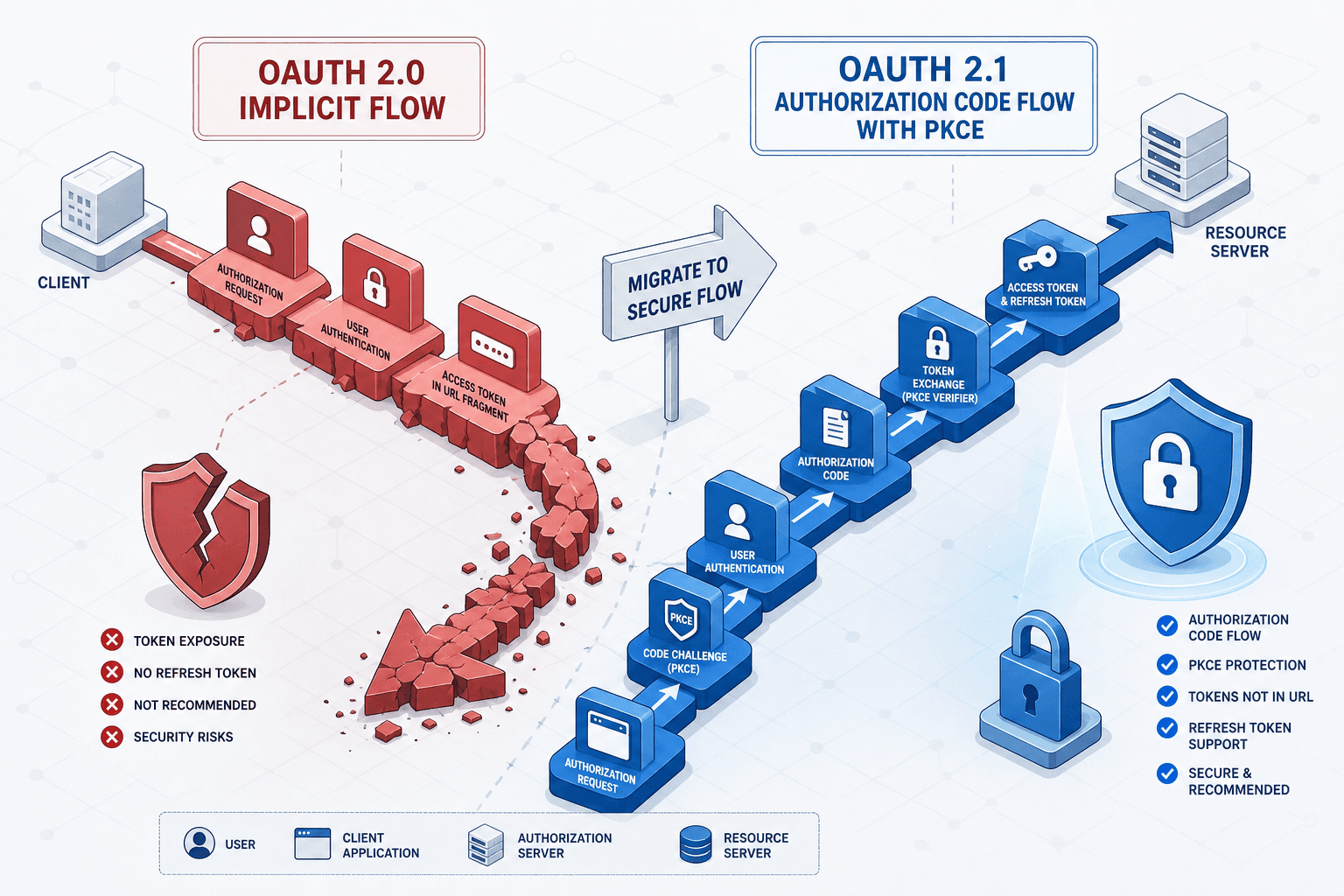
In the original OAuth 2.0 specification (RFC 6749), the Implicit Flow allowed a public client, such as a Single Page Application (SPA) running entirely in a browser, to receive an access token directly from the authorization server without an intermediate authorization code step. This design was intended to simplify the architecture for public clients that cannot securely store a client secret. However, the mechanism of token delivery in this flow relies on the authorization server redirecting the user agent to a URI containing the token in the query string or fragment.
This delivery method creates a severe security vulnerability. When a token is placed in a URL fragment (#access_token=...), it is sent to the browser's history, cached by proxies, and potentially leaked via the Referer header if the user navigates away from the application. Furthermore, the token is exposed in the browser's network logs and can be intercepted if the initial redirect is not secured end-to-end. The IETF recognized that this attack surface is inherent to the flow's design, not a configuration error. Consequently, the OAuth 2.1 draft explicitly deprecates the Implicit Flow, stating that it must not be used in new implementations.
PKCE as the New Foundation
The mechanism replacing the Implicit Flow is the Authorization Code Flow augmented with Proof Key for Code Exchange (PKCE). PKCE (RFC 7636) was originally designed for mobile apps but is now mandatory for all public clients, including SPAs. The core mechanism of PKCE solves the "interception attack" problem without requiring a client secret. In a standard Authorization Code Flow, an attacker who intercepts the authorization code can exchange it for an access token. PKCE binds the code to the client dynamically.
Consider a concrete scenario involving an actor named Alice (the user), a client named WebApp (the SPA), and an authorization server named AuthServer. In the old Implicit Flow, WebApp would request a token directly. In the new PKCE-enabled flow, the mechanism changes as follows:
- Challenge Generation: Before sending the authorization request,
WebAppgenerates a randomcode_verifierstring. It then applies a SHA-256 hash function to this verifier and encodes it using URL-safe Base64 to create acode_challenge. - Request:
WebAppsends the authorization request toAuthServerincluding thecode_challengeand acode_challenge_method(usuallyS256). - Code Issuance:
AuthServerissues an authorization code and redirectsAliceback toWebAppwith the code. No token is present here yet. - Token Exchange:
WebAppreceives the code and initiates a POST request to the token endpoint. Crucially, it includes the originalcode_verifierin the request body. - Verification:
AuthServerhashes the receivedcode_verifierand compares it against the storedcode_challenge. If they match, it issues the token.
This mechanism ensures that even if an attacker intercepts the authorization code, they cannot exchange it for a token because they do not possess the code_verifier, which was generated locally by WebApp and never transmitted to the server until the final exchange. This effectively neutralizes the risk of code interception attacks, which were the primary reason the Implicit Flow was deemed insecure.
Migration Strategy for Single Page Applications (SPAs)
The migration path for existing applications involves a systematic replacement of the token acquisition logic. For SPSPAs, the change is architectural: you must stop using the response_type=token parameter and switch to response_type=code. This requires adding a backend component or using a specific library pattern to handle the token exchange securely. If your application is a native mobile app or a desktop app, the mechanism remains similar, but the code_verifier generation must happen in a trusted execution environment.
Here is a concrete example of the HTTP request difference. In the deprecated Implicit Flow, the request might look like this:
GET /authorize?response_type=token&client_id=my_client_id&redirect_uri=https://app.example.com/callback HTTP/1.1In the mandatory OAuth 2.1 compliant flow with PKCE, the request changes significantly:
GET /authorize?response_type=code&client_id=my_client_id&redirect_uri=https://app.example.com/callback
    &code_challenge=EdnC4bzO46gM2y36fE6zXq4h5s7d8f9g0h1j2k3l4m5n6o7p8q9r0s1t2u3v4w5x6y7z
    &code_challenge_method=S256&state=random_state_string HTTP/1.1
Note the addition of response_type=code and the specific PKCE parameters. The state parameter is also critical; it must be used to prevent Cross-Site Request Forgery (CSRF) attacks by ensuring the response matches the request initiated by the user. The OAuth 2.1 draft requires that the state parameter be included and validated to ensure the integrity of the session. While the base RFC 6749 treats this as optional but recommended, the new draft elevates it to a requirement.
For backend-to-backend API calls, the dynamic registration of clients and the use of private keys (RFC 7523) are also being standardized as best practices, though the core token exchange remains the same. The "OAuth 2.1" document will likely clarify that the "Client Credentials" flow is the only appropriate method for machine-to-machine communication, while the "Authorization Code" flow is the only valid method for user-impersonating applications.
The deprecation of the Implicit Flow is not just a recommendation; it is a necessary evolution. Industry experience over the last decade has shown that complex workarounds like token lifetimes and strict CORS policies are insufficient because the fundamental flaw is the exposure of the token in the URL. By mandating PKCE, the IETF forces a clean break, ensuring that the security model aligns with the actual threat landscape where browsers are no longer trusted boundaries.
Preparing for this shift requires an audit of your current authentication flows. Identify any usage of response_type=token or response_type=id_token in isolation. Replace these with the Authorization Code Flow with PKCE. Ensure your token endpoint validation logic checks for the presence of the code_verifier and validates the hash match before issuing tokens. This preparation is not about learning a new protocol; it is about enforcing the security mechanisms that have been available since 2015 but were previously optional. The cost of migration is the refactoring of client-side logic, but the cost of inaction is the continued exposure of user credentials to interception attacks.
The final piece of the puzzle is the handling of refresh tokens. While not strictly part of the "OAuth 2.1" title, the new guidelines emphasize that refresh tokens should be rotated upon use to mitigate the impact of token theft. This mechanism, known as refresh token rotation, ensures that if a refresh token is stolen, it becomes invalid immediately after use, preventing the attacker from maintaining long-term access. Implementing this requires state management on the server side to track token versions, but it is the only way to truly secure long-lived sessions in a public client environment.
Conclusion
In summary, "OAuth 2.1" represents the formalization of the security posture the industry has already adopted through best practices. The mechanism of change is the removal of the Implicit Flow and the mandatory adoption of PKCE, fundamentally altering the OAuth protocol changes required for modern security. By understanding the cryptographic binding of the code_verifier and the code_challenge, developers can migrate their applications to a state where token leakage is mathematically improbable. These shifts are not merely suggestions but are critical updates to API security standards that ensure robust authentication. Adhering to these new guidelines facilitates secure token handling across all client types. The path forward is clear: replace implicit flows, implement PKCE, and enforce state validation. This is the definition of secure OAuth 2.0 implementation in the modern web, ensuring that your infrastructure is resilient against evolving threats.
Common Pitfalls
When migrating to the new standards, several pitfalls frequently undermine the security benefits. First, developers often forget to implement PKCE when converting from Implicit Flow, leaving SPAs vulnerable to code interception. Second, improper state parameter validation is a common oversight; failing to generate a unique, unpredictable state string for each session allows attackers to perform CSRF attacks easily. Third, neglecting to rotate refresh tokens upon use can leave long-lived sessions open to theft, allowing attackers to maintain access even after a token has been compromised.
Practical Takeaways
To successfully navigate this transition, focus on these actionable steps:
- Audit all existing authentication flows immediately to identify any usage of the deprecated Implicit Flow.
- Implement the Authorization Code Flow with PKCE for all public clients, ensuring
code_challengegeneration happens client-side. - Enforce strict validation of the
stateparameter and implement refresh token rotation on the server side.
FAQ
Q: Is OAuth 2.1 a completely new protocol? A: No, it is a consolidation of existing RFCs (6749, 6750, 7636) that makes previously optional security measures mandatory.
Q: Can I still use the Implicit Flow for legacy apps? A: The OAuth 2.1 draft explicitly deprecates the Implicit Flow for new implementations, and it is strongly recommended to migrate existing apps to avoid security risks.
Q: Do I need a backend for SPAs with PKCE? A: Yes, unlike the Implicit Flow, PKCE requires a secure backend or a specific library pattern to handle the token exchange after the redirect.
Related posts
OAuth 2.0 Fundamentals: Grant Types Explained Simply
A clear explanation of OAuth 2.0 grant types including authorization code, client credentials, and PKCE for secure API access.
Understanding OAuth2 Incremental Authorization
A technical overview of incremental authorization in OAuth2 to improve scope management and consent user experience.
Building an Identity-Aware API Gateway with Kong and OIDC
A guide to configuring Kong Gateway with OpenID Connect for secure API authentication using JWT tokens.