Identity Broker vs Identity Provider: Architectural Distinctions
Understand the architectural differences between identity brokers and identity providers, focusing on token translation and topology design for engineers.
In modern Identity and Access Management (IAM) architecture, the terms "identity broker" and "identity provider" are frequently conflated by product marketers, yet they represent fundamentally different mechanisms in the data flow of authentication. For engineers, this distinction is not merely semantic; it dictates where trust is anchored, how tokens are transformed, and how system failures propagate across federated environments.
The core functional difference is straightforward: an Identity Provider is a source of truth that issues credentials based on direct authentication. An Identity Broker is an intermediary that aggregates, translates, and routes identity assertions from one or more IdPs to Service Providers (SPs). Understanding this requires analyzing the mechanism of token issuance versus the mechanism of token translation.
The Identity Provider: The Trust Anchor
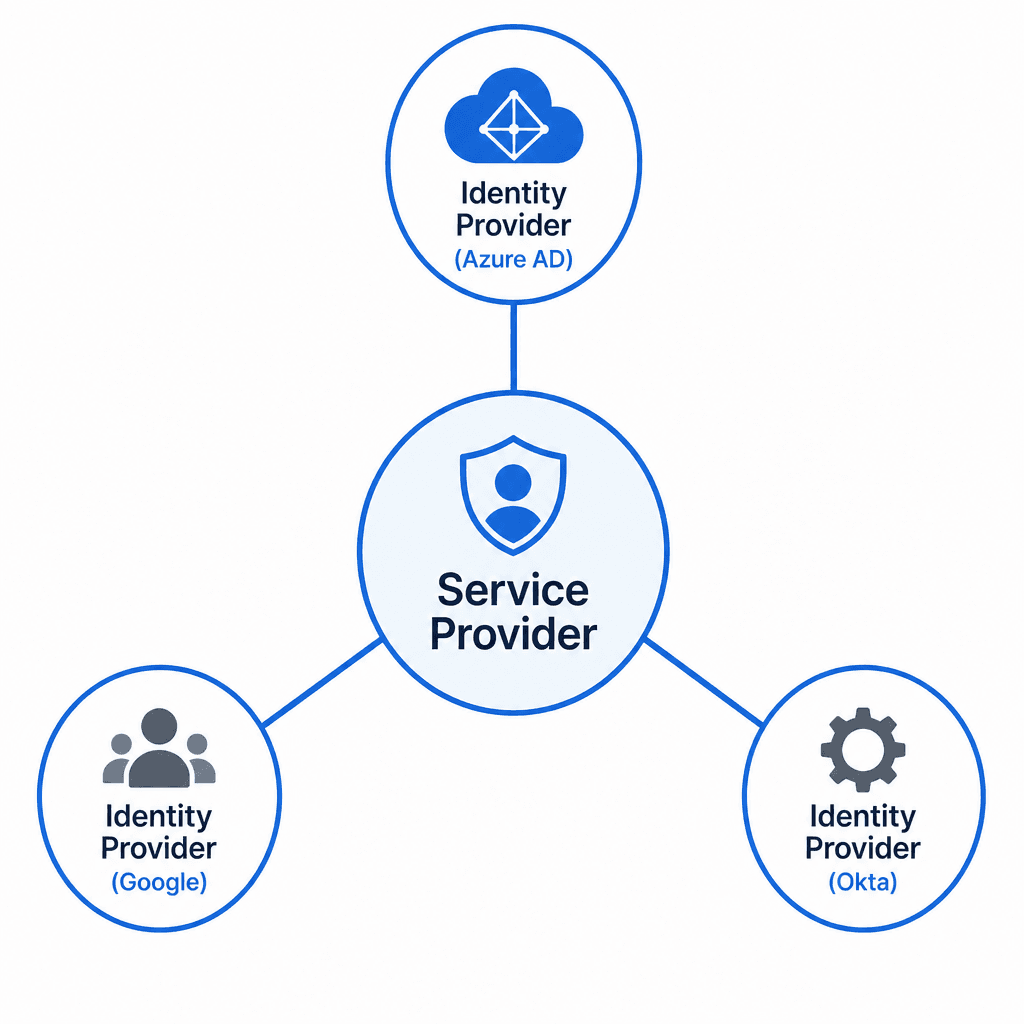
An Identity Provider is a system that verifies a user’s identity and issues a security token asserting that verification. The IdP holds the "source of truth" for a specific set of users. When a user logs in via an IdP, the system performs the authentication check (password, MFA, biometric) and then constructs a signed assertion.
The mechanism here is issuance. The IdP does not care about the destination service’s internal schema; it only ensures that the token is cryptographically signed and readable by the intended audience. This behavior is standardized in protocols like OpenID Connect (OIDC) Core and SAML 2.0, where the IdP acts as the ultimate authority for the subject's attributes. Consider a well-known implementation like Azure AD or Google; these systems generate tokens that rely on their own public key infrastructure for validation, establishing them as the root trust anchor for the users within their domain.
Consider a standard OpenID Connect (OIDC) flow with Google as the IdP:
- The user attempts to access
app.example.com. - The app redirects the user to
accounts.google.com. - Google authenticates the user.
- Google redirects back to the app with an
id_token(JWT) containing claims likesub,email, andname.
The trust model here is direct. The Service Provider (app) must trust Google’s public key to validate the signature. The IdP is the root of the trust chain for those specific users. It does not transform the identity; it exposes it in its native format.
The Identity Broker: The Protocol Translator
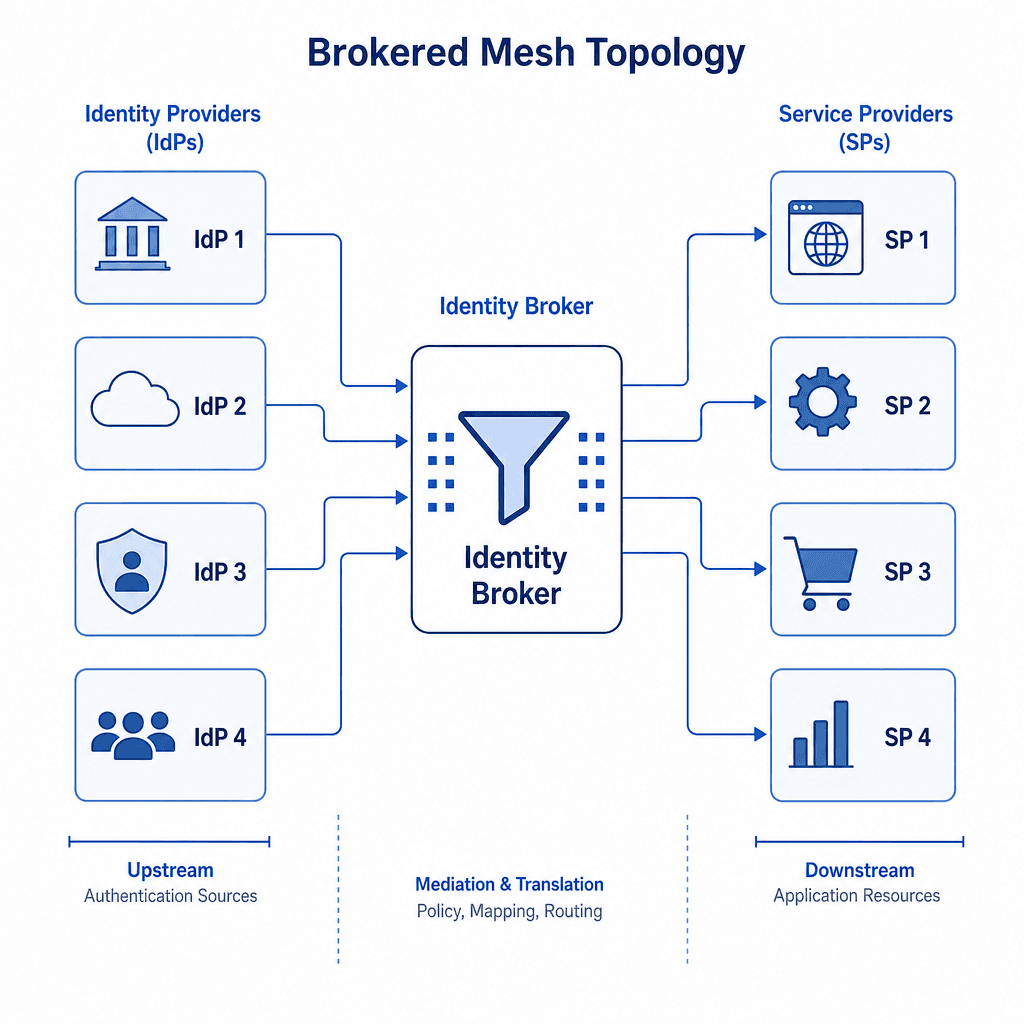
An Identity Broker sits between the IdP and the Service Provider. Its primary mechanism is translation and aggregation. A broker allows an organization to connect multiple disparate identity sources (e.g., Azure AD for employees, Okta for contractors, and a legacy LDAP for vendors) and present them as a single identity source to downstream applications.
The broker does not typically authenticate the user directly against a password store (though it can act as an IdP for the downstream app). Instead, it acts as a proxy that intercepts the authentication flow, negotiates with the upstream IdP, and then reformats the resulting token for the downstream SP. Implementations like Keycloak or Auth0 often serve this role, providing configurable pipelines for attribute mapping and protocol switching.
Token Translation Mechanism
The most critical function of a broker is attribute mapping. Upstream IdPs and downstream SPs rarely speak the same language regarding user attributes.
For example:
- Upstream IdP (Azure AD) returns a claim
onPremisesSecurityIdentifier. - Downstream SP (Salesforce) expects a claim
emailAddressor a customExternalId.
A broker intercepts the SAML assertion or OIDC ID token from Azure AD. It parses the XML/JSON, extracts the onPremisesSecurityIdentifier, looks up the corresponding emailAddress in a local mapping table, and constructs a new SAML assertion or OIDC token signed by the broker’s own keys. To the downstream SP, the broker is the IdP.
This mechanism decouples the downstream application from the complexity of the upstream identity ecosystem. The SP trusts the broker, and the broker trusts the upstream IdPs. This creates a layered trust model.
Topology: Hub-and-Spoke vs. Brokered Mesh
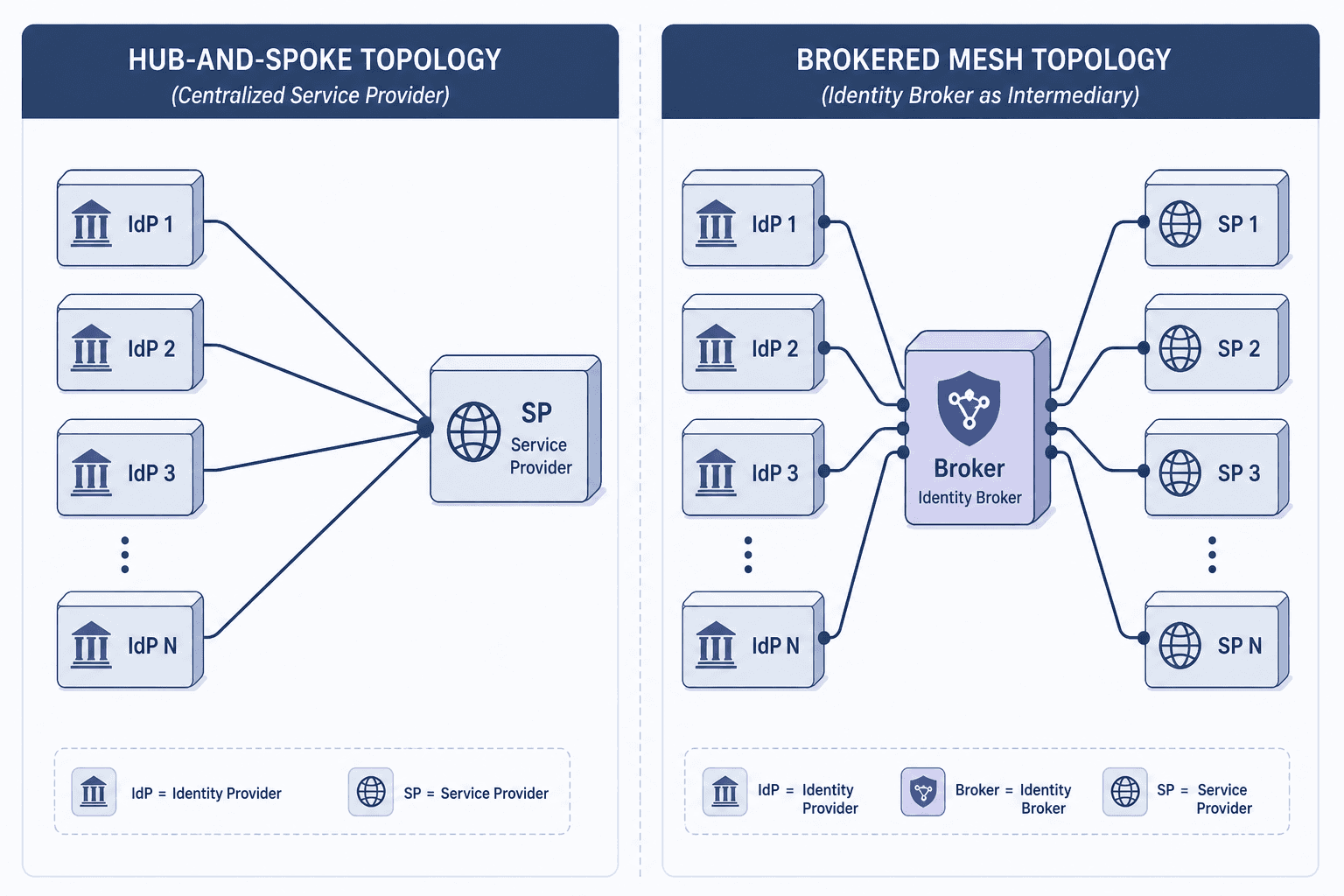
The architectural choice between using an IdP directly and using a Broker impacts the topology of your system. Recognized architectural patterns, such as those discussed in the Enterprise Integration Patterns literature, highlight the trade-offs between coupling and latency in these designs.
1. Direct IdP Integration (Hub-and-Spoke)
In this model, every Service Provider connects directly to the IdP.
- Flow: SP <-> IdP
- Pros: Simple configuration. Low latency (one hop).
- Cons: High coupling. If the IdP changes its attribute schema, every SP must be updated. If you have 50 SPs and 3 different IdPs (HR system, partner portal, legacy system), you must configure 150 connections. The IdP becomes a bottleneck and a single point of failure for the entire federation.
2. Brokered Topology (Star/Mesh)
In this model, all IdPs connect to the Broker, and all SPs connect only to the Broker.
- Flow: SP <-> Broker <-> IdP(s)
- Pros: Centralized policy enforcement. You can apply consistent attribute mapping rules in one place. The Broker can aggregate identities (e.g., merging a GitHub identity with a corporate email). The SPs are insulated from upstream changes.
- Cons: Added latency (two hops). Complexity in managing the broker’s mapping logic. The broker becomes a critical infrastructure component; if it fails, all federated access fails.
Why Engineers Choose Brokers
Engineers introduce a broker when the cost of managing direct IdP-SP connections outweighs the latency penalty. This typically happens in three scenarios:
- Protocol Heterogeneity: An organization uses SAML 2.0 for internal legacy apps but needs to expose identity via OIDC to mobile apps. A broker can translate SAML assertions into OIDC tokens on the fly, handling the complex mapping of XML-based SAML attributes to JSON-based OIDC claims.
- Attribute Normalization: Different IdPs use different namespaces. A broker can normalize
uidfrom LDAP,upnfrom Active Directory, andemailfrom Google into a singlesubclaim for the SP. - Aggregation: A user might have an identity in HR (Active Directory) and an identity in a contractor portal (Okta). A broker can link these two identities and present a unified profile to the SP, hiding the fact that the user exists in two separate systems.
Conclusion
The Identity Provider is the vault; it holds the key and verifies the user. The Identity Broker is the translator; it takes the key from the vault, explains what it means to the receiver, and ensures the door opens correctly.
Confusing the two leads to architectural fragility. If you treat a broker as an IdP, you may attempt to store passwords or manage MFA at the broker layer when it should simply be routing assertions. If you treat an IdP as a broker, you will fail to handle attribute mapping across heterogeneous systems.
For engineers, the decision is clear: Use an IdP when you have a single source of truth and a single protocol. Use a Broker when you need to aggregate multiple sources, translate protocols, or normalize attributes before they reach the service provider. The key architectural distinction lies in whether the system generates trust or merely relays it. Successful implementation requires careful consideration of token translation, topology design, and the complexities of brokering identity across diverse systems.
Related posts
Is Keycloak an IdP? Clarifying the Terminology
Clarifies whether Keycloak functions as an Identity Provider (IdP) or Authorization Server, explaining the terminology and roles in modern authentication.
How Identity Provider Bridging Works: SAML-to-OIDC Token Translation
An examination of SAML-to-OIDC token translation via identity broker solutions like Keycloak to enable protocol bridging between legacy and modern systems.
Building Your Own Identity Provider: What It Really Costs
An examination of the hidden costs, maintenance burden, and security risks involved in building a custom identity provider versus buying a solution.
