Building Your Own Identity Provider: What It Really Costs
An examination of the hidden costs, maintenance burden, and security risks involved in building a custom identity provider versus buying a solution.
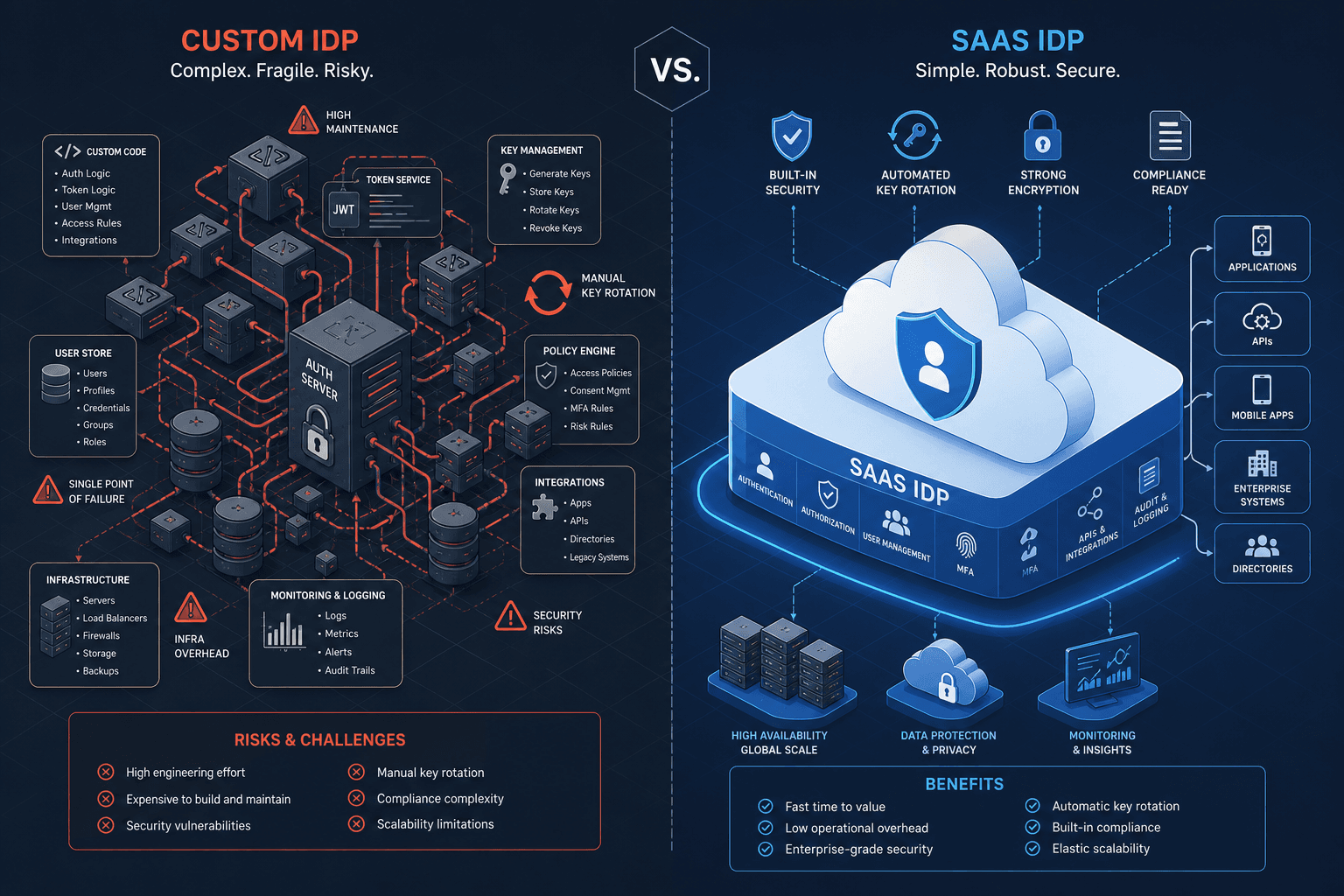
The decision to build a custom Identity Provider (IDP) often begins with a seductive premise: "We already have user tables. We can just add an authentication layer." For engineering managers and architects, this feels like a victory of efficiency—leveraging existing infrastructure to save licensing fees. However, this calculation ignores the structural reality of identity management. An IDP is not merely a database lookup; it is a security boundary that handles cryptographic key rotation, stateful session management, and complex protocol implementations.
When you build your own idp, you are not just writing code; you are assuming liability for every security breach, compliance violation, and protocol incompatibility that arises. The true cost is not the initial sprint to get POST /login working. It is the ongoing, compounding interest paid in security audits, feature debt, and engineering distraction.
The Illusion of Simplicity
The initial scope of a custom identity provider is almost always underestimated. Architects typically visualize a simple flow: receive credentials, check the database, issue a JWT. This mental model fails because it abstracts away the mechanism-level complexities of modern standards like OAuth 2.0 and OpenID Connect (OIDC). In the context of build vs buy decisions, underestimating these complexities is the primary driver of cost overruns.
Consider the mechanism of token issuance. A naive implementation might generate a random string and store it in Redis. However, production-grade systems require JSON Web Tokens (JWTs) signed with asymmetric keys (RS256 or ES256). This introduces a new layer of operational complexity: key management. You must now handle key rotation without invalidating active sessions for users. If you rotate keys too quickly, clients fail validation; too slowly, and a compromised private key exposes all user data.
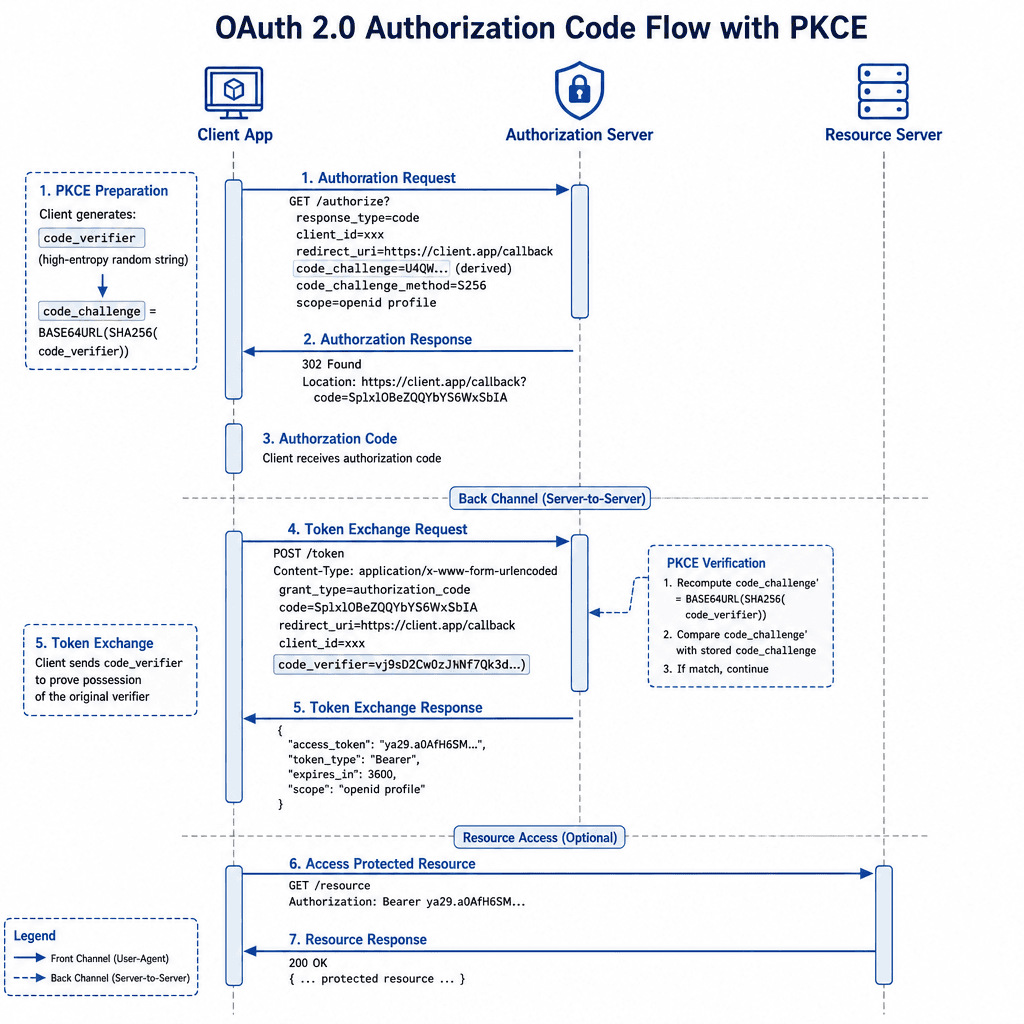
Furthermore, the OAuth 2.0 authorization code flow is not a simple redirect. It requires state parameter validation to prevent Cross-Site Request Forgery (CSRF), nonce validation in OIDC to prevent replay attacks, and Proof Key for Code Exchange (PKCE) for public clients (mobile apps and SPAs). Implementing PKCE correctly requires generating a code verifier and challenge on the client, transmitting the challenge in the authorization request, and validating the verifier in the token exchange. Any deviation from the RFC 7636 specification breaks interoperability with standard clients.
The time spent debugging why a specific client library fails to validate your token structure is not "development"; it is reverse-engineering a standard you did not write. You become the maintainer of the protocol itself.
The Security Audit Trap
The most significant hidden cost of a custom IDP is the security burden. When you use a SaaS provider like Auth0, Okta, or Azure AD, the security audit is absorbed by their scale. They have dedicated teams monitoring for CVEs in their dependencies, conducting penetration tests, and maintaining SOC 2 compliance.
When you build your own IDP, you inherit 100% of this risk. Let’s look at the mechanism of supply chain vulnerability. Your oauth server will likely rely on libraries for JWT handling, HTTP serving, and database connectivity. If a critical vulnerability is disclosed in a widely used library (e.g., Log4j or a similar npm/package ecosystem component), you are responsible for the patching cycle.
This is not a trivial task. You must:
- Identify all instances of the vulnerable dependency.
- Test the patched version against your custom logic (since you may have monkey-patched or extended the library).
- Deploy the fix without disrupting active sessions.
- Document the incident for compliance audits.
In a SaaS model, this happens automatically in the background. In a custom model, it requires dedicated engineering hours. Moreover, if your system handles PII (Personally Identifiable Information) or health data, you are subject to regular third-party penetration testing. These audits can cost tens of thousands of dollars per engagement and require weeks of preparation. You are paying for security infrastructure that a SaaS provider distributes across thousands of tenants, effectively subsidizing your security posture through their volume.
Feature Debt and Compliance
Identity is not a static feature; it is a dynamic set of requirements driven by user behavior and regulation. A custom IDP quickly accumulates "feature debt"—the cumulative cost of maintaining outdated or incomplete security mechanisms. In any build vs buy analysis, this debt is often overlooked because it is invisible until it causes a failure.
Consider Multi-Factor Authentication (MFA). Initially, you might implement SMS-based 2FA. But SMS is vulnerable to SIM-swapping attacks. To be secure, you must eventually support TOTP (Time-based One-Time Password) and WebAuthn (FIDO2). WebAuthn requires handling hardware security keys, biometric prompts, and complex challenge-response mechanisms. Each new method adds attack surface and integration complexity.
Then there is compliance. GDPR and CCPA require the ability to delete all user data upon request. In a custom IDP, this means ensuring that not only the primary user record is deleted, but also all associated sessions, audit logs, and linked third-party tokens. If you miss one orphaned record, you face legal liability. SaaS providers provide API hooks for data portability and deletion as a standard feature. Building this robustly in-house requires significant backend orchestration.
Audit logging is another critical requirement. You must log every successful and failed login attempt, password change, and permission grant. These logs must be immutable and tamper-evident. Storing and securing this data at scale is a distributed systems problem in its own right, separate from your core business logic. Furthermore, defining and enforcing granular access controls via scope parameters requires rigorous testing to prevent privilege escalation vulnerabilities.
The Total Cost of Ownership (TCO) Model
To make an informed decision, we must compare the TCO of building versus buying. The build vs buy decision hinges on whether the organization has the specialized engineering resources to maintain the identity infrastructure indefinitely.
Custom IDP Costs:
- Engineering Time: 2–3 senior engineers for 3–6 months to build a secure, compliant MVP. Annual maintenance: 1–2 engineers for patching, feature updates, and on-call support.
- Infrastructure: Dedicated servers or containers for the IDP, separate from your main application to isolate breach impact.
- Security: Annual penetration tests ($20k–$50k), vulnerability scanning subscriptions, and potential compliance consulting.
- Opportunity Cost: Engineering hours spent on auth are hours not spent on revenue-generating features.
SaaS IDP Costs:
- Subscription: Typically $5–$15 per active user per month, with volume discounts.
- Integration Time: 1–2 engineers for 2–4 weeks to integrate the SDK and configure flows.
- Maintenance: Minimal. Updates are handled by the provider.
The crossover point varies, but generally, for companies with fewer than 50,000 monthly active users (MAU), the SaaS model is cheaper. For larger organizations, the cost of a custom IDP can be justified if there are strict regulatory requirements for data residency (e.g., on-premises deployment) or if the identity system is deeply integrated into a proprietary protocol that no SaaS provider supports.
However, even in those cases, the maintenance burden remains. You are still managing key rotation, MFA methods, and compliance audits.
Conclusion
Building a custom IDP is not a cost-saving measure; it is a strategic decision to internalize a complex, high-liability function. The hidden costs are not just in the initial code, but in the perpetual tax of security, compliance, and protocol maintenance. For most organizations, the ROI of buying a solution far outweighs the perceived savings of building one. The best identity strategy is often the one you don’t have to maintain.
If you do proceed with building, treat it as a critical security product. Invest in automated testing, formal specification validation, and regular external audits. Do not underestimate the depth of the water.
Related posts
Switching Identity Providers Without Breaking Auth Flows
A technical guide for identity engineers on migrating identity providers using parallel runs and credential migration strategies to maintain auth continuity.
Why Multi-Cloud Identity Fragments
An examination of identity fragmentation across AWS, Azure, and GCP, comparing identity models to understand multi-cloud challenges.
SAML Metadata Exchange and Trust Establishment
A technical examination of SAML metadata exchange, covering trust establishment, entity descriptors, certificate rollover, and metadata refresh mechanisms.
