CPU Inference in 2026: What's Actually Viable
An examination of CPU inference viability in 2026 using AMX, AVX-512, and OpenVINO for small models.
For years, the dogma in production machine learning has been simple: if you are running a Large Language Model (LLM), you need a GPU. CPUs were reserved for preprocessing, data ingestion, and orchestration. This hierarchy existed because GPUs offered massive parallel throughput via thousands of cores, while CPUs struggled with the dense linear algebra required by transformer architectures.
However, by 2026, this binary has fractured. For small models (typically defined as <7 billion parameters) and low-batch-size workloads, CPU inference is no longer a "fallback" option—it is often the economically and technically superior choice. This shift is driven by two converging factors: specialized CPU extensions like Intel Advanced Matrix Extensions (AMX) and mature, hardware-aware runtimes like OpenVINO.
This article examines the mechanism-level viability of CPU inference, moving beyond cost arguments to explain how modern CPUs achieve competitive latency for small models.
The Economic and Latency Reality
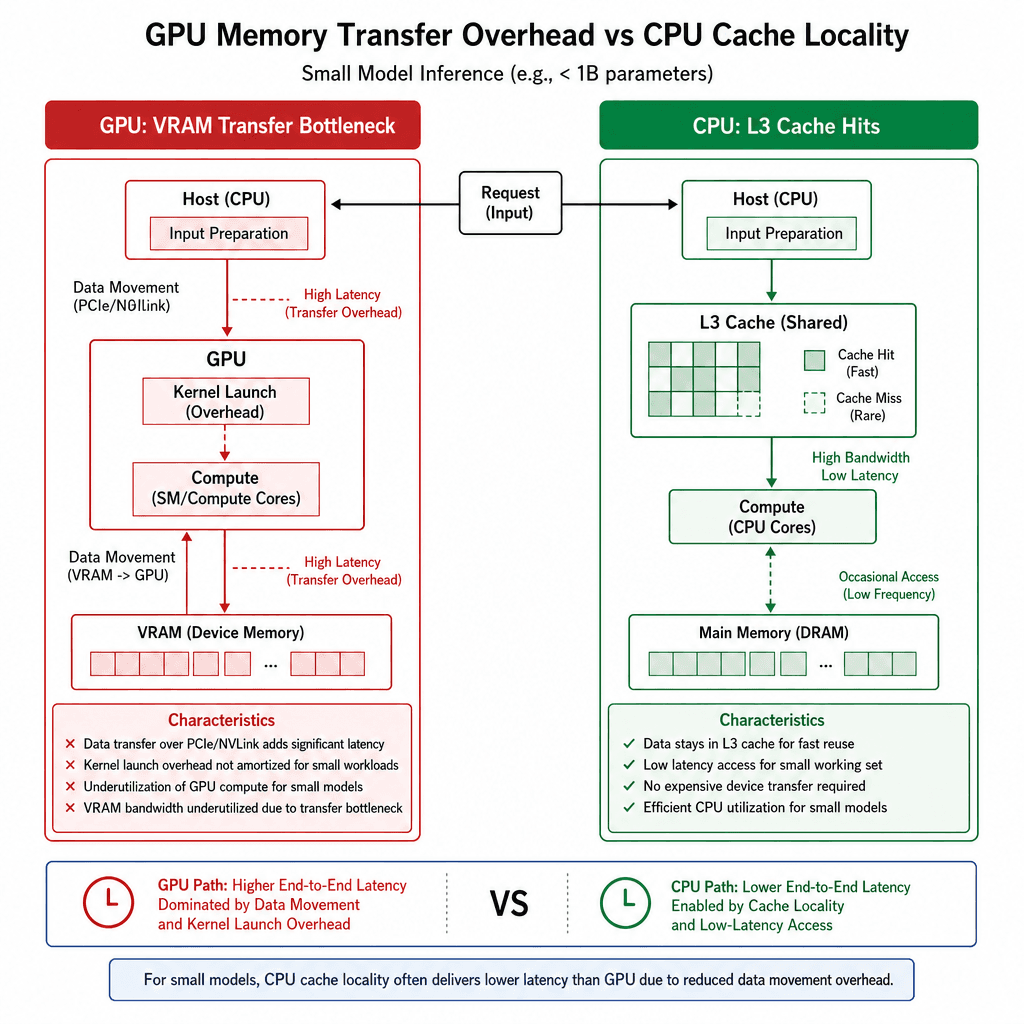
To understand why CPUs are viable, we must first understand why GPUs are often inefficient for small models.
GPUs excel at high-throughput matrix multiplication. However, they suffer from significant overhead in two areas: memory transfer and kernel launch latency. When a request arrives for a small model (e.g., a 3B parameter model), the time spent transferring weights from GPU VRAM to compute units, plus the time to launch the CUDA kernel, can dominate the actual computation time. This is particularly true for "cold start" scenarios or low-concurrency services where the GPU sits idle between requests.
CPUs, conversely, have much lower latency overhead and larger, hierarchically organized caches (L1/L2/L3). For a small model that fits entirely within the CPU's L3 cache (or even L2), the data movement penalty is minimal. The CPU can fetch weights and compute them with minimal latency jitter, making it ideal for:
- Low-batch-size inference: Processing 1–4 requests simultaneously.
- High-concurrency, low-latency services: Serving thousands of small requests where GPU utilization would be poor.
- Cost-sensitive deployments: Where GPU hours are prohibitively expensive compared to CPU cores.
Hardware Mechanisms: AMX and AVX-512
The primary barrier to CPU inference was the lack of vectorized instructions capable of performing large-scale matrix multiplications efficiently. Legacy SIMD (Single Instruction, Multiple Data) instructions like SSE and AVX2 operated on 128-bit or 256-bit vectors, requiring many iterations to process a single matrix tile. As model sizes grew, the instruction-level overhead and memory bandwidth requirements began to bottleneck CPU performance, making it difficult to compete with GPU-accelerated pipelines. To bridge this gap, modern processors have introduced specialized execution units designed specifically for the linear algebra patterns inherent in neural network workloads.
AVX-512: The Bridge
AVX-512 extended vector width to 512 bits, allowing 16 single-precision floats or 64 8-bit integers to be processed in a single instruction. While this doubled throughput compared to AVX2, it still required complex loop unrolling and software optimization to approach GPU-like performance. Most frameworks relied on highly tuned BLAS libraries (like Intel MKL) to leverage AVX-512, but these often fell short for deep learning workloads due to memory access patterns.
Intel AMX: Dedicated Matrix Accelerator
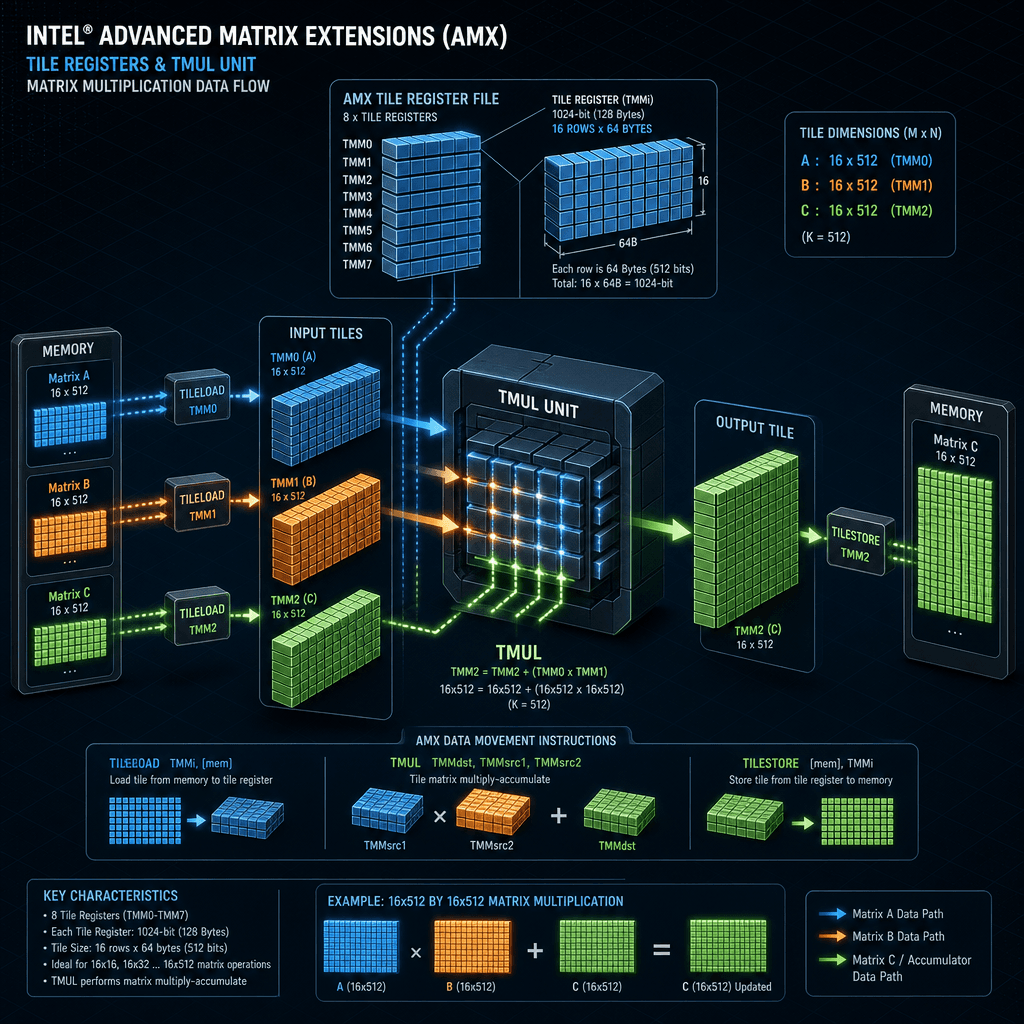
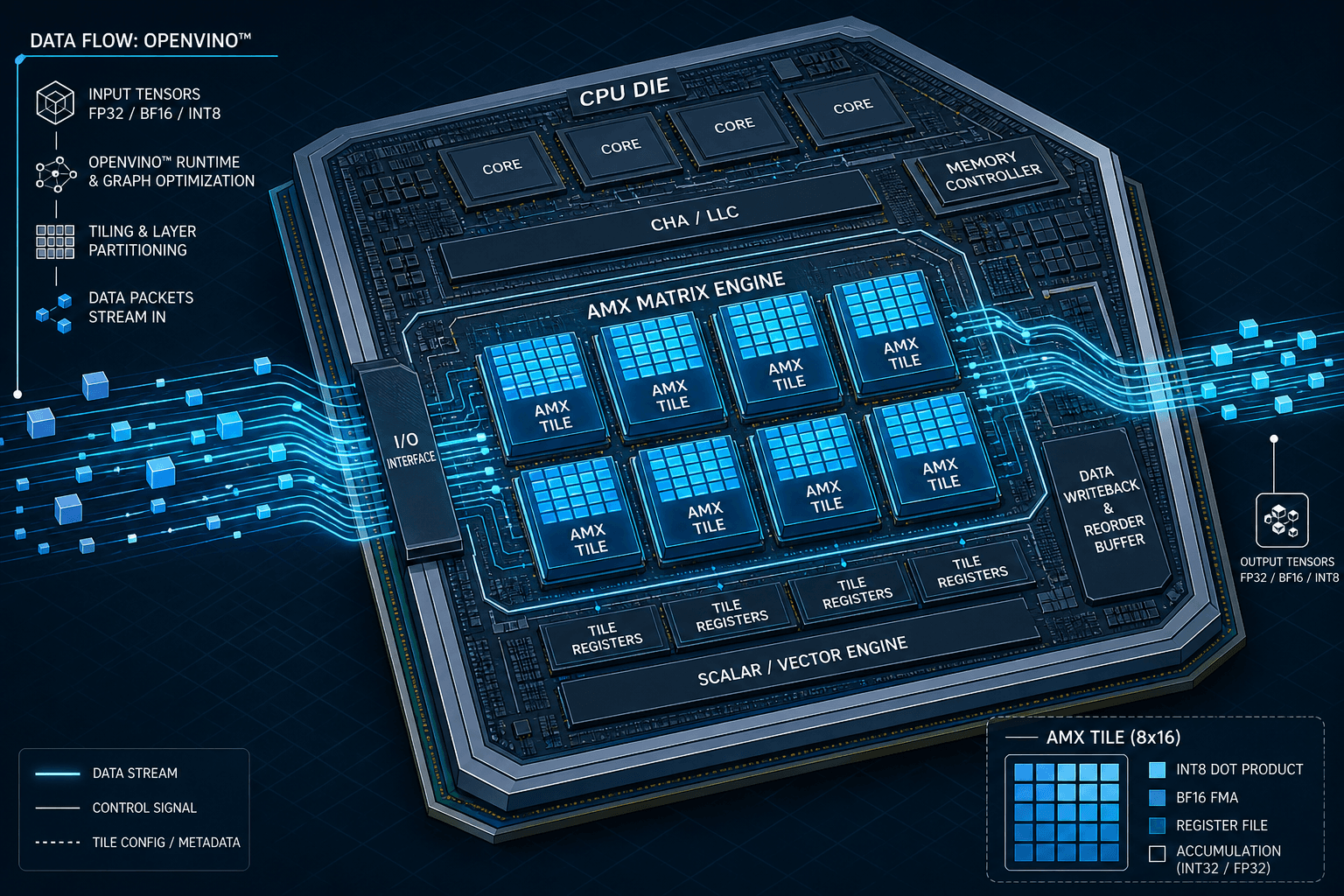
Intel AMX, introduced with the Sapphire Rapids architecture and refined in subsequent generations, is a dedicated matrix accelerator embedded within the CPU core. Unlike AVX-512, which is general-purpose SIMD, AMX is specialized for matrix-matrix multiplication.
AMX operates using a 2D tile architecture. It features:
- TMUL: The Tile Matrix Multiplication unit.
- Tile Registers: Large, dedicated registers (up to 1KB each) that hold matrix tiles.
- Data Movement Instructions: Specialized instructions (
TILELOADD,TILESTORED) that move data between memory and tile registers efficiently.
The mechanism works as follows:
- Data Loading: Weights and activations are loaded into tile registers from memory.
- Matrix Multiply: The
TMULinstruction performs a block of dot products in parallel. For example, a singleTMULoperation can multiply a 16x64 matrix by a 64x16 matrix, producing a 16x16 result. - Accumulation: Results are accumulated in destination tiles.
This hardware acceleration reduces the number of instructions required for matrix multiplication by an order of magnitude compared to AVX-512. For INT8 (8-bit integer) inference, AMX accelerates the matrix multiplication of quantized data, reducing the relative overhead of dequantization compared to general-purpose SIMD instructions. This is critical because most small models are deployed in INT8 precision to reduce memory footprint and increase throughput.
Software Stack: OpenVINO and Quantization
Hardware capabilities are useless without software that understands them. OpenVINO, Intel's open-source toolkit for optimizing and deploying inference models, acts as the bridge between high-level models (PyTorch, TensorFlow) and low-level CPU instructions.
Quantization-Aware Optimization
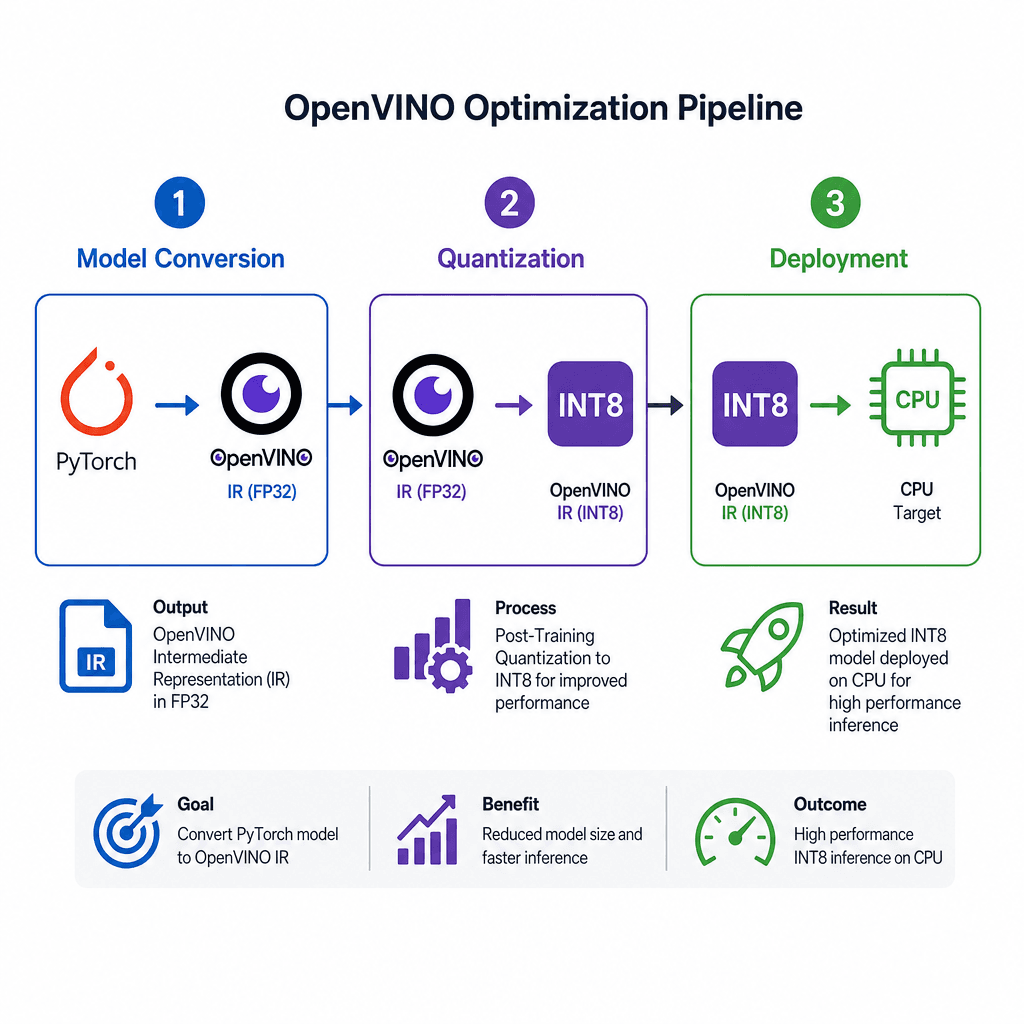
OpenVINO excels at Post-Training Quantization (PTQ) and Quantization-Aware Training (QAT). For CPU inference, INT8 quantization is the standard. This process maps 32-bit floating-point weights and activations to 8-bit integers.
The mechanism involves:
- Calibration: Running a representative dataset through the model to determine the dynamic range of activations and weights.
- Scale Factor Calculation: Computing scaling factors to map FP32 values to INT8 ranges.
- Graph Optimization: OpenVINO fuses operators (e.g., Conv + Bias + ReLU) into single kernels, reducing memory bandwidth pressure.
When combined with AMX, OpenVINO generates code that directly maps to the TMUL instructions. This results in a significant speedup compared to FP32 inference on AVX-512. Benchmarks consistently show that INT8 inference on AMX-enabled CPUs can achieve significantly faster throughput than FP32 inference on the same hardware, and often match or exceed GPU performance for small models under specific batch sizes.
Example: Optimizing a Small LLM with OpenVINO
Consider a 3B parameter model (e.g., Phi-3-mini quantized to INT8). Deploying this on a GPU might require 6–8 GB of VRAM and significant memory bandwidth. On a CPU with AMX:
- Convert: Use OpenVINO's Model Converter to transform the PyTorch model into an IR (Intermediate Representation) file with INT8 precision.
- Optimize: Apply calibration to ensure accuracy retention.
- Deploy: Load the model using the OpenVINO C++ or Python API.
import openvino.runtime as ov
from openvino.runtime import Core

core = Core()

# Load the optimized INT8 model
model = core.read_model(model="optimized_phi3_mini_int8.xml")

# Compile for CPU with AMX optimization
compiled_model = core.compile_model(model, "CPU")

# Infer
input_tensor = ... # Prepare input
output = compiled_model(input_tensor)
The key here is the compile_model(..., "CPU") call. OpenVINO automatically detects AMX support and schedules matrix operations to use tile registers. If AMX is not available, it falls back to AVX-512, ensuring compatibility.
Workload Viability Matrix
Not all CPU inference is equal. Viability depends on the interplay between model size, batch size, and concurrency.
| Scenario | GPU Viability | CPU Viability (AMX) | Reason |
|---|---|---|---|
| Large Model (>70B), High Batch | High | Low | GPU memory bandwidth dominates; CPU cannot hold model in cache. |
| Small Model (<7B), Low Batch (1-4) | Low | High | GPU overhead dominates; CPU cache locality shines. |
| Small Model, High Concurrency | Medium | High | CPU cores handle concurrent requests efficiently; GPU utilization drops. |
| Real-time Streaming | Medium | High | CPU latency jitter is lower; no cold-start penalty. |
Key Takeaways for Architects
- Model Size Threshold: For models under 7B parameters, CPU inference is often viable if quantized to INT8. Above 7B, GPU memory bandwidth becomes a hard constraint that CPUs cannot easily overcome.
- Batch Size Matters: If your service processes single requests or small batches, CPUs are likely more cost-effective and faster due to lower latency overhead.
- Hardware Dependency: AMX is specific to Intel's latest architectures. AMD CPUs currently rely on AVX-512 and do not have a direct AMX equivalent in current generations, though their NPU architectures (XDNA) are evolving for specific edge workloads. Ensure your deployment target supports AMX.
- Quantization is Non-Negotiable: FP32 CPU inference is rarely competitive. INT8 quantization is essential to leverage AMX and reduce memory bandwidth.
Conclusion
CPU inference in 2026 is not a compromise; it is a strategic choice for small models. By leveraging Intel AMX for hardware-accelerated matrix multiplication and OpenVINO for optimized runtime execution, developers can achieve low-latency, high-concurrency inference at a fraction of the cost of GPU-based solutions.
For backend developers and architects, the decision matrix has shifted. Instead of defaulting to GPUs, evaluate your workload's batch size and concurrency profile. If you are serving small models with low batch sizes, the CPU—armed with AMX and INT8 quantization—offers a reliable, cost-effective, and high-performance alternative.
FAQ
Is CPU inference viable for models larger than 7B parameters? Generally, no. Models larger than 7B parameters typically exceed the capacity of CPU L3 caches, forcing reliance on main memory bandwidth. GPUs offer significantly higher memory bandwidth, making them necessary for larger models unless extreme quantization (e.g., INT4) is applied, which still favors GPU acceleration for throughput.
Does OpenVINO work with non-Intel CPUs? OpenVINO is optimized for Intel hardware, including CPUs, GPUs, and VPUs. While it may support other vendors' hardware in experimental modes or through generic backends, its full feature set, including AMX acceleration, is exclusive to Intel processors.
Can I use AMX with PyTorch directly? PyTorch has added support for AMX via its Intel Extension for PyTorch (IPEX). However, for production deployments, OpenVINO is often preferred because it handles the conversion, quantization, and compilation steps more seamlessly, abstracting away the low-level instruction scheduling.
Related posts
Jailbreak Detection: Classifiers, Heuristics, and Cost
Examines jailbreak detection methods using classifiers and heuristics, focusing on precision, recall, latency, and cost trade-offs for security and ML engineers.
Long-Context Models vs Retrieval: An Honest Comparison
A technical comparison of long-context models and RAG systems, analyzing cost, latency, and million-token capabilities for architects and ML engineers.
Semantic Caching That Actually Saves Money
Learn how semantic caching reduces LLM costs by storing similar prompts, managing similarity thresholds, and handling invalidation for platform engineers.
