Long-Context Models vs Retrieval: An Honest Comparison
A technical comparison of long-context models and RAG systems, analyzing cost, latency, and million-token capabilities for architects and ML engineers.
This is Part 5 of the Context Engineering series.
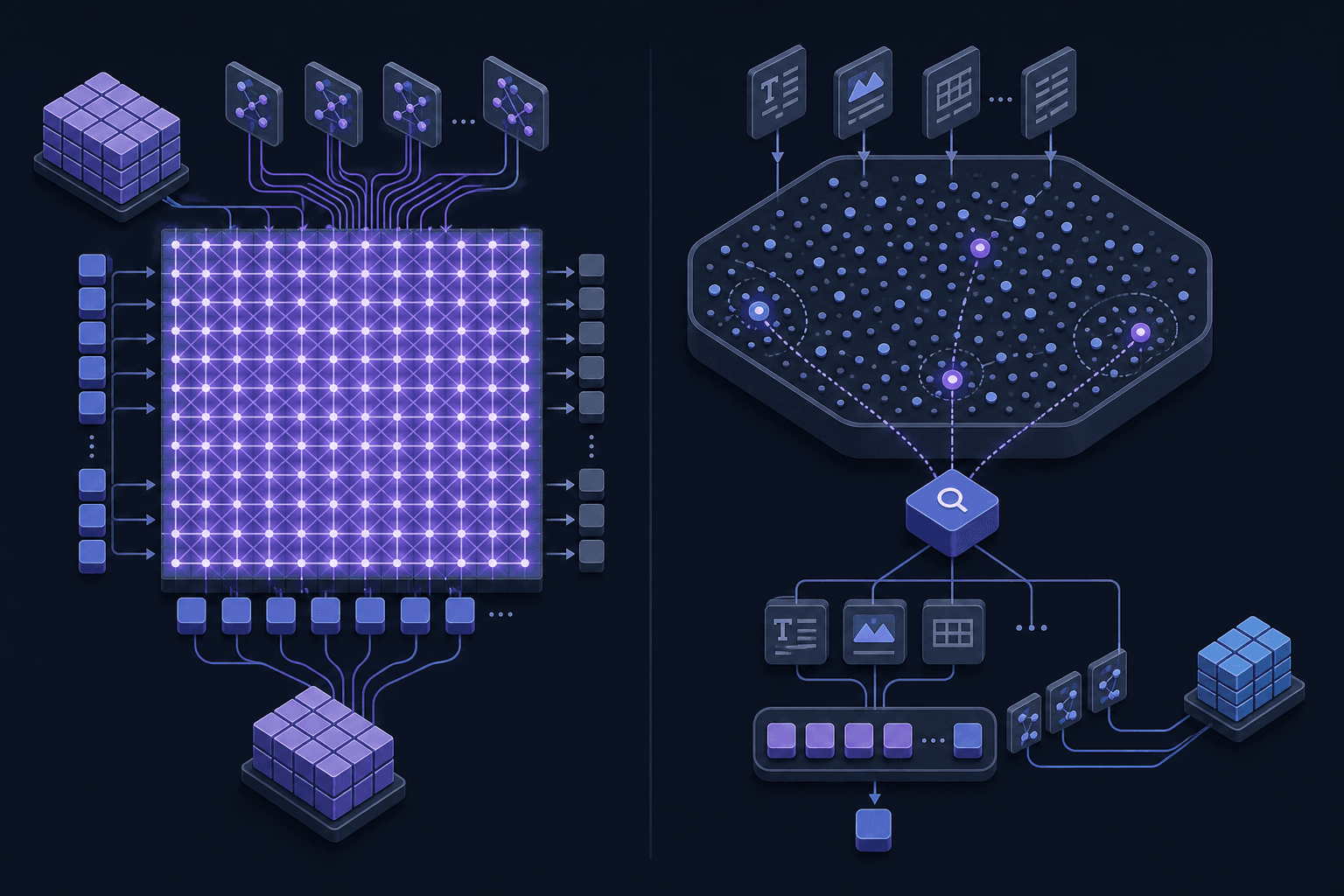
The debate between using massive context windows (e.g., 128k, 1M tokens) and Retrieval-Augmented Generation (RAG) is often framed as a binary choice: "Why retrieve when we can just paste everything?" This framing is misleading. The decision is not about capability but about the efficiency of information flow. Long-context models offer a unified view of data, while RAG offers a filtered view. For architects and ML engineers, the choice hinges on three mechanisms: attention complexity, memory bandwidth, and the signal-to-noise ratio in the input stream.
The Attention Mechanism: Global vs. Sparse
At the core of Large Language Models (LLMs) is the self-attention mechanism. In a standard transformer, every token attends to every other token in the context window. This creates a quadratic complexity with respect to sequence length , where is the number of tokens in the context. While optimizations like FlashAttention reduce the constant factors and improve memory efficiency, the fundamental constraint remains: the model must process the entire sequence to generate the next token.
When you use a long-context model, you are asking the GPU to maintain a Key-Value (KV) cache for every token in that million-token sequence. The KV cache stores the attention states for previous tokens, allowing the model to attend to them without recomputing. For a 1M token context, this cache can consume tens of gigabytes of VRAM, even for lightweight models. This is a memory-bound operation.
In contrast, RAG breaks the problem into two phases: retrieval and generation. During retrieval, a vector database or BM25 index identifies a small subset of relevant documents (e.g., 5–10 chunks). During generation, the model only attends to these chunks plus the query. The attention matrix is small. The mechanism here is sparse attention: the model ignores the vast majority of the corpus because it was never loaded into the context window.
Latency and Throughput: The Bottleneck of Memory Bandwidth
Latency in LLMs is dominated by two phases: Prefill (processing the input prompt) and Decode (generating the output).
Long-Context Prefill: When you send a 1M token prompt to a long-context model, the prefill phase must process all 1M tokens. Even with FlashAttention, this involves massive matrix multiplications. The latency here scales roughly quadratically with respect to , consistent with the attention mechanism's complexity, and the absolute time is significant. You are paying for the compute to read and encode every single word in the corpus.
RAG Prefill: In RAG, the prefill phase processes only the retrieved chunks (e.g., 2k tokens) plus the query. This is orders of magnitude faster than processing 1M tokens. The retrieval step itself has latency (vector search), but modern vector databases (like Milvus or Pinecone) operate at millisecond scales for index sizes in the millions. The total end-to-end latency for RAG is typically dominated by the generation phase, which is fast because the context is short.
Throughput Implications: If you are serving 100 requests per second, long-context models will quickly saturate GPU memory due to the KV cache. You may need to shard requests across multiple GPUs or use continuous batching with careful memory management. RAG allows higher throughput because the context size is predictable and small, enabling more concurrent requests per GPU.
Cost Dynamics: Compute vs. Storage
The cost structure of long-context and RAG systems is fundamentally different. A thorough cost comparison reveals that while long-context models charge for compute, RAG systems charge for infrastructure and retrieval efficiency.
Long-Context Cost: Cost is driven by compute. Every token in the input context is processed. If your input context grows from 1k to 1M tokens, the compute cost for the prefill phase increases by far more than 1000x, since attention scales quadratically with sequence length. Additionally, the KV cache size grows linearly, increasing VRAM requirements. For a 7B parameter model, a 1M token context might require 100GB+ of VRAM just for the cache, forcing you to use larger, more expensive GPUs (e.g., A100/H100) or multi-GPU setups.
RAG Cost: Cost is driven by storage and retrieval infrastructure. Vector databases require disk space and CPU/GPU resources for indexing. However, the generation cost is low because the context is small. You pay for the embedding model (usually a small, cheap model) and the vector search. The LLM inference cost is minimal because you are only generating responses based on a few pages of text.
The Million-Token Scenario: For a 1M token corpus, long-context models become prohibitively expensive for frequent querying. Each query requires processing the entire 1M tokens. RAG, however, keeps the cost per query constant regardless of the corpus size, as long as the retrieval mechanism scales. The only variable cost in RAG is the accuracy of the retrieval; if you miss relevant chunks, you may need to refine the index, but you do not pay for the compute of irrelevant data.
Accuracy and the "Lost in the Middle" Phenomenon
Accuracy is where RAG often outperforms long-context models, despite the latter's apparent advantage. Empirical studies have shown that LLMs suffer from a "lost in the middle" problem, where they perform poorly on information located in the center of the context window, compared to the beginning or end. This is attributed to the diminishing attention weights for intermediate tokens as the sequence length grows.
In a 1M token context, the relevant information is likely buried deep in the sequence. The model may attend to the first few thousand tokens (the start) and the last few thousand (the end), but the critical middle section may be ignored. This leads to hallucinations or missed details.
RAG mitigates this by ensuring that only the most relevant chunks are included in the context. By retrieving the top-k most similar chunks, you increase the probability that the relevant information is present in the input. Furthermore, RAG allows for explicit citation and verification. The model can be prompted to answer based only on the retrieved chunks, reducing the likelihood of conflating information from different parts of the corpus.
When to Choose Which
The decision should be guided by the nature of the task:
-
Use Long-Context When:
- The document is coherent and self-contained (e.g., a single long contract, a novel, a codebase).
- The reasoning requires global understanding of the entire sequence (e.g., summarizing a book, finding inconsistencies across a long document).
- The latency requirements are relaxed, and the cost of processing the full context is acceptable.
-
Use RAG When:
- The corpus is large and constantly changing (e.g., a knowledge base, a news feed).
- The query is specific and requires precise, up-to-date information.
- Cost and latency are critical constraints.
- You need to control hallucination by grounding the response in specific, verifiable sources.
Conclusion
Long-context models and RAG are not competitors; they are tools for different scales of information processing. Long-context models excel at global reasoning within a bounded, high-density context. RAG excels at scalable, efficient retrieval from vast, dynamic corpora. For million-token scenarios, RAG is almost always the more cost-effective and accurate choice, unless the task fundamentally requires a holistic view of the entire sequence. Architects should design systems that combine both: using RAG for initial retrieval and filtering, and long-context models for deep reasoning over the retrieved subset. This hybrid approach leverages the strengths of both mechanisms while mitigating their weaknesses.
Related posts
Jailbreak Detection: Classifiers, Heuristics, and Cost
Examines jailbreak detection methods using classifiers and heuristics, focusing on precision, recall, latency, and cost trade-offs for security and ML engineers.
Caching Strategies for RAG Pipelines
Explore effective caching strategies for RAG pipelines, including embedding and retrieval caches, to improve hit rates and reduce latency, while managing invalidation effectively.
Router Architectures: Small Model First, Big Model on Escalation
Explore router architectures that route requests to small models first, escalating to larger models only when necessary for cost optimization and efficiency.
