Router Architectures: Small Model First, Big Model on Escalation
Explore router architectures that route requests to small models first, escalating to larger models only when necessary for cost optimization and efficiency.
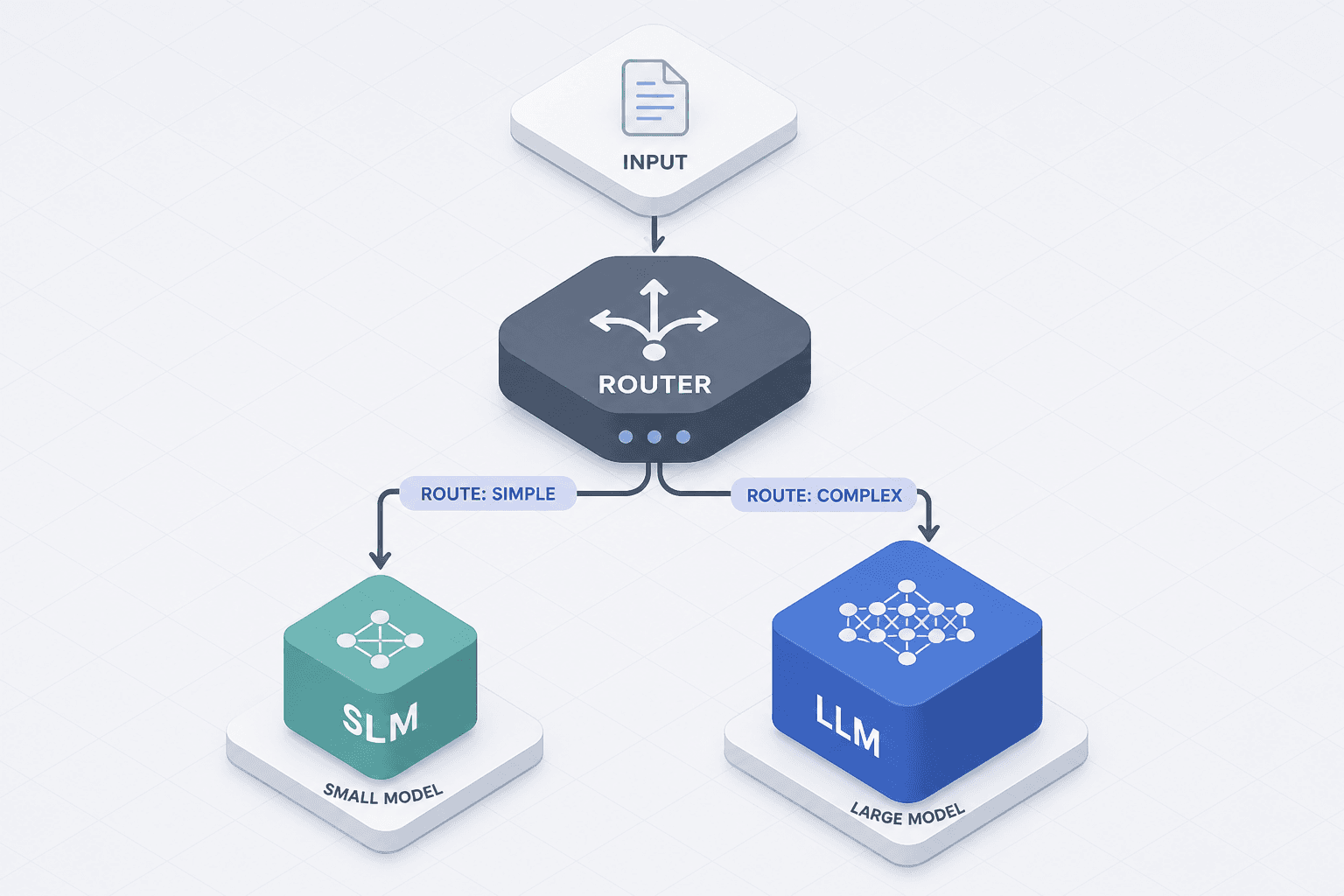
In the current landscape of Large Language Models (LLMs), cost and latency are not just metrics; they are the primary constraints on scalability. A naive approach—sending every user query to the most capable model available—results in exponential cost growth as usage scales. The alternative, using only small language models (SLMs), often yields unacceptable quality drops on complex reasoning tasks.
The solution lies in a hierarchical routing architecture. This approach treats model selection not as a binary choice but as a dynamic workflow. By routing requests to a small model first and escalating to a large model only when necessary, systems can achieve near-Large-Model quality at a fraction of the cost. This article explores the mechanism of this "cascade" or "escalation" router, how it makes decisions, and the trade-offs involved.
The Economic Mechanism: Why Linear Scaling Fails
To understand why a router is necessary, we must look at the cost structure of inference. Large models (e.g., Llama 3 70B, GPT-4) require significant GPU memory and compute time per token. Small models (e.g., Llama 3 8B, Phi-3) are cheaper to run and faster to generate.
However, the relationship between model size and performance is not linear. While exact metrics vary by model pair and task distribution, illustrative examples suggest that a small model might handle a majority of simple queries with high accuracy, yet at a significantly lower cost than its larger counterpart. The remaining portion of queries—such as complex code generation or multi-step reasoning—often requires the large model’s capacity.
A router architecture exploits this distribution. It does not treat all queries equally. Instead, it categorizes them by difficulty. This creates a "cost-per-successful-response" metric that is optimized by minimizing the number of times the expensive model is invoked.
The Difficulty Classifier: How the Router Decides
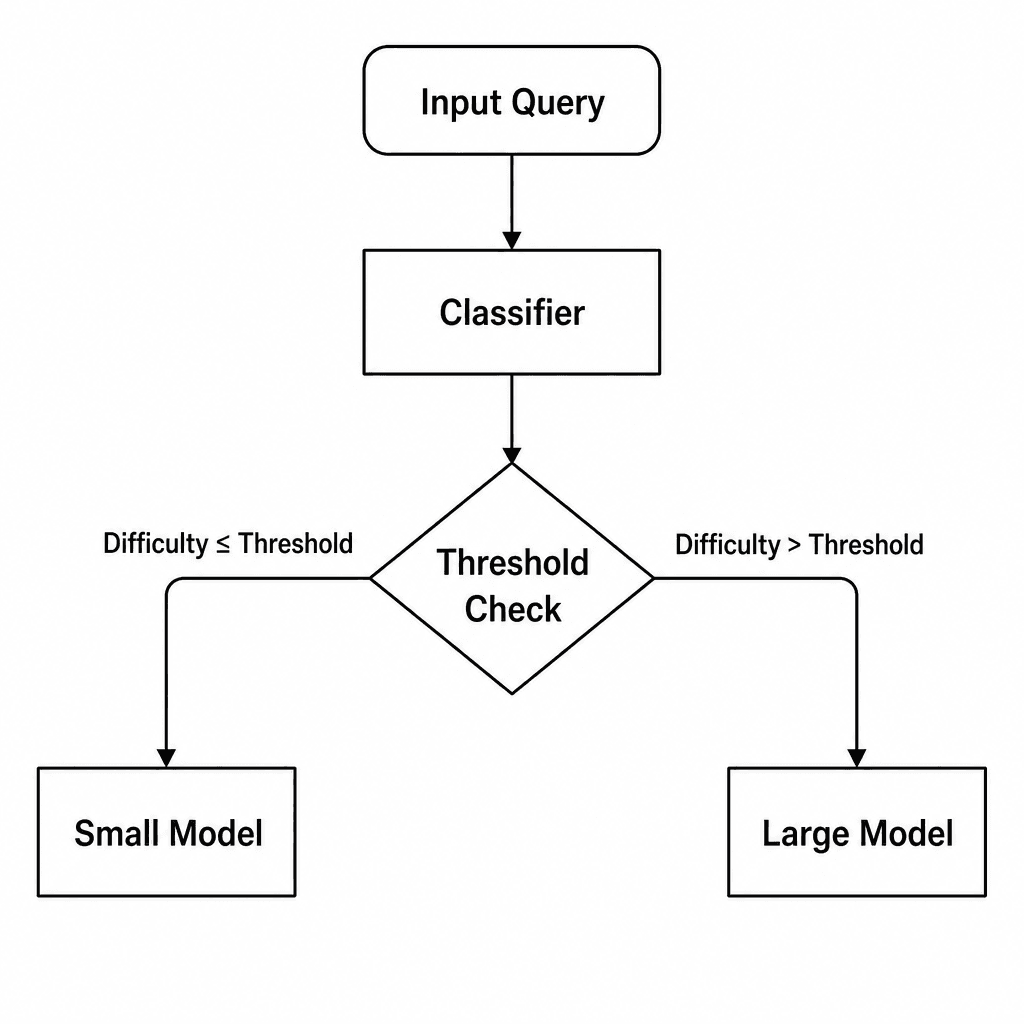
The core component of this architecture is the difficulty classifier. This module evaluates the incoming query and determines the probability that the small model will succeed. Implementation strategies generally fall into two categories: heuristic-based routing and model-based routing.
Heuristic-based routing relies on rule-based logic, such as keyword matching or query length, to quickly estimate complexity. While fast, this approach is often insufficient for nuanced tasks. In contrast, model-based routing employs neural networks or statistical analysis of the model's output to make more nuanced decisions.
There are three primary mechanisms for implementing model-based classifiers:
- Logit Analysis: The router analyzes the output probabilities of the small model. Accessing raw logits requires explicit API configuration (e.g.,
logprobs=True) and involves deriving probabilities via softmax, which adds a minor computational step. If the top predicted token has a high probability, the system assumes high confidence. If the distribution is flat or uncertain, it triggers an escalation. Note that while logit analysis is fast, calibration literature (e.g., Kull et al.) suggests it may be misleading if the model is confidently wrong, particularly in out-of-distribution scenarios. - Internal Consistency Checks: The small model generates multiple responses (e.g., via sampling). If the responses are consistent, the router accepts the result. If they vary significantly, it indicates ambiguity, triggering escalation.
- Auxiliary Classifier: A separate, tiny neural network is trained specifically to predict whether a query is "easy" or "hard." This classifier is trained on historical data where the small model’s success rate is known.
Each method has trade-offs. Logit analysis is fast but subject to calibration issues. Consistency checks are robust but increase latency due to multiple generations. Auxiliary classifiers offer the best balance but require additional training and maintenance. Heuristic methods serve as a lightweight fallback but lack the precision of neural approaches.
Workflow: A Concrete Scenario
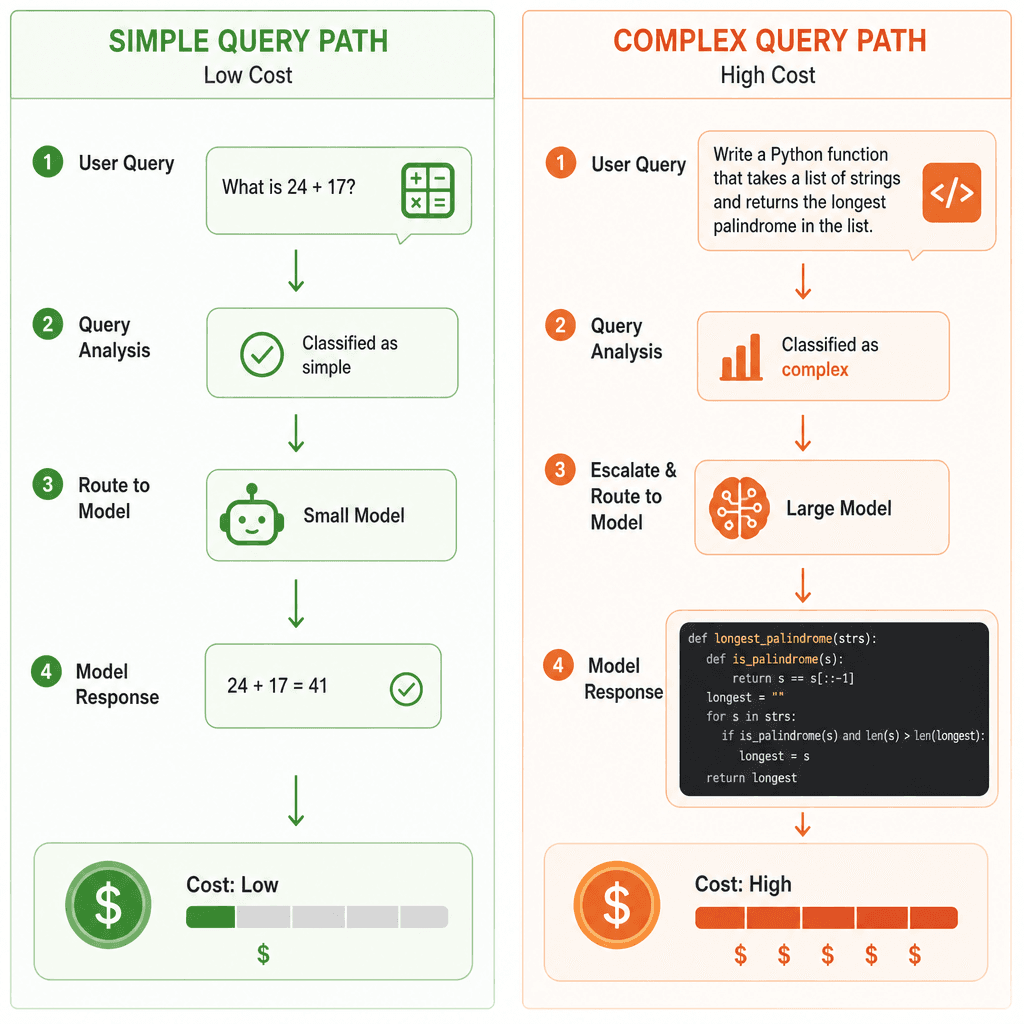
Let’s trace a user query through a typical escalation router. Note that the following example uses a simplified heuristic for illustration purposes, whereas production systems typically employ the more robust model-based classifiers described above.
User Query: "Write a Python function to sort a list of dictionaries by a nested key."
- Ingestion: The query enters the router.
- Classification: The difficulty classifier analyzes the query. It recognizes keywords like "Python," "sort," "dictionaries," and "nested key." It assigns a difficulty score of 0.7 (on a scale of 0-1, where 1 is very hard).
- Threshold Check: The system has a predefined threshold of 0.6. Since 0.7 > 0.6, the router decides the task is too complex for the small model.
- Escalation: The query is forwarded to the large model (e.g., Llama 3 70B).
- Response: The large model generates the correct Python code. The response is returned to the user.
Now, consider a simpler query:
User Query: "What is 2+2?"
- Ingestion: The query enters the router.
- Classification: The classifier identifies this as a simple arithmetic question. It assigns a difficulty score of 0.1.
- Threshold Check: 0.1 < 0.6. The task is easy.
- Execution: The query is sent to the small model (e.g., Llama 3 8B).
- Response: The small model returns "4". The response is returned to the user.
This workflow ensures that the expensive model is only used when necessary, saving significant computational resources over time.
Trade-offs and Risks
While this architecture is efficient, it introduces new failure modes.
False Negatives: The most critical risk is escalating when not needed. If the classifier incorrectly marks an easy query as hard, the system incurs unnecessary cost. This can happen if the classifier is poorly calibrated or if the query is ambiguous. To mitigate this, systems often use ensemble methods, combining multiple classifiers to reduce error rates.
False Positives: Conversely, if the classifier incorrectly marks a hard query as easy, the small model may fail or produce low-quality output. This degrades user experience. In some cases, the system can include a "retry" mechanism, where the small model’s output is validated against a set of criteria before being returned.
Latency Overhead: The router itself adds a small amount of latency. For very simple queries, this overhead might outweigh the benefits of using a small model. Therefore, the router must be extremely lightweight, often implemented as a simple heuristic or a tiny neural network.
Conclusion
Router architectures that prioritize small models and escalate to large models represent a pragmatic approach to LLM deployment. By leveraging the cost-efficiency of small models and the capability of large models, systems can optimize for both performance and budget.
The key to success lies in the accuracy of the difficulty classifier. As models evolve and become more capable, the threshold for escalation may need to be adjusted. However, the fundamental principle remains: do not use a sledgehammer to crack a nut. Use the right tool for the job, and only escalate when necessary.
This architecture is not just a cost-saving measure; it is a design pattern that reflects a deeper understanding of the trade-offs between intelligence, speed, and expense. As the field moves towards more specialized and efficient models, the role of the router will only become more critical.
Related posts
Long-Context Models vs Retrieval: An Honest Comparison
A technical comparison of long-context models and RAG systems, analyzing cost, latency, and million-token capabilities for architects and ML engineers.
Why Small Language Models Are Winning Real Workloads
An examination of how small language models (SLMs) deliver lower latency and reduced cost for task-specific workloads compared to large models.
Jailbreak Detection: Classifiers, Heuristics, and Cost
Examines jailbreak detection methods using classifiers and heuristics, focusing on precision, recall, latency, and cost trade-offs for security and ML engineers.
