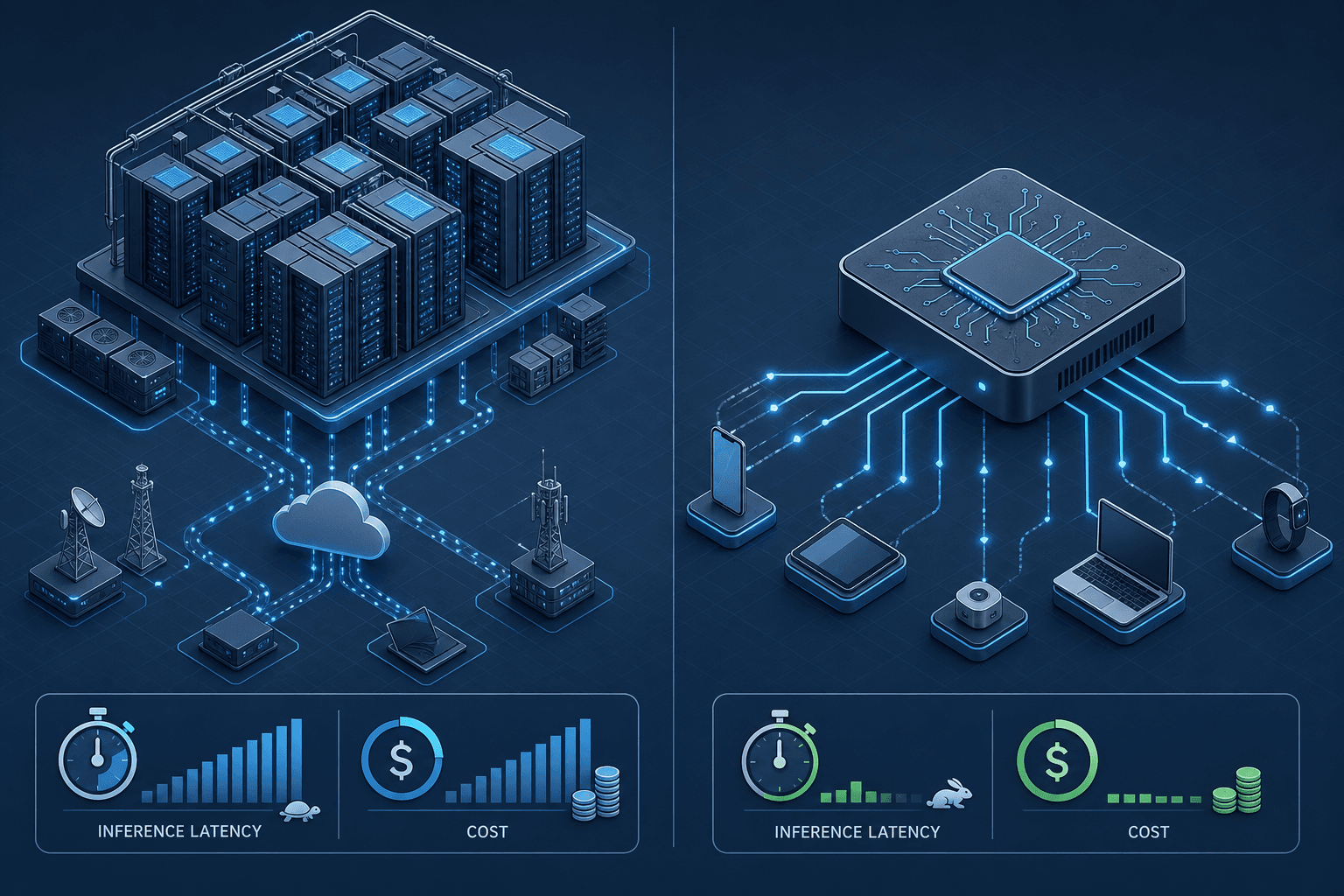
Why Small Language Models Are Winning Real Workloads
An examination of how small language models (SLMs) deliver lower latency and reduced cost for task-specific workloads compared to large models.
The prevailing narrative in artificial intelligence has long been dominated by the arms race for parameter count. For years, the assumption was that scaling laws dictated that larger models—those with hundreds of billions of parameters—would inevitably solve any problem better than smaller ones. However, in production environments, this assumption has collided with the hard constraints of economics, latency, and hardware. Small language models (SLMs), typically defined as models ranging from 1 billion to 13 billion parameters, are not just cheaper alternatives; they are architecturally optimized engines that deliver superior performance-to-cost ratios for task-specific workloads.
This is Part 1 of the Small Models & Distillation series.
The shift toward SLMs is driven by three mechanical realities: the non-linear cost of inference, the efficacy of knowledge distillation, and the advantages of edge deployment.
The Mechanics of Inference Cost and Latency
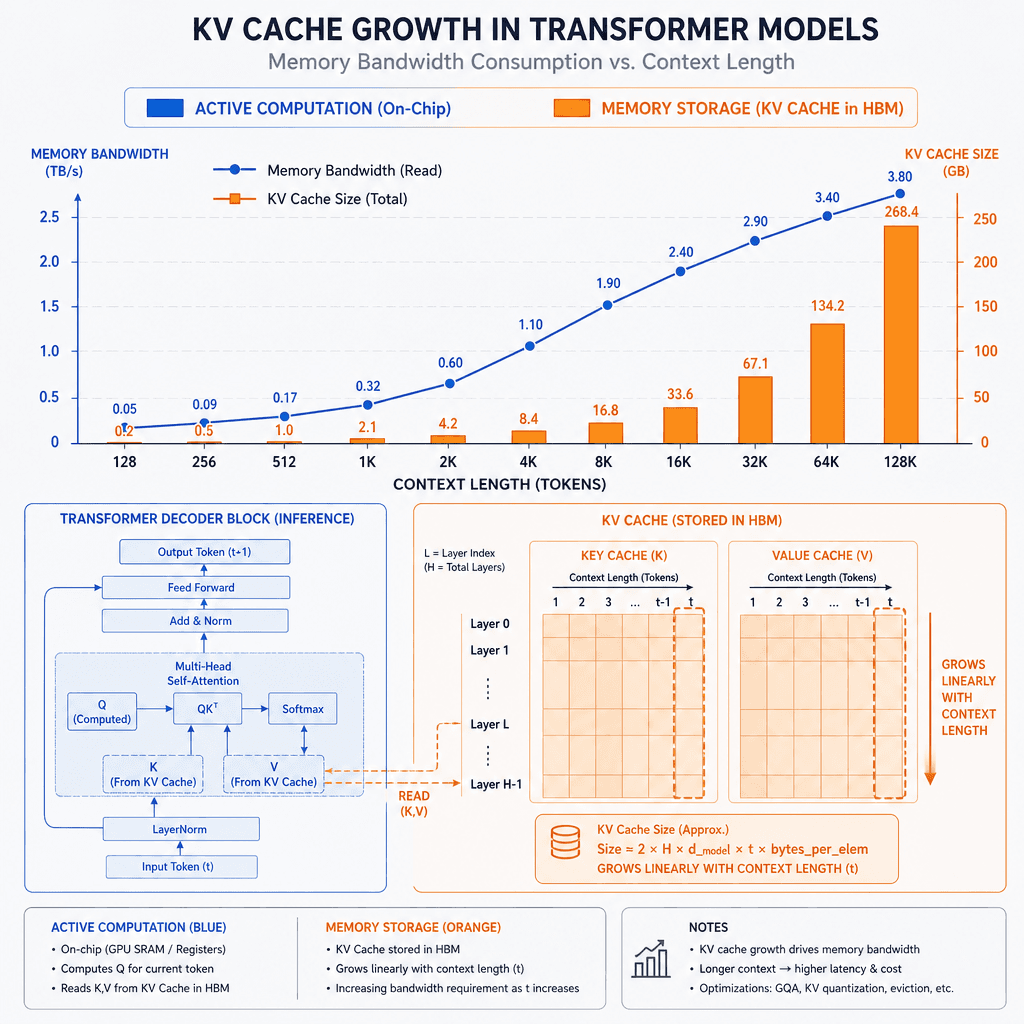
To understand why SLMs win, one must first understand the mechanics of transformer inference. When a Large Language Model (LLM) generates text, it does not simply compute a next token; it maintains a Key-Value (KV) cache. This cache stores the attention states for every previous token in the context window to avoid recomputing them. As the context grows, the KV cache grows linearly, consuming significant GPU memory bandwidth.
For a 70-billion parameter model, the memory footprint of the KV cache can become a bottleneck, forcing the system to swap data between high-bandwidth memory (HBM) and slower system RAM, or even disk, if memory is exhausted. This phenomenon, known as memory-bound inference, drastically increases Time-to-First-Token (TTFT) and Time-per-Output-Token (TPOT).
SLMs mitigate this by reducing the parameter count, which directly reduces the size of the attention matrices and the KV cache. For example, a 3-billion parameter model requires significantly less memory bandwidth to load weights and compute attention than its 70-billion counterpart. This reduction allows SLMs to run on fewer GPUs or even single consumer-grade GPUs, reducing the infrastructure cost per request by orders of magnitude.
Furthermore, the latency reduction is not just about raw compute. In real-time applications like customer service bots or live translation, the delay between user input and model response is critical. SLMs can generate responses faster because they have fewer operations to perform per token. This speed advantage is measurable: benchmarks show that SLMs can achieve up to 2x–5x faster inference speeds compared to larger models when batch sizes are optimized for single-request latency.
Knowledge Distillation: The Compression Engine
The primary mechanism that allows SLMs to maintain high accuracy despite their small size is Knowledge Distillation (KD). KD is a technique where a smaller "student" model is trained to mimic the behavior of a larger, more capable "teacher" model.
In traditional training, a model learns from ground-truth labels (e.g., "this image is a cat"). In distillation, the student model learns from the teacher’s probability distributions over all possible classes, not just the correct one. This provides the student with "dark knowledge"—information about the relationships between classes. For instance, if a large model assigns a 60% probability to "dog" and 30% to "wolf" for an ambiguous image, the student learns that "dog" and "wolf" are semantically close, even if the correct label is "dog."
This process allows SLMs to inherit the reasoning capabilities of larger models without the computational overhead. For example, Microsoft’s Phi-2 model, with only 2.7 billion parameters, was distilled from larger models using synthetic data generated by high-capacity teachers. The result was a model that outperformed LLaMA-13B on MATH and HumanEval benchmarks, demonstrating the efficacy of this approach.
Distillation is not limited to final predictions. It can also be applied to intermediate layers, where the student model is trained to match the internal representations (activations) of the teacher. This multi-level distillation ensures that the SLM captures the nuanced decision-making processes of the larger model, leading to higher accuracy on complex tasks.
Domain-Specific Data Curation
Another key advantage of SLMs is their ability to be fine-tuned on highly specific, high-quality datasets. Large models are trained on massive, diverse corpora to achieve general-purpose competence. This breadth comes at the cost of depth in any single domain. An SLM, by contrast, can be trained on a curated dataset of millions of examples from a specific industry, such as legal document review, medical coding, or software debugging.
This targeted training allows the SLM to learn domain-specific patterns and terminology more effectively than a general-purpose LLM. For instance, a 7-billion parameter model fine-tuned on GitHub code repositories can outperform a 70-billion parameter general-purpose model on code generation tasks because it has seen more relevant examples and has fewer parameters to "dilute" its focus.
The data curation process often involves generating synthetic data using larger models and then filtering it for quality. This creates a feedback loop where the SLM is trained on data that is specifically optimized for its size and capability. This approach is particularly effective for tasks that require strict adherence to format or style, such as JSON output generation or structured data extraction.
Edge Deployment and Hardware Co-Design
The final pillar of the SLM advantage is deployment flexibility. Large models require specialized, expensive hardware (e.g., NVIDIA A100 or H100 GPUs) and significant cooling infrastructure. SLMs, however, can run on edge devices, such as smartphones, laptops, and IoT devices, equipped with Neural Processing Units (NPUs).
Running models on the edge eliminates network latency and ensures data privacy, as sensitive data never leaves the user’s device. For applications like real-time speech recognition, on-screen text summarization, or personal assistant features, this local processing is essential.
Hardware vendors are increasingly designing NPUs specifically for small models. For example, Apple’s Neural Engine and Qualcomm’s AI Hub provide optimizations for models under 13 billion parameters. These optimizations include quantization techniques that reduce the precision of the model weights from 32-bit floating point to 4-bit integer, further reducing memory usage and increasing inference speed without significant accuracy loss.

This hardware co-design enables SLMs to run efficiently on a wide range of devices, from low-power microcontrollers to high-end mobile phones. This democratizes access to AI capabilities and reduces the carbon footprint associated with cloud-based inference.
Conclusion
Small Language Models are not a temporary trend but a logical evolution in the field of AI engineering. By leveraging knowledge distillation, targeted data curation, and edge-optimized hardware, SLMs offer a compelling alternative to large models for task-specific workloads. They provide lower latency, reduced cost, and enhanced privacy, making them ideal for production environments where efficiency and reliability are paramount. As the technology matures, we can expect SLMs to become the default choice for a growing range of applications, from customer service to personal assistance, reshaping the landscape of AI deployment.
Related posts
Router Architectures: Small Model First, Big Model on Escalation
Explore router architectures that route requests to small models first, escalating to larger models only when necessary for cost optimization and efficiency.
Jailbreak Detection: Classifiers, Heuristics, and Cost
Examines jailbreak detection methods using classifiers and heuristics, focusing on precision, recall, latency, and cost trade-offs for security and ML engineers.
Function-Calling Fine-Tunes: Teaching a Small Model Your Tools
Learn how to fine-tune small language models for reliable function calling and tool use by mining execution traces.
