The Lost-in-the-Middle Problem and How to Route Around It
An examination of the lost-in-the-middle phenomenon in large language models and practical strategies for routing and reordering context to improve retrieval accuracy.
Part 2 of the Context Engineering series.
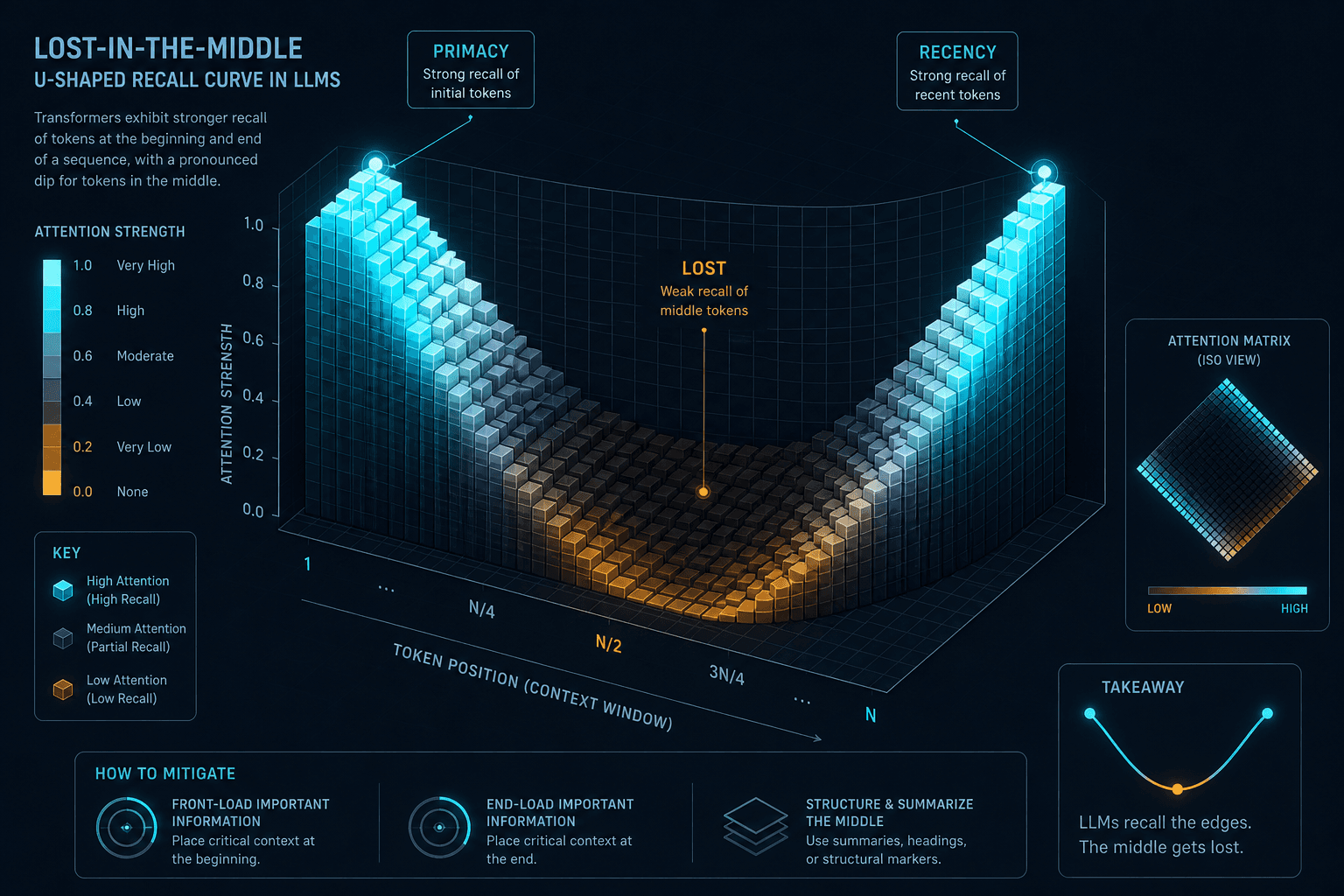
When you feed a large language model (LLM) a 100-page document and ask it to extract a specific fact buried on page 50, the model often fails—not because it lacks the knowledge, but because it cannot locate the signal within the noise. This is the lost-in-the-middle phenomenon, technically known as position bias. It is a fundamental limitation in how current Transformer architectures process long contexts, causing models to disproportionately attend to information at the beginning (primacy effect) and end (recency effect) of a sequence while ignoring the middle.
For developers building retrieval-augmented generation (RAG) systems or long-context agents, understanding this bias is not academic; it is a structural constraint that dictates how you must route data. You cannot simply throw more tokens at the problem and expect linear scaling in accuracy.
The Mechanism: Why the Middle Disappears
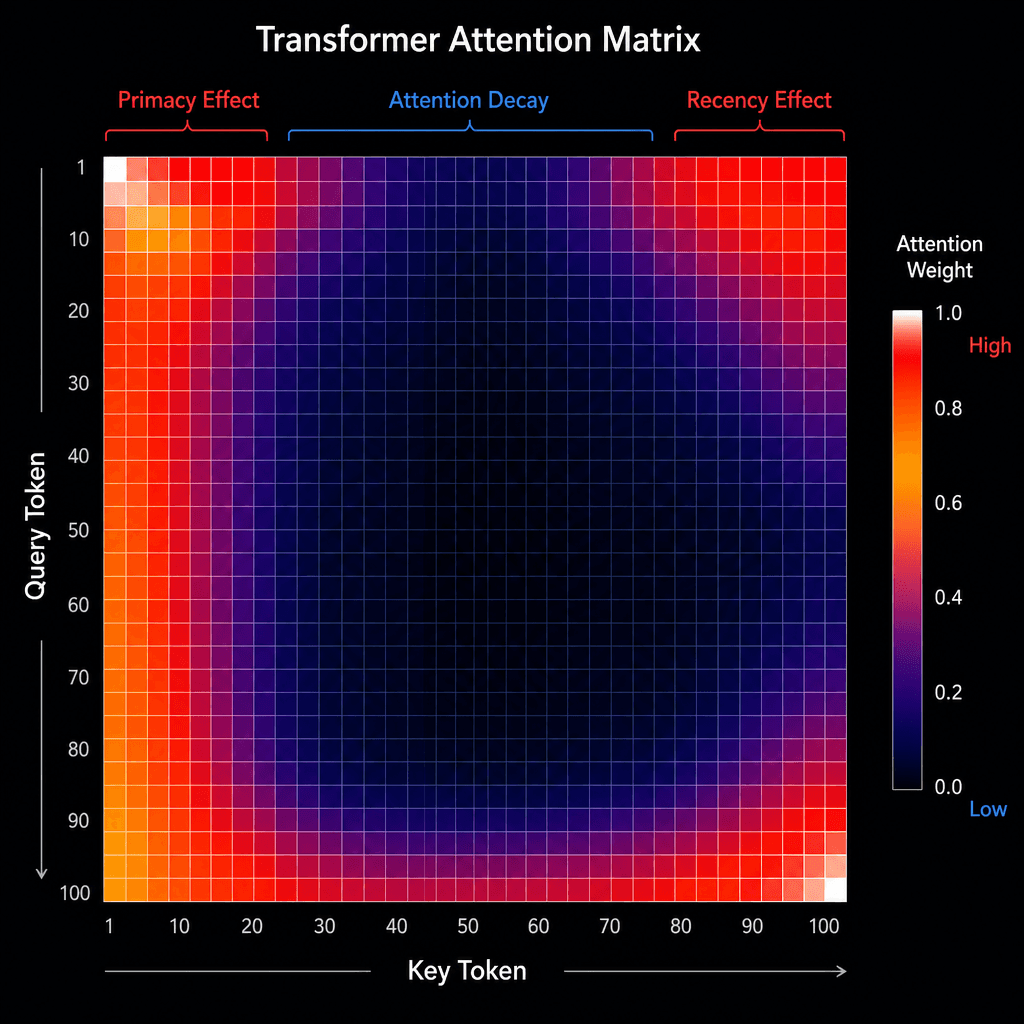
The root cause lies in the self-attention mechanism. In a standard Transformer, every token attends to every other token. However, the strength of this attention is modulated by positional encodings. As the context window grows, the model’s capacity to distinguish between distinct positions dilutes.
Research by Liu et al. (2023) empirically demonstrated that when LLMs are given documents containing contradictory or distinct facts, their ability to retrieve information from the middle of the context drops significantly compared to the edges. This creates a U-shaped recall curve, making the needle in haystack problem particularly acute for mid-sequence data.
Mechanistically, this happens because:
- Positional Encoding Decay: Absolute positional encodings (like standard sinusoidal embeddings) become less discriminative as sequence length increases. The model struggles to map "position 5000" to a unique semantic slot when it has only been trained on shorter sequences.
- Attention Head Specialization: Some attention heads specialize in local dependencies (nearby tokens), while others handle global structure. In long contexts, the global heads often fail to maintain coherence across the entire span, causing mid-sequence tokens to be treated as "noise" rather than critical signal.
- Training Data Distribution: Most pre-training data consists of short-to-medium length texts. Models have rarely seen stable, long-range dependencies in the middle of 30k-token sequences during pre-training, leading to poor generalization at inference time.
The Retrieval Paradox
Human readers approach long documents differently than LLMs. Humans use strategic reading: we skim headings, we remember the introduction and conclusion, and we re-read complex sections. LLMs, however, process all tokens in parallel during the forward pass. There is no "re-reading" in the traditional sense; the model makes a single pass through the attention matrix.
This leads to a paradox in RAG systems: as you increase the number of retrieved chunks to improve recall, you often decrease precision. Adding more context pushes the most relevant chunk further toward the middle of the sequence, where the model’s attention is weakest.
Therefore, the solution is not to train better models (which is outside the scope of application development) but to apply core context-engineering principles. You must treat the context window as a constrained resource with non-uniform access quality.
Practical Routing Strategies
To mitigate position bias, you must route information so that critical data lands in high-attention zones (edges) or use architectural patterns that bypass the long-context bottleneck entirely.
1. Post-Processing Reordering
The simplest and most effective immediate fix is to reorder your context before injection. If you have five retrieved chunks, do not concatenate them in chronological or relevance-score order. Instead, place the most critical chunk (the one most likely to contain the answer) at the very beginning or very end.
For example, if you are answering a question based on a legal contract, move the clause most directly relevant to the query to the start of the context block. This leverages the primacy effect. If the model misses the first chunk, it has a higher chance of catching the last chunk due to recency.
def reorder_context_for_position_bias(chunks, target_chunk_index):
    """
    Reorders chunks so the most important one is at the start.
    """
    if target_chunk_index == 0:
        return chunks

    # Move the target chunk to the front
    reordered = [chunks[target_chunk_index]]
    # Add remaining chunks, preserving relative order where possible
    reordered.extend(chunks[:target_chunk_index])
    reordered.extend(chunks[target_chunk_index+1:])

    return reordered
2. Agentic Routing and Splitting
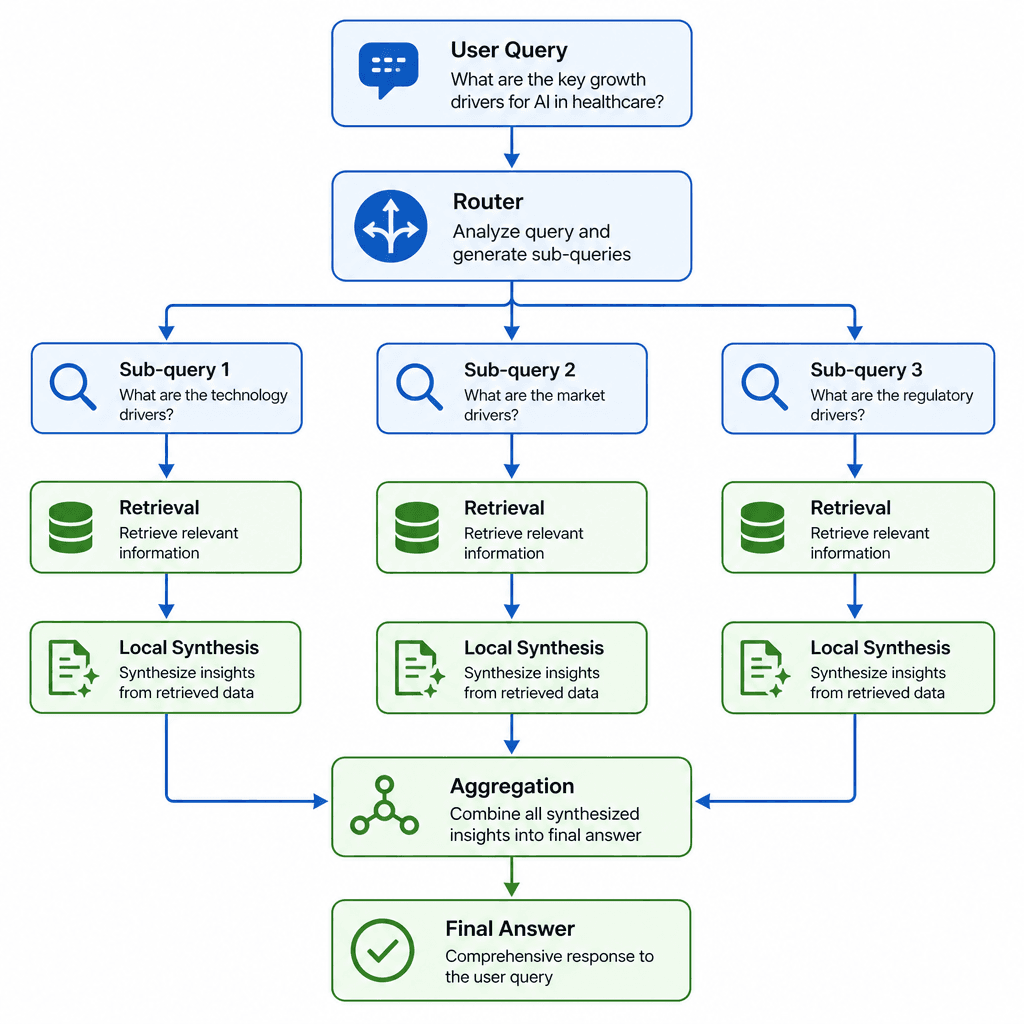
Instead of passing a single long context to the model, use an agentic pattern to split the query. This is particularly effective for complex, multi-hop questions.
The Router Pattern:
- Query Decomposition: An LLM breaks the user’s question into sub-questions.
- Parallel Retrieval: Each sub-question retrieves a small, focused set of chunks (e.g., 2-3 chunks).
- Local Synthesis: Each sub-query is answered using only its small context window. Because the context is short, the "middle" problem is minimized (the chunks are effectively at the edge of a short window).
- Global Aggregation: A final LLM step aggregates the local answers.
This approach reduces the effective context length per model call, keeping tokens within the high-attention zone.
3. Hybrid Retrieval with Filtering
Never send raw, unfiltered chunks to the LLM if you can avoid it. Use a two-stage retrieval pipeline:
- Vector Search: Retrieve the top 20-50 chunks based on semantic similarity.
- Reranking: Use a cross-encoder model (which is computationally expensive but highly accurate) to score these chunks against the query.
- Selection: Select only the top 3-5 reranked chunks for context injection.
By reducing the number of chunks, you ensure that the relevant information is not pushed deep into the middle. A 5-chunk context has a much higher probability of successful extraction than a 20-chunk context.
Conclusion
The Lost-in-the-Middle problem is a reminder that LLMs are not universal reasoners; they are pattern matchers with specific structural weaknesses. As a developer, you cannot change the architecture of the Transformer, but you can change how you feed it.
By understanding that attention decays in the middle of long sequences, you can design systems that route information strategically. Prioritize edge placement, split complex tasks, and filter aggressively. These are not workarounds; they are the fundamental laws of context engineering for the current generation of models.
As context windows continue to expand, these biases may shift, but the principle remains: the model’s attention is a finite, non-uniform resource. Treat it accordingly.
Common Pitfalls
- Relying on Larger Context Windows: Assuming that increasing the context window size from 8k to 32k will automatically solve retrieval issues. Without reordering or filtering, larger windows often exacerbate the dilution of attention in the middle.
- Ignoring Reranking Costs: Skipping the cross-encoder reranking step to save latency or cost, which forces the LLM to process noisy, irrelevant chunks that push the true signal further into the low-attention middle zone.
- Chronological Ordering: Automatically appending retrieved chunks in the order they were found or chronologically without considering their relevance to the specific query, leaving the most critical information stranded in the middle.
Practical Takeaways
- Edges are Gold: Always place the highest-confidence answer or most relevant fact at the very start or very end of the context window.
- Shorter is Better: Keep individual context windows as short as possible. If you must use long contexts, break them down into smaller, focused chunks processed in parallel.
- Filter Aggressively: Never trust raw vector search results. Always apply a reranker to reduce the number of chunks before injecting them into the LLM.
FAQ
Q: Does the lost-in-the-middle problem affect all LLMs equally? A: No. Newer models with improved positional encoding techniques (like RoPE variations or ALiBi) show reduced position bias, but the issue persists in most standard Transformer architectures, especially as context length increases.
Q: Can fine-tuning fix the lost-in-the-middle problem? A: Fine-tuning on long-context datasets can help models learn to attend to the middle more effectively, but it is not a guaranteed fix. Engineering the input context (routing/reordering) remains the most reliable immediate solution.
Q: Is reordering context a form of prompt injection? A: No. Reordering is a structural manipulation of the input data to align with the model's attention mechanics. It is a legitimate context engineering technique, distinct from prompt injection which attempts to manipulate model behavior through adversarial text.
Related posts
Caching Strategies for RAG Pipelines
Explore effective caching strategies for RAG pipelines, including embedding and retrieval caches, to improve hit rates and reduce latency, while managing invalidation effectively.
HyDE and Query Expansion: Do They Still Help?
An examination of HyDE and query expansion techniques in modern retrieval systems, assessing their continued relevance and performance benchmarks.
Fine-Tuning an Embedding Model for Domain Retrieval
A guide to fine-tuning sentence transformers using hard negatives and contrastive learning for improved domain adaptation in retrieval systems.
