Fine-Tuning an Embedding Model for Domain Retrieval
A guide to fine-tuning sentence transformers using hard negatives and contrastive learning for improved domain adaptation in retrieval systems.
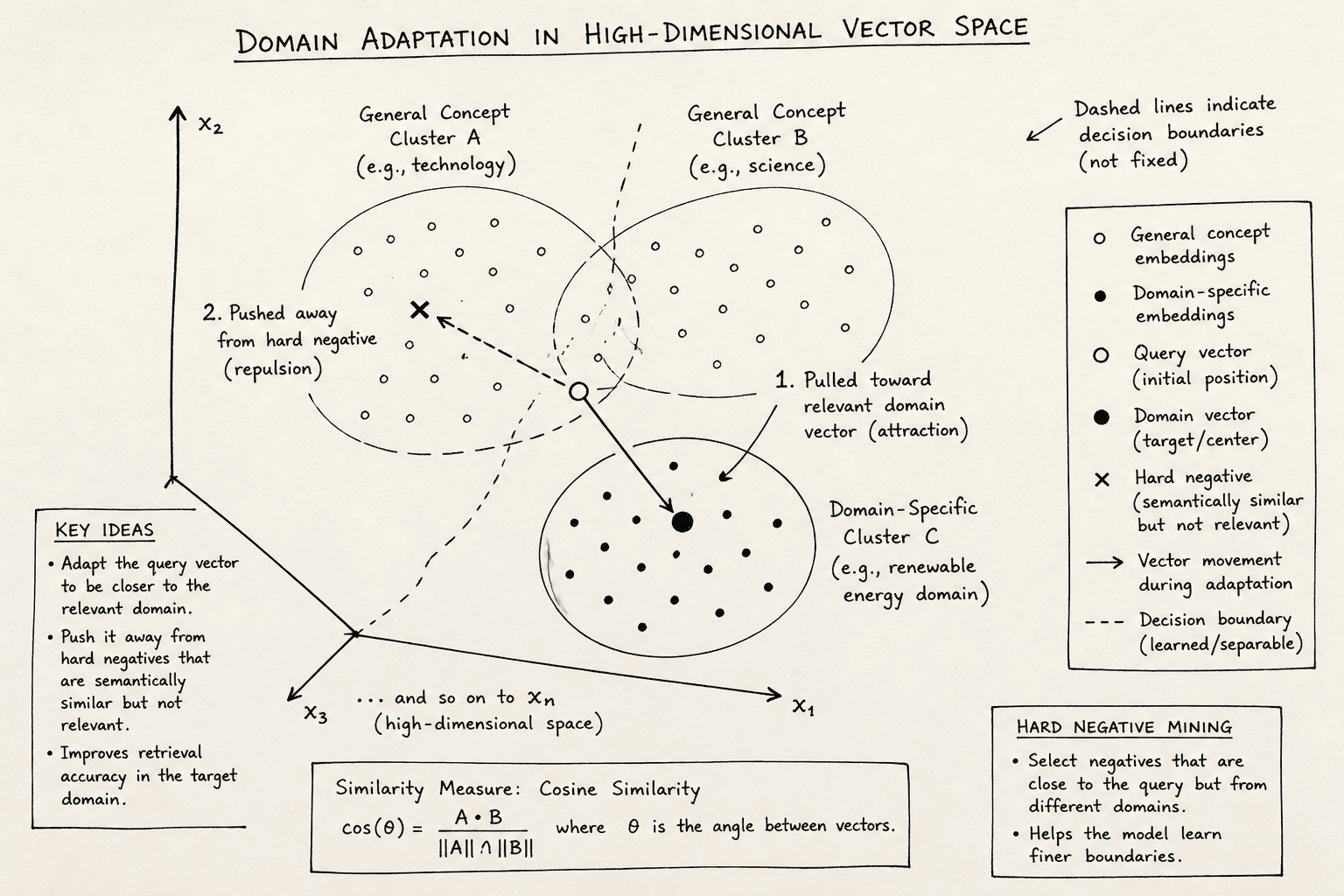
Pre-trained embedding models like all-MiniLM-L6-v2 are trained on massive corpora like Wikipedia and news articles. They excel at general semantic similarity: "How does a cat differ from a dog?" However, they often fail in specialized domains. In a legal retrieval system, a query for "breach of contract" might return a generic definition of contract law rather than the specific case precedent you need. This happens because the model’s latent space clusters general concepts, not domain-specific relevance signals.
To fix this, you must perform embedding fine tuning using contrastive learning with hard negatives. This approach forces the model to distinguish between documents that look similar but have different relevance labels.
The Problem: General Semantics vs. Domain Relevance
Embedding models map text to vectors in a high-dimensional space. Similarity is measured via cosine similarity. When you query a vector database, you retrieve the nearest neighbors.
If your domain is medical records, the pre-trained model might cluster "headache" with "migraine" and "tension headache." But in a clinical context, you might need to distinguish between a primary headache and a secondary headache caused by a tumor. The pre-trained model sees them as semantically similar. A fine-tuned model, trained on specific query-document pairs, learns that "headache + tumor" is relevant, while "headache + rest" is not, even if the semantic overlap is high.
The Solution: Hard Negatives and Contrastive Loss
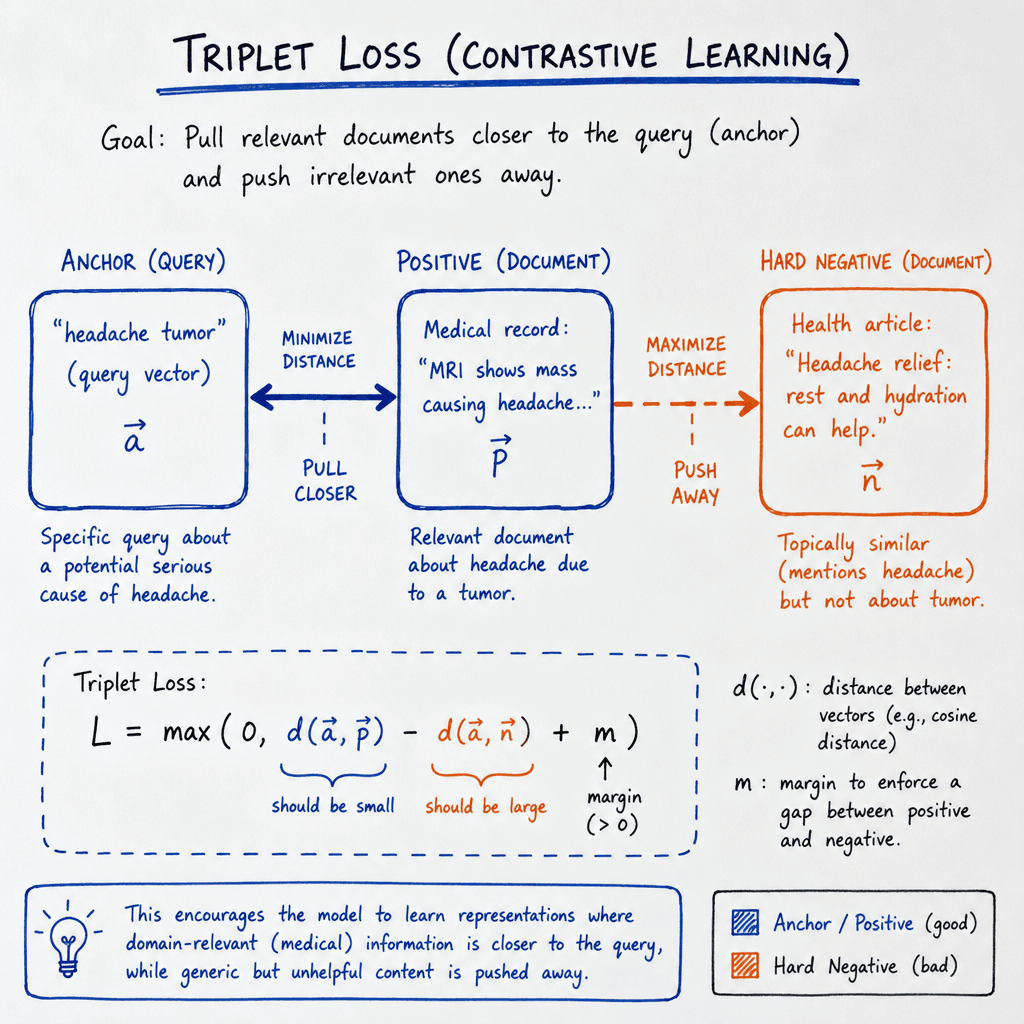
This approach is central to domain adaptation in retrieval systems. The core mechanism is contrastive learning. You provide the model with triplets:
- Anchor (Query): The user's search query.
- Positive (Document): A document known to be relevant to the query.
- Hard Negative (Document): A document that is not relevant but is semantically similar to the query.
Why Hard Negatives?
Easy negatives (random documents) are already far away in the vector space. The model doesn’t need to learn much to push them away. Hard negatives are the key. They are close to the anchor but should be pushed away. This forces the model to refine its decision boundary.
For example:
- Query: "How to fix a leaking faucet"
- Positive: A guide on replacing washer cartridges.
- Easy Negative: A recipe for chocolate cake. (Already far away)
- Hard Negative: A guide on fixing a leaking pipe under the sink. (Semantically similar, but not the direct answer)
By pushing the pipe repair guide away from the query, the model learns to focus on "faucet" and "washer" rather than just "leaking plumbing."
Implementation with Sentence-Transformers
The sentence-transformers library simplifies this process. You’ll use the MultipleNegativesRankingLoss or TripletLoss to handle the contrastive objective.
Step 1: Prepare the Data
You need a dataset of queries and relevant documents. If you don’t have labeled data, you can generate synthetic pairs or use existing datasets like MS MARCO as a starting point.
True domain-specific hard negatives often require manual curation or a separate mining step, as the library's default loss functions rely on in-batch negatives. For MultipleNegativesRankingLoss, you simply provide pairs, and the loss function treats other items in the same batch as negatives.
from sentence_transformers import SentenceTransformer, InputExample, losses
from torch.utils.data import DataLoader

# Define your training examples as InputExample objects
# Each example contains a query and a list of relevant documents
train_examples = [
    InputExample(texts=["query: fix leaking faucet", "positive: replace washer cartridge"]),
    InputExample(texts=["query: fix leaking faucet", "positive: tighten faucet handle"]),
]
Step 2: Define the Model and Loss
Choose a base model. For domain adaptation, start with a smaller model like all-MiniLM-L6-v2 if you have limited compute, or all-mpnet-base-v2 for higher capacity.
# Load pre-trained model
model = SentenceTransformer('all-MiniLM-L6-v2')

# Define the contrastive loss
# MultipleNegativesRankingLoss is efficient and works well with large batches
train_loss = losses.MultipleNegativesRankingLoss(model)
Step 3: Train the Model
Use a DataLoader to feed the data into the model. Note that MultipleNegativesRankingLoss uses in-batch negatives, which can serve as hard negatives if the batch is diverse, but it does not perform active mining. For true hard negative mining, a separate step or utility like sentence-transformers's mine_hard_negatives function is required.
# Create DataLoader
train_dataloader = DataLoader(train_examples, shuffle=True, batch_size=16)

# Fine-tune the model
model.fit(
    train_objectives=[(train_dataloader, train_loss)],
    epochs=3,
    warmup_steps=100,
    output_path='./fine-tuned-embedding-model'
)
Evaluating the Fine-Tuned Model
Don’t just trust the loss curve. Evaluate using Mean Reciprocal Rank (MRR) or Normalized Discounted Cumulative Gain (NDCG) on a held-out validation set. As noted in the Hugging Face documentation for sentence-transformers, these metrics are standard for ranking tasks and provide a robust measure of retrieval quality beyond simple accuracy. Compare the performance of the pre-trained model against the fine-tuned model.
If the fine-tuned model improves MRR by even 5-10%, it’s likely capturing domain-specific nuances that the general model missed.
Key Takeaways
- Rule of Thumb: General models optimize for broad similarity, not task-specific relevance. They are not domain experts.
- Rule of Thumb: Hard negatives drive improvement. They force the model to learn subtle distinctions that easy negatives cannot.
- Rule of Thumb: Contrastive loss is the engine. It pulls positives together and pushes negatives away in the vector space.
- Rule of Thumb: Data quality matters. Garbage in, garbage out. Ensure your positive pairs are truly relevant and your negatives are genuinely hard.
Fine-tuning embedding models is not just about adding more data; it’s about teaching the model what matters in your specific context. By leveraging hard negatives and contrastive learning, you can transform a general-purpose embedding model into a precise domain-specific retrieval engine.
Conclusion
Adapting pre-trained embeddings to specific domains requires moving beyond generic semantic similarity. By introducing hard negatives and utilizing contrastive loss functions, you force the model to learn finer decision boundaries. This process transforms a broad, general-purpose tool into a precise instrument for domain-specific retrieval, ensuring that the most relevant information rises to the top of your search results.
Related posts
Continued Pretraining for Domain Adaptation
Explore continued pretraining techniques for domain adaptation, including corpus mixing and handling drift in ML models.
HyDE and Query Expansion: Do They Still Help?
An examination of HyDE and query expansion techniques in modern retrieval systems, assessing their continued relevance and performance benchmarks.
The Lost-in-the-Middle Problem and How to Route Around It
An examination of the lost-in-the-middle phenomenon in large language models and practical strategies for routing and reordering context to improve retrieval accuracy.
