Continued Pretraining for Domain Adaptation
Explore continued pretraining techniques for domain adaptation, including corpus mixing and handling drift in ML models.
When an organization moves from using a generic Large Language Model (LLM) to one that understands its specific internal jargon, regulatory constraints, or niche industry logic, the first instinct is often to fine-tune the model using Low-Rank Adaptation (LoRA). However, fine-tuning primarily adjusts the model’s output distribution based on a limited set of examples. It does not fundamentally alter the model’s underlying world knowledge or linguistic priors. When the domain gap is significant—such as shifting from general English to legal contract analysis or biomedical literature—continued pretraining (CPT), also known as Domain-Adaptive Pretraining (DAPT), is required.
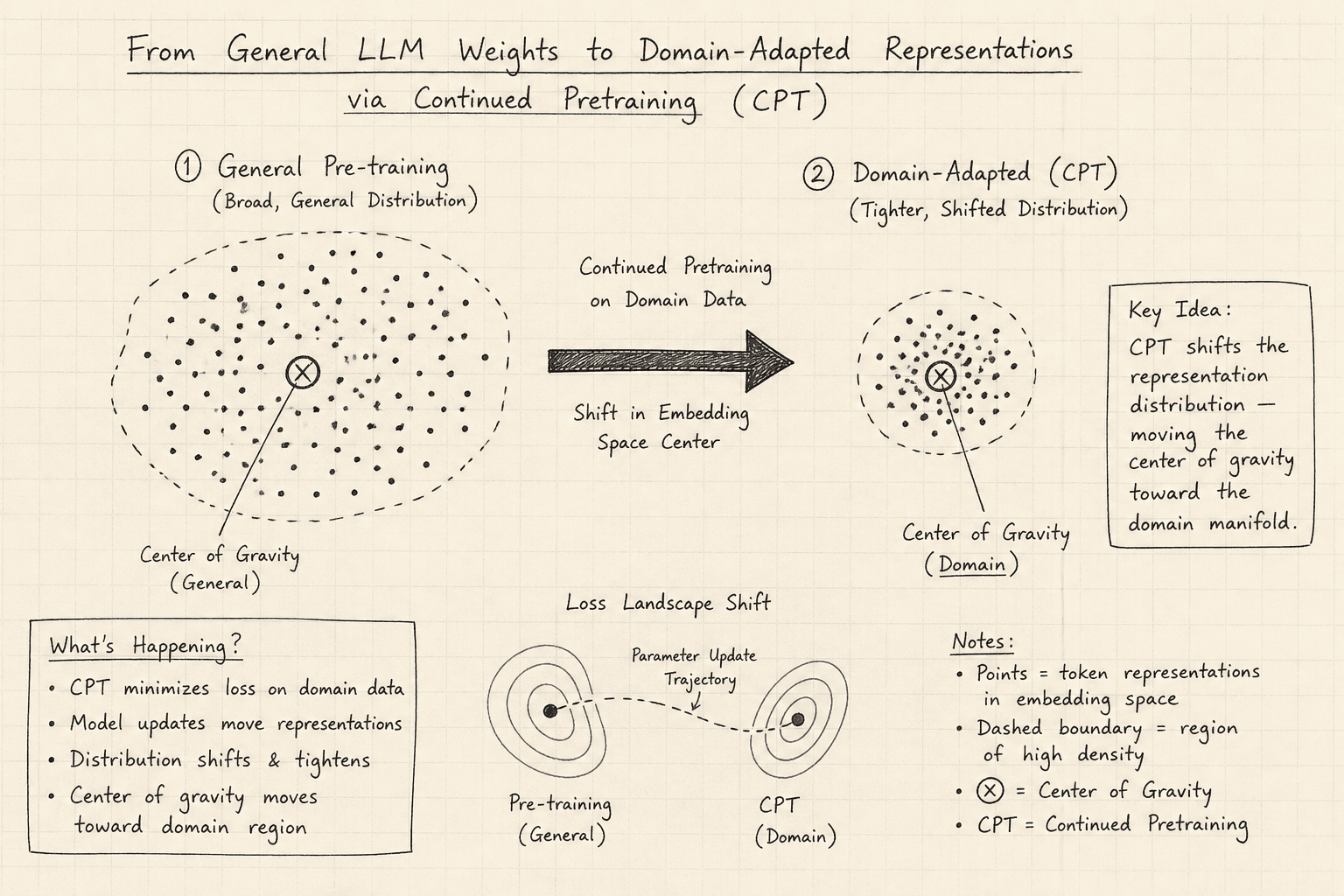
CPT involves taking a pre-trained model and continuing its training objective (typically next-token prediction) on a large, domain-specific corpus. This process re-aligns the model’s internal representations with the statistical properties of the target domain. The mechanism here is not just "learning more," but restructuring the loss landscape so that the domain-specific patterns become the default prior, rather than an exception.
The Mechanism: Why CPT Over Fine-Tuning?
Fine-tuning operates by adjusting a small subset of parameters (or adding adapters like LoRA) to map input embeddings to desired outputs. It assumes the underlying feature space extracted by the base model is already adequate for the task. CPT, conversely, modifies the base weight matrices of the transformer layers across all layers. By exposing the model to millions of domain-specific tokens, CPT shifts the position of the model’s "center of gravity" in the high-dimensional embedding space.
Consider a medical LLM. A general model knows "cell" refers to biology. A legal model might associate it with corporate structure. A domain-adapted model must learn that in its specific context, "cell" almost exclusively refers to biological units, and that terms like "plasma" refer to blood components, not sci-fi concepts. This requires updating the attention heads that route semantic information, not just the final classification layer. Without CPT, the model retains strong conflicting priors from its pre-training phase, leading to hallucinations when domain terms clash with general usage.
Corpus Mixing: Balancing Forgetting and Adaptation
The most critical technical decision in CPT is corpus construction. Training exclusively on domain data risks catastrophic forgetting, where the model loses its general language capabilities, syntax understanding, and broad factual knowledge. The solution is corpus mixing: blending a high-quality, general-purpose dataset (like Common Crawl or The Pile) with a domain-specific dataset.
The mixing ratio is not arbitrary. It depends on the size of the domain corpus and the severity of the domain shift. A common heuristic is to maintain a ratio where general data constitutes 10-30% of the total training tokens, ensuring the model retains its linguistic backbone. However, this ratio must be adjusted based on the diversity of the domain data. If the domain corpus is highly noisy or narrow (e.g., only social media comments from a specific subreddit), the general data portion must increase to provide a stabilizing prior.
For example, if adapting a model for financial analysis, you might mix 80% financial reports, earnings call transcripts, and news articles with 20% general web text. The general text acts as a regularizer, preventing the model from overfitting to the specific stylistic quirks of financial jargon. This mixing must be done at the token level, meaning the data loader shuffles both sources together before batching, ensuring the model sees interleaved contexts during training.
Handling Drift in Domain Corpora
Data drift is a persistent challenge in domain adaptation. In many industries, the relevant data changes rapidly. A model trained on 2021 healthcare data may fail in 2024 due to new treatments, regulatory changes, or evolving terminology (e.g., post-pandemic protocols). This is temporal drift. Additionally, concept drift can occur if the definition of terms shifts within the domain.
CPT mitigates drift through iterative re-training. Instead of a one-time adaptation, organizations should establish a pipeline where the model is periodically re-pretrained on updated corpora. However, simply adding new data is insufficient if the new data distribution diverges significantly from the old. To handle this, engineers use dynamic weighting or curriculum learning.
One effective mechanism is to calculate the perplexity of the new domain data against the current model. If the perplexity is high, it indicates a significant distribution shift. In such cases, the model should be trained on a mixture that includes older, stable domain data alongside the new data, rather than exclusively on the new data. This creates a continuity buffer. Another approach is to use replay buffers, where a subset of old training examples is mixed into the new training batches. This ensures the model does not completely overwrite previous domain knowledge when adapting to recent changes.
Practical Implementation of DAPT
Implementing DAPT requires careful attention to hyperparameters and validation. The learning rate is the most sensitive parameter. Since the model is already pre-trained, using a high learning rate will destabilize the existing weights. A common practice is to use a learning rate that is 5-10 times smaller than the initial pre-training learning rate. For example, if the original pre-training used a peak LR of 3e-4, the DAPT phase might start at 3e-5.
The training schedule should include a warm-up period to gradually adjust the weights without causing initial divergence. Validation is equally critical. Do not rely solely on loss metrics, as loss can plateau without indicating improved domain understanding. Instead, use domain-specific benchmarks. If adapting for code generation, evaluate on HumanEval or MBPP. If adapting for legal tasks, use cases from the CaseHOLD dataset. Track these metrics alongside general benchmarks (like MMLU) to monitor the trade-off between domain specialization and general capability.
Finally, monitor the embedding drift. By projecting embeddings from the original and adapted models onto a lower-dimensional space (using PCA or t-SNE), you can visualize how much the representation space has shifted. A moderate shift indicates successful adaptation; an extreme shift suggests catastrophic forgetting. This visual diagnostic helps engineers decide when to stop training or when to reintroduce more general data.
Common Pitfalls
Engineers implementing CPT often encounter several predictable pitfalls that can degrade model performance or waste computational resources:
- Catastrophic Forgetting: As noted, training exclusively on domain data erases general knowledge. Always use corpus mixing to maintain a balance.
- Overfitting to Narrow Domains: If the domain corpus is too homogeneous (e.g., only one type of legal contract), the model may become brittle and fail on slightly varied inputs within the same domain. Ensure your corpus captures the diversity of real-world usage.
- Ignoring General Benchmarks: Focusing solely on domain-specific metrics can lead to models that perform well on niche tasks but fail at basic reasoning or instruction following. Continuously monitor general benchmarks like MMLU or HELM.
- Incorrect Learning Rate Scaling: Using a learning rate too close to the initial pre-training rate can cause instability. Conversely, a rate that is too low may result in insufficient adaptation. Use learning rate warm-up and cosine decay schedules.
Practical Takeaways
- Mix Corpora: Blend 10-30% general data with domain data to prevent catastrophic forgetting.
- Monitor Embeddings: Use PCA/t-SNE to visualize representation shifts and detect forgetting or over-adaptation.
- Iterate on Drift: Implement periodic re-training pipelines to handle temporal and concept drift in dynamic domains.
- Validate Broadly: Track both domain-specific and general benchmarks to ensure balanced performance.
FAQ
Q: How much data do I need for effective CPT? A: Generally, hundreds of millions to billions of tokens are recommended. The exact amount depends on the domain complexity and the initial pre-training size of the base model. Larger models often require more data to adapt effectively without overfitting.
Q: Can I use CPT for very small domains? A: CPT is most effective for domains with significant divergence from general language. For minor style adjustments or specific instruction-following tasks, fine-tuning (LoRA/QLoRA) is often more efficient and sufficient.
Q: What are the compute requirements for CPT? A: CPT is computationally intensive, requiring full model gradient updates. It typically demands more GPU hours than parameter-efficient fine-tuning methods. Ensure you have sufficient infrastructure for large-scale pre-training runs.
Q: How do I know if CPT is better than fine-tuning? A: If the model struggles with domain-specific terminology, reasoning, or factual accuracy despite fine-tuning, CPT is likely necessary. If the task is primarily about output format or specific instructions, fine-tuning may suffice.
Conclusion
Continued pretraining is not a simple step of "feeding more data." It is a precise mechanism for reshaping the model’s internal knowledge structure. By carefully mixing corpora to prevent forgetting and implementing strategies to handle data drift, ML engineers can transform generic models into specialized experts.
Related posts
Query Rewriting: The Underrated RAG Upgrade
Explore how query rewriting and expansion improve RAG recall by resolving coreference and enhancing conversational search capabilities.
Fine-Tuning an Embedding Model for Domain Retrieval
A guide to fine-tuning sentence transformers using hard negatives and contrastive learning for improved domain adaptation in retrieval systems.
Hyperparameters That Actually Matter
A practical examination of key hyperparameters like learning rate, batch size, and epochs for ML engineers fine-tuning LLMs.
