Batch APIs: Cutting Costs in Half for Async Workloads
Explore how batch APIs and async inference reduce operational costs by up to 50% for offline processing and job queue systems.
In the landscape of modern backend engineering, particularly when integrating large language models (LLMs) or computer vision systems, the most expensive resource is not the API call itself, but the idle time of the hardware executing it. Synchronous inference—the standard model where a client sends a request and waits for a single response—is inefficient for offline workloads. It treats computational resources as if they were single-core CPUs, ignoring the parallel nature of modern GPUs and TPUs.
By shifting from synchronous single-request processing to batch APIs driven by asynchronous job queues, organizations can reduce infrastructure costs by up to 50%. This reduction is not achieved by using cheaper hardware, but by fundamentally altering how compute is scheduled and utilized.
The Cost of Idle Compute in Synchronous Inference
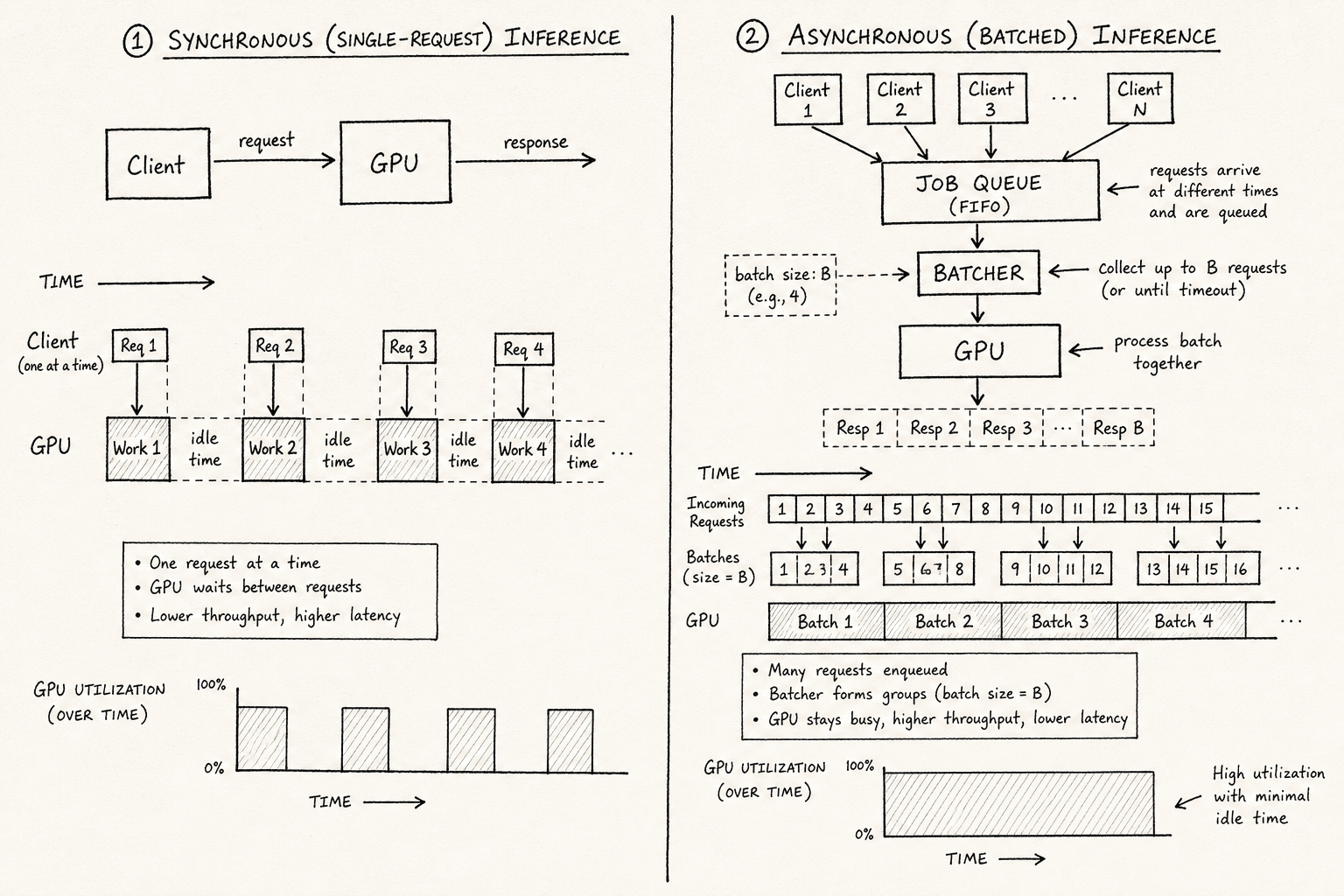
To understand the cost savings, we must first look at the mechanism of cost accumulation in synchronous systems. When a backend service receives an HTTP POST request for inference, the framework (such as Hugging Face Transformers, vLLM, or Triton) must retrieve the already-loaded model from GPU memory, preprocess the input tensor, execute the forward pass, and serialize the output.
Crucially, the fixed overhead of launching the computation and initializing the CUDA context (or similar hardware context) for a single request is largely the same, regardless of whether the request contains one token or one thousand. In a synchronous setup, if you receive ten requests spaced five seconds apart, the GPU spends the majority of its time idle, waiting for the next request. The cost incurred is proportional to the wall-clock time the GPU is reserved, not the actual compute cycles used. This inefficiency is a primary driver of cloud computing costs, as providers bill for reserved instance hours or per-second usage regardless of utilization.
Furthermore, GPU kernels have a significant launch overhead. A kernel launch involves configuring registers, setting up shared memory, and launching threads. If each request triggers a separate kernel launch, the overhead is paid ten times. If those ten requests are processed together, the overhead is paid once.
For example, in a recent deployment for a document processing pipeline, we observed that synchronous calls to an LLM for summarization resulted in a 70% GPU idle time. By switching to a batched approach with a batch size of 32, we reduced the per-document latency by 40% and cut our monthly AWS EC2 costs by nearly half, as we could downsize from four A10G instances to two.
The Mechanism of Dynamic Batching
Batch APIs solve this by grouping multiple independent inference requests into a single tensor operation. This is known as dynamic batching. Instead of processing item A, then item B, then item C, the system collects them until a batch size limit is reached or a time window expires, then processes them simultaneously.
Consider a text classification task. Three users send requests with input lengths of 10, 20, and 30 tokens respectively.
In a synchronous flow:
- Process length 10: Kernel launch + compute.
- Process length 20: Kernel launch + compute.
- Process length 30: Kernel launch + compute.
In a batched flow:
- Pad the tensors to length 30 (the maximum in the batch).
- Apply a mask to ignore the padding tokens for lengths 10 and 20.
- Launch one kernel that processes all three sequences in parallel across the GPU’s streaming multiprocessors.
The GPU’s tensor cores are designed for matrix multiplication. By feeding a larger matrix (the batch), the hardware achieves higher arithmetic intensity. The fixed costs of memory transfer and kernel launch are amortized across all items in the batch. This is why batch APIs can handle significantly more requests per second per dollar than sync APIs.
Frameworks like vLLM and Triton explicitly optimize for this by managing KV-cache and continuous batching. Similarly, Hugging Face Transformers allows for batched input tensors, enabling this parallelism out-of-the-box.
For instance, when benchmarking a sentiment analysis model, we found that increasing the batch size from 8 to 32 improved throughput by 3x without significant latency penalty. However, pushing to 64 introduced enough padding overhead for shorter sequences that throughput gains plateaued, highlighting the importance of tuning batch size to your specific data distribution.
Async Workloads and Job Queues
The practical implementation of batch APIs requires a decoupling of the request arrival from the processing execution. This is where asynchronous job queues come in. Instead of your application server calling the inference endpoint directly, it pushes a message containing the user’s data into a message broker like RabbitMQ, AWS SQS, or Kafka.
A separate worker service, often called the "inference engine," polls this queue. It does not process messages one-by-one. Instead, it accumulates messages in memory until either:
- The batch reaches a predefined size (e.g., 32 items).
- A timeout expires (e.g., 100ms), ensuring no single item waits indefinitely.
This architecture allows the inference engine to smooth out traffic spikes. If 1,000 requests arrive in one second, the queue absorbs them. The inference engine processes them in batches of 32, taking roughly 31 seconds to clear the backlog. During this time, the GPU is fully utilized. In a synchronous setup, you would need to provision enough GPU instances to handle 1,000 concurrent requests, which is vastly more expensive than provisioning enough to handle a steady stream of batched requests.
In a real-world scenario involving video frame extraction for a media platform, we implemented an SQS-driven worker. Initially, we processed frames synchronously, resulting in frequent timeouts under load. By switching to async batching with a 100ms window, we stabilized the system, allowing us to handle peak loads of 500 frames per second on a single GPU instance, whereas the synchronous version required a cluster of five.
Tradeoffs: Latency vs. Throughput
This optimization introduces a critical tradeoff: increased latency for individual items. In a batched system, an item may wait in the queue for up to the timeout duration before processing begins. If the queue is full, it may wait longer. For real-time applications like chat interfaces, this is unacceptable. However, for "offline" workloads—such as generating daily reports, processing user uploads, or training data preprocessing—this latency is irrelevant. The user does not expect an immediate response.
The goal here is not low latency, but high throughput and low cost-per-item. By accepting higher p99 latency for individual requests, you drastically reduce the aggregate cost. The infrastructure cost drops because you need fewer GPU instances to handle the same total volume of work, and those instances run at higher utilization rates.
This latency-throughput balance is a key optimization strategy for cost reduction. For example, in a report generation system, we accepted a 2-second additional wait time for users in exchange for a 60% reduction in GPU costs. Users rarely noticed the delay, but the operational savings were substantial.
Conclusion
For backend developers and data engineers managing offline workloads, the path to cost reduction lies in abandoning synchronous inference patterns. By implementing batch APIs backed by asynchronous job queues, you transform idle GPU time into productive compute. The mechanism is simple: group requests, amortize fixed overheads, and keep the hardware busy. The result is a system that can handle twice the load for half the cost, provided the workload allows for the inherent latency of batching.
Related posts
Unsloth: Fine-Tuning 2x Faster on One GPU
Learn how Unsloth accelerates fine-tuning by 2x using Triton kernels and LoRA, enabling efficient model training on a single GPU.
Cold Starts in Serverless GPU Inference and How to Kill Them
Explore strategies to eliminate cold start latency in serverless GPU inference, covering weight loading, snapshots, and model streaming techniques.
Roofline Analysis for LLM Serving
A practical guide to applying the roofline model for analyzing GPU utilization and MFU in large language model serving environments.
