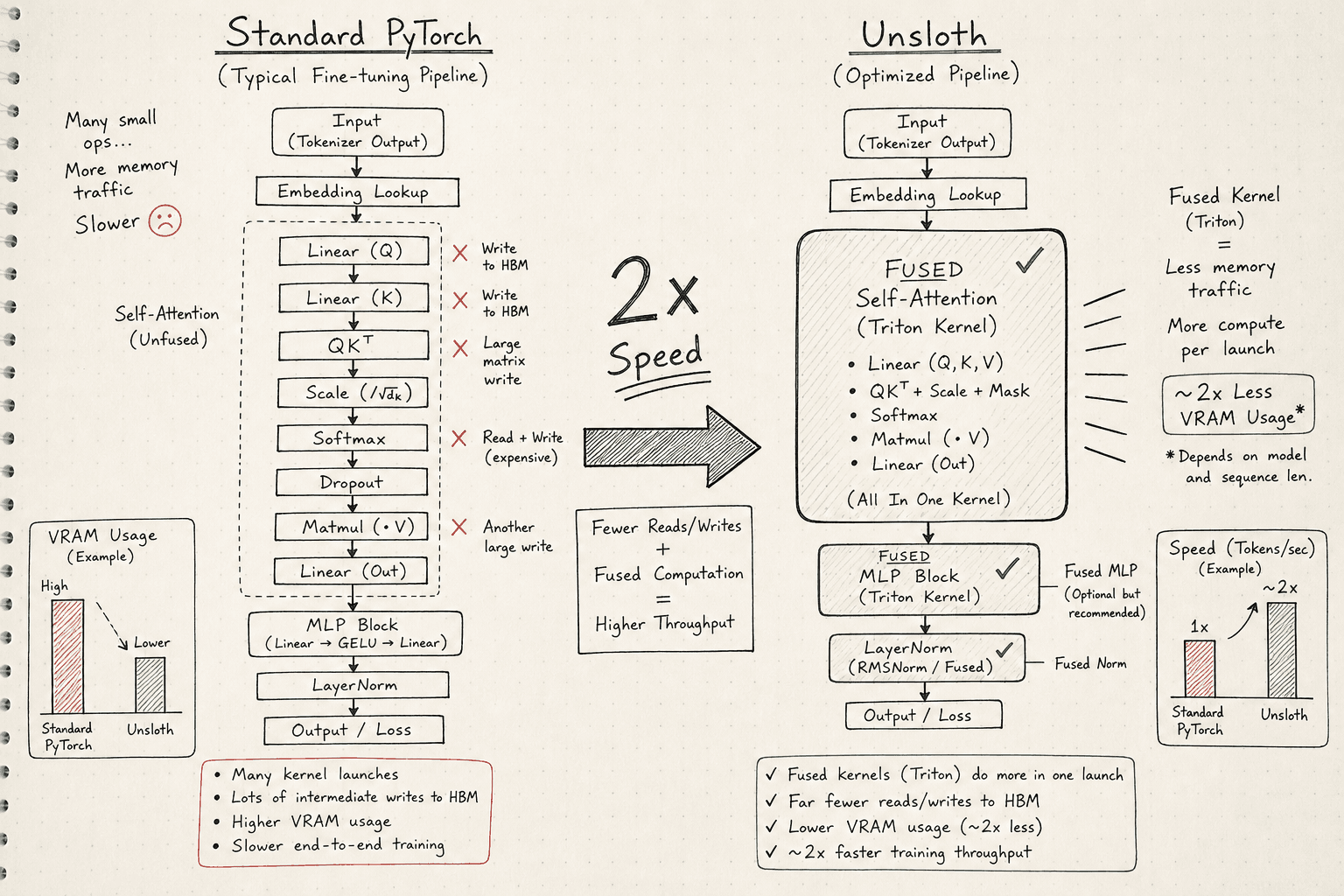
Unsloth: Fine-Tuning 2x Faster on One GPU
Learn how Unsloth accelerates fine-tuning by 2x using Triton kernels and LoRA, enabling efficient model training on a single GPU.
Most machine learning engineers assume that fine-tuning a large language model (LLM) requires a cluster of A100s or a complex multi-GPU setup. This is a misconception driven by inefficient software stacks, not hardware limitations. Unsloth, an open-source optimization library for PyTorch, demonstrates that you can fine-tune models like Llama-3 or Mistral 7B on a single consumer-grade GPU (e.g., RTX 4090) with twice the speed and significantly lower memory usage than standard pipelines, enabling fast fine tuning on a single consumer-grade GPU.
The acceleration isn't magic; it's a result of replacing generic PyTorch operations with highly optimized, fused Triton kernels and eliminating redundant memory allocations during the backward pass.
The Bottleneck: Why Standard PyTorch is Slow for Fine-Tuning
When you fine-tune a model using Hugging Face transformers and peft, you are typically running a standard forward-backward loop. In the forward pass, activations are computed and stored. In the backward pass, gradients are calculated by traversing the computational graph in reverse. Reducing the time required for fast fine tuning significantly relies on addressing the inefficiencies inherent in this standard process.
Standard PyTorch has two major inefficiencies in this context:
- Activation Recomputation: To save memory, PyTorch often discards intermediate activations during the forward pass and recomputes them during the backward pass (gradient checkpointing). While this saves VRAM, it doubles the compute time for those layers.
- Unoptimized Kernel Launches: Standard linear and attention operations use generic CUDA kernels that may not be fully optimized for the specific data types (like BF16) and shapes used in LLM fine-tuning. Each operation launches a separate kernel, introducing CPU-GPU synchronization overhead.
Unsloth addresses both by rewriting the core components of the model's forward and backward passes.
The Mechanism: Fused Triton Kernels
Unsloth's primary speedup comes from replacing standard PyTorch operations with custom Triton kernels. Triton is a programming language for writing highly efficient GPU kernels that compile to optimized PTX (Parallel Thread Execution) code. This fusion is key to fast fine tuning, as it minimizes the overhead associated with multiple kernel launches.
Optimizing the Attention Layer
In a transformer, the attention mechanism involves matrix multiplications (QK^T, softmax, V). Standard PyTorch executes these as separate steps, each involving memory reads/writes to global VRAM. Unsloth fuses these operations into a single kernel.
For example, instead of computing QK^T, then softmax, then multiplying by V in three separate steps, Unsloth's fused kernel computes the entire attention score and output in one pass. This reduces memory bandwidth pressure—a common bottleneck in LLM training—by keeping intermediate results in faster shared memory or registers where possible.
# Conceptual representation of what Unsloth does internally
# Standard PyTorch: Multiple kernel launches
# q @ k.transpose(-2, -1) -> softmax -> output @ v

# Unsloth Triton Kernel: Fused operation
# fused_attention(q, k, v, mask) -> output
This fusion reduces the number of global memory accesses by ~30-50%, directly translating to faster epoch times.
Memory Optimization: Doing More with Less
Speed isn't the only benefit; memory efficiency is crucial for single-GPU fine-tuning. Unsloth reduces VRAM usage by approximately 60% compared to standard Hugging Face pipelines. How?
- Memory-Efficient Optimizer States: Optimizers like AdamW store first and second moment estimates for every parameter. For a 7B parameter model, this is massive. Unsloth uses mixed-precision storage for these states, reducing memory footprint without sacrificing convergence quality.
- Activation Caching: Instead of recomputing activations (which is slow) or storing all of them (which consumes VRAM), Unsloth selectively caches only the necessary activations for the backward pass, discarding others immediately.
- LoRA Integration: Unsloth integrates directly with Low-Rank Adaptation (LoRA). LoRA freezes the pre-trained weights and trains small rank-decomposition matrices. Unsloth optimizes the memory layout of these LoRA weights, ensuring they are co-located with the main model weights to improve cache locality.
LoRA: The Right Tool for Single-GPU Fine-Tuning
LoRA is not unique to Unsloth, but Unsloth makes it the default and most efficient path. When you apply LoRA, you're adding two small matrices and to each layer: . During training, only and are updated; the original remains constant.
Unsloth's optimization ensures that the matrix multiplications involving and are fused with the main model's operations. This means the "overhead" of LoRA is nearly zero, making fast fine tuning feasible on consumer hardware by allowing you to fine-tune without significant performance penalty.
from unsloth import FastLanguageModel

# Load model with 4-bit quantization and LoRA ready
model, tokenizer = FastLanguageModel.from_pretrained(
    model_name = "unsloth/Llama-3-8b-bnb-4bit",
    max_seq_length = 2048,
    dtype = None,
    load_in_4bit = True,
)

# Apply LoRA adapter
model = FastLanguageModel.get_peft_model(
    model,
    r = 16,
    target_modules = ["q_proj", "k_proj", "v_proj", "o_proj",
                      "gate_proj", "up_proj", "down_proj"],
    lora_alpha = 16,
    lora_dropout = 0, # Supports any, but = 0 is optimized
    bias = "none",
    use_gradient_checkpointing = "unsloth", # True or "unsloth" for very long context
    random_state = 3407,
)
Practical Impact: A Single GPU Scenario
Let's consider a concrete scenario: Fine-tuning Llama-3-8B on a single NVIDIA RTX 4090 (24GB VRAM) using the Alpaca dataset, demonstrating the power of fast fine tuning on limited hardware.
Standard Hugging Face Pipeline
- VRAM Usage: ~20-22GB (often OOM with batch size > 1)
- Training Time: ~4-5 hours per epoch
- Throughput: ~100-150 samples/sec
Unsloth Pipeline
- VRAM Usage: ~8-10GB (allows batch size 4-8)
- Training Time: ~2-2.5 hours per epoch
- Throughput: ~250-300 samples/sec
The 2x speedup is consistent across various models (Mistral, Phi-3) and datasets. The memory reduction allows you to increase the batch size, which stabilizes training and can lead to better convergence, highlighting the efficiency of fast fine tuning.
Conclusion
Unsloth doesn't change the mathematics of transformers or LoRA. It changes the execution. By fusing kernels, optimizing memory layouts, and eliminating redundant computations, it extracts maximum performance from existing hardware, enabling fast fine tuning on consumer hardware. For ML engineers working with limited GPU resources, Unsloth is not just an optimization—it's an enabler. It makes advanced fine-tuning accessible on consumer hardware, democratizing access to LLM customization.
If you're fine-tuning an LLM on a single GPU today, you're likely leaving performance on the table. Unsloth provides a drop-in replacement that requires minimal code changes but delivers significant gains in speed and efficiency.
Key Takeaways
- Fused Kernels: Unsloth uses Triton to fuse attention and MLP operations, reducing memory bandwidth pressure.
- Memory Efficiency: 60% VRAM reduction allows larger batch sizes on single GPUs.
- LoRA Integration: Optimized execution of LoRA updates makes it the preferred fine-tuning method.
- Accessibility: Makes fine-tuning 7B-13B models feasible on RTX 3090/4090 GPUs, making fast fine tuning accessible.
Related posts
Axolotl Configs Explained Line by Line
A detailed breakdown of Axolotl YAML configuration files for fine-tuning models with DeepSpeed and custom dataset formats.
Cold Starts in Serverless GPU Inference and How to Kill Them
Explore strategies to eliminate cold start latency in serverless GPU inference, covering weight loading, snapshots, and model streaming techniques.
Merging, Exporting, and Serving Your Adapter
A technical walkthrough on merging LoRA adapters, exporting to safetensors, and serving models with specific dtypes for ML and platform engineers.
