Function Calling vs Structured Output: Choosing an Interface
A comparison of function calling and structured output for API design, helping backend developers choose the right interface for tool use and JSON mode.
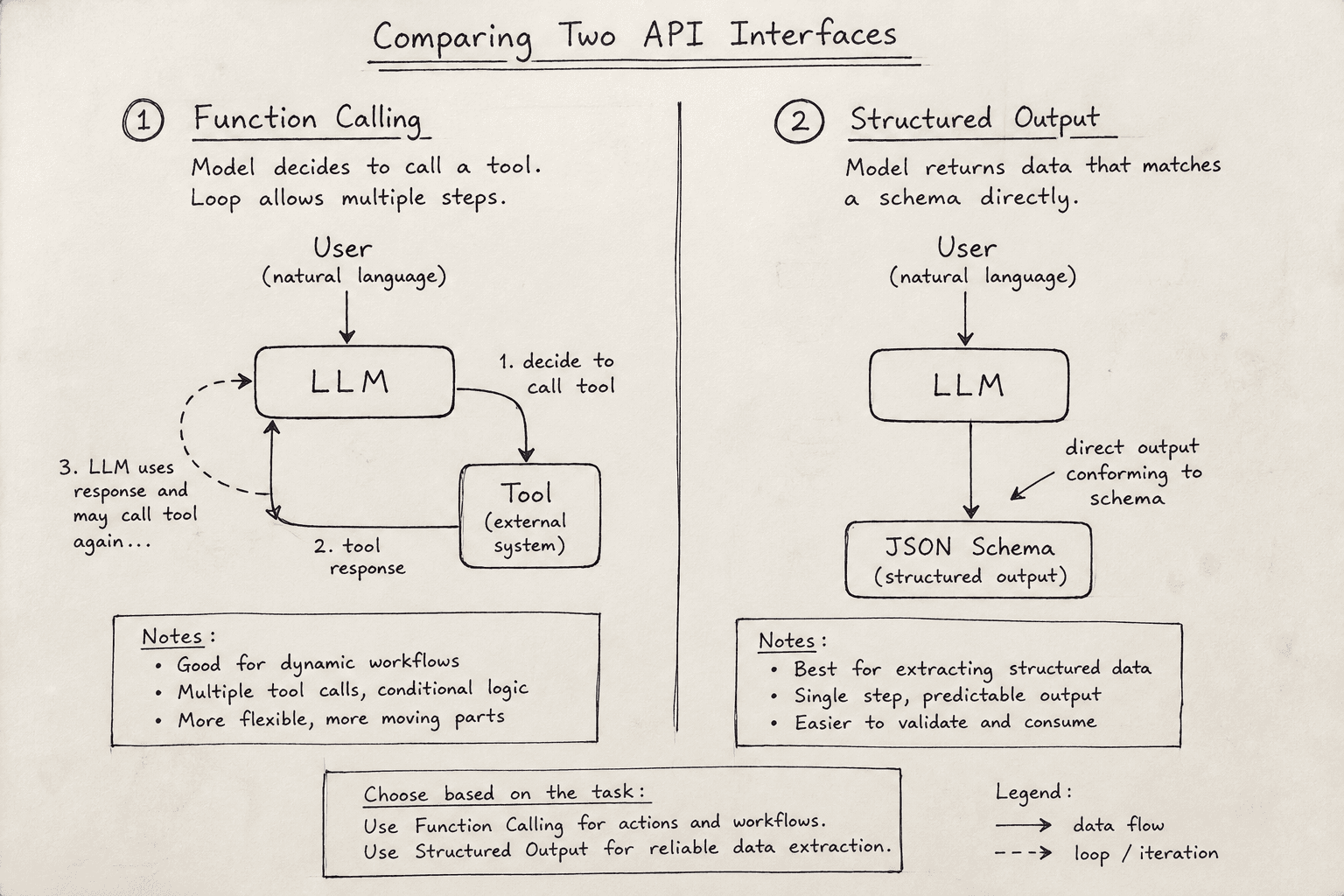
When integrating Large Language Models (LLMs) into backend systems, developers frequently encounter two distinct interfaces for obtaining deterministic results: Function Calling and Structured Output. While both aim to reduce hallucination and enforce structure, they operate on fundamentally different mechanisms within the model’s inference pipeline. Confusing them leads to fragile architectures where the model is asked to perform actions it cannot execute or return data it cannot validate.
Backend developers often struggle with this choice because the line between "extracting data" and "triggering an action" can appear blurry in user prompts. This article dissects the internal mechanisms of both approaches, helping you choose the correct interface based on whether the primary requirement is tool execution or data extraction. We will cover the technical underpinnings, error handling strategies, and specific selection criteria to ensure robust integration.
The Mechanism of Function Calling
Function calling is not merely a formatting constraint; it is a semantic routing mechanism. When you enable function calling, you provide the LLM with a list of tool definitions (signatures) and their descriptions. The model’s task shifts from generating arbitrary text to predicting a specific JSON structure that invokes one of these tools.
How It Works Internally
The LLM does not "execute" the code. Instead, it outputs a structured message indicating which function to call and with what arguments. The backend intercepts this output, executes the actual code, and then feeds the result back to the model.
Consider a backend service managing inventory. You define a tool update_stock:
{
  "name": "update_stock",
  "description": "Updates the stock level for a specific SKU",
  "parameters": {
    "type": "object",
    "properties": {
      "sku": {"type": "string"},
      "quantity": {"type": "integer"}
    },
    "required": ["sku", "quantity"]
  }
}
When a user asks, "Set the stock for SKU-123 to 50," the LLM generates:
{
  "name": "update_stock",
  "arguments": "{\"sku\": \"SKU-123\", \"quantity\": 50}"
}
The critical mechanism here is argument validation. The backend parses the arguments JSON and validates it against the provided schema. If validation fails (e.g., quantity is a string), the backend returns an error to the LLM, allowing the model to correct its reasoning in the next turn. This creates a closed-loop control system where the LLM acts as a policy engine, and the backend acts as the executor.
For a deeper understanding of this mechanism, refer to the OpenAI Function Calling Documentation or Anthropic's Tool Use Guide, which detail how providers handle these semantic routing requests.
The Mechanism of Structured Output
Structured output, often referred to as "JSON mode" or "schema-constrained decoding," operates differently. It does not invoke external tools. Instead, it constrains the probability distribution of the next token generated by the model to ensure compliance with a predefined schema (e.g., JSON Schema, Pydantic models).
How It Works Internally
When using structured output, the LLM still generates text, but the decoding process is guided by a parser. For example, if you specify a JSON schema with a user object containing name and age, the model is forced to output valid JSON that matches this structure.
Using the same inventory scenario, if you only need to extract the SKU and quantity without updating the database immediately, you would use structured output:
{
  "name": "extract_inventory_request",
  "parameters": {
    "type": "object",
    "properties": {
      "sku": {"type": "string"},
      "quantity": {"type": "integer"}
    },
    "required": ["sku", "quantity"]
  }
}
The LLM outputs:
{
  "sku": "SKU-123",
  "quantity": 50
}
Here, there is no intermediate execution step. The backend parses the JSON directly. If the model hallucinates (e.g., outputs "quantity": "fifty"), the parser throws an error, and the request fails. Unlike function calling, there is no automatic retry loop unless explicitly implemented by the developer.
It is important to note that while JSON is the most common format for structured output, the term "JSON mode" is sometimes used interchangeably. However, structured output is a broader concept that can apply to other schema types (e.g., XML, CSV) if supported by the provider. JSON mode is simply a specific implementation of structured output.
Data Flow and Error Handling
The choice between function calling and structured output significantly impacts your error handling strategy.
Function Calling: Semantic Validation
In function calling, the model’s primary failure mode is incorrect argument selection or missing arguments. The backend validates these arguments before execution. If validation fails, the backend can return a structured error to the LLM, prompting it to refine its output. This is ideal for complex interactions where the LLM needs to "think" about the correct tool and parameters.
Example Error Flow:
- LLM calls
update_stockwithsku: 123(integer instead of string). - Backend validation fails.
- Backend returns:
"Error: sku must be a string." - LLM corrects:
"sku": "123".
Structured Output: Structural Validation
In structured output, the model’s primary failure mode is schema violation due to hallucination or formatting errors. The backend must parse the output and handle exceptions. If parsing fails, the request typically fails unless you implement a retry mechanism that feeds the error back to the model.
Example Error Flow:
- LLM outputs:
{ "sku": "SKU-123", "status": "success" }(extra field). - Backend parser fails (strict mode).
- Backend returns:
"Error: Unexpected field 'status'." - LLM retries with corrected schema.
Selection Criteria: When to Use Which
Choosing the right interface depends on the intent of the interaction.
Use Function Calling When:
- Action is Required: The LLM needs to trigger an external process (e.g., send an email, query a database, update a record).
- Complex Reasoning is Needed: The LLM must decide which tool to use based on the user’s intent.
- Stateful Interactions: The backend needs to provide feedback to the LLM to correct its reasoning (e.g., "The item was not found, try again").
- Cost Consideration: Be aware that function calling typically incurs higher token costs due to multi-turn interactions (request -> tool execution -> response) compared to single-pass structured output.
Use Structured Output When:
- Data Extraction is the Goal: You need to parse unstructured text into a structured format (e.g., extract entities from a document, summarize a text into a JSON object).
- No External Execution is Needed: The LLM’s output is the final product, and you simply need to validate its structure.
- Performance is Critical: Structured output is a single pass, offering lower latency than the multi-step function calling loop.
- Flexibility in Format: You require strict schema adherence but may need formats beyond JSON, such as XML or CSV, if supported by your provider.
Common Pitfalls
Even experienced developers can misapply these interfaces. Here are common mistakes to avoid:
- Using Function Calling for Simple Data Extraction: If you only need to extract a name or date, function calling introduces unnecessary overhead. The model must route to a tool, the backend must parse and validate, and potentially a round-trip is needed. Use structured output for pure extraction tasks to save tokens and latency.
- Using Structured Output for Complex Multi-Step Reasoning: Structured output cannot handle logic that requires external state or iterative refinement. If the LLM needs to check a database availability before deciding on a price, structured output is insufficient. Use function calling to allow the model to interact with your backend services iteratively.
- Ignoring Schema Rigidity: In structured output, strict schemas can lead to frequent parsing failures if the model is prone to minor hallucinations. Ensure your schema is robust, or implement graceful fallbacks. Conversely, in function calling, overly broad tool descriptions can lead to the model choosing the wrong tool. Be precise in your tool definitions.
Conclusion
Function calling and structured output are not interchangeable. Function calling is a tool-use interface that enables the LLM to act as a controller for external systems, leveraging backend validation for semantic correctness. Structured output is a data-extraction interface that constrains the LLM’s output to a specific format, leveraging parsing for structural correctness.
For backend developers, the key takeaway is to align the interface with the intent: use function calling when you need the LLM to do something, and structured output when you need the LLM to describe something. Misapplying these interfaces leads to unnecessary complexity, increased latency, and fragile error handling.
Related posts
Function-Calling Fine-Tunes: Teaching a Small Model Your Tools
Learn how to fine-tune small language models for reliable function calling and tool use by mining execution traces.
The Tool-Calling Loop, Implemented From Scratch
A technical walkthrough of implementing a tool-calling loop for AI agents from scratch, covering function calling, message history, and the agent loop.
Designing an Attribute Model for ABAC
A practical guide to designing an effective attribute model for Attribute-Based Access Control, covering subject, resource, and environment attributes.
