Getting Reliable JSON Out of Any Model
A technical examination of constrained decoding, outlines, and schema validation techniques to ensure reliable JSON output from language models.
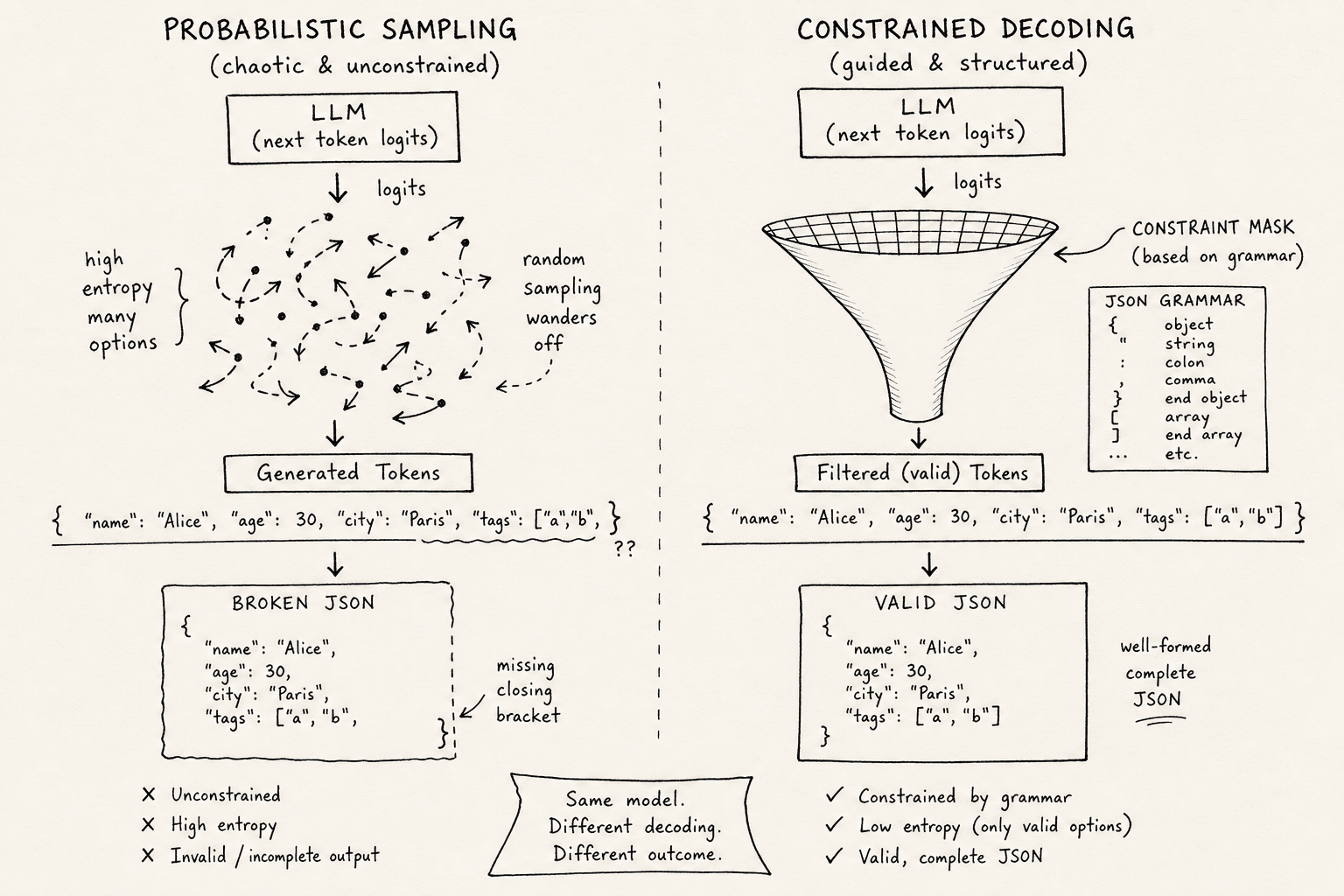
Backend developers integrating Large Language Models (LLMs) into production pipelines quickly encounter a specific failure mode: the model outputs valid English but invalid JSON. This is not a bug in your parser; it is a fundamental mismatch between how LLMs generate text and how JSON structures data. To achieve production-grade reliability, you must move beyond post-hoc validation and retry loops, implementing constrained decoding and schema-aware generation mechanisms.
The Mechanism of Failure
To understand why JSON generation fails, we must look at the autoregressive mechanism. An LLM predicts the next token based on the probability distribution of all previous tokens. When generating text, the model operates in an unstructured space. When generating JSON, it operates in a highly constrained structural space.
Consider a standard generation loop with temperature > 0. The model generates an opening brace {. The next token might be a property name like "status". However, because the model does not inherently "count" brackets or understand syntactic scope, it can easily hallucinate a trailing comma, forget a closing quote, or output a value type that contradicts the schema (e.g., a string where an integer is expected).
Standard parsers like json.loads() will throw a JSONDecodeError on these minor syntactic deviations. In a production system, this leads to a "retry loop" where the backend re-sends the prompt, hoping for a different random seed that yields valid JSON. This is inefficient, increases latency, and does not guarantee success. Research indicates that without constraints, up to 10% of raw LLM outputs may fail basic JSON parsing checks, making blind retries a significant cost center.
Constrained Decoding: Masking the Search Space
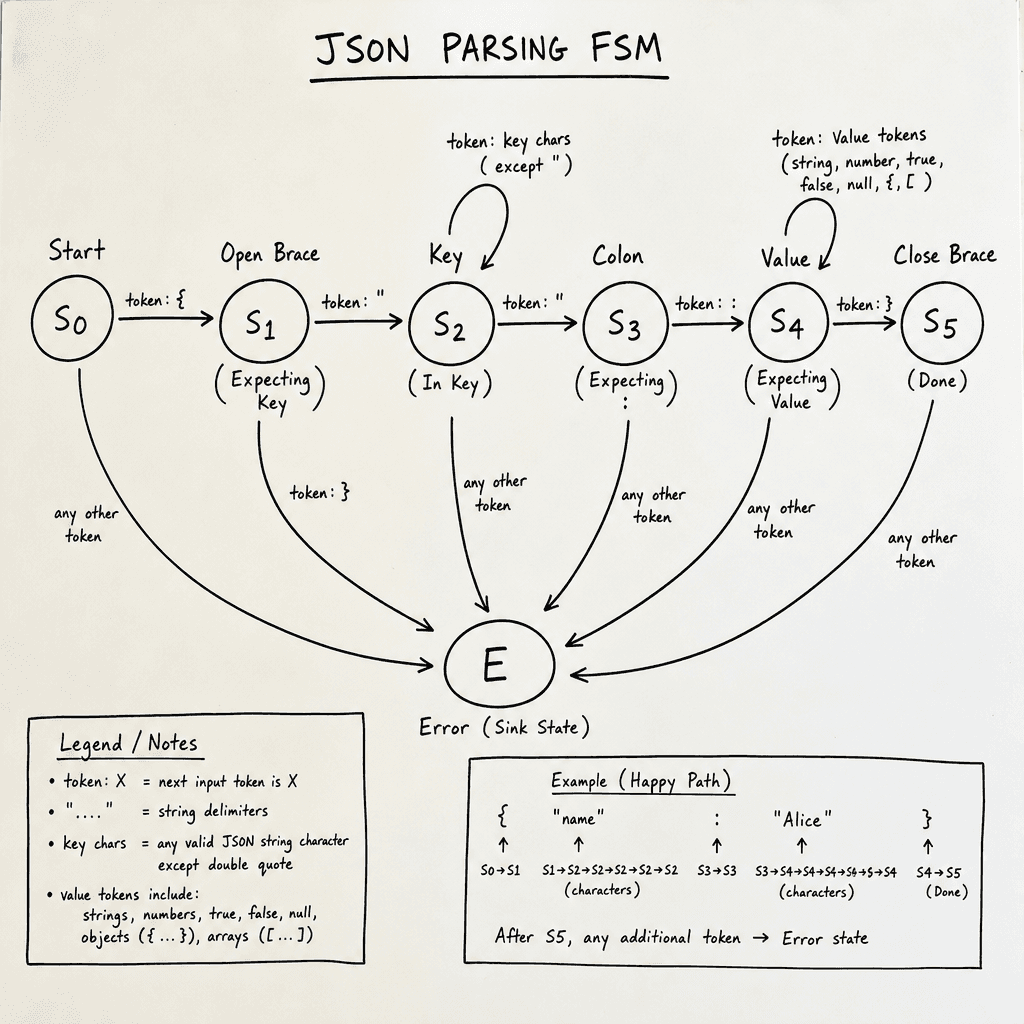
The solution is constrained decoding. Instead of allowing the model to choose from its entire vocabulary of ~50,000+ tokens at each step, constrained decoding dynamically masks the token space to only include tokens that maintain syntactic validity.
This is typically implemented by compiling a formal grammar (such as a Context-Free Grammar or CFG) into a finite state machine (FSM) or a regex pattern. As the model generates each token, the decoder checks: Is this token valid given the current state of the JSON structure?
For example:
- The model outputs
{. The FSM transitions to a state expecting a key. - The model outputs
"user". The FSM transitions to a state expecting a colon. - The model outputs
:. The FSM transitions to a state expecting a value. - If the schema dictates
"user"is an integer, the decoder masks out all string tokens and only allows integer tokens.
Libraries like outlines and lm-format-enforcer implement this by integrating with the model's inference engine (e.g., vLLM, HuggingFace Transformers). They intercept the logits (raw probability scores) before sampling and set the probability of invalid tokens to zero (or negative infinity). This guarantees that the output is syntactically valid JSON by construction.
Here is a concrete example using outlines to define a simple schema and generate output:
import outlines
import json

# Define a simple Pydantic model to represent the JSON structure
from pydantic import BaseModel, Field

class User(BaseModel):
    id: int
    name: str
    active: bool

# Load a model and generate constrained output
model = outlines.models.transformers("mistralai/Mistral-7B-Instruct-v0.2")
generator = outlines.generate.json(model, User)
response = generator("Extract user details from: John Doe is active and has ID 123.")

# response is now a valid User instance
print(response.model_dump_json())
This approach shifts the burden of correctness from the model's probabilistic guessing to a deterministic grammar enforcement layer.
Schema-Driven Generation: Semantic Constraints
Syntactic validity is necessary but not sufficient. You also need semantic validity. A model might output valid JSON that doesn’t match your business logic (e.g., an age field containing a string instead of an integer).
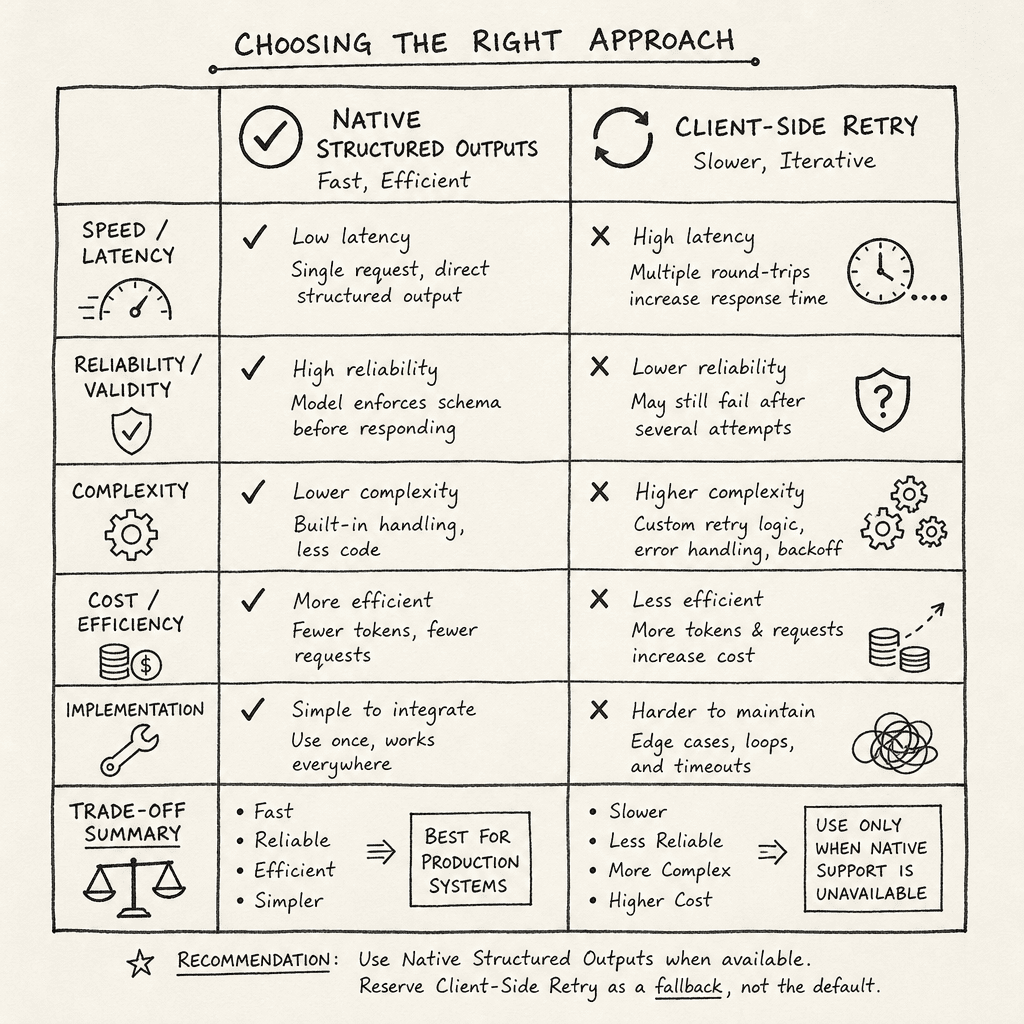
Schema-driven generation extends constrained decoding by incorporating JSON Schema definitions. Modern LLM providers and client libraries now support native structured output formats. For instance, OpenAI’s API allows you to specify response_format: { type: "json_schema", json_schema: { ... } }. Under the hood, this often leverages constrained decoding techniques to ensure the output adheres to the schema’s types and required fields.
Client-side libraries like instructor serve as a critical bridge between unconstrained models and structured outputs. instructor wraps the model call and applies post-processing validation against a Pydantic model or JSON Schema. If the output fails validation, instructor can automatically retry with a modified prompt that includes the error message, leveraging the model’s ability to self-correct. This process is a form of schema validation that ensures the output matches the business logic defined in the JSON Schema, often involving post-generation checks or strict schema-aligned decoding when native constraints are unavailable.
Production Trade-offs: Latency vs. Reliability
Implementing constrained decoding introduces latency overhead. Compiling grammars and masking logits at every token generation step is computationally more expensive than standard sampling. However, this cost is often lower than the cumulative cost of multiple failed retries.
Consider a scenario where 10% of standard LLM outputs are invalid JSON. A retry loop might require 2–3 attempts on average, effectively doubling or tripling the latency and cost. Constrained decoding adds a fixed overhead per token. Benchmarks from libraries like lm-format-enforcer suggest a typical 10–20% slower generation speed compared to unconstrained sampling, though this varies by hardware and model size. For high-throughput systems, the deterministic success rate usually outweighs the slight latency increase.
Recommendation for Backend Developers
- Use Native Structured Outputs: If using OpenAI, Anthropic, or similar providers, leverage their native
response_formator structured output parameters. This is the most efficient path. - Adopt Constrained Decoding Libraries: For open-weight models or custom inference engines, use
outlinesorlm-format-enforcerto enforce JSON grammar. - Validate Early: Even with constrained decoding, validate the output against your JSON Schema immediately after generation. This catches semantic errors (e.g., a string where an enum is expected) that syntactic constraints might not catch if the schema isn’t perfectly aligned with the grammar.
- Avoid Blind Retries: Do not rely on retry loops for JSON validity. They are a symptom of insufficient constraint enforcement. Use them only for semantic validation failures, and even then, consider refining the prompt or schema instead of blindly retrying.
By treating JSON output as a structural constraint problem rather than a text generation problem, you can build LLM integrations that are reliable, predictable, and production-ready.
Related posts
Tools, Resources, and Prompts: The Three MCP Primitives
An examination of the three core Model Context Protocol primitives: tools, resources, and prompts, and how they enable structured AI integration.
Caching Strategies for RAG Pipelines
Explore effective caching strategies for RAG pipelines, including embedding and retrieval caches, to improve hit rates and reduce latency, while managing invalidation effectively.
Model Gateways and Multi-Provider Routing
Implement model gateways and multi-provider routing with LiteLLM for resilient LLM applications.
