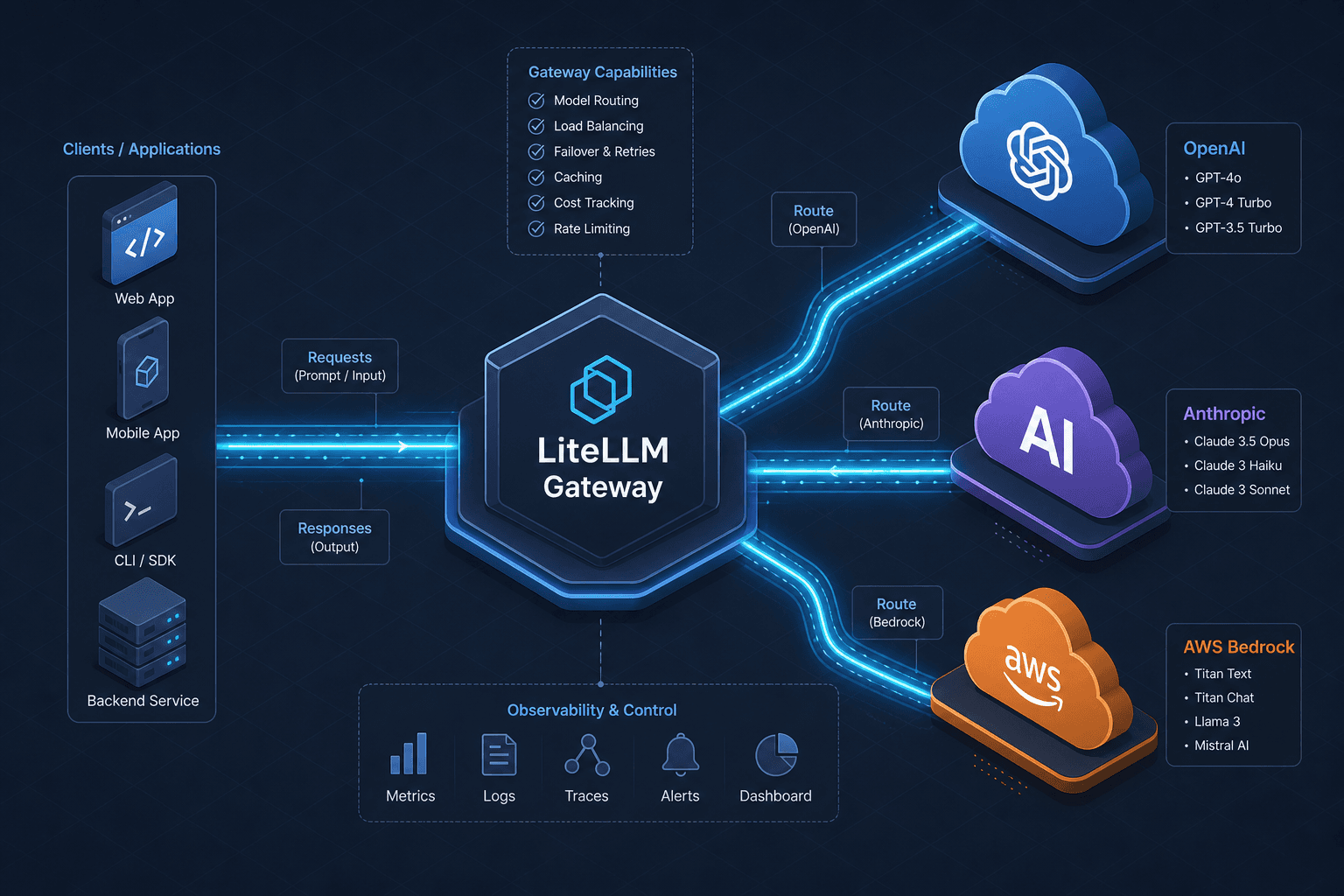
Model Gateways and Multi-Provider Routing
Implement model gateways and multi-provider routing with LiteLLM for resilient LLM applications.
Part 6 of the LLMOps in Production series.
In production LLM applications, relying on a single provider creates a critical single point of failure. When OpenAI experiences an outage or Anthropic hits a rate limit, your application stops working. A model gateway acts as an abstraction layer that sits between your application code and multiple LLM providers, providing a unified interface, standardized error handling, and intelligent routing. This article explores how to implement this architecture using LiteLLM to ensure high availability, cost efficiency, and resilience.
The Mechanism of Abstraction
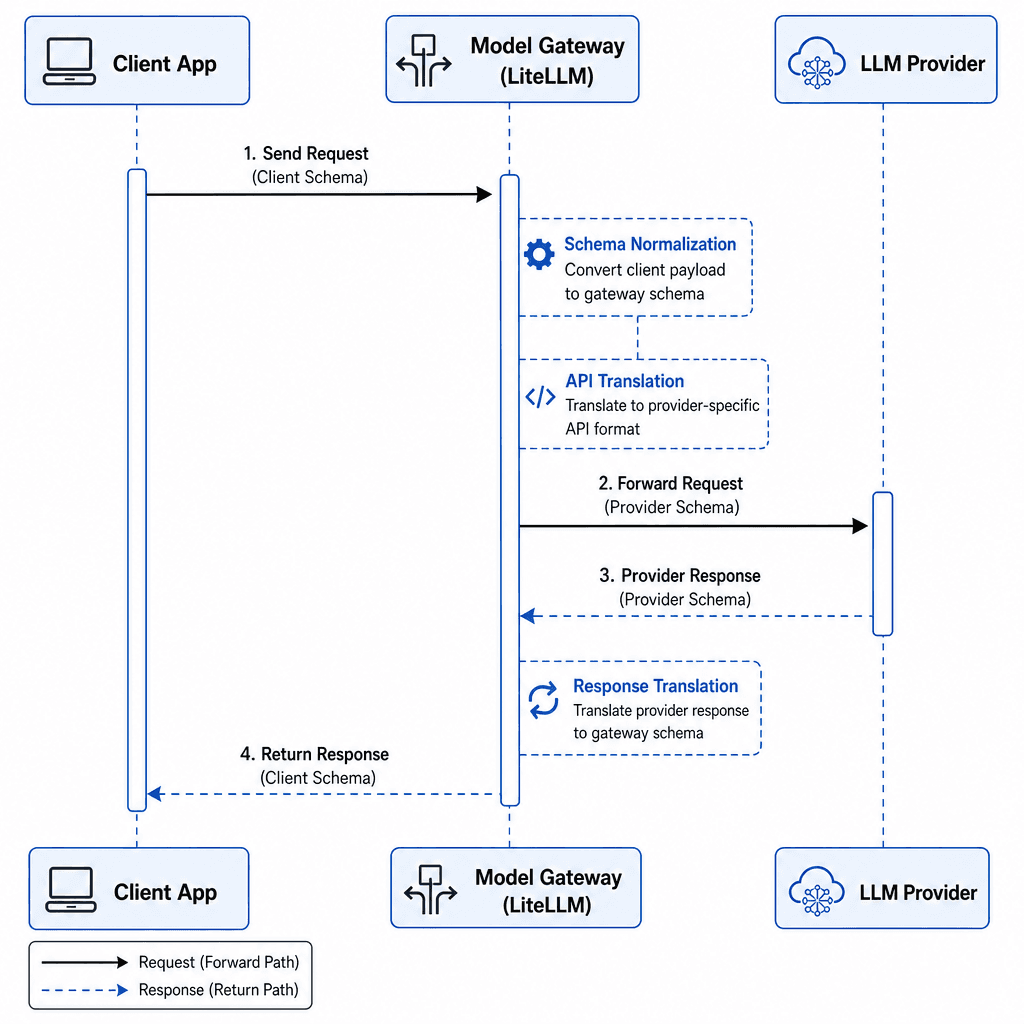
The core mechanism of an llm gateway is schema normalization. Different providers expose different API structures. OpenAI uses messages with role and content fields. Anthropic uses a different structure with system prompts and specific tool-use formats. AWS Bedrock requires JSON payloads with model IDs and region-specific endpoints.
LiteLLM solves this by translating these disparate schemas into a single, OpenAI-compatible format before sending the request to the provider. This means your application code only needs to know one API: the OpenAI chat completion format.
For example, when you call LiteLLM with the model claude-3-sonnet-20240229, LiteLLM internally maps this to Anthropic’s specific API endpoint and transforms the payload into the format Anthropic expects. Conversely, it transforms Anthropic’s response back into the OpenAI format. This abstraction allows you to swap providers without changing your application code.
import litellm

# This call works regardless of whether the model is from OpenAI, Anthropic, or AWS
response = litellm.completion(
    model="claude-3-sonnet-20240229",
    messages=[{"role": "user", "content": "Hello, world!"}]
)
This uniformity is critical for platform engineers because it decouples your business logic from provider-specific quirks. You can test locally with OpenAI and deploy to production with AWS Bedrock without modifying the core inference code.
Routing Strategies: Load Distribution and Cost Optimization
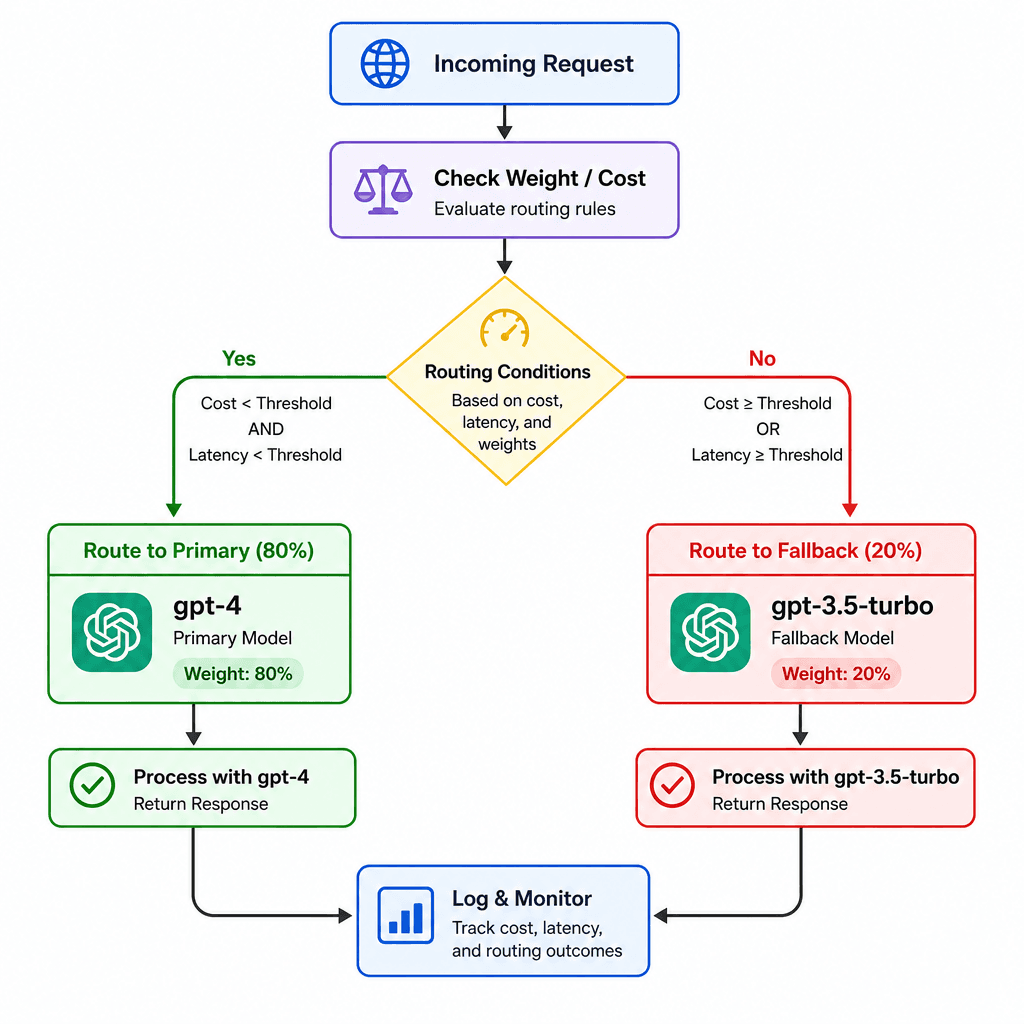
multi provider routing enables you to distribute traffic across different models or providers based on predefined strategies. This is not just about failover; it’s about optimizing for cost, latency, and capacity.
One common strategy is weighted routing. You can define a configuration where 80% of requests go to a cheaper, faster model (e.g., gpt-3.5-turbo) and 20% go to a more capable but expensive model (e.g., gpt-4o). This allows you to balance cost and quality.
Another strategy is provider-specific fallback. You can configure your gateway to prefer one provider for certain tasks while using another as a backup. For instance, you might route image generation tasks to Stability AI and text completion to OpenAI, with a fallback to Azure OpenAI if the primary provider is unavailable.
LiteLLM’s Proxy server supports these routing configurations via a config.yaml file. You can define multiple models with different weights and fallback priorities.
model_list:
  - model_name: gpt-4
    litellm_params:
      model: openai/gpt-4
      api_key: os.environ/OPENAI_API_KEY
  - model_name: gpt-4
    litellm_params:
      model: azure/gpt-4
      api_base: https://your-resource.openai.azure.com/
      api_version: "2023-05-15"
      api_key: os.environ/AZURE_API_KEY
In this configuration, LiteLLM can be configured to try the first model in the list and fall back to the second if the first fails. This is essential for ensuring continuous availability.
Failover and Resilience Mechanisms
High availability in LLM systems depends on robust failover mechanisms. An llm failover strategy handles this by intercepting errors and automatically retrying requests with alternative providers or models.
Consider a scenario where your primary provider, OpenAI, experiences a 500 Internal Server Error. Without a gateway, your application would crash or return an error to the user. With LiteLLM’s Proxy, you can configure automatic retries and fallbacks.
LiteLLM supports several types of fallbacks:
- Model Fallback: If
gpt-4fails, trygpt-3.5-turbo. - Provider Fallback: If
openai/gpt-4fails, tryazure/gpt-4. - Time-based Fallback: Wait for a certain period before retrying.
You can define these fallbacks in the litellm configuration. For example, you can specify a list of fallback models. If the primary model fails, LiteLLM automatically attempts the next model in the list.
import litellm

response = litellm.completion(
    model="gpt-4",
    messages=[{"role": "user", "content": "Hello"}],
    fallbacks=["gpt-3.5-turbo", "claude-3-sonnet"]
)
In this example, if gpt-4 fails, LiteLLM will automatically try gpt-3.5-turbo. If that also fails, it will try claude-3-sonnet. This ensures that your application remains responsive even when individual providers experience issues.
Additionally, you can configure timeout and retry policies. If a request takes too long, the gateway can terminate it and try an alternative provider. This is crucial for maintaining low latency and preventing cascading failures in your application.
Observability and Cost Control
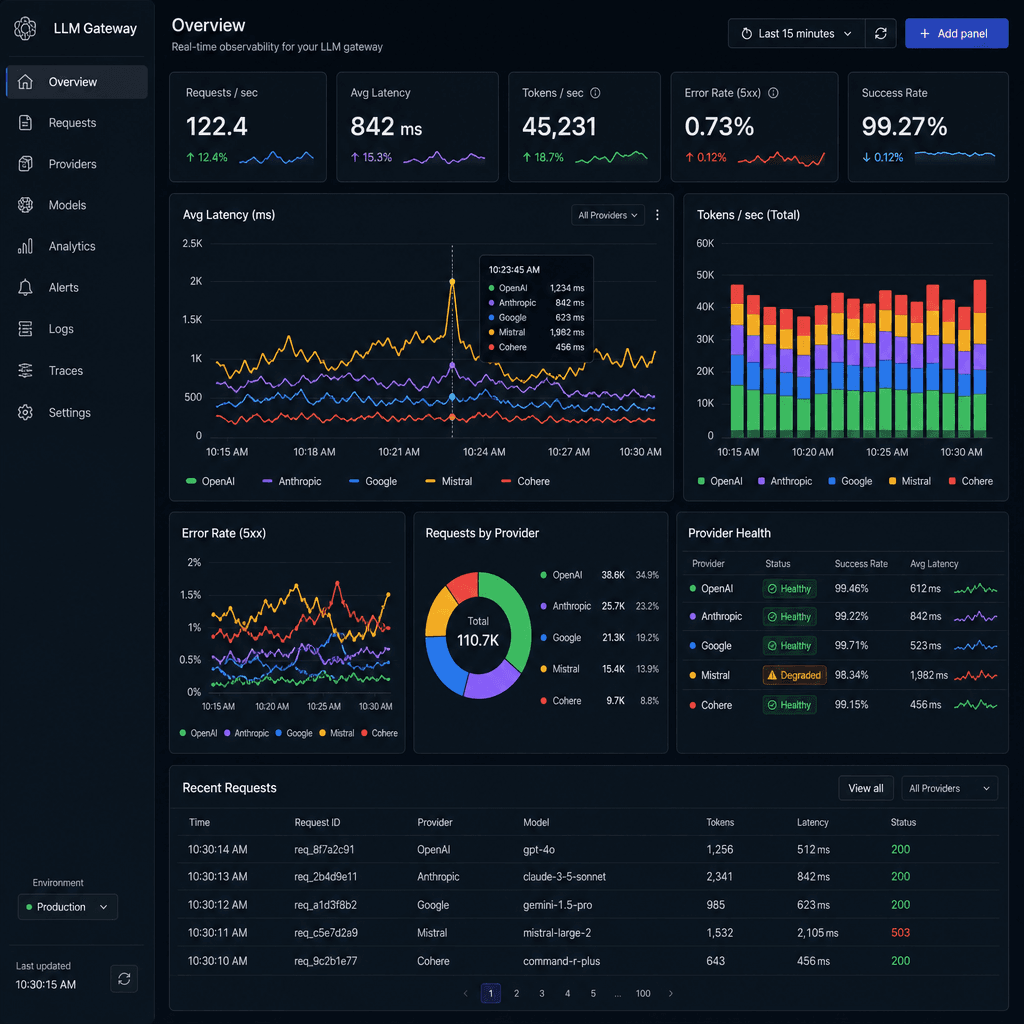
Multi-provider routing introduces complexity in tracking costs and performance. A model gateway provides centralized observability, allowing you to monitor token usage, latency, and error rates across all providers.
LiteLLM’s Proxy server logs every request, including the provider, model, token usage, and latency. This data can be exported to monitoring systems like Prometheus, Grafana, or Datadog for real-time insights.
To effectively manage this, you should configure dashboards that track specific metrics such as:
- Token Usage by Provider: Breakdown of input/output tokens per provider to identify cost drivers.
- Latency Percentiles (P50, P95, P99): To detect slow providers or degraded performance.
- Error Rates by Status Code: To quickly identify if a specific provider is returning 4xx or 5xx errors.
- Cost per Request: Aggregated cost based on token counts and provider pricing tiers.
By aggregating this data, you can identify cost anomalies and optimize your routing strategies. For example, if you notice that Azure OpenAI is significantly more expensive than OpenAI for similar tasks, you can adjust your routing weights to reduce costs.
Moreover, observability helps in debugging. If a specific provider starts returning errors, you can quickly identify the issue and take corrective action. This visibility is essential for maintaining reliability in production environments.
Conclusion
Model gateways like LiteLLM are essential for building resilient, scalable, and cost-effective LLM applications. By abstracting provider-specific APIs, enabling multi-provider routing, and providing robust failover mechanisms, they solve the critical challenges of vendor lock-in and availability fragility. Platform engineers should adopt this architecture to ensure their LLM applications remain reliable and performant in the face of provider outages and rate limits.
Related posts
Multi-Provider Failover with LiteLLM
Implement resilient AI routing using LiteLLM to handle multi-provider failover and fallback strategies for backend systems.
Getting Reliable JSON Out of Any Model
A technical examination of constrained decoding, outlines, and schema validation techniques to ensure reliable JSON output from language models.
Rate Limits, Retries, and Graceful Degradation
A practical guide to implementing rate limiting, exponential backoff, and graceful degradation in LLMOps to handle 429 errors and ensure system stability.
