Multi-Provider Failover with LiteLLM
Implement resilient AI routing using LiteLLM to handle multi-provider failover and fallback strategies for backend systems.
In production backend systems, relying on a single Large Language Model (LLM) provider is a single point of failure. When OpenAI, Anthropic, or Azure experience an outage, or when rate limits are hit, your application stops serving users. Direct integration with a single provider’s SDK embeds fragility into your codebase. To build backend resilience ai, you must decouple your application logic from specific provider implementations.
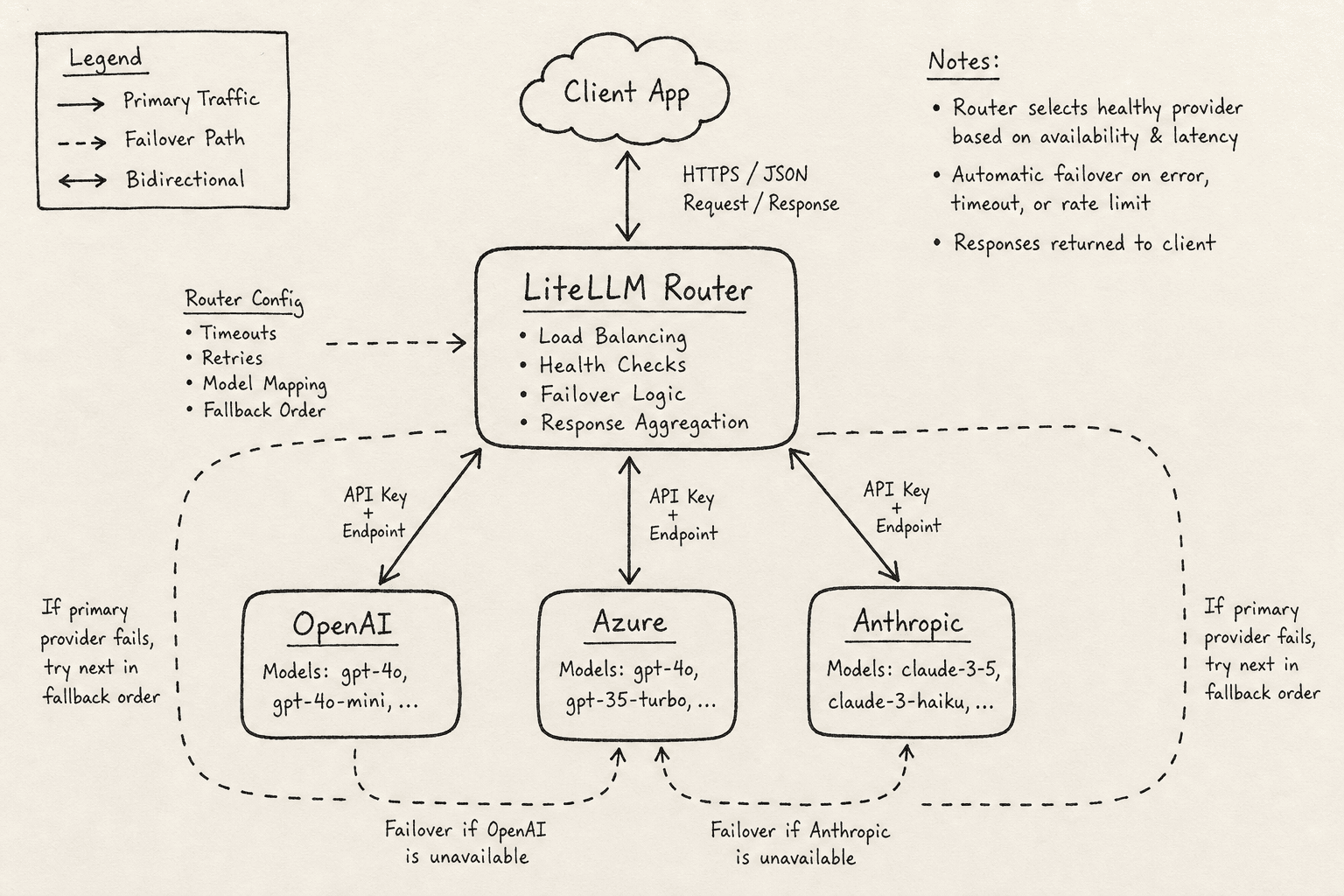
LiteLLM’s Router solves this by acting as a reverse proxy that abstracts multiple providers into a unified interface. It does not just cache responses; it actively manages traffic distribution and failure recovery. The core mechanism is a configurable routing table that maps model names to provider endpoints, allowing the system to route requests dynamically based on health, load, and priority.
The Router as a Dependency Graph
The Router treats each provider (e.g., openai, azure, anthropic) as a node in a graph. Your backend application sends a standard OpenAI-compatible request to the Router. The Router then consults its configuration to determine which node should handle the request. This abstraction means your backend code never needs to know if the request is ultimately handled by an Azure instance or an Anthropic Claude model.
This separation is critical for failover. If the primary node becomes unreachable, the Router intercepts the failure and redirects the request to a secondary node. The application sees only a successful response or a generic error, never the internal plumbing of the failover.
Weighted Round-Robin Distribution
Before failover even becomes necessary, the Router manages load distribution using weighted round-robin. This mechanism ensures that you can utilize capacity across multiple providers simultaneously, preventing any single provider from becoming a bottleneck.
Consider a scenario where you have budget for both OpenAI GPT-4o and Azure GPT-4. You configure the Router with weights: 70% for OpenAI and 30% for Azure. For every 10 requests, the Router sends 7 to OpenAI and 3 to Azure. This is not strictly deterministic; the Router uses weighted random selection, so over many requests the traffic approximates a 7:3 split between OpenAI and Azure, though any single set of 10 requests may vary from that exact ratio. This setup provides ai provider redundancy, ensuring that if one provider degrades, the other can absorb the overflow without manual intervention.
model_list:
  - model_name: gpt-4o
    litellm_params:
      model: openai/gpt-4o
      rpm: 1000
      tpm: 100  # tokens per minute

  - model_name: gpt-4o-azure
    litellm_params:
      model: azure/gpt-4o
      api_base: https://resource.openai.azure.com/
      api_key: "AZURE_KEY"
      rpm: 500
In this configuration, the Router tracks the request count per minute (rpm) for each model. If OpenAI hits its rate limit, the Router’s internal counter flags the node as constrained. Subsequent requests in that minute are automatically shifted to the Azure node, provided it has remaining capacity. This is load-based failover, distinct from error-based failover.
Automatic Error-Based Failover
Load balancing is proactive; error-based failover is reactive. When a provider returns an error—such as a 429 Too Many Requests, 500 Internal Server Error, or a network timeout—the Router’s failover mechanism triggers.
The Router maintains a list of fallback models for each primary model. When a request to the primary model fails, the Router does not return the error to the client immediately. Instead, it retries the request against the first fallback model in the list. If that also fails, it moves to the next, and so on.
This process happens at the protocol level. The application sends one request; the Router may send three or four underlying requests to different providers before returning a result. This transparency is the key to resilience.
model_list:
  - model_name: gpt-4o
    litellm_params:
      model: openai/gpt-4o
      api_key: "OPENAI_KEY"

  - model_name: gpt-4o-fallback
    litellm_params:
      model: anthropic/claude-3-sonnet-20240229
      api_key: "ANTHROPIC_KEY"
In this setup, gpt-4o is the primary. If the OpenAI API is down, the Router automatically routes the request to anthropic/claude-3-sonnet-20240229. Note that the model_name in the primary and fallback can differ, allowing you to switch model families entirely during a failover event.
Configuration Strategy and Tradeoffs
Implementing multi-provider failover requires careful configuration of timeouts and retry logic. The Router uses exponential backoff for retries. If a provider is slow to respond, the Router waits longer between attempts, preventing a thundering herd problem where rapid retries overwhelm the failing provider.
You must define the num_retries parameter in the litellm_params. A value of 3 is typical. It is crucial to distinguish between local retry logic and global routing logic. Local retries apply to re-attempting the request against the same provider target to handle transient network glitches. Global failovers apply to switching to a different provider when the primary target is consistently unreachable or erroring. The Router will attempt the request up to three times on the same provider (local retry) before moving to the next fallback in the list (global failover).
model_list:
  - model_name: gpt-4o
    litellm_params:
      model: openai/gpt-4o
      api_key: "OPENAI_KEY"
      num_retries: 3
      request_timeout: 60
The tradeoff here is latency versus availability. Adding more fallbacks increases the chance of a successful response but also increases the time taken to resolve a failure. If the primary provider is slow but not down, the Router might still wait for the timeout before trying the fallback, adding latency. To mitigate this, you can set aggressive timeouts for primary providers and longer timeouts for fallbacks, or use the retry_after header from the provider to inform the Router’s backoff strategy.
Another consideration is cost. Fallbacks are often cheaper or more expensive models. If you fail over from GPT-4 to Claude Sonnet, your cost structure changes. The Router does not enforce cost limits; it only enforces routing rules. You must monitor usage across all providers to prevent unexpected bill spikes.
Operationalizing Resilience
To operationalize this, you deploy the Router as a separate service or sidecar in your infrastructure. It exposes a single OpenAI-compatible endpoint. Your backend applications point to this endpoint instead of directly to api.openai.com.
Monitoring is essential. The Router provides metrics on request counts, errors, and latency per provider. You should alert on high error rates from specific providers, indicating that the failover mechanism is actively working. If you see consistent failovers, it suggests a persistent issue with your primary provider, requiring architectural review.
By configuring LiteLLM’s Router, you transform your AI infrastructure from a fragile chain into a resilient mesh. The Router handles the complexity of provider heterogeneity, rate limiting, and error recovery, allowing your backend to focus on business logic rather than API connectivity issues. This approach ensures that your application remains available even when individual components fail, delivering a consistent experience to your users. This is the essence of litellm high availability.
Common Pitfalls
When implementing multi-provider failover, several common pitfalls can undermine your resilience efforts:
- Ignoring Cost Implications: Fallbacks are often different models with different pricing structures. Failing over from a premium model to a cheaper one might save money, but failing over from a cheap model to a premium one can cause bill shocks. Always track costs per provider.
- Not Monitoring Error Rates: If you don't monitor error rates, you won't know if your failover mechanism is actually being triggered. Silent failures in the routing layer mean your primary provider might be degraded while you assume everything is fine.
- Assuming Failover is Instant: Failover is not instantaneous. It involves detecting an error, waiting for a timeout or retry limit, and then attempting a new request. This adds latency to the user's experience. Design your UI to handle increased latency gracefully.
Practical Takeaways
To ensure your AI infrastructure remains robust, keep these mental models in mind:
- Decouple Logic from Providers: Your business logic should never depend on a specific provider's SDK or error codes. Use the Router as an abstraction layer.
- Monitor Failover Frequency: High failover rates indicate a problem with your primary provider or your configuration. Treat this as a signal to investigate, not just a background noise.
- Test Fallbacks in Staging: Before going live, simulate failures in your staging environment. Verify that the Router correctly routes requests to fallback models and that the responses are acceptable.
FAQ
How does LiteLLM handle rate limits?
LiteLLM tracks request counts per minute (rpm) and tokens per minute (tpm) for each model. If a provider hits its rate limit, the Router flags the node as constrained and automatically shifts traffic to other configured providers with available capacity.
Can I mix model families in failover?
Yes. The Router allows you to define different model_names for primary and fallback models. You can fail over from an OpenAI GPT model to an Anthropic Claude model, or from one version of a model to another, as long as the Router is configured with the necessary credentials and endpoints.
What metrics should I monitor? Key metrics include request count, error rate, latency, and cost per provider. Specifically, watch for spikes in error rates on the primary provider, which indicate active failover, and monitor latency to ensure fallbacks are not introducing unacceptable delays.
Conclusion
LiteLLM’s Router transforms static API calls into a dynamic, fault-tolerant routing layer by treating providers as interchangeable nodes in a dependency graph. By leveraging weighted round-robin and exponential backoff mechanisms, you ensure availability even when specific providers fail. Decoupling your application from specific provider implementations is not just an optimization; it is a requirement for resilient modern backend systems.
Next Steps
To solidify your understanding, audit your current rotation policy and identify any single points of failure. Try the linked snippet locally to simulate a provider outage and observe how LiteLLM handles the transition.
Related posts
Model Gateways and Multi-Provider Routing
Implement model gateways and multi-provider routing with LiteLLM for resilient LLM applications.
Estimating LLM Costs Before You Build
A practical guide for engineering managers and architects on estimating LLM costs using unit economics, token forecasting, and sensitivity analysis to build within budget.
Prompt Caching Across Providers: A Practical Comparison
A practical comparison of prompt caching mechanisms across major AI providers, focusing on cache TTL, cost savings, and prefix matching strategies for backend developers.
