Token Budgets, Quotas & Chargeback | LLMOps
Implement token budgets, quotas, and chargeback mechanisms to manage LLM costs and ensure financial accountability in production environments.
Token Budgets, Quotas, and Chargeback
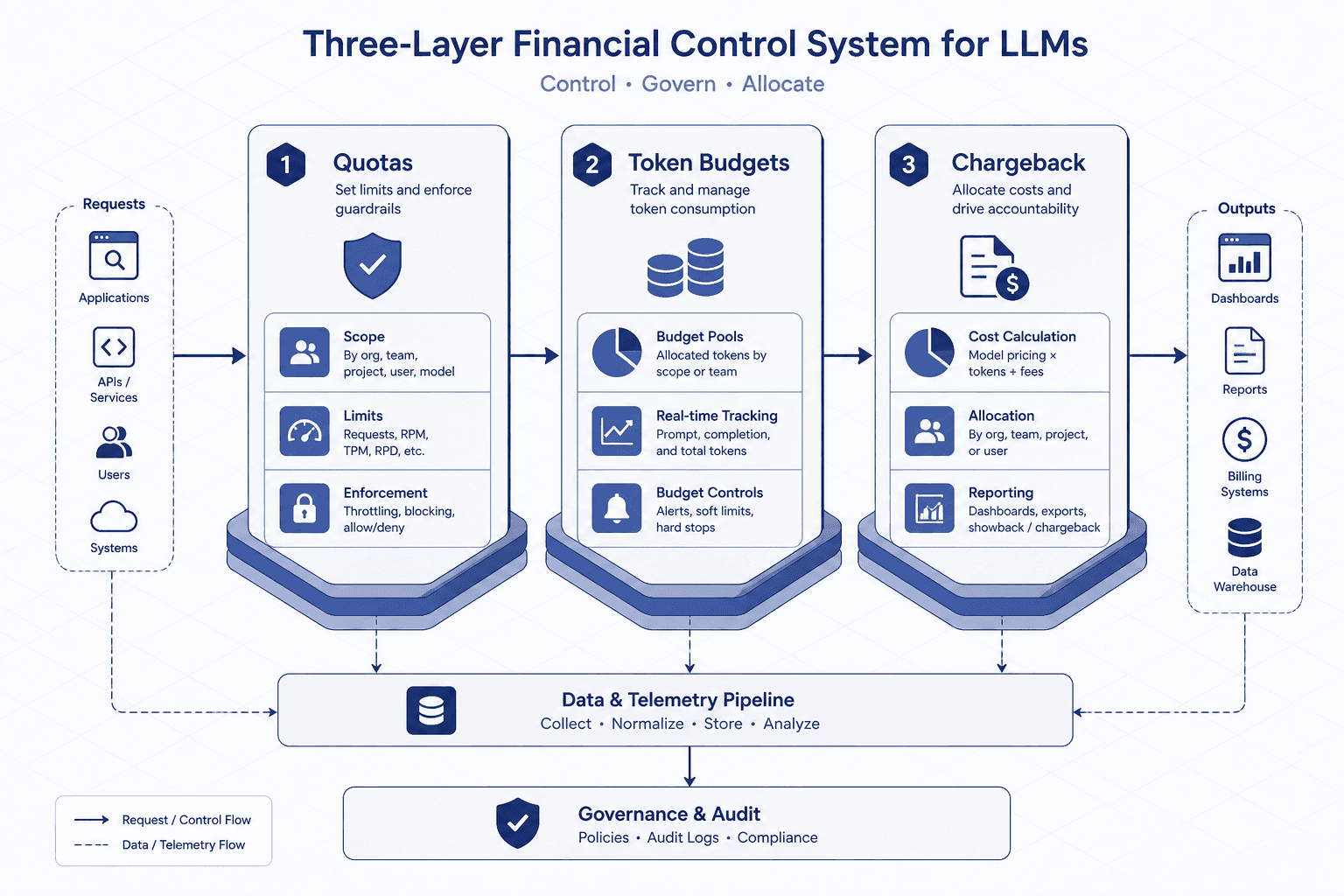
In production LLM systems, the cost curve is not linear; it scales quadratically with context window usage and linearly with concurrency. Unlike traditional API calls where latency is the primary constraint, LLMs introduce a dual constraint: latency and token consumption. Without explicit controls, a single misconfigured prompt or a runaway agent loop can consume an entire month’s budget in seconds. Managing this requires three distinct mechanisms: quotas (hard limits), token budgets (soft limits with graceful degradation), and chargeback (financial attribution).
Quotas: The Hard Guardrails
Quotas are the first line of defense. They are binary: either the request is allowed or it is rejected. Quotas operate at the infrastructure layer, typically via an API gateway or a custom middleware wrapper around your LLM client. As noted in Cloudflare’s rate-limiting documentation and AWS API Gateway best practices, effective quota management requires careful handling of burst limits and error responses to ensure system stability.
There are two primary types of quotas:
- Rate Limits: Requests per second (RPS) or requests per minute (RPM). These prevent system overload and protect against accidental infinite loops.
- Volume Caps: Total tokens or total dollars per user, project, or organization within a fixed time window (e.g., daily or monthly).
Common Pitfalls
When implementing quotas, engineering teams often encounter several recurring issues that undermine cost control:
- Ignoring Burst Limits: Focusing only on average RPS while ignoring burst capacity can lead to sudden spikes in cost that exceed daily caps before the system can react.
- Poor Error Handling: Client code that does not gracefully handle
429 Too Many Requestsor quota exhaustion errors can lead to retry storms, exacerbating the problem. - Lack of Trend Monitoring: Failing to monitor quota utilization trends means teams miss early warnings of budget creep, leading to reactive rather than proactive management.
Mechanism: Implementation via Middleware
Implementing quotas requires intercepting the request before it leaves your application and checking the current state against a counter.
import time
from collections import defaultdict

class QuotaManager:
    def __init__(self):
        # Key: user_id, Value: { 'tokens_used': 0, 'last_reset': timestamp }
        self.usage = defaultdict(lambda: {'tokens_used': 0, 'last_reset': time.time()})
        self.daily_limit = 100000  # Tokens per day

    def check_quota(self, user_id, estimated_tokens):
        now = time.time()
        user_data = self.usage[user_id]

        # Reset counter if day has passed
        if now - user_data['last_reset'] > 86400:
            user_data['tokens_used'] = 0
            user_data['last_reset'] = now

        if user_data['tokens_used'] + estimated_tokens > self.daily_limit:
            raise Exception("Quota exceeded")

        return True

    def record_usage(self, user_id, actual_tokens):
        self.usage[user_id]['tokens_used'] += actual_tokens
Quotas are essential for preventing financial shock. However, they are blunt instruments. A strict quota might block a valid but expensive request (e.g., summarizing a large document) while allowing many cheap, low-value requests. This is where token budgets come in.
Token Budgets: Graceful Degradation
A token budget is a soft limit. It does not immediately reject the request. Instead, it monitors consumption in real-time and triggers mitigation strategies when thresholds are breached. The goal is to preserve the user experience while containing costs.
Mechanism: Real-Time Context Tracking
LLM providers charge based on input tokens (prompt + history) and output tokens (completion). The context window is finite. If you exceed it, the request fails. A token budget system must track the cumulative size of the conversation history and the estimated size of the new prompt.
When a budget threshold is reached (e.g., 80% of the daily budget), the system can:
- Throttle: Increase latency or reduce priority.
- Truncate: Automatically shorten the conversation history by removing older messages.
- Summarize: Replace the old history with a concise summary generated by a smaller, cheaper model.
- Warn: Return a warning header to the frontend, allowing the UI to display a "High Usage" banner.
Example: Summarization Trigger
def generate_response(user_id, prompt, history):
    budget_check = quota_manager.check_budget(user_id)

    if budget_check.is_critical:
        # Trigger summarization of history
        history = summarize_history(history)
        prompt = f"Here is a summary of previous context: {history}\n\nUser: {prompt}"

    response = llm_client.chat(prompt=prompt, history=history)
    quota_manager.record_usage(user_id, response.token_count)
    return response
Token budgets require accurate token estimation. Most LLM clients provide a method to estimate token count before sending the request. If the estimation is off, the budget may be slightly under- or over-applied. This is acceptable because budgets are designed for control, not precision. Precision belongs to chargeback.
Chargeback: Financial Attribution
Quotas and budgets control usage. Chargeback explains why the usage happened. Chargeback is the process of attributing LLM costs to specific business units, projects, or users. This is critical for FinOps: identifying waste and optimizing ROI.
Practical Takeaways
To effectively implement chargeback, consider these mental models and rules:
- Quotas are binary, budgets are fluid: Use quotas to stop bleeding and budgets to steer the ship.
- Chargeback drives accountability, not just accounting: The goal is to change developer behavior, not just to produce a spreadsheet.
- Estimation errors require reconciliation windows: Accept that initial estimates will be imperfect; build processes to reconcile actuals against estimates periodically.
Mechanism: Unit-of-Work Abstraction
To implement chargeback, you must define a "unit of work." This is a logical grouping of LLM calls that corresponds to a business value. Examples include:
- A single customer support ticket resolution.
- A batch processing job for data enrichment.
- A specific feature flag in the application (e.g., "AI Assistant V2").
Each unit of work must carry metadata that includes:
- Cost Center: The department or team responsible.
- Project ID: The specific product or feature.
- User ID: The end-user (if applicable).
Implementation: Logging and Aggregation
Every LLM call should be logged with its associated metadata. This log is then aggregated into a cost report.
def log_llm_call(cost_center, project_id, user_id, input_tokens, output_tokens, model):
    # Map model to price per token
    price_input = MODEL_PRICES[model]['input']
    price_output = MODEL_PRICES[model]['output']

    total_cost = (input_tokens * price_input) + (output_tokens * price_output)

    # Store in cost database
    cost_db.insert({
        'cost_center': cost_center,
        'project_id': project_id,
        'user_id': user_id,
        'total_cost': total_cost,
        'timestamp': time.time()
    })
Challenge: Estimation Errors
LLM providers often charge based on actual tokens used, which may differ from the estimated tokens sent. Chargeback systems must reconcile these differences. A common approach is to use a "reconciliation window." For example, if the estimated cost was $0.05 but the actual cost was $0.06, the chargeback report reflects the actual cost. Over time, estimation errors average out, but for high-volume systems, even small discrepancies can accumulate.
Attribution Strategy
- Direct Attribution: Assign costs directly to the user or project that initiated the call.
- Shared Attribution: For shared resources (e.g., a common summarization service), split costs across all consumers based on usage.
- Overhead Allocation: Allocate infrastructure costs (API gateway, logging) as a percentage of total LLM spend.
Conclusion
Token budgets, quotas, and chargeback form a complete cost management strategy. Quotas prevent catastrophic overspending. Token budgets optimize usage by enabling graceful degradation. Chargeback provides the visibility needed to make informed decisions about model selection, prompt engineering, and resource allocation. Without this triad, LLM operations remain a black box of unpredictable costs. Implementing these mechanisms transforms LLM spend from a liability into a measurable, manageable asset.
FAQ
What happens when a quota is exceeded?
When a quota is exceeded, the system typically returns a 429 Too Many Requests or a custom error code indicating that the limit has been reached. The request is rejected immediately, and no tokens are consumed for that specific call.
How do token budgets differ from rate limits? Rate limits constrain the speed of requests (e.g., requests per second) to protect infrastructure. Token budgets constrain the volume or cost of usage over time (e.g., tokens per day) to protect the budget. A system can have both.
Can chargeback be automated in real-time? Yes, chargeback can be automated in real-time by logging metadata with every API call and aggregating it into a cost database. However, full financial reconciliation with provider invoices often happens asynchronously due to billing cycles and estimation variances.
Related posts
Incident Response for AI Systems
A practical guide to managing incidents in AI systems, covering runbooks, quality degradation alerts, and postmortem processes for SREs and engineering managers.
Model Gateways and Multi-Provider Routing
Implement model gateways and multi-provider routing with LiteLLM for resilient LLM applications.
Rate Limits, Retries, and Graceful Degradation
A practical guide to implementing rate limiting, exponential backoff, and graceful degradation in LLMOps to handle 429 errors and ensure system stability.
