
Context Engineering Is the New Prompt Engineering
Explore how context engineering optimizes token budgets and context windows, evolving beyond basic prompt engineering for better LLM outcomes.
Part 1 of the Context Engineering series.
For the past two years, the industry has obsessed over prompt engineering—the art of crafting precise instructions to guide Large Language Models (LLMs). We treated prompts as magic incantations: if we just added enough system instructions, examples, and formatting cues, the model would comply. This approach worked for simple queries but collapsed under complexity. As applications moved from chatbots to autonomous agents processing thousands of documents, the bottleneck shifted from instruction clarity to context capacity.
Context engineering is the discipline of structuring, filtering, and optimizing the data fed into the context window. It treats the context window not as an infinite black box, but as a finite, noisy resource where every token competes for attention. If prompt engineering is about writing the script, context engineering is about directing the stage.
The Illusion of Infinite Memory
Developers often mistake the context window for a database. They assume that if they paste 50,000 words into the prompt, the model will "read" them all. It does not. The context window is a constrained input buffer that feeds directly into the model’s attention mechanism.
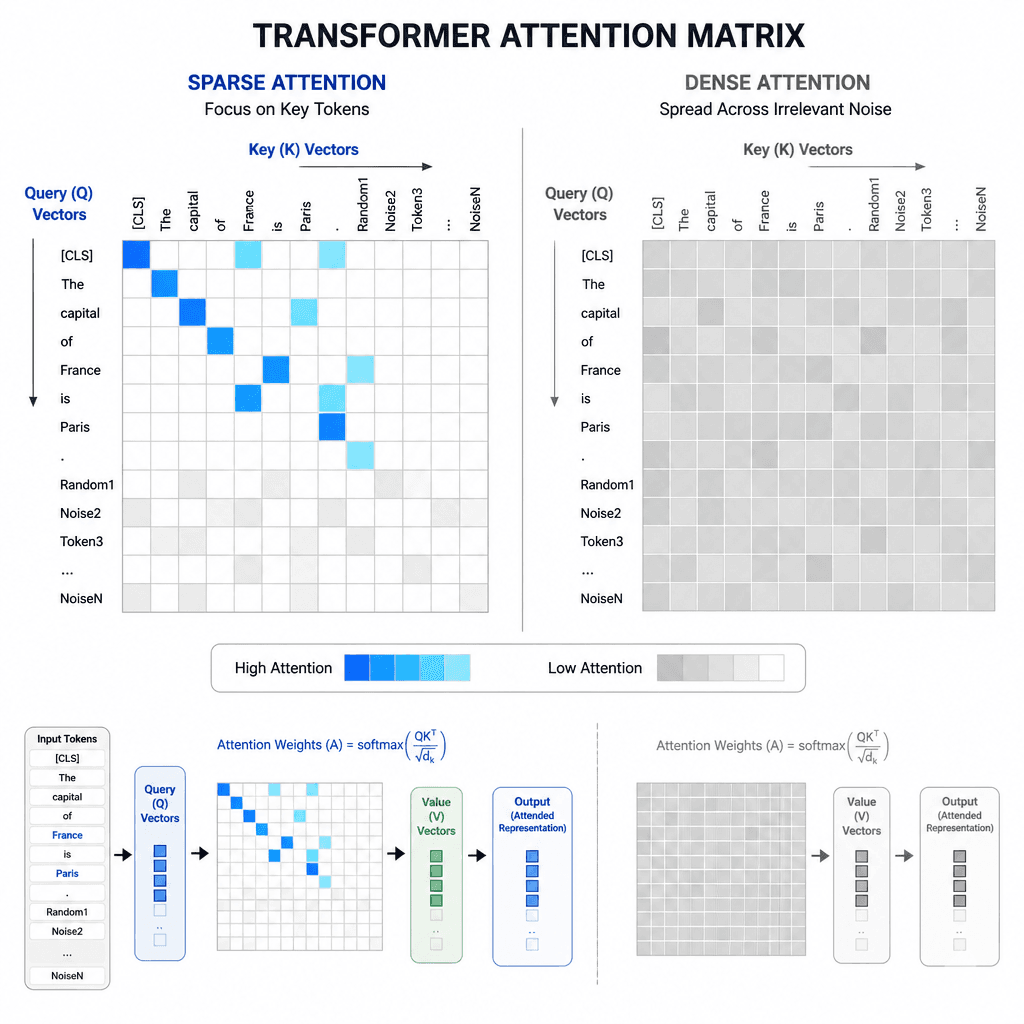
The core mechanism at play is self-attention. In a Transformer architecture, every token in the input sequence calculates an attention score against every other token. This creates a dense graph of relationships. When the context window is flooded with irrelevant text, the attention scores for key information dilute. The model spends its "computational budget" attending to noise rather than signal.
This leads to the "Lost in the Middle" phenomenon, empirically demonstrated by Liu et al. In their study, models were given long documents with key facts placed either at the beginning, the end, or the middle. Accuracy dropped significantly for facts placed in the middle, even when the total context was well within the window limit. The model’s attention head distribution becomes skewed by structural limitations of positional encodings and attention mechanisms, often manifesting as 'recency' or 'primacy' effects, rather than a learned 'bias'.
Prompt engineering cannot fix this. No amount of polite instruction ("Please read the middle carefully") overrides the architectural limitation of attention distribution. Context engineering solves this by manipulating the structure of the input to align with the model’s attention biases.
Structuring for Attention
Context engineering applies specific architectural patterns to maximize signal-to-noise ratio. The goal is to ensure that the most critical tokens receive the highest attention weights. These techniques are essential for modern ai development workflows, ensuring systems remain performant as complexity grows.
1. Semantic Chunking and Re-ranking
Naive context injection involves splitting a document into equal-sized chunks and appending them. This is inefficient. A chunk containing metadata might be irrelevant to a query about code logic, yet it consumes tokens and attention capacity.
Effective context engineering uses semantic chunking. Instead of fixed word counts, chunks are created based on topic boundaries. More importantly, these chunks are embedded and scored for relevance to the user’s query before being added to the context window.
# Naive approach: Append all chunks
context = "\n".join([chunk.text for chunk in chunks])

# Context Engineering approach: Retrieve top-k relevant chunks
query_embedding = embed(query)
relevant_chunks = vector_store.search(query_embedding, k=3)
context = "\n".join([c.text for c in relevant_chunks])
By retrieving only the top three relevant chunks, you reduce the context window size by 60–80%, drastically reducing latency and cost while increasing accuracy. The model attends only to what matters.
2. Positional Optimization
Knowing that models favor the beginning and end of the context, context engineers strategically place information. Critical system instructions and the user’s primary question go first. Supporting evidence goes in the middle. The final answer or summary prompt goes last.
This is not a suggestion; it is a requirement for reliable performance in long-context scenarios. This approach is critical for scalable ai development. If you must include a large reference document, summarize it at the top, provide the full text in the middle (if necessary), and reiterate the key constraint at the bottom.
The Token Budget Trade-off
Every token in the context window has a dual cost: monetary (API pricing) and computational (inference latency). Context engineering is fundamentally an exercise in budget management. This strategy exemplifies llm optimization by balancing resource usage against output quality.
Consider an agent that needs to analyze 100 PDFs. A prompt-engineering mindset might involve creating a mega-prompt that includes all text. This would exceed token limits or result in catastrophic hallucination due to attention dilution.
A context-engineering approach breaks this down:
- Indexing: Embed all PDFs.
- Filtering: For each user query, retrieve only the top 5 relevant pages.
- Compression: If the retrieved pages are still too long, use a secondary LLM call to summarize them into bullet points.
- Injection: Feed the summarized bullets into the final context window.
This pipeline reduces the input size from ~50,000 tokens to ~500 tokens. The cost drops by 99%, latency decreases, and accuracy improves because the model is no longer distracted by irrelevant paragraphs. This is a core technique for 'llm optimization', ensuring that every dollar spent on API calls yields maximum informational value.
Beyond RAG: Prompt Compression
Context engineering also includes prompt compression. Instead of sending raw text, some systems use a lightweight model to compress the conversation history into a concise summary. This summary acts as a "memory" that preserves key facts without retaining the full token footprint.
This is distinct from simple summarization. It is a structural optimization that preserves the state of the conversation while shedding the noise. Tools like LangChain’s ConversationSummaryMemory implement this by iteratively updating a summary string as the conversation grows, ensuring the context window never exceeds a fixed size. This is a common pattern in ai development, reflecting broader trends toward efficient state management in conversational AI.
Conclusion
Prompt engineering is a tactical skill; context engineering is a strategic architecture. As LLMs become more integrated into complex workflows, the ability to manage context windows efficiently will separate production-ready systems from experimental prototypes.
The future of LLM development is not about writing better prompts. It is about building systems that understand the physics of attention, the economics of tokens, and the geometry of information retrieval. Effective llm optimization requires moving beyond simple prompts to holistic system design. If you want your models to perform reliably at scale, stop asking them to remember everything. Start engineering their context.
Related posts
Cost Control for Agent Loops: Budgets & Kill Switches
Implement token budgets, depth limits, and kill switches to control agent loop costs and prevent runaway spending.
Structured Context: XML Tags, and Delimiters
Explore how structured prompts, XML tags, and delimiters improve JSON context formatting for developers.
The Lost-in-the-Middle Problem and How to Route Around It
An examination of the lost-in-the-middle phenomenon in large language models and practical strategies for routing and reordering context to improve retrieval accuracy.
