Building a PII Redaction Layer for LLM Logs
Implement a PII redaction layer for LLM logs to ensure GDPR compliance and protect sensitive data during tokenization and retention.
When you log an API request to an LLM, you are not just storing text; you are storing the entire context window of a model that has been trained on vast amounts of human data. For backend developers and privacy engineers, this creates a critical vulnerability: LLM logs are effectively plaintext databases of sensitive user information. If these logs are accessed by an attacker, or if they leak into third-party observability platforms, the PII (Personally Identifiable Information) contained within them is exposed.
Standard log sanitization techniques—such as replacing credit card numbers with XXXX-XXXX-XXXX-XXXX—are insufficient. This is obfuscation, not redaction. An LLM can often reverse obfuscation through pattern recognition or adversarial prompting (e.g., "Decode the masked credit card"). True security requires removing the sensitive data from the processing pipeline entirely or rendering it cryptographically unrecognizable without the proper key.
The Mechanism of Failure: Context Persistence
To understand the solution, we must first understand the failure mode. When a user submits a prompt containing their name and social security number (SSN), the LLM processes this in its context window. Even if the model does not output the SSN in its response, the SSN exists in the log entry associated with that conversation ID.
Most logging frameworks (like Winston, Log4j, or structured JSON loggers) serialize the entire request and response payload. If you simply filter out the word "SSN" from the log string, you leave the digits behind. If you use a regex to mask it, you leave the semantic meaning intact for the model's training data if fine-tuning occurs later.
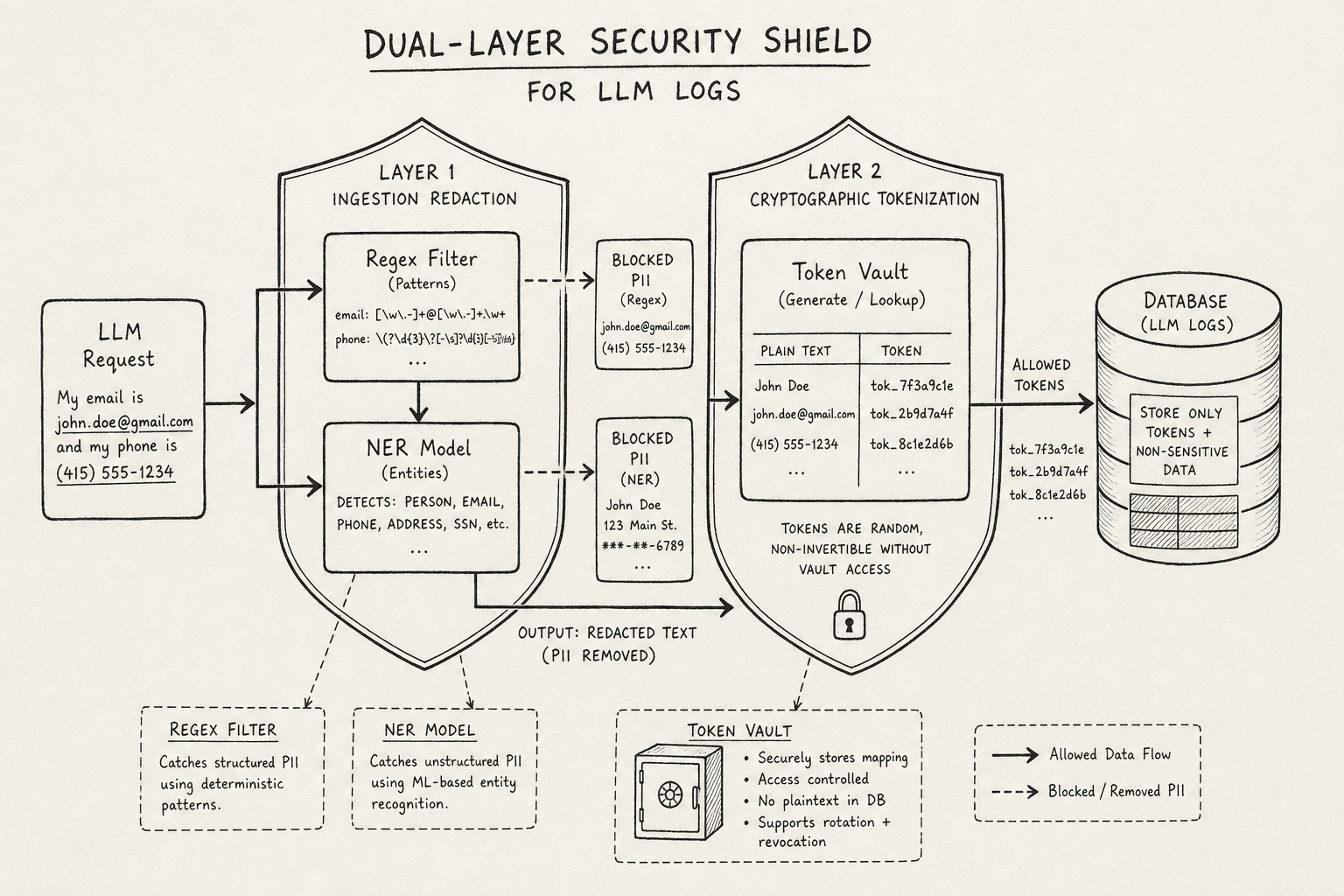
Therefore, the defense must operate at two distinct layers:
- Ingestion-Time Redaction: Immediate removal of PII before it is written to disk or sent to a cloud log aggregator.
- Cryptographic Tokenization: Replacing PII with reversible tokens for debugging, where the mapping is stored in a separate, highly secured vault.
Layer 1: Ingestion-Time Redaction with Regex and NER
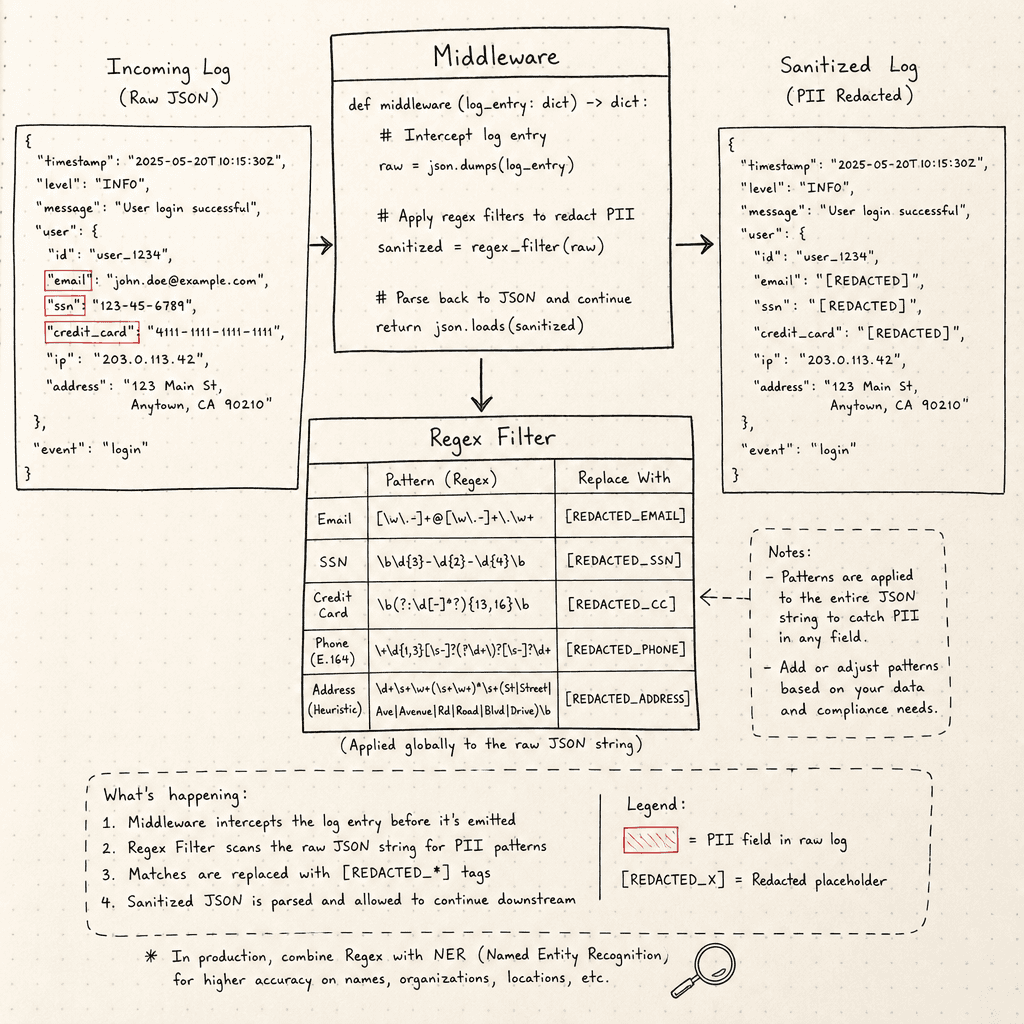
The first line of defense is a middleware component that intercepts log entries before they are persisted. This layer should use a combination of Regular Expressions (Regex) for known formats and Named Entity Recognition (NER) for contextual identification.
Regex is fast and deterministic. It handles structured data like emails, phone numbers, and credit card numbers. However, Regex fails on unstructured data like names or medical conditions. This is where lightweight NER models come in. You do not need a full LLM here; a small NLP model (like spaCy's en_core_web_sm) can identify entities in milliseconds.
From a logging security perspective, intercepting logs at the source ensures that sensitive data never enters the observability pipeline. For privacy engineering teams, this automated interception reduces the manual burden of auditing logs for accidental PII leaks. Best practices for logging security dictate that this redaction happens before any serialization to disk or network transmission, ensuring that even if the logging framework itself is compromised, the data remains protected.
Here is a practical implementation using Python and re for a basic PII scrubber:
import re
import json

# Define PII patterns based on regex standards
PII_PATTERNS = {
    "email": r'\b[A-Za-z0-9._%+-]+@[A-Za-z0-9.-]+\.[A-Z|a-z]{2,}\b',
    "credit_card": r'\b(?:\d[ -]*?){13,16}\b',
    "ssn": r'\b\d{3}-\d{2}-\d{4}\b',
    "phone": r'\b\d{3}[-.]?\d{3}[-.]?\d{4}\b'
}

def redact_pii(text: str) -> str:
    """
    Redacts known PII patterns from a text string.
    Returns the text with PII replaced by [REDACTED].
    """
    if not isinstance(text, str):
        return text

    for pii_type, pattern in PII_PATTERNS.items():
        # Replace matches with a generic placeholder
        text = re.sub(pattern, f"[{pii_type.upper()}]", text)
    return text

def log_llm_request(request_payload: dict, response_payload: dict):
    """
    Middleware function to log LLM interactions securely.
    """
    # Redact both input and output
    safe_input = redact_pii(json.dumps(request_payload))
    safe_output = redact_pii(json.dumps(response_payload))

    # Log only the sanitized strings
    print(f"LLM Call: Input={safe_input[:50]}..., Output={safe_output[:50]}...")
Critical Caveat: Regex alone is not enough for GDPR compliance. If your application handles medical data or proprietary code, you must integrate an NER library. However, be aware that NER models can have false positives. Always test your redaction layer against a dataset of known PII types specific to your domain.
Layer 2: Cryptographic Tokenization for Debugging
Redaction removes data, which is great for security but terrible for debugging. If a user reports that the LLM hallucinated a fact based on their personal history, and you have redacted that history, you cannot reproduce the bug.
This is where Tokenization comes in. Instead of deleting the PII, you replace it with a unique, random string (a token) that has no mathematical relationship to the original data. This approach is a cornerstone of modern llm security architectures, as it allows for deep debugging without exposing raw sensitive data to every engineer with access to the logs.
How Tokenization Works
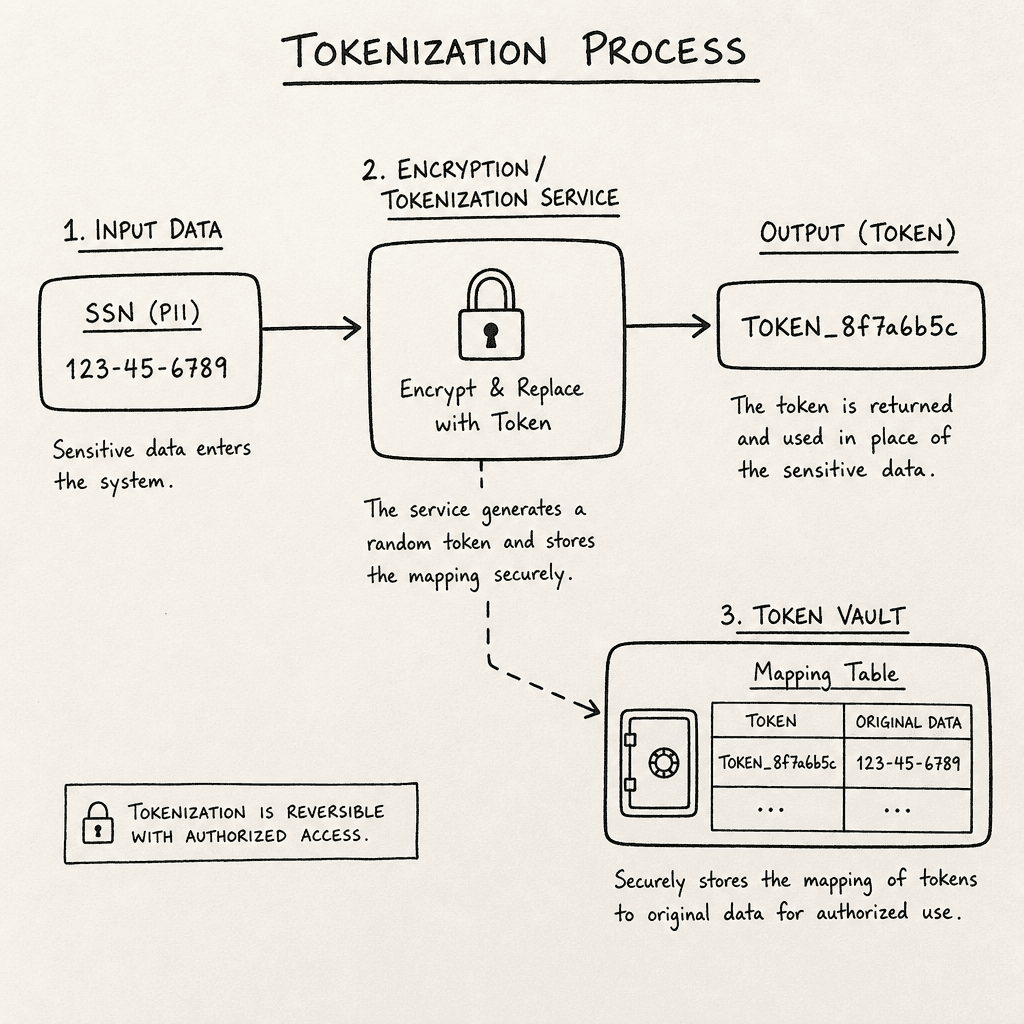
- Input: User provides SSN
123-45-6789. - Encryption: The system encrypts
123-45-6789using a strong symmetric key (e.g., AES-256) in Format-Preserving Encryption (FPE) mode. This ensures the token looks like an SSN (same length, same format) so it doesn't break downstream parsers. - Output: The log contains
987-65-4321. - Storage: The mapping
987-65-4321 -> 123-45-6789is stored in a separate, encrypted database (the "Token Vault").
This approach allows you to:
- Debug: Use a secure admin panel to look up the token and see the original data.
- Comply: Under GDPR, if a user requests deletion, you delete the mapping in the Token Vault. The log entry still contains
987-65-4321, but without the vault, it is meaningless garbage data. This satisfies the "Right to be Forgotten" (GDPR Article 17).
Implementation Considerations
Do not roll your own encryption. Use established libraries like pyca/cryptography or AWS KMS. Ensure the encryption key is never stored in the same environment as the log storage.
from cryptography.fernet import Fernet
import os

# Generate a key for demonstration purposes. In production, load from env/vault.
KEY = Fernet.generate_key()
fernet = Fernet(KEY)

def tokenize_pii(value: str) -> str:
    """
    Encrypts value using Fernet symmetric encryption.
    Returns the encrypted token as a base64 string.
    """
    # Encrypt the value
    encrypted_value = fernet.encrypt(value.encode('utf-8'))
    # Return as string for logging compatibility
    return encrypted_value.decode('utf-8')

def log_with_tokens(request_payload: dict):
    # Replace PII with tokens before logging
    if 'user_ssn' in request_payload:
        request_payload['user_ssn'] = tokenize_pii(request_payload['user_ssn'])
    print(f"LLM Request (Tokenized): {request_payload}")
Retention Policies and Data Minimization
Building the redaction layer is only half the battle. You must also implement strict data retention policies. GDPR Article 5(1)(e) mandates that personal data be kept no longer than necessary. For LLM logs, this means:
- Automated Deletion: Set up lifecycle policies in your log storage (e.g., CloudWatch Logs, Datadog, Elasticsearch) to delete raw logs after a short period (e.g., 30 days) unless they are flagged for investigation.
- Token Expiration: Tokens should have a limited lifespan. If a token is not used for debugging within 90 days, it should be purged from the vault.
- Access Auditing: Every time a developer looks up a token to see the original PII, it must be logged. Who accessed the data? Why? When? This creates an audit trail for privacy audits.
Effective sensitive data protection requires more than just redaction; it demands a holistic view of the data lifecycle. By enforcing strict retention periods, you minimize the window of exposure in case of a breach. Furthermore, different compliance frameworks have varying requirements: HIPAA may require 6 years of retention for certain audit logs, while CCPA aligns closely with GDPR's deletion rights. Integrating these varied requirements into a unified retention strategy is a key aspect of backend security posture, ensuring that legal obligations are met without hoarding unnecessary data.
Conclusion
Protecting PII in LLM logs is not a feature; it is a foundational requirement for any production-grade AI system. By combining ingestion-time redaction (to prevent leakage) with cryptographic tokenization (to enable safe debugging), you create a robust defense that aligns with GDPR and other privacy regulations.
Remember: Obfuscation is not security. If your log data can be reverse-engineered by a human or an automated script, it is still a breach waiting to happen. Implement these layers now, before your first customer asks you to delete their data.
Related posts
Identity Data Security: Encrypting and Tokenizing PII in Identity Stores
An examination of identity data security strategies focusing on encrypting and tokenizing personally identifiable information within identity stores.
PII Detection and Redaction in LLM Pipelines
Implementing effective PII detection and redaction in LLM pipelines using tools like Presidio to ensure data protection and log hygiene.
Log Retention, CloudWatch Logs, and Cost Control
Strategies for managing CloudWatch Logs retention, log classes, and S3 tiering to control AWS logging costs effectively.
