Implementing UserDetailsService Correctly
A guide to implementing Spring Security's UserDetailsService securely, preventing user enumeration via UsernameNotFoundException.
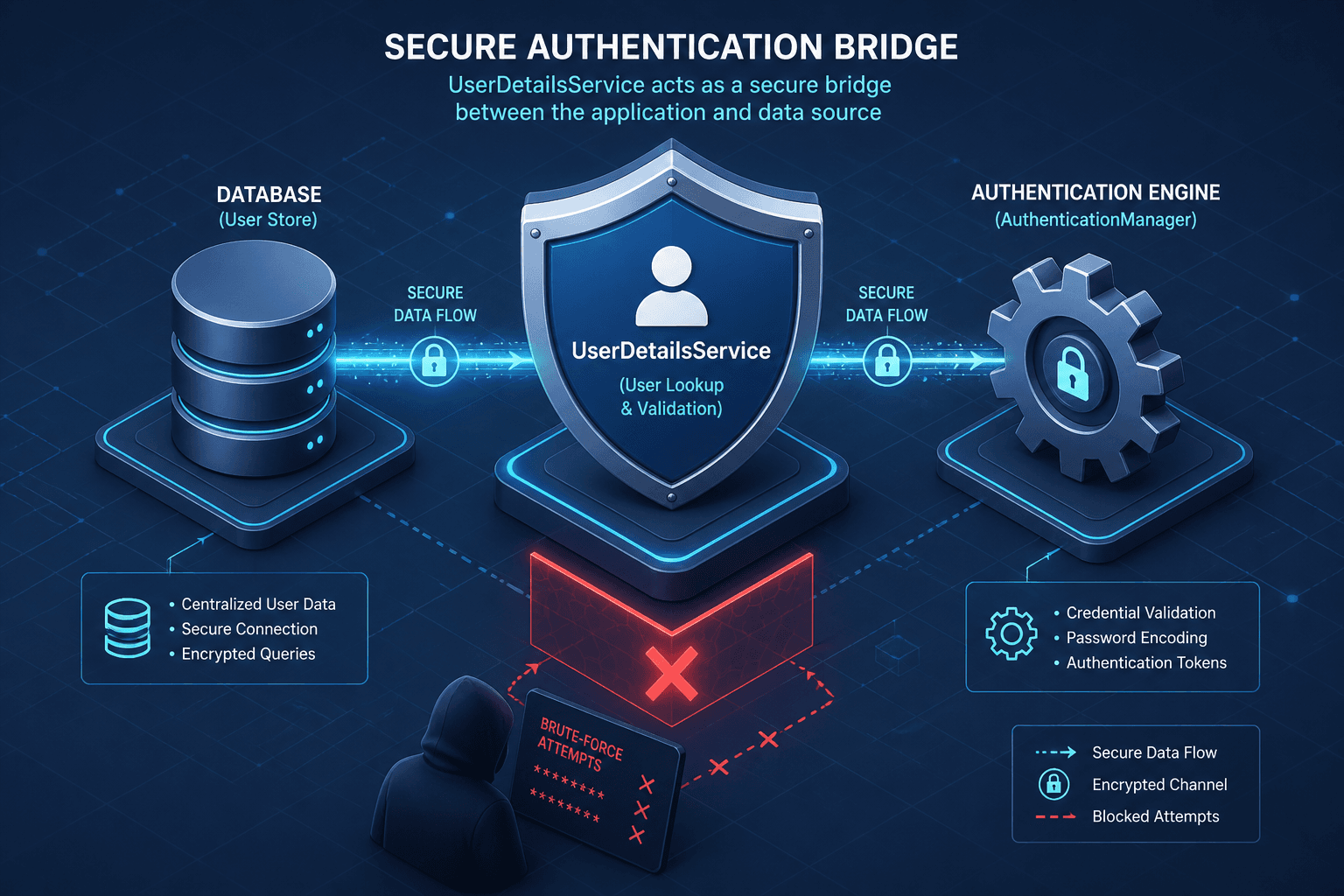
Spring Security’s UserDetailsService is the bridge between your application’s data store and the framework’s authentication engine. Its contract is simple: given a username, return a UserDetails object containing authorities and credentials. However, the way you implement this interface determines whether your application silently accepts brute-force attacks or actively leaks information about its user base.
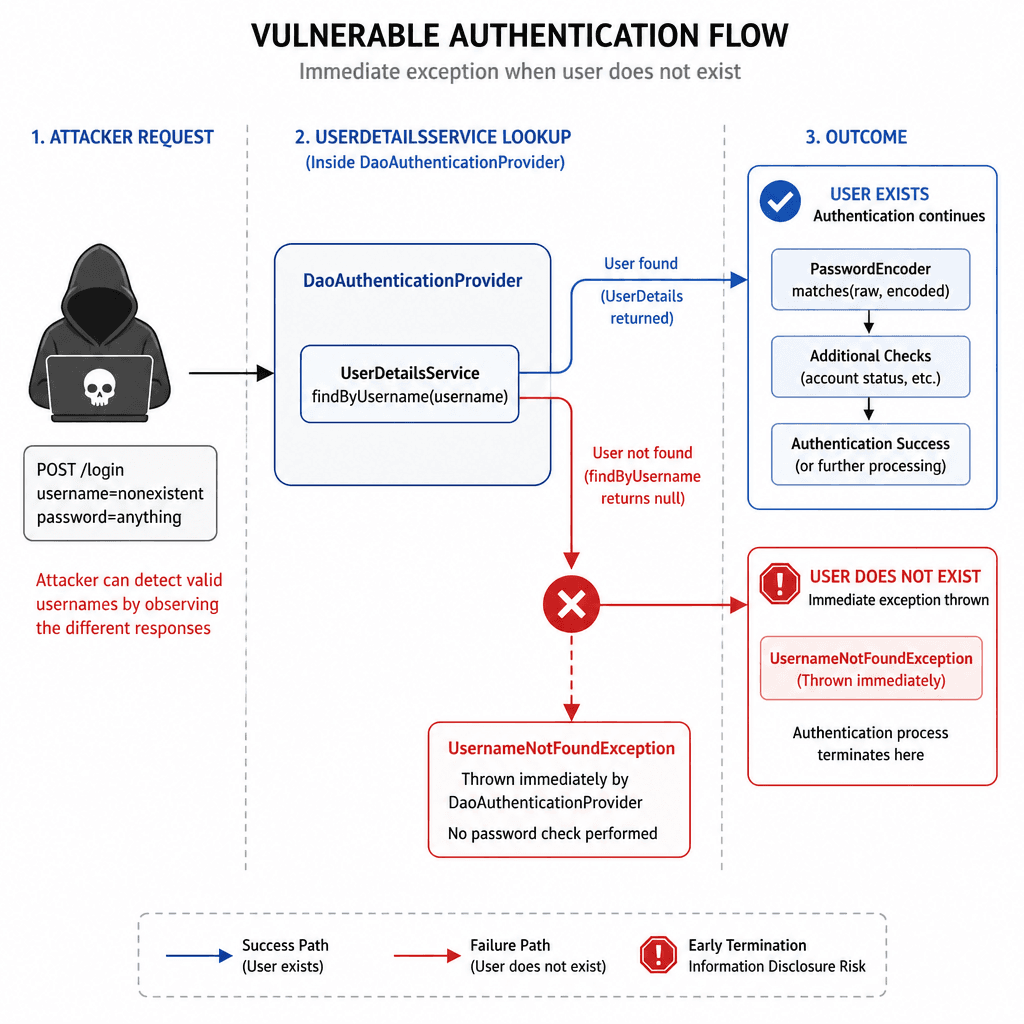
The most common mistake is allowing the UserDetailsService to signal the absence of a user. When you throw a UsernameNotFoundException or return null, you create a user enumeration vulnerability. As noted in Spring Security documentation on authentication providers, throwing specific exceptions for non-existent users allows attackers to distinguish between invalid usernames and valid ones with incorrect passwords. An attacker can determine which usernames exist in your system by observing how your application responds to authentication attempts.
The Mechanism of Leakage
To understand why this is a problem, we must look at the mechanism of DaoAuthenticationProvider, the default authentication provider in Spring Security. As detailed in the Spring Security reference guide, the provider orchestrates the authentication process by retrieving user details, checking account status, and validating credentials.
When an authentication request arrives, DaoAuthenticationProvider performs three steps:
- Retrieve the user from the
UserDetailsService. - Check if the user is enabled/locked.
- Validate the password using the
PasswordEncoder.
If step 1 fails—either by throwing UsernameNotFoundException or returning null—the provider typically throws an AuthenticationException before reaching the password check. This early exit creates a distinguishable signal. According to security best practices regarding timing attack mitigation, any deviation in response time or error type between valid and invalid users can be exploited.
Consider an attacker sending hundreds of authentication requests with different usernames. If the application responds with "User not found" for alice@example.com but "Invalid password" for bob@example.com, the attacker knows bob exists and alice does not. Even if the error messages are sanitized to a generic "Authentication failed," timing attacks can still differentiate between the two paths. Checking a database for existence is often faster than hashing a password, creating a measurable time difference.
The Vulnerable Pattern
A typical JPA implementation might look like this:
@Service
public class CustomUserDetailsService implements UserDetailsService {

    @Autowired
    private UserRepository userRepository;

    @Override
    public UserDetails loadUserByUsername(String username) throws UsernameNotFoundException {
        // This is the vulnerable line
        User user = userRepository.findByUsername(username)
                .orElseThrow(() -> new UsernameNotFoundException("User not found: " + username));

        return new org.springframework.security.core.userdetails.User(
                user.getUsername(),
                user.getPassword(),
                user.isEnabled(),
                true, true, true,
                getAuthorities(user)
        );
    }
}
In this scenario, if userRepository.findByUsername(username) returns an empty Optional, the code throws UsernameNotFoundException. Spring Security's DaoAuthenticationProvider catches this and, before propagating it further, runs the password encoder against an internally generated dummy hash to narrow the timing gap between existing and non-existing usernames. This built-in mitigation offers no protection, however, if a UserDetailsService returns null instead of throwing, since that path skips the encoder call and fails immediately, or if the exception's message is allowed to reach the client, confirming that the username does not exist.
The Secure Mechanism: Generic Failure
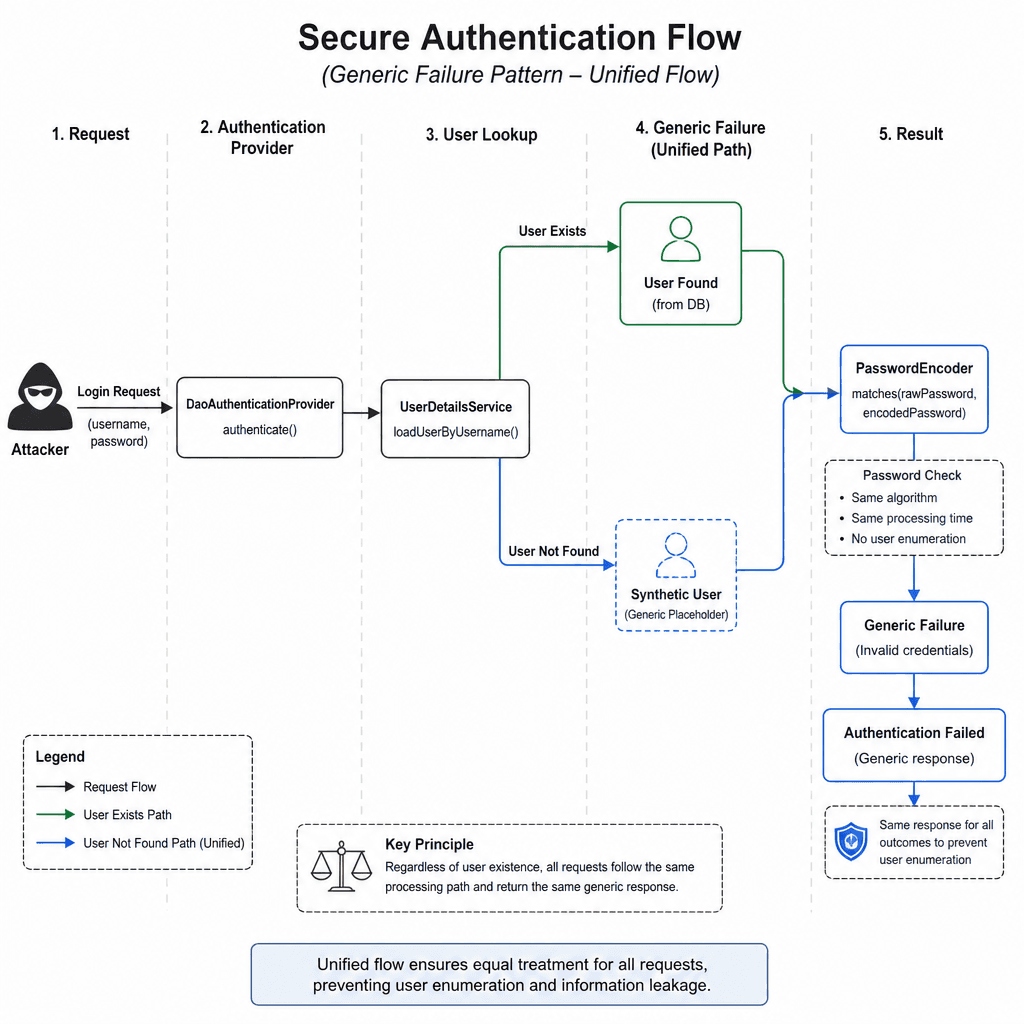
The solution is to ensure that the authentication flow always reaches the password validation stage, regardless of whether the username exists. This is known as the "generic failure" pattern, a recommended approach in secure authentication design to prevent user enumeration.
If the username does not exist in the database, you should return a synthetic UserDetails object with no valid credentials. This forces the DaoAuthenticationProvider to proceed to the password comparison step. Since the synthetic user has no password or a non-matching hash, the authentication will fail with the same generic message as a valid user with a wrong password.
Here is the corrected implementation:
@Service
public class SecureUserDetailsService implements UserDetailsService {

    @Autowired
    private UserRepository userRepository;

    @Autowired
    private PasswordEncoder passwordEncoder;

    @Override
    public UserDetails loadUserByUsername(String username) throws UsernameNotFoundException {
        Optional<User> userOpt = userRepository.findByUsername(username);

        if (userOpt.isPresent()) {
            User user = userOpt.get();
            return new org.springframework.security.core.userdetails.User(
                    user.getUsername(),
                    user.getPassword(),
                    user.isEnabled(),
                    true, true, true,
                    getAuthorities(user)
            );
        } else {
            // Return a dummy user with a dummy hash
            // This ensures the password encoder is invoked, equalizing response time
            return new org.springframework.security.core.userdetails.User(
                    username,
                    "$2a$10$N9qo8uLOickgx2ZMRZoMyeIjZAgcfl7p92ldGxad68LJZdL17lhWy", // Dummy BCrypt hash
                    true, // Enabled to avoid AccountStatusException
                    true, true, true,
                    AuthorityUtils.NO_AUTHORITIES
            );
        }
    }

    private Collection<? extends GrantedAuthority> getAuthorities(User user) {
        // Map user roles to GrantedAuthority
        return user.getRoles().stream()
                .map(role -> new SimpleGrantedAuthority("ROLE_" + role))
                .collect(Collectors.toList());
    }
}
Why This Works
By returning a synthetic user, we ensure that DaoAuthenticationProvider always calls passwordEncoder.matches(rawPassword, storedPassword). As explained in the Spring Security documentation on password encoding, this method is designed to be constant-time where possible, meaning the execution time does not vary significantly based on the input, thereby mitigating timing attacks.
- For valid users: The encoder compares the provided password against the real hash.
- For invalid users: The encoder compares the provided password against a dummy hash.
In both cases, the operation takes roughly the same amount of time because the password hashing algorithm (e.g., BCrypt) is computationally expensive and consistent in its execution time. Even if the stored password is a dummy hash, the framework’s behavior is standardized to prevent timing side-channels.
Note: Some password encoders may throw exceptions if the stored hash is empty or malformed. To avoid this, using a valid dummy hash like $2a$10$dummyhash... ensures compatibility. The most robust approach is to ensure the loadUserByUsername method never throws UsernameNotFoundException.
Handling Enablement Checks
A subtle point is the isEnabled() flag. If you return a dummy user with isEnabled() = false, the DaoAuthenticationProvider might throw an AccountStatusException before checking the password. As detailed in the Spring Security reference on account status, such exceptions are thrown during the pre-authentication checks, reintroducing the timing difference and leaking information that the account is disabled or non-existent.
To prevent this, the synthetic user should be marked as enabled (true). The authentication will still fail because the password won’t match, but it will fail at the password comparison stage, not the account status stage. This ensures that the failure path is identical for both valid and invalid usernames.
Conclusion
Implementing UserDetailsService securely requires thinking beyond simple data retrieval. The key principle is to avoid leaking information about the existence of users. By returning a synthetic user when the actual user is not found, you ensure that all authentication attempts follow the same code path, equalizing response times and error messages. This simple change closes a common user enumeration vector and strengthens your application’s security posture, aligning with secure authentication best practices outlined in industry standards.
Always test your authentication flow with tools that measure response times and analyze error responses to ensure no distinguishing information is leaked.
Related posts
Spring Security SAML: A Working Integration
A practical guide to integrating Spring Security SAML with Spring Boot, covering SAML2 relying party configuration, service provider setup, and metadata handling.
Spring Security SSO With Group and Role Mapping
Implement Spring Security SSO with group and role mapping using GrantedAuthoritiesMapper and OIDC claims for secure access control.
AuthenticationManager, Providers, and UserDetailsService
An examination of Spring Security's core components: AuthenticationManager, AuthenticationProvider, and UserDetailsService, and how they interact.
