OIDC Dynamic Client Registration (RFC 7591)
A technical examination of RFC 7591, covering dynamic client registration, initial access tokens, and automated client management for backend systems.
OIDC Dynamic Client Registration: Automating Identity for Backend Systems
In traditional OpenID Connect (OIDC) deployments, every application (client) that seeks authentication must be manually registered with the Authorization Server (AS). An administrator creates a client_id, assigns a client_secret, and defines allowed redirect URIs and scopes. This works fine for a handful of web apps. It breaks down for microservices architectures, SaaS platforms with tenant isolation, or any system where clients are created programmatically at scale.
RFC 7591, Dynamic Client Registration, addresses this by allowing clients to register themselves via a standard HTTP API. For backend developers and platform engineers, this means shifting from manual configuration management to automated lifecycle management for oidc dcr implementations. However, automation introduces new attack surfaces. This examination details the mechanism of RFC 7591, focusing on the role of Initial Access Tokens and the operational realities of implementing dynamic registration.
The Operational Friction of Static Clients
The protocol works as follows. In a static setup, the AS maintains a database of trusted clients. When a new service instance starts, the developer must:
- Log into the AS admin console.
- Create a new client entry.
- Copy the generated credentials.
- Configure the new service with those credentials.
This process is error-prone and unscalable. In a Kubernetes cluster with auto-scaling, you cannot manually register each pod. RFC 7591 eliminates this step by allowing the client to call the /register endpoint (or a similar configured path) and receive credentials in return.
The Registration Mechanism
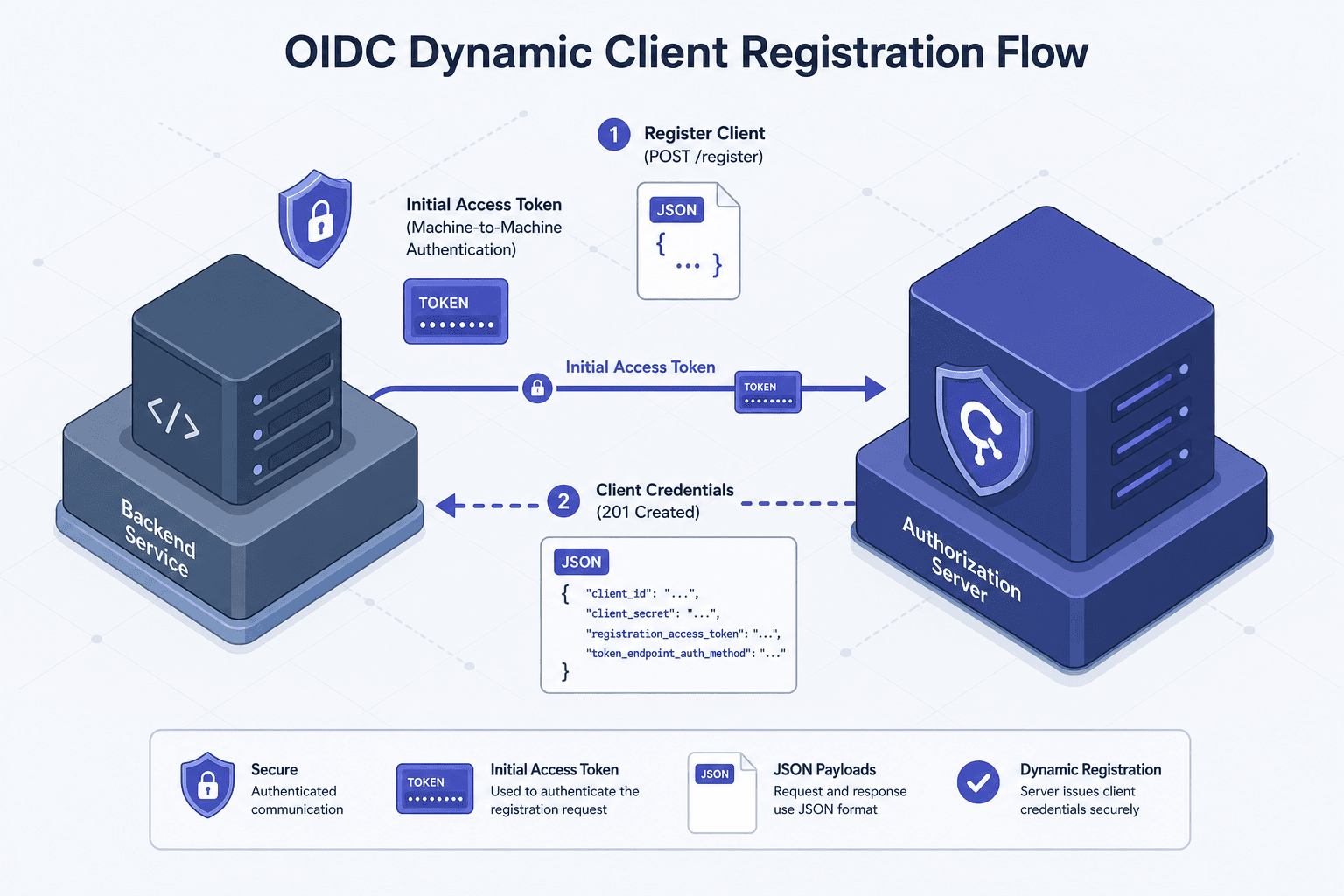
The core interaction is a simple HTTPS POST request to the Authorization Server’s registration endpoint. The client sends a JSON payload containing client_metadata. The server validates this metadata against its policy and returns a client_id and optionally a client_secret.
The Request Structure
The client constructs a POST request to the registration_endpoint. The body is a JSON object. Not all fields are mandatory; the specification defines a set of default values if metadata is omitted.
POST /register HTTP/1.1
Host: auth.example.com
Content-Type: application/json

{
  "client_name": "backend-service-alpha",
  "grant_types": ["authorization_code", "client_credentials"],
  "redirect_uris": ["https://app.example.com/callback"],
  "scope": "openid profile email"
}
Key fields in the request include:
client_name: A human-readable name for the client.grant_types: The OAuth 2.0 flows the client intends to use.redirect_uris: A list of URIs where the AS can redirect the user-agent after authorization. For backend-only services usingclient_credentials, this may be omitted or set to a dummy value depending on AS implementation.scope: The initial set of permissions the client requests.
The Response
Upon successful validation, the AS returns a 201 Created status with a JSON response containing the newly minted credentials:
{
  "client_id": "a1b2c3d4e5f6",
  "client_secret": "s3cr3t_k3y_v4lu3",
  "registration_access_token": "reg_access_token_value",
  "registration_client_uri": "https://auth.example.com/register/a1b2c3d4e5f6",
  "client_id_issued_at": 1678886400
}
The client_id is the unique identifier. The client_secret is often returned only once for security reasons. The registration_client_uri provides a canonical URL for future updates to this client’s metadata.
Security: Initial Access Tokens
The most critical aspect of RFC 7591 is preventing unauthorized registration. If the /register endpoint is publicly accessible without restriction, any attacker can create thousands of clients, leading to resource exhaustion or phishing campaigns.
RFC 7591 introduces the Initial Access Token as the primary mechanism to control who can register clients.
How Initial Access Tokens Work
An Initial Access Token is a bearer token issued by the AS specifically for the purpose of client registration. It is distinct from the access tokens used for user authentication.
-
Issuance: The AS administrator generates one or more Initial Access Tokens. These can be:
- Pre-shared: Distributed to trusted partners or internal services via secure channels.
- One-time use: Each token can be used only once. After a successful registration, the token is invalidated.
- Time-limited: Tokens expire after a short window (e.g., 24 hours).
-
Presentation: The client includes the Initial Access Token in the
Authorizationheader of the registration request:
POST /register HTTP/1.1
Host: auth.example.com
Content-Type: application/json
Authorization: Bearer initial_access_token_xyz123

{
  "client_name": "trusted-partner-app",
  "redirect_uris": ["https://partner.example.com/callback"]
}- Validation: The AS verifies the token’s validity, scope, and usage count. If valid, it proceeds with registration. If invalid or already used, it returns a
401 Unauthorizedor403 Forbidden.
Alternative Protection Methods
Not all AS implementations support Initial Access Tokens. Some use simpler mechanisms:
- IP Whitelisting: Only requests from specific IP ranges are allowed to register. This is a valid but less secure alternative for specific internal contexts.
- Pre-shared Keys: A simple header or query parameter containing a secret key.
- No Authentication: For internal networks where the AS is not exposed to the public internet (not recommended for production).
Opinion: Relying solely on IP whitelisting is fragile. Network configurations change, and compromised internal hosts can still abuse the endpoint. Initial Access Tokens provide cryptographic proof of authorization and are the preferred method for production systems.
Client Lifecycle Management
Registration is just the beginning. Clients need to update their metadata over time. RFC 7591 defines operations for updating client metadata, facilitating automated client management tasks.
Updating Metadata
Clients can update their own metadata (e.g., adding a new redirect URI for a new environment) by making a POST request to the registration_client_uri returned during registration. The request must include a registration_access_token (if supported by the AS).
POST /register/a1b2c3d4e5f6 HTTP/1.1
Host: auth.example.com
Content-Type: application/json
Authorization: Bearer registration_access_token

{
  "redirect_uris": [
    "https://app.example.com/callback",
    "https://app-staging.example.com/callback"
  ]
}
This enables self-service management, reducing the burden on platform teams. However, it requires careful validation logic on the AS to prevent malicious clients from hijacking the registration by exploiting race conditions or weak authentication.
Secret Rotation
Clients can also rotate their client_secret by requesting a new one. The AS typically returns a new secret while keeping the old one valid for a grace period to allow for smooth transition. This is crucial for security compliance, ensuring that compromised secrets do not immediately grant full access. Note that while RFC 7591 does not mandate a specific rotation endpoint, secret rotation is a common implementation-specific feature or part of the client_metadata update process.
Implementation Tradeoffs and Risks
Implementing RFC 7591 is not without challenges. The primary risk is abuse. Since the registration endpoint is an API, it is susceptible to:
- Denial of Service (DoS): Attackers flooding the endpoint with registration requests, consuming database resources.
- Phishing: Creating fake clients that mimic legitimate services to trick users into authorizing malicious apps.
Mitigation Strategies
- Rate Limiting: Strictly limit the number of registration requests per IP or per Initial Access Token.
- Validation Rules: Enforce strict validation on
redirect_uris(e.g., requiring HTTPS, matching domain patterns). - Audit Logging: Log every registration request, including the Initial Access Token used, for forensic analysis.
- Client Authentication: Require strong authentication for the registration endpoint, not just Initial Access Tokens. Consider using mTLS for high-security environments.
Conclusion
RFC 7591 provides a standardized way to automate client registration in OIDC via rfc-7591, essential for modern, scalable backend systems. By leveraging Initial Access Tokens and metadata updates, platform engineers can reduce operational overhead and improve security posture through automated oidc dcr lifecycle management. However, the public-facing nature of the registration endpoint demands rigorous security controls, including rate limiting, validation, and audit logging. Implementing DCR correctly requires balancing automation with strong access control, ensuring that only authorized clients can join the ecosystem.
Related posts
Understanding OAuth2 Multiple Response Types: A Technical Guide
An examination of OAuth2 response types including hybrid flow, OIDC response types, and authorization server configurations for beginners.
OpenID Connect Guide: Extending OAuth 2.0 for Identity Verification
An examination of OpenID Connect (OIDC) and how it extends OAuth 2.0 to handle identity verification using ID tokens and discovery protocols.
API Gateway OIDC: Kong and Friends
Implement OIDC authentication in Kong API Gateway, covering JWT validation, JWKS caching, and upstream header propagation.
