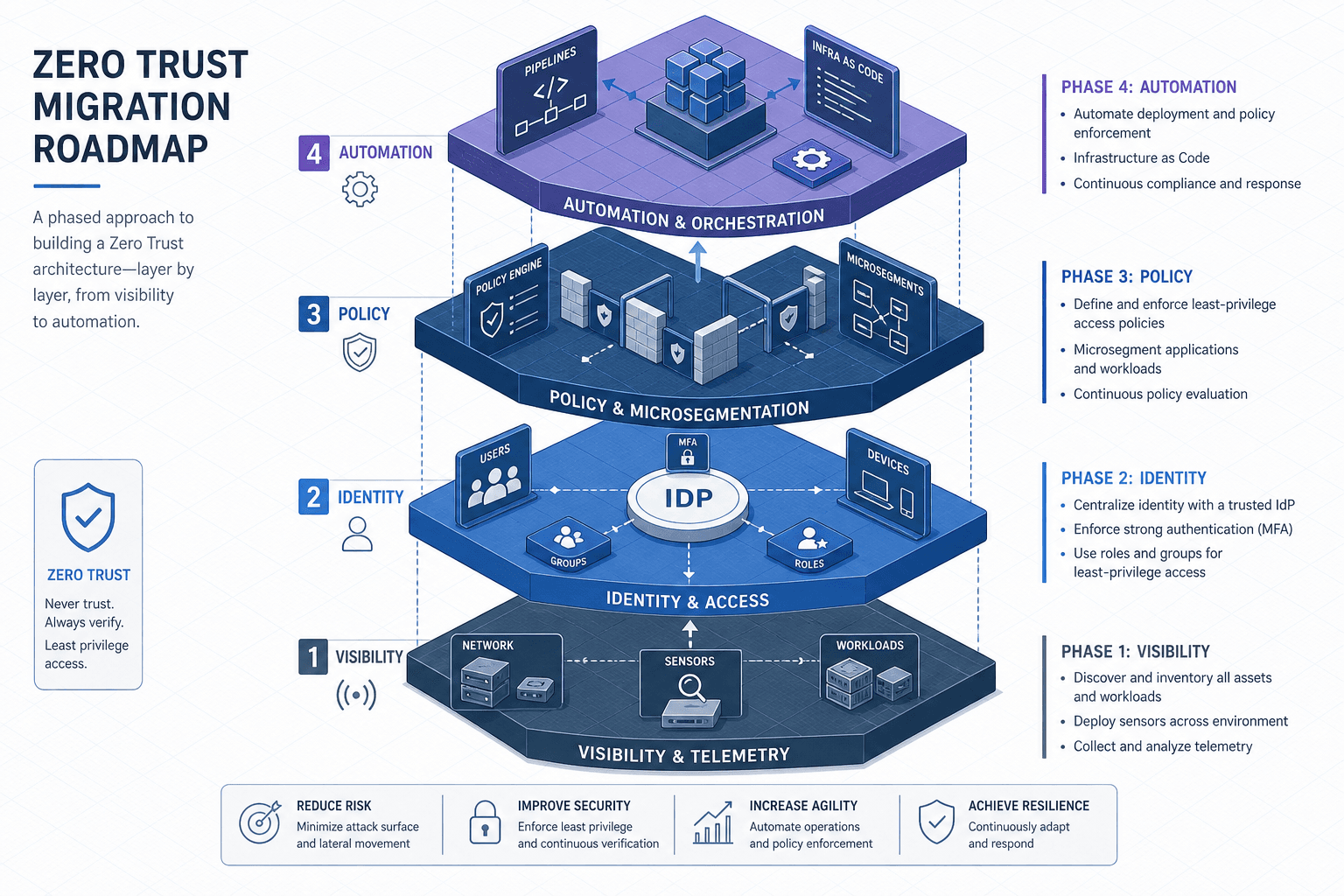
A Phased Zero Trust Rollout Plan
A structured roadmap for implementing zero trust security in phases, designed for engineering managers and architects to ensure secure migration.
Zero Trust is frequently misunderstood as a single technology purchase—a Next-Generation Firewall (NGFW) or a Secure Web Gateway (SWG). This misconception leads to failed implementations where engineers bolt on security controls without changing the underlying access model. Zero Trust is fundamentally a migration strategy. It requires shifting the trust boundary from the network perimeter (IP addresses and subnets) to the identity of the user and the health of the device.
Part 5 of the Zero Trust series.
For engineering managers and architects, the challenge is not buying tools but orchestrating a phased migration that maintains business continuity while incrementally reducing the attack surface. This plan outlines a four-phase rollout designed to minimize operational disruption while ensuring that every step builds on a verifiable security baseline.
Phase 1: Visibility and Asset Discovery
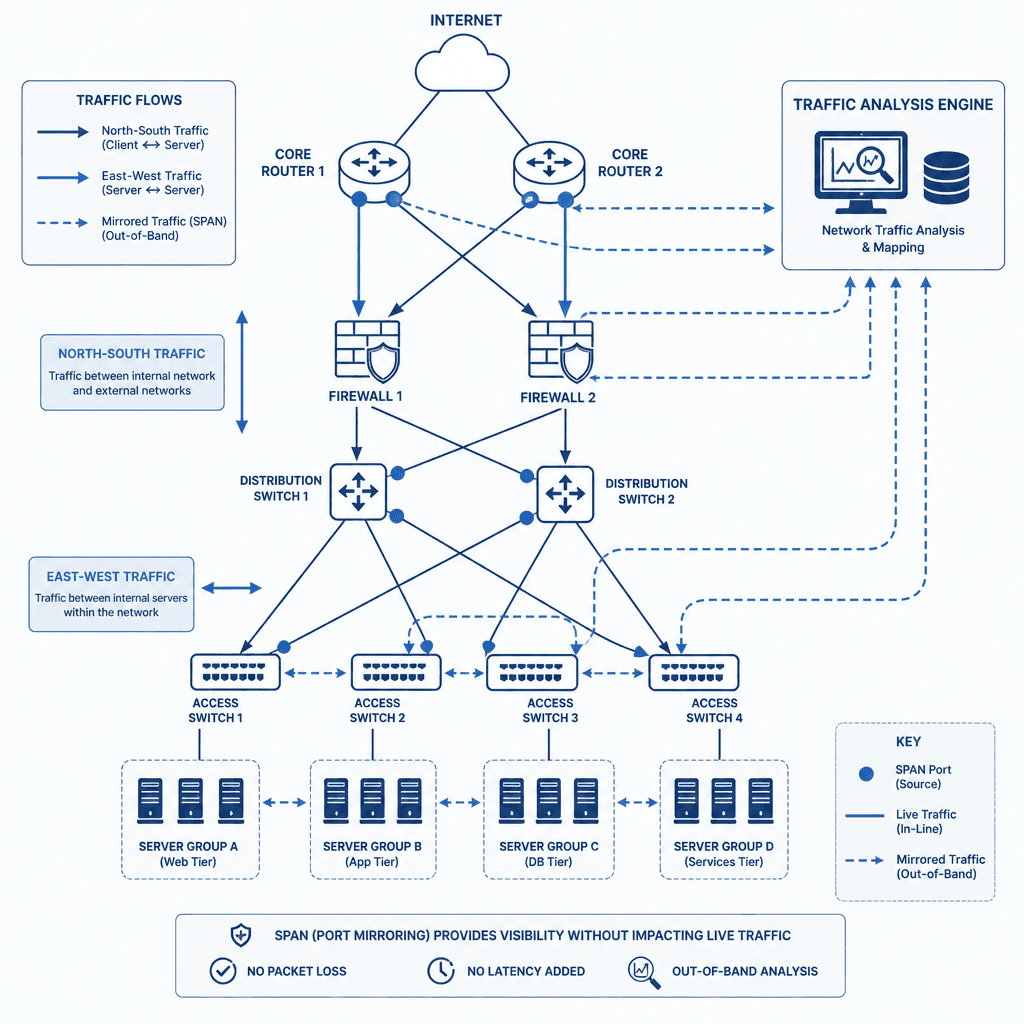
You cannot secure what you cannot see. The first phase focuses on passive observation. In legacy architectures, trust is implicit; if a device is on the corporate VLAN, it is trusted. This phase breaks that assumption by establishing a complete inventory of assets and their communication patterns without blocking traffic.
Mechanism: Network Traffic Analysis (NTA) and Asset Fingerprinting
Deploy agentless sensors at key network egress points and internal segment boundaries. These sensors mirror traffic (SPAN ports) to analyze metadata—source/destination IPs, ports, protocols, and packet sizes. This creates a "normal" baseline of behavior.
- Inventory Creation: Use automated discovery tools to catalog all hardware, software, and cloud workloads. This includes shadow IT discovered via DNS logs.
- Traffic Flow Mapping: Identify who talks to whom. For example, a development server should only communicate with specific CI/CD runners and databases, not the public internet or other development teams.
- Baseline Definition: Establish thresholds for normal data transfer volumes and connection frequencies.
Checkpoint: A complete, updated asset inventory and a documented map of east-west and north-south traffic flows. No blocking policies are in place yet; the goal is pure visibility. This checkpoint ensures the rollout plan has a solid foundation before enforcing restrictions.
Phase 2: Identity Consolidation and MFA
Once visibility is established, the next step is to harden the primary vector of trust: identity. In most legacy systems, authentication is fragmented across Active Directory, SaaS providers, and on-prem applications. An attacker who compromises one credential can pivot laterally.
Mechanism: Centralized Identity Provider (IdP) and Universal MFA
Implement a central IdP (e.g., Okta, Azure AD, Ping Identity) that serves as the source of truth for all user identities. The critical technical shift here is enforcing Multi-Factor Authentication (MFA) universally, including for legacy protocols that traditionally do not support it (e.g., RDP, SSH, SMTP). Note that enforcing MFA on legacy protocols often introduces operational complexity, requiring careful testing of protocol adapters and reverse proxies to avoid disrupting critical workflows.
- MFA Enforcement: Require MFA for all remote access and administrative privileges immediately. For on-prem applications, use protocol adapters (like reverse proxies) to intercept authentication requests and inject MFA challenges.
- Privileged Access Management (PAM): Isolate high-value accounts. Admins should not use their standard credentials for daily tasks. Instead, they request just-in-time (JIT) access to specific systems.
- Device Trust Integration: Begin collecting device health telemetry (OS version, patch level, endpoint protection status) and sending it to the IdP. This data will be used in later phases to make access decisions.
Checkpoint: MFA is enforced for 100% of users and 100% of remote access points. Privileged accounts are isolated in a PAM solution. Device health data is being collected but not yet enforced. Verifying these checkpoints ensures that identity is the new perimeter before moving to policy enforcement.
Phase 3: Least Privilege and Microsegmentation
With identity consolidated, the organization can begin enforcing least privilege. This phase moves from "who are you?" to "what are you allowed to do?" It involves restricting lateral movement within the network.
Mechanism: Dynamic Access Policies and Microsegmentation
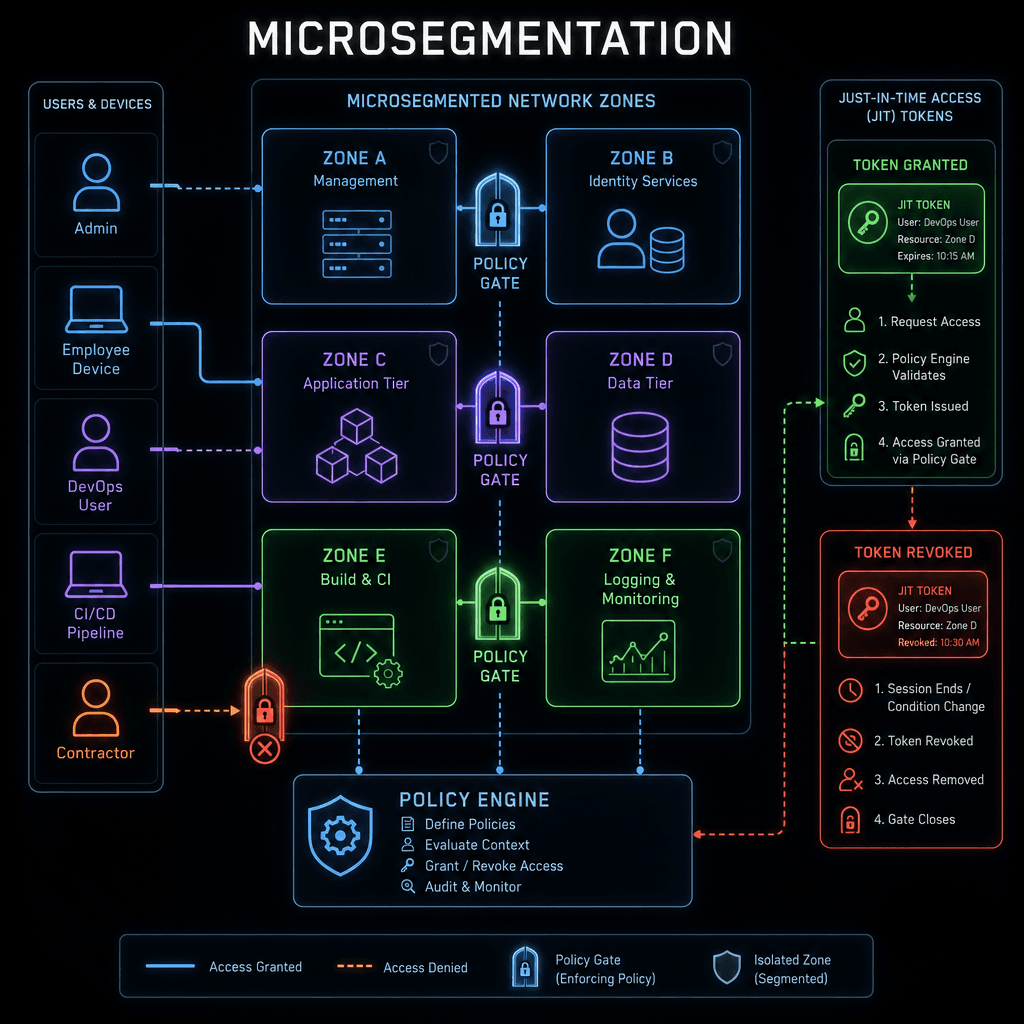
Deploy policy engines that evaluate context before granting access. These engines sit between the user/device and the resource, acting as a gatekeeper.
- Microsegmentation: Divide the network into small, isolated zones. Instead of allowing a web server to talk to any database, define explicit rules:
Web_Server_IP->DB_IP:Portonly ifUser_Role = DeveloperandDevice_Status = Compliant. - Just-in-Time (JIT) Access: Instead of granting permanent access to resources, grant temporary access for a specific task. Once the task is complete, the access token is revoked. This reduces the window of opportunity for attackers.
- Context-Aware Policies: Implement policies that consider:
- User Role: Junior vs. Senior Engineer.
- Device Health: Is the device patched? Is it encrypted?
- Location: Is the user accessing from a known office IP or an anonymous proxy?
- Time: Are access requests happening during off-hours?
Checkpoint: Lateral movement is restricted by microsegmentation policies. JIT access is enabled for all privileged operations. Access decisions are dynamically evaluated based on user, device, and context. This phase is critical for the migration from a flat network architecture to a segmented, secure environment.
Phase 4: Automation and Continuous Verification
The final phase transforms security from a manual, policy-heavy process into an automated, continuous loop. As the environment scales, manual policy updates become impossible. Automation ensures that security controls keep pace with infrastructure changes.
Mechanism: Infrastructure as Code (IaC) and Telemetry-Driven Revocation
Integrate security policies into the CI/CD pipeline. Security is no longer a gate at the end of the development process but a built-in constraint.
- Policy as Code: Define access policies in code (e.g., using OPA, Rego, or CloudFormation). When developers deploy new infrastructure, the policy engine automatically applies the correct least-privilege rules.
- Continuous Monitoring and Anomaly Detection: Use machine learning or statistical models to analyze telemetry data in real-time. If a user suddenly accesses unusual resources or transfers large amounts of data, the system automatically flags and potentially blocks the session.
- Automated Revocation: If a device is compromised or a user leaves the organization, access tokens are instantly revoked across all services. This is achieved through integration with the IdP and endpoint detection and response (EDR) tools.
Checkpoint: Security policies are managed as code. Anomalies trigger automated responses. The system continuously verifies trust throughout the session, not just at login. Completing this phase finalizes the roadmap, ensuring that security evolves automatically alongside the infrastructure.
Conclusion
A phased Zero Trust rollout is not about achieving perfection overnight. It is about reducing risk incrementally. By starting with visibility, then consolidating identity, enforcing least privilege, and finally automating verification, engineering teams can migrate away from the fragile perimeter model without disrupting business operations. Each phase builds on the previous one, creating a resilient, adaptive security posture that can withstand modern threats.
Related posts
Policy Enforcement Points and Micro-Segmentation
Explore how Policy Enforcement Points and micro-segmentation enforce Zero Trust principles via service mesh and authorization architecture.
What Zero Trust Actually Requires
An examination of the practical requirements for Zero Trust Architecture based on NIST 800-207, covering tenets, maturity models, and implementation steps.
Understanding OAuth 2.0 Pushed Authorization Requests (PAR)
An examination of RFC 9126 and how Pushed Authorization Requests enhance OAuth 2.0 security by preventing authorization code interception attacks.