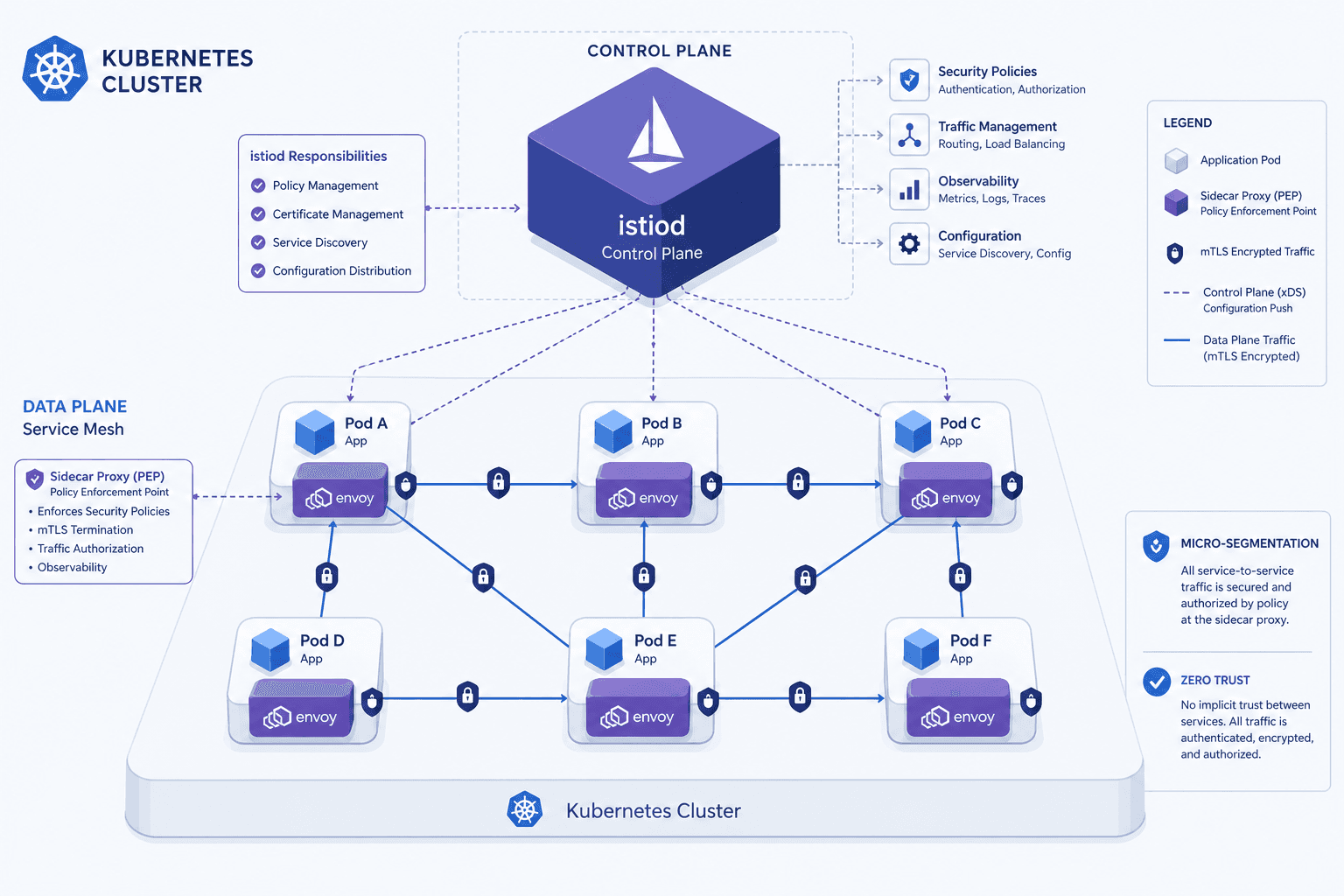
Policy Enforcement Points and Micro-Segmentation
Explore how Policy Enforcement Points and micro-segmentation enforce Zero Trust principles via service mesh and authorization architecture.
In a Zero Trust architecture, the fundamental assumption is that the network is hostile. Traditional perimeter security relied on "trust but verify" within a corporate boundary, assuming that once inside the firewall, traffic was safe. Zero Trust flips this: every request is untrusted until proven otherwise. The Policy Enforcement Point (PEP) is the mechanism that enforces this reality, serving as a critical component in zero trust network access implementations. While often conflated with network segmentation, micro-segmentation is actually the outcome of rigorous, identity-aware policy enforcement at the workload level. As Part 4 of the Zero Trust series, this article examines how PEPs operate within service mesh architectures to enforce these principles, moving beyond static network rules to dynamic, context-aware authorization.
The Mechanism of the Policy Enforcement Point
To understand micro-segmentation, one must first understand the anatomy of a decision. In authorization theory, particularly models like XACML (an OASIS standard) or modern policy engines like OPA (Open Policy Agent), a request goes through three distinct stages:
- Policy Enforcement Point (PEP): The component that intercepts the request. It does not decide whether to allow or deny; it asks.
- Policy Decision Point (PDP): The engine that evaluates the request against policies, context, and user identity.
- Policy Information Point (PIP): The source of attributes (e.g., "Is this user an admin?", "What time is it?") used by the PDP.
The PEP is the gatekeeper. In a web application, this might be an API gateway. In a service mesh, it is the sidecar proxy. The PEP’s primary job is to block all traffic by default and only allow it if the PDP explicitly grants permission. This is the "deny-by-default" posture that defines Zero Trust.
Consider a simple HTTP request. The PEP receives the connection. In theoretical models, the PEP pauses the flow, extracts metadata (source IP, destination port, HTTP headers, certificate subject), and sends a synchronous query to the PDP. However, in practical service mesh implementations like Istio or Envoy, this interaction is optimized. The PEP typically enforces locally cached policies pushed by the control plane (which acts as the PDP) rather than querying a remote decision engine for every single request. This ensures low-latency enforcement while maintaining the separation of concerns: the PEP remains static in its interception logic, while the policies it enforces are dynamic and centrally managed.
Micro-Segmentation as Dynamic State
Micro-segmentation is often misunderstood as simply creating more subnets. In reality, it is the granular application of PEP policies to individual workloads. Traditional VLANs segment at Layer 2 or 3, allowing broad trust within a subnet. Micro-segmentation operates at Layer 4 through Layer 7, enforcing policies based on identity, not just IP address.
The key difference is dynamism. In a static network, if a server’s IP changes, the firewall rule must be updated. In a micro-segmented environment using PEPs, the policy is bound to the workload’s identity (e.g., its Kubernetes ServiceAccount or mTLS certificate). When the workload moves, the PEP enforces the same policy regardless of location. This is critical in cloud-native environments where pods are ephemeral.
For example, a database workload might have a PEP configured to only accept connections from specific application services. Even if an attacker compromises a web server and attempts to connect directly to the database, the PEP on the database side will inspect the source certificate or token. If it doesn’t match the allowed identities, the PEP blocks the connection. This prevents lateral movement, a common attack vector in breaches, and represents the core of effective security policy enforcement in modern infrastructures.
Service Mesh Integration: The Data Plane as PEP
Service meshes like Istio, Linkerd, and Consul Connect provide the infrastructure for PEPs at scale. They implement the PEP function via sidecar proxies (typically Envoy). Each pod gets its own sidecar, which acts as the PEP for all inbound and outbound traffic.
Here is how the flow works in an Istio deployment:
apiVersion: security.istio.io/v1beta1
kind: AuthorizationPolicy
metadata:
  name: backend-policy
spec:
  selector:
    matchLabels:
      app: backend
  action: ALLOW
  rules:
  - from:
    - source:
        namespaces: ["frontend"]
    when:
    - key: request.auth.claims[iss]
values: ["https://auth.example.com"]- Control Plane (Istiod): Runs the PDP logic. It watches Kubernetes resources (Services, VirtualServices, DestinationRules, AuthorizationPolicies) and translates them into Envoy configurations.
- Data Plane (Envoy Sidecars): Acts as the PEP. It receives the configuration from Istiod and applies it to the traffic flowing through the pod.
When a request arrives at a service, the Envoy sidecar intercepts it. It checks its local cache for an AuthorizationPolicy. If a policy exists, it evaluates the request against it. If the policy requires mutual TLS (mTLS), it verifies the client’s certificate. If the policy restricts access to specific namespaces, it checks the source namespace.
This architecture allows for fine-grained control. For instance, you can define a policy that only allows requests from the "frontend" namespace to the "backend" namespace, but only if the request includes a specific JWT claim. The PEP (Envoy) enforces this in real-time, with minimal latency overhead.
Ephemeral Enforcement and Zero Trust
The true power of PEPs in micro-segmentation is their ability to enforce Zero Trust principles in ephemeral environments. In a traditional data center, servers are long-lived, and their security posture is relatively stable. In Kubernetes, pods may live for minutes. The PEP ensures that each pod is secured independently, regardless of its lifecycle.
Consider a scenario where an attacker exploits a vulnerability in a web application to gain shell access. They attempt to scan the network for other services. In a flat network, they might find and connect to a database. In a micro-segmented environment, the PEP on the database side will block the connection because the attacker’s pod does not have the required identity or permissions. The PEP acts as a continuous verifier, ensuring that only authorized workloads can communicate.
This is further enhanced by short-lived certificates and tokens. The PEP validates these credentials on every request, ensuring that even if a credential is stolen, its validity window is limited. This "never trust, always verify" approach is the core of Zero Trust.
Conclusion
Micro-segmentation is not a network topology; it is a policy enforcement strategy. By leveraging Policy Enforcement Points within service mesh architectures, organizations can enforce fine-grained, identity-aware access controls at the workload level. This decouples security from infrastructure, allowing for dynamic, scalable, and resilient Zero Trust implementations. For security and platform engineers, understanding the PEP-PDP interaction is essential for designing secure, resilient systems. The future of network security is not in bigger firewalls, but in smarter, more distributed enforcement points.
Related posts
A Phased Zero Trust Rollout Plan
A structured roadmap for implementing zero trust security in phases, designed for engineering managers and architects to ensure secure migration.
Zero Trust Architecture: A Practical Implementation Guide
A practical walkthrough of implementing zero trust architecture, covering identity security, least privilege, micro-segmentation, and continuous verification.
What Zero Trust Actually Requires
An examination of the practical requirements for Zero Trust Architecture based on NIST 800-207, covering tenets, maturity models, and implementation steps.