Magic Links: Design, Threats, and Session Binding
An examination of magic link authentication design, security threats, and session binding techniques for backend developers.
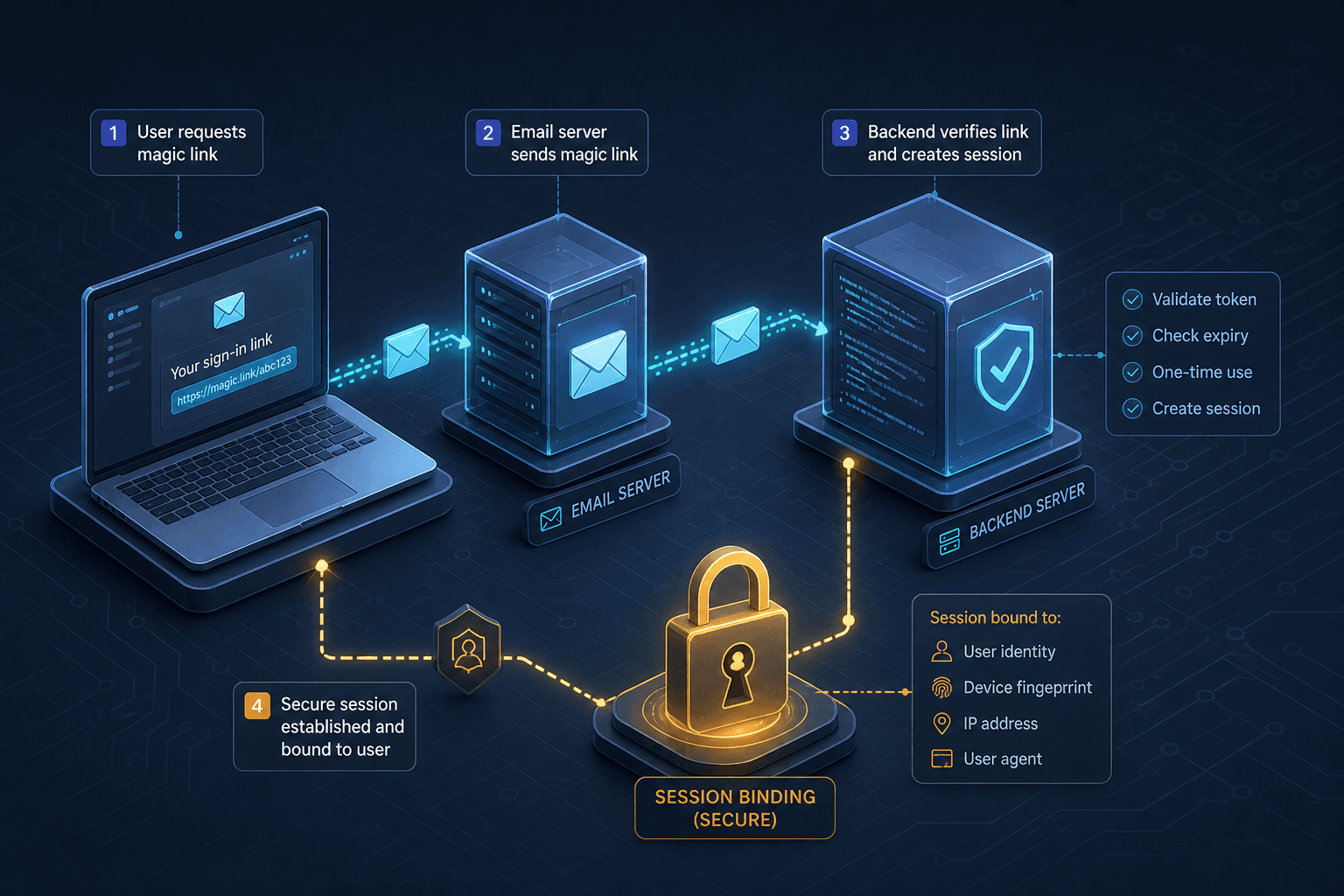
Magic links are often marketed as a smooth user experience, but from a backend perspective, they are a complex authentication protocol that shifts trust boundaries. The core misunderstanding among many developers is that the magic link itself provides security. It does not. The magic link is merely a one-time, time-limited URL delivered through an email channel. The security guarantee comes from how the backend validates that URL, binds it to a specific user session, and ensures it cannot be reused. This article examines the mechanism of magic link authentication, the specific threats posed by email infrastructure, and the technical requirements for secure session binding.
The Mechanism of Trust
To understand the security model, we must first map the data flow. Unlike traditional passwords, where the user memorizes a secret, magic links rely on possession of an email inbox. The backend generates a cryptographically random token, stores a hash of that token in the database, and sends the plain-text token in an email. When the user clicks the link, the frontend sends the token back to the backend. The backend hashes the incoming token, compares it against the stored hash, and if they match, grants access.
The critical mechanism here is statelessness of the token combined with statefulness of the validation. The token itself contains no user identity or signature that the frontend can verify. The backend is the sole source of truth. This means the token must be high-entropy (typically 256-bit) to prevent brute-force guessing, and it must have a short TTL (Time To Live), usually between 5 and 15 minutes. If the token is valid too long, the attack surface expands significantly.
Consider the following API interaction:
POST /auth/magic-link/request
Content-Type: application/json

{
  "email": "user@example.com"
}
The backend responds with 202 Accepted immediately, regardless of whether the email exists. This prevents user enumeration attacks. The actual work happens asynchronously. The backend generates a token, stores hash(token) and user_id in the session table, and sends the email. The email contains a URL like https://app.example.com/auth/verify?token=abc123....
The Threat Model
Magic links introduce three distinct threat vectors that do not exist in traditional password-based systems.
1. Email Prefetching
Many email providers and Internet Service Providers (ISPs) prefetch links in emails to improve load times. If a user receives a magic link, the email client may fetch the URL before the user clicks it. If the link is structured as a GET request to a sensitive endpoint, the prefetch request may authenticate the user prematurely. Worse, if the link is not single-use, the prefetch consumes the token, locking the user out of their own account because the next legitimate click will fail validation.
This is particularly dangerous if the email client caches the response or logs the request. Some enterprise email gateways scan URLs for malware by fetching them in a sandboxed environment. If the magic link triggers a session creation or token generation, this automated fetch can create unauthorized sessions or exhaust rate limits.
2. Token Leakage via Referer Headers
When a user clicks a magic link, the browser sends the full URL, including the token, in the Referer header to any third-party scripts loaded on the landing page. If the landing page includes analytics, ad trackers, or other third-party JavaScript, these services may log the token. Since magic link tokens are often the only credential needed to access the account, this leakage is equivalent to leaking a password.
3. Session Fixation and Binding
If the magic link validation does not bind the token to the user’s current session, an attacker who intercepts a valid token (via phishing or network sniffing) can use it to hijack an existing session. More critically, if the backend creates a new session upon receiving the token without verifying the client’s previous state, it opens the door to session fixation attacks. The attacker sets a session ID, sends the victim a magic link, and when the victim clicks it, the backend associates the new authentication state with the attacker-controlled session ID.
Session Binding: The Technical Defense
The primary defense against these threats is session binding. The magic link token must not stand alone as an authentication artifact. It must be bound to the user’s current session context.
How Binding Works
- Session ID Generation: When the user requests a magic link, the backend generates a new session ID (SID) and associates it with the user’s identity in a pending state.
- Token Association: The magic link token is hashed and stored in the database, associated with both the
user_idand thesession_id. - Cookie Setting: The backend sets a cookie with the
session_idin the response to the initial request. This cookie is markedHttpOnly,Secure, andSameSite=Strict. - Validation: When the user clicks the link, the frontend sends the token and the
session_idcookie. The backend verifies that:- The token hash matches the stored hash.
- The token is associated with the provided
session_id. - The
session_idhas not expired. - The token has not been used (atomic deletion).
- Session Regeneration: Upon successful validation, the backend MUST regenerate the session ID and issue a new cookie, invalidating the old session ID. Binding alone is insufficient; regeneration is the standard defense against fixation.
This binding ensures that even if an attacker intercepts the token, they cannot use it unless they also control the session cookie. Since the session cookie is HttpOnly, it cannot be accessed by JavaScript, preventing leakage via third-party scripts.
Atomic Validation
The validation step must be atomic. The backend must read the token, verify it, delete it, and update the session state in a single transaction. This prevents race conditions where two requests using the same token are processed concurrently, potentially granting double access or invalidating the token before the second request completes.
-- Pseudocode for atomic validation
BEGIN TRANSACTION;
SELECT hash, session_id, created_at INTO result FROM magic_tokens WHERE hash = $1 FOR UPDATE;
IF NOT FOUND THEN
    ROLLBACK;
    RETURN 400;
END IF;
IF NOW() > result.created_at + INTERVAL '15 minutes' THEN
    ROLLBACK;
    RETURN 410;
END IF;
DELETE FROM magic_tokens WHERE hash = $1;
UPDATE sessions SET authenticated = TRUE WHERE id = result.session_id;
COMMIT;
Mitigation Strategies
Beyond session binding, several additional measures are required to secure magic link implementations.
HTTPS Enforcement
Magic links must only be served over HTTPS. Any transmission over HTTP exposes the token in transit. Furthermore, the landing page must enforce HTTPS to prevent man-in-the-middle attacks.
Referrer-Policy
Set the Referrer-Policy header to no-referrer or strict-origin-when-cross-origin on the magic link landing page. This prevents the token from being leaked in the Referer header to third-party domains. Note that while this mitigates cross-origin leakage, it does not prevent same-origin leakage to the landing page's own analytics; for that, stripping the token from the URL or using POST is required.
Single-Use Enforcement
Tokens must be single-use. Even if a user accidentally sends the link to themselves or another person, the token should become invalid after the first successful validation. This limits the window of opportunity for an attacker.
User Enumeration Prevention
As mentioned, the /auth/magic-link/request endpoint must return the same response whether the email exists or not. Do not send an email if the user does not exist. Instead, log the attempt internally for security monitoring. This prevents attackers from enumerating valid email addresses in your system.
Conclusion
Magic links offer a convenient authentication experience, but they shift the burden of security from the user to the backend. The token itself is not a credential; it is a temporary key that must be tightly bound to a session and protected against prefetching, leakage, and reuse. By implementing strict session binding, atomic validation, and strong header policies, backend developers can mitigate the unique threats posed by magic link authentication. The goal is not to eliminate risk, but to contain it within a well-defined, verifiable boundary.
Related posts
Why Passwords Are Finally Losing | WebAuthn Guide
An examination of why passwordless authentication is replacing traditional passwords due to phishing resistance and security improvements.
SecurityFilterChain in Spring Security 6
A technical walkthrough of configuring SecurityFilterChain in Spring Security 6 using the Lambda DSL and RequestMatchers for Java developers.
Decoding client_secret_basic Default in RFC 8414
An examination of the token_endpoint_auth_methods_supported metadata field in RFC 8414 and why client_secret_basic remains the default authentication method.