What RAG Actually Solves (and What It Doesn't)
An examination of Retrieval Augmented Generation (RAG), clarifying how it reduces hallucination through grounding while identifying its architectural limitations.
Retrieval Augmented Generation (RAG) is frequently marketed as the definitive solution to Large Language Model (LLM) hallucination. This is a partial truth. RAG does not eliminate hallucination; it merely shifts the failure mode. Instead of the model inventing facts from its internal parametric memory, the model may now hallucinate by misinterpreting, ignoring, or poorly synthesizing the external context provided to it.
This article is Part 1 of the RAG from Zero to Production series.
To understand RAG, we must strip away the marketing and look at the mechanism. RAG is an architectural pattern that decouples knowledge storage from reasoning. It allows a static model to access dynamic data without retraining. But this decoupling introduces new failure points that architects must manage.
The Mechanism of Grounding
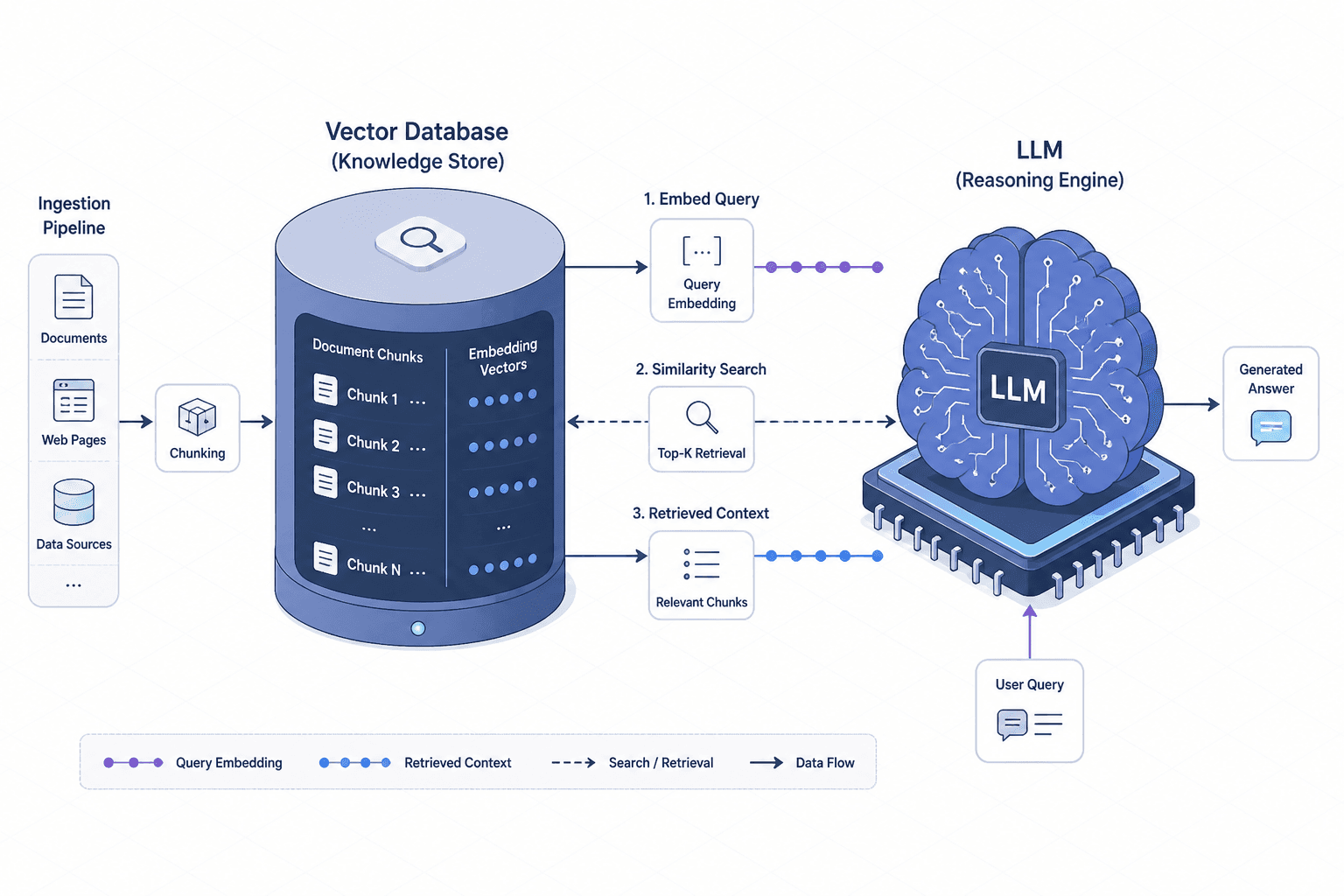
At its core, RAG is a data pipeline, not a new model. The process follows three distinct steps:
- Ingestion: External documents are chunked and embedded into a vector database.
- Retrieval: A user query is embedded, and the system performs a similarity search to find the most relevant chunks.
- Generation: The retrieved chunks are injected into the LLM’s prompt as context, and the model generates a response based on that combined input.
This is distinct from fine-tuning. Fine-tuning updates the model’s weights (parameters) to encode new knowledge. RAG keeps the weights frozen and updates only the data fed into the prompt.
Grounding, in this context, means tying the generated tokens to specific source artifacts. If the LLM says, "The server failed at 3 PM," grounding requires that this statement be traceable to a specific log file chunk retrieved in step 2. Without grounding, the LLM is generating based on probabilistic patterns in its training data. With grounding, it is generating based on a constrained subset of provided evidence.
What RAG Solves
RAG solves three specific problems effectively:
1. Verifiability
When an LLM answers from its pre-training data, you cannot verify the source. It might be recalling a fact from a book published in 2020 or a blog post from 2023. With RAG, the system returns citations. The user can click the link and verify the context. This shifts the trust model from "trust the model" to "trust the retrieval pipeline."
2. Data Freshness
LLMs are static snapshots of the internet at their training cutoff date. RAG allows you to query data that exists after the model was trained. You can ingest a PDF uploaded yesterday and query it today. This is critical for enterprise knowledge bases where information changes frequently.
3. Cost and Latency of Updates
Fine-tuning a large model is expensive and slow. If your company policy changes, you cannot retrain GPT-4. You can, however, update your vector database in seconds. RAG provides a low-latency path to updating the "knowledge base" without touching the model weights.
What RAG Doesn’t Solve
Despite its utility, RAG has significant architectural limitations. It does not solve the fundamental issues of LLMs, and it introduces new ones.
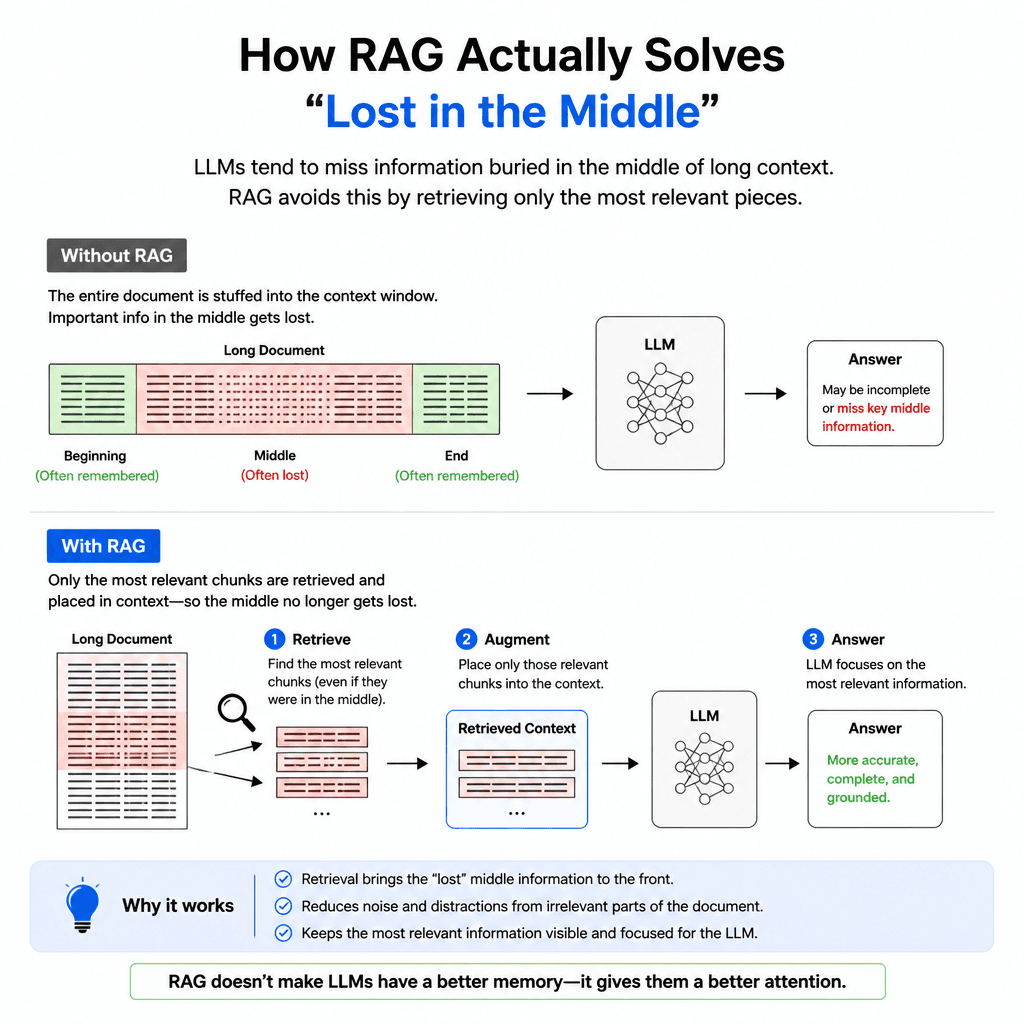
1. The "Lost in the Middle" Phenomenon
Research shows that LLMs struggle to use information placed in the middle of long contexts. In a study by Liu et al., models were asked to find a needle in a haystack—a specific fact inserted into a long document. When the fact was placed at the beginning or end, retrieval accuracy was high. When placed in the middle, accuracy dropped significantly.
If your retrieval system returns 5 chunks, and the correct answer is in chunk 3, the LLM may ignore it in favor of chunk 1 or 5. RAG does not fix this; it often exacerbates it by increasing context length.
2. Retrieval Failure
RAG is only as good as its retrieval system. If the vector search returns irrelevant chunks due to poor embedding quality or noisy data, the LLM will generate a confident but incorrect answer based on that bad context. This is known as "garbage in, gospel out." The LLM will treat the retrieved text as authoritative, even if it’s irrelevant.
3. Multi-Hop Reasoning
RAG struggles with questions that require synthesizing information from multiple, disjointed sources. If a question requires combining data from Chunk A and Chunk B, and the retrieval system only returns Chunk A, the LLM cannot answer correctly. Standard RAG pipelines are typically single-hop. They retrieve the "most similar" chunk, not the "most necessary" set of chunks for complex reasoning.
4. Hallucination Within Context
RAG does not stop the LLM from hallucinating within the provided context. If the retrieved text is ambiguous or contradictory, the LLM may make up a connection that isn’t there. It may also fail to follow negative constraints (e.g., "only use information from the retrieved text") if the prompt is not carefully engineered.
Architectural Reality Check
For developers, the key takeaway is that RAG shifts the burden of correctness from the LLM to the retrieval pipeline.
You are no longer just managing an LLM API call. You are managing:
- Chunking strategies: How do you split documents to preserve context?
- Embedding models: Which model best captures semantic similarity for your domain?
- Re-ranking: Do you need a second pass to filter irrelevant results?
- Prompt engineering: How do you instruct the LLM to handle missing or conflicting information?
RAG is an effective tool for grounding LLMs in specific data, but it is not a silver bullet. It solves the problem of access to dynamic information, but it does not solve the problem of reasoning over that information. Architects must design for retrieval failure, context window limits, and the inherent biases of both the embedding model and the generator.
Conclusion
RAG is not a magic fix for hallucination; it is a mechanism to constrain the generative search space of an LLM by providing external context, shifting the problem from "memory retrieval" to "information retrieval." By understanding what RAG solves—verifiability, freshness, and cost—and what it doesn’t—reasoning gaps, middle-context blindness, and retrieval failures—architects can build more reliable systems.