AWS KMS and Encryption: Data Protection Strategy
Explore AWS KMS, envelope encryption, and CloudHSM for a comprehensive data protection strategy.
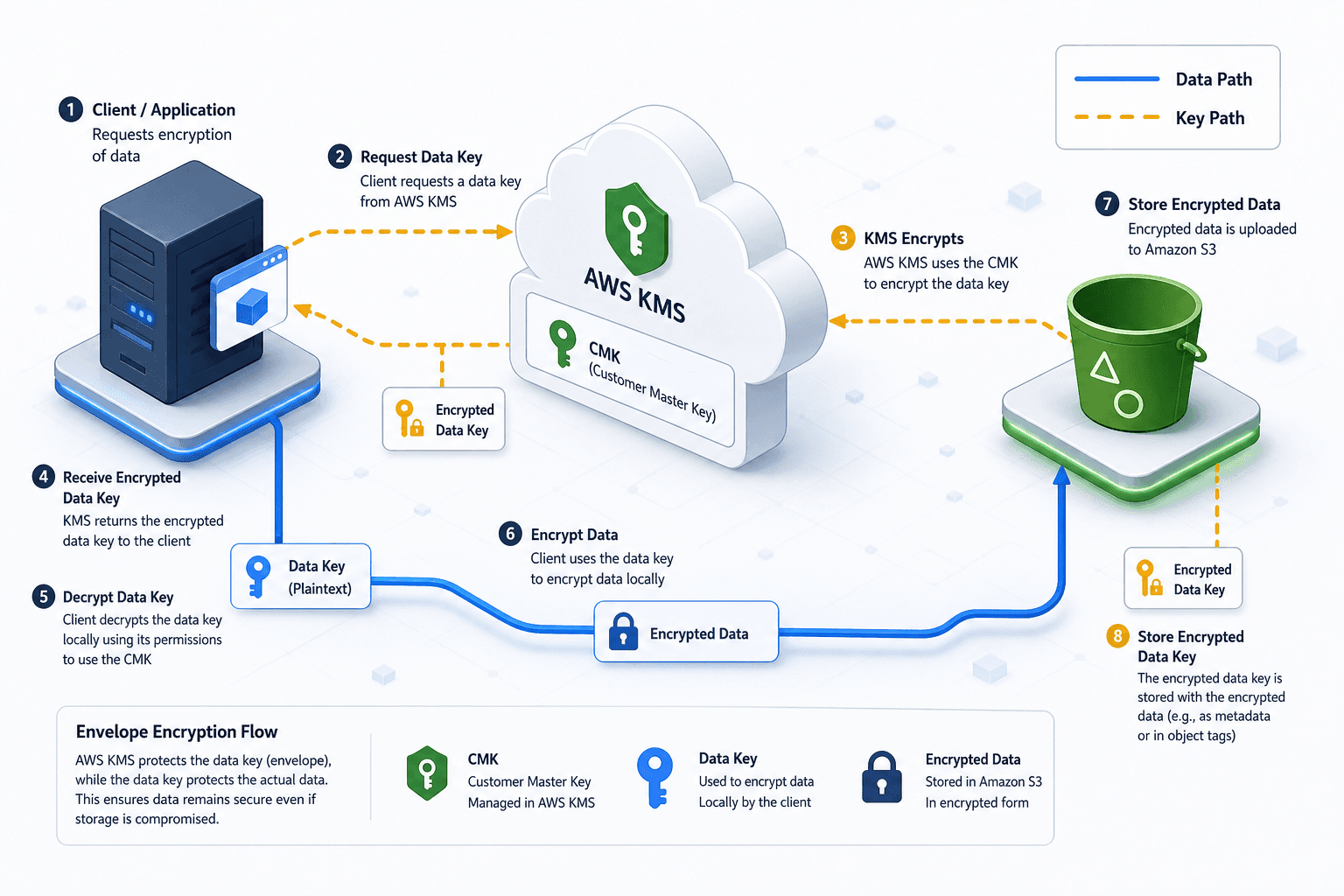
To secure data infrastructure effectively, one must first correct a fundamental misconception: AWS Key Management Service (KMS) is not a data store, but a control plane for cryptographic keys. Effective security relies on "Envelope Encryption" to decouple key management from data processing, allowing data keys to be stored in plaintext alongside encrypted data while the master key remains isolated. This strategy ensures that the heavy lifting of data encryption happens locally, while the centralized service only handles the generation and protection of the keys themselves.
The Mechanism of Envelope Encryption
The architectural necessity of Envelope Encryption arises from the limitations of sending large data payloads to a centralized API. Attempting to send a 50GB database backup directly to the KMS API would trigger network timeouts, rate limits, and prohibitive cost penalties. Instead, the Customer Master Key (CMK), often referred to historically as a "Master Key," never directly encrypts the data payload. It acts as a key generator.
When an application needs to encrypt a file, it calls the KMS API with a request to GenerateDataKey. The KMS service generates a random 256-bit key (the Data Key) and encrypts a copy of it using the CMK. The API response contains two distinct components: the Data Key in plaintext and the Data Key in ciphertext (often called the "encrypted key").
The application takes the plaintext Data Key, uses it to encrypt the data locally on the server, and then discards the plaintext key from memory. It stores the encrypted data and the ciphertext Data Key together in the storage system (e.g., S3, EBS, or RDS). The CMK remains safe inside the KMS service, never leaving the secure boundary.
This mechanism is critical for performance. Local symmetric encryption (like AES-256-GCM) is orders of magnitude faster than a network round-trip to a centralized service. By moving the heavy lifting to the client and only using the network for key generation, you achieve the security benefits of centralized key management without the latency penalty.
Key Policies: The Gatekeeper
Access to these keys is not governed by standard IAM policies alone. While IAM policies control who can call the API, the Key Policy is the resource-based policy attached directly to the CMK itself. It is the primary mechanism for defining trust boundaries within the KMS service. Note that while legacy documentation may refer to "Master Keys," the current standard terminology is CMK (Customer Master Key) or simply "Key."
Consider a scenario where you have a Lambda function that needs to decrypt data. You cannot simply attach an IAM policy to the Lambda execution role and expect it to work. The Key Policy must explicitly allow that role to perform kms:Decrypt or kms:GenerateDataKey. If the Key Policy denies the action, the IAM policy's permission is ignored.
A typical Key Policy structure looks like this:
{
  "Version": "2012-10-17",
  "Statement": [
    {
      "Sid": "Enable IAM User Permissions",
      "Effect": "Allow",
      "Principal": {
        "AWS": "arn:aws:iam::123456789012:root"
      },
      "Action": "kms:*",
      "Resource": "*"
    },
    {
      "Sid": "Allow Lambda to Decrypt",
      "Effect": "Allow",
      "Principal": {
        "AWS": "arn:aws:iam::123456789012:role/LambdaExecutionRole"
      },
      "Action": [
        "kms:Decrypt",
        "kms:GenerateDataKey"
      ],
      "Resource": "*"
    }
  ]
}
This policy ensures that even if the IAM role has broad permissions, the specific CMK restricts access to only the actions defined here. This separation allows you to manage key access independently of the broader infrastructure access controls.
Operational Scenario: S3 and EC2
Let's trace the data flow in a concrete environment. You have an EC2 instance (app-server-01) running an application that writes logs to an S3 bucket (secure-logs-bucket). Both are configured to use a specific CMK (alias/my-log-key).
- Request: The application on
app-server-01prepares to write a log entry. It calls the KMSGenerateDataKeyAPI, specifying the CMK and the number of bytes required (e.g., 256). - Response: KMS returns the
PlaintextDataKeyand theCiphertextBlob(the encrypted key). - Local Encryption: The application uses the
PlaintextDataKeyto encrypt the log data using AES-256. It immediately deletes the plaintext key from its RAM. - Storage: The application uploads the encrypted log data and the
CiphertextBlobtosecure-logs-bucket. The log file now contains the encrypted key as metadata or in a sidecar file. - Decryption: Later, when the application needs to read the log, it fetches the file. It sends the
CiphertextBlobto KMS via theDecryptAPI. KMS uses the CMK to decrypt the key, returning thePlaintextDataKey. The application uses this key to decrypt the log data locally, processes it, and discards the key again.
Notice that the CMK never touches the log data. The data path and the key path are entirely separate. This isolation prevents a breach of the storage layer from immediately exposing the encryption keys.
CloudHSM: The Hardware Boundary
For most workloads, the KMS service is sufficient. However, some organizations operate under strict regulatory requirements (such as PCI-DSS or specific government standards) that mandate the keys never leave their control or that the cryptographic operations occur in FIPS 140-2 Level 3 validated hardware. In these cases, KMS is not enough because the CMKs are managed by AWS infrastructure.
This is where AWS CloudHSM enters the strategy. CloudHSM provides dedicated Hardware Security Modules (HSMs) in the AWS cloud. Unlike KMS, where the keys are managed by the AWS service, in CloudHSM, you manage the HSMs. You have exclusive access to the HSM instances. The keys are generated and stored on the physical chip inside the appliance, and the cryptographic operations happen inside that box.
The mechanism here is different. You interact with CloudHSM via a PKCS#11 or JCE provider, not the KMS API. You are essentially renting a physical server with a specialized security chip. This adds significant operational overhead compared to KMS—you must manage the cluster, patching, and availability—but it satisfies the requirement for "exclusive key ownership."
If your strategy requires you to prove to an auditor that no other tenant in the cloud could theoretically access your keys, CloudHSM is the mechanism. This is often a prerequisite for specific cloud compliance frameworks that demand physical isolation of cryptographic material. If you just need strong encryption and key rotation, KMS with Envelope Encryption is the standard.
Strategic Tradeoffs
Choosing between KMS and CloudHSM is not a binary decision of "better or worse," but a tradeoff between operational convenience and strict compliance boundaries.
KMS offers a fully managed experience. You get automatic key rotation (for certain key types), integration with almost every AWS service, and the envelope encryption mechanism built-in. The tradeoff is that you trust AWS's isolation mechanisms. You do not have the physical keys.
CloudHSM offers maximum control but requires you to build the automation for key management, backup, and disaster recovery yourself. You pay for the dedicated hardware plus the operational cost of managing the HSM lifecycle.
In a typical modern architecture, I recommend starting with KMS and Envelope Encryption. It covers 95% of compliance requirements (SOC2, HIPAA, GDPR) without the complexity of managing hardware. Only introduce CloudHSM if your specific regulatory framework explicitly demands FIPS 140-2 Level 3 validation or exclusive key custody that KMS cannot provide.
The core lesson is that encryption is not just about turning data into gibberish; it is about the mechanism of key delivery and storage. By keeping the data keys short-lived and local, and the master keys remote and managed, you create a defense-in-depth strategy that survives both storage breaches and API compromises.
Common Pitfalls
Implementing envelope encryption introduces several subtle risks that can compromise security if overlooked.
- Improper Key Rotation: Many teams assume KMS handles all rotation automatically. While KMS can rotate CMKs automatically for certain types, this does not automatically re-encrypt existing data. You must plan for a background job to re-wrap data keys using the new CMK version, or rely on services that handle this transparently.
- Retaining Plaintext Keys: The most critical step in envelope encryption is discarding the plaintext Data Key from memory immediately after use. Failing to clear this key from RAM or storing it in logs/cache creates a vulnerability where an attacker with memory access can recover the key to decrypt the data.
- Incorrect Key Policy Permissions: As discussed, the Key Policy overrides IAM policies. A common mistake is granting
kms:*to a broad IAM role without restricting the Key Policy to specific actions likeGenerateDataKeyorDecrypt. This can lead to unauthorized access if the IAM policy is later modified or if a lateral movement attack occurs.
Conclusion
Implementing a comprehensive data protection strategy in AWS requires a clear understanding of the separation between data and keys. By leveraging Envelope Encryption, organizations can achieve high-performance security without the latency of centralized encryption for large datasets. Whether utilizing the managed simplicity of KMS with strict Key Policies or the hardware-bound isolation of CloudHSM, the goal remains consistent: isolate the Master Key to ensure that even if storage is compromised, the data remains secure.
Practical Takeaways
To simplify your approach to AWS encryption, remember these three mental models:
- Data stays local, keys stay remote: The heavy lifting of encryption happens on your server; only the short-lived keys travel across the network.
- Key Policy overrides IAM: Always verify the Key Policy attached to the CMK, as it is the final gatekeeper for access regardless of IAM permissions.
- KMS is for convenience, CloudHSM is for control: Choose KMS for 95% of use cases to save operational effort, and reserve CloudHSM for strict regulatory mandates requiring physical hardware isolation.
FAQ
Q: Can I use CloudHSM to encrypt data directly without KMS? A: Yes. CloudHSM allows you to perform cryptographic operations directly on the HSM hardware using standard libraries like PKCS#11. You manage the data encryption keys and the data itself, without the data ever leaving your application to be processed by a managed service like KMS.
Q: Does envelope encryption work with Amazon S3 Server-Side Encryption (SSE-S3)? A: No. SSE-S3 uses keys managed internally by AWS S3, not your KMS keys. Envelope encryption with KMS is implemented via SSE-KMS, where you specify the CMK, or SSE-C, where you provide your own key.
Q: How often should I rotate my Data Keys? A: In the envelope encryption model, Data Keys are short-lived. They are generated per request or per object. You do not need to manually rotate them; they are discarded immediately after the encryption operation is complete. Only the CMK (Master Key) requires rotation management.
Related posts
RFC 8693: Token Exchange, Delegation, and Impersonation
RFC 8693 defines token exchange, delegation, and impersonation mechanisms for OAuth 2.0, enabling secure identity propagation across service boundaries.
Implementing and Validating Discovery in Your Client
A technical walkthrough for backend developers on implementing OAuth 2.1 discovery, issuer validation, and strict discovery document validation using OpenIDConnectConfigurationRetriever.
Decoding client_secret_basic Default in RFC 8414
An examination of the token_endpoint_auth_methods_supported metadata field in RFC 8414 and why client_secret_basic remains the default authentication method.