Spring Security with Reactive WebFlux: Security for Reactive Applications
An examination of Spring Security integrated with Reactive WebFlux, covering authentication, reactive JWT, and securing reactive applications.
Part 1 of the Spring Reactive Architecture Series
In Spring WebFlux, the traditional per-thread security model collapses because threads are scarce resources shared by thousands of concurrent connections. If a security filter blocks a thread waiting for JWT validation or a database lookup, the entire application hangs. The mechanism here is not about "adding" security; it is about rewriting the security chain to be fully non-blocking, ensuring backpressure is maintained throughout the request lifecycle.
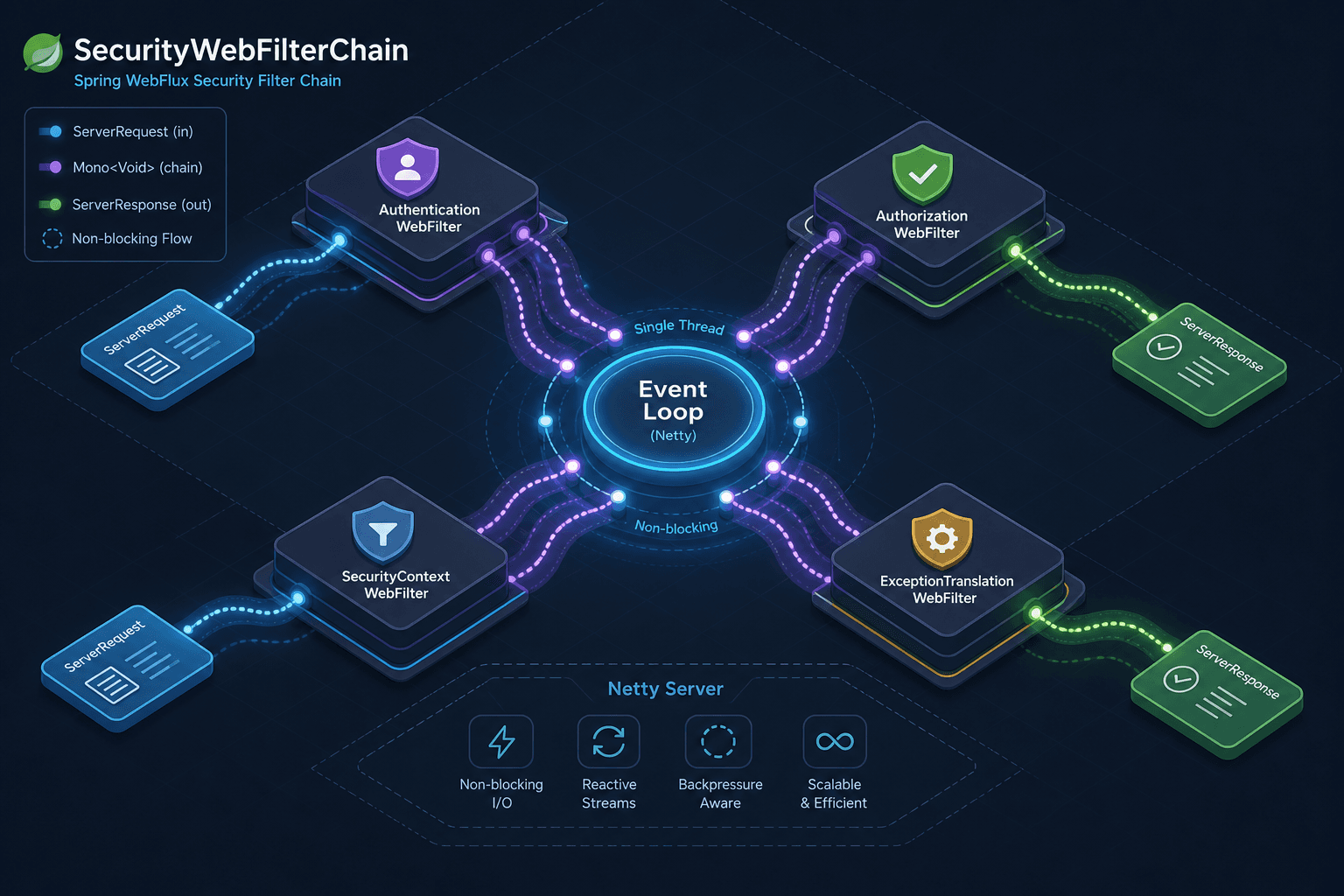
The core difference lies in the filter chain itself. In Spring Security for WebFlux, the entry point is SecurityWebFilterChain. Unlike the FilterChain in Servlet, which accepts HttpServletRequest and HttpServletResponse, the reactive chain accepts ServerRequest and ServerResponse. These are immutable, functional interfaces that do not expose blocking methods. When you configure a SecurityWebFilterChain, you are defining a sequence of WebFilter instances. Each filter must return a Mono<Void> or Flux<Void> to signal completion. This signals to the reactor core that the filter has yielded control back to the event loop, allowing other requests to be processed while the current one waits for asynchronous operations to finish.
Consider a scenario where we need to validate a JWT token for an incoming request. In a blocking application, you might write code that extracts the token, sends a synchronous HTTP call to a user service, and returns the user object. In WebFlux, this is impossible within the filter chain without risking a deadlock. Instead, we construct a ServerOAuth2AuthorizedClientManager or a custom AuthenticationConverter that returns a Mono<Authentication>.
The Mechanism of Reactive Chains
To understand how SecurityWebFilterChain intercepts ServerHttpRequest without blocking the event loop, we must contrast the traditional blocking calls with the non-blocking access provided by ServerRequest. In the reactive model, the SecurityWebFilterChain acts as a gateway where each WebFilter processes the request asynchronously.
The SecurityWebFilterChain accepts a ServerHttpRequest and returns a ServerResponse. This functional approach ensures that no thread is held hostage by I/O operations. When a filter completes its work, it returns a Mono<Void> or Flux<Void>, indicating that the stream is ready to proceed. This mechanism allows the reactor core to schedule other tasks while the current request waits for external resources like a database or an identity provider.
@Bean
public ServerAuthenticationConverter jwtAuthenticationConverter() {
    return serverRequest -> {
        String token = serverRequest.headers()
            .firstHeader("Authorization")
            .map(authHeader -> authHeader.substring(7)) // Remove "Bearer "
            .orElse("");

        return Mono.fromSupplier(() -> {
            try {
                // Non-blocking decoding logic
                Jwt jwt = jwtDecoder.decode(token);
                return new JwtAuthenticationToken(jwt);
            } catch (InvalidJwtException e) {
                return null;
            }
        });
    };
}
Notice that the ServerAuthenticationConverter returns a Mono<Authentication>. If the token is invalid, the Mono emits an error or null, which the security chain interprets as a failed authentication. If valid, it emits the JwtAuthenticationToken. This token is then placed into a reactive SecurityContext that is attached to the ServerWebExchange. Crucially, this context is passed down the chain via the exchange object, not via ThreadLocal. This allows the security context to be accessed by downstream filters and controller methods without ever requiring a thread to be blocked waiting for data.
Stateless Authentication with JWT
This shift enables stateless authentication flows where the user identity travels with the request artifact (the token) rather than being stored in a server-side session. In WebFlux, HttpSession is an anti-pattern because maintaining a session implies state storage that often requires locking or database access, which breaks the reactive promise. Instead, the ServerOAuth2ResourceServerAutoConfiguration provides a default setup that uses a JwtDecoder to validate tokens and populates the context via a default ServerAuthenticationConverter.
Let's look at the mechanism of a reactive JWT validator. We create a class that implements ServerAuthenticationConverter. This class extracts the token from the Authorization header using ServerRequest.headers(). It then passes this token to a reactive JWT decoder. The decoder does not block; it schedules the parsing and validation on a different scheduler if necessary, or relies on the non-blocking crypto libraries available in Java 17+.
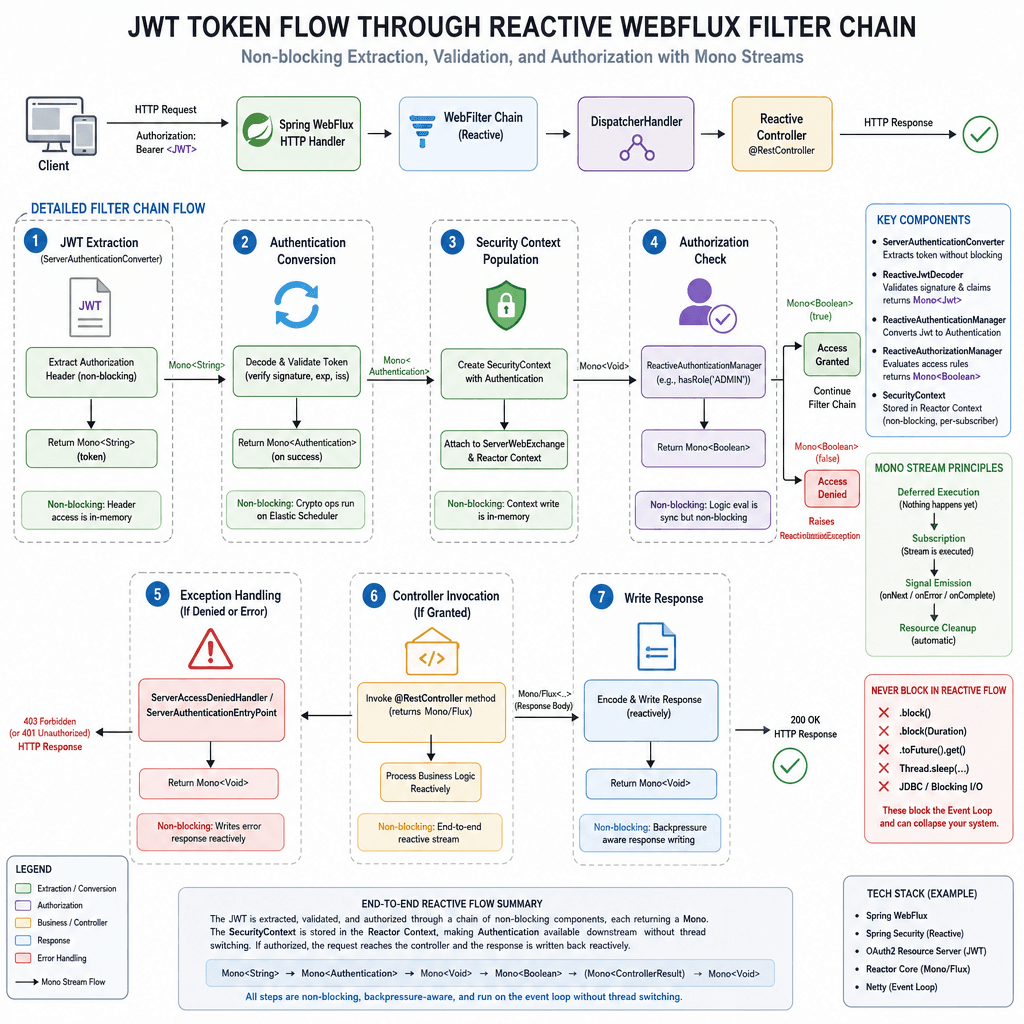
Another nuance is the handling of authentication failures. In a blocking app, you might throw an exception that the servlet container catches. In WebFlux, exceptions are propagated as errors in the Flux or Mono stream. You must configure a ServerAuthenticationEntryPoint that handles these errors. This entry point typically returns a 401 Unauthorized response with a JSON body, rather than redirecting to a login page (which relies on cookies and sessions, both problematic in pure reactive setups).
The mechanism of the security context is distinct from the servlet context. The Authentication object is stored in ServerWebExchange attributes and propagated through the ReactorContext, but the context itself is not a ReactorContext. Every subsequent component in the chain can access it via ServerWebExchange.getAttributes() or by injecting ReactiveSecurityContextHolder.
For example, in a service layer, you might need to know the current user. You can use ReactiveSecurityContextHolder statically:
@Service
public class OrderService {
    public Mono<Order> createOrder(OrderRequest request) {
        return ReactiveSecurityContextHolder.getContext()
            .map(securityContext -> securityContext.getAuthentication().getName())
            .flatMap(username -> orderRepository.save(new Order(username, request)));
    }
}
This pattern ensures that the user identity flows through the application without ever blocking. The context.getContext() returns a Mono<SecurityContext>, which we map to extract the username.
Opinion: While reactive security is powerful, it introduces complexity in debugging. When a Mono fails, the stack trace is often lost or wrapped in OnNextMissing or OnErrorNotImplemented exceptions if the error is not handled upstream. It is essential to always use .onErrorResume or .onErrorMap in your security chains to ensure meaningful error messages are returned to the client, rather than generic 500 errors.
Finally, consider the dependency on the underlying transport. WebFlux often runs on Netty. The security configuration must account for the fact that Netty handles SSL termination differently than Tomcat. If you are using mutual TLS (mTLS), the certificate extraction happens at the transport layer before the request reaches the Spring Security filters. In this case, the Authentication object is populated based on the client certificate, not a JWT. The ServerHttpSecurity configuration must include the appropriate ClientCertificateAuthenticationManager to handle this flow, ensuring the certificate is validated against the trusted CA list before the request is even considered authenticated.
Conclusion
The convergence of Spring Security and WebFlux represents a fundamental shift from thread-per-request to event-driven security. By understanding that the SecurityContext is now a stream of data rather than a thread-local variable, you can build applications that scale horizontally without the overhead of managing session affinity or blocking I/O. The key is to respect the non-blocking contract at every step: no .block(), no ThreadLocal, and no blocking database calls.
Common Pitfalls
When implementing reactive security, developers frequently encounter specific traps that undermine the benefits of WebFlux. First, accidental blocking occurs when developers use .block() or blocking I/O inside filters or controllers, which starves the event loop. Second, context propagation errors happen when relying on ThreadLocal assumptions or failing to pass ServerWebExchange correctly between components, leading to null Authentication objects. Third, error handling gaps arise when reactive streams fail without proper .onErrorResume handlers, causing the application to swallow exceptions or return generic 500 errors instead of meaningful security responses.
Practical Takeaways
To navigate these challenges effectively, adopt these mental models:
- Streams over Threads: Always view security data as a stream (
Mono/Flux) that flows through the chain, never as a static variable attached to a thread. - Non-Blocking Contract: Treat the event loop as a shared resource; any operation that waits for I/O must be asynchronous.
- Explicit Error Handling: Assume every reactive stream can fail; explicitly map and resume errors to ensure security boundaries are respected in the response.
FAQ
Q: Can I use ThreadLocal for security context in WebFlux?
A: No. ThreadLocal is tied to the specific thread executing the code. In WebFlux, the same thread may process multiple requests sequentially or concurrently, and the context is passed via ServerWebExchange and ReactorContext instead.
Q: How do I handle session-based authentication in WebFlux? A: While possible, it is generally discouraged. Session-based auth requires storing state, which often leads to blocking database calls or Redis operations. Stateless JWT is preferred for reactive applications to maintain non-blocking guarantees.
Q: Does @PreAuthorize block the event loop?
A: The standard SpEL expression evaluation within @PreAuthorize is synchronous. However, it does not block the event loop unless the expression itself triggers a blocking operation. For fully non-blocking checks, you must implement a custom ReactiveAuthorizationManager.
Related posts
Reactive Security: WebFlux & JwtAuthenticationToken
Explore WebFlux security patterns using ReactiveSecurityContextHolder and JwtAuthenticationToken for non-blocking authentication.
AuthenticationManager, Providers, and UserDetailsService
An examination of Spring Security's core components: AuthenticationManager, AuthenticationProvider, and UserDetailsService, and how they interact.
SecurityFilterChain in Spring Security 6
A technical walkthrough of configuring SecurityFilterChain in Spring Security 6 using the Lambda DSL and RequestMatchers for Java developers.