Spring Security Password Encoding: BCrypt, Argon2, and PBKDF2
An examination of password encoding strategies in Spring Security using BCrypt, Argon2, and PBKDF2 to ensure secure password storage.
In the architecture of a Spring Security application, the PasswordEncoder is not merely a utility for hiding data; it is the boundary condition between user input and database persistence. This article explores the mechanisms of BCrypt, Argon2, and PBKDF2 within Spring Security to implement secure password hashing. As the 15th part of the Spring Security Deep Dive Series, we examine how the choice of algorithm dictates computational cost and resistance to specific attack vectors.
The PasswordEncoder Interface Mechanism
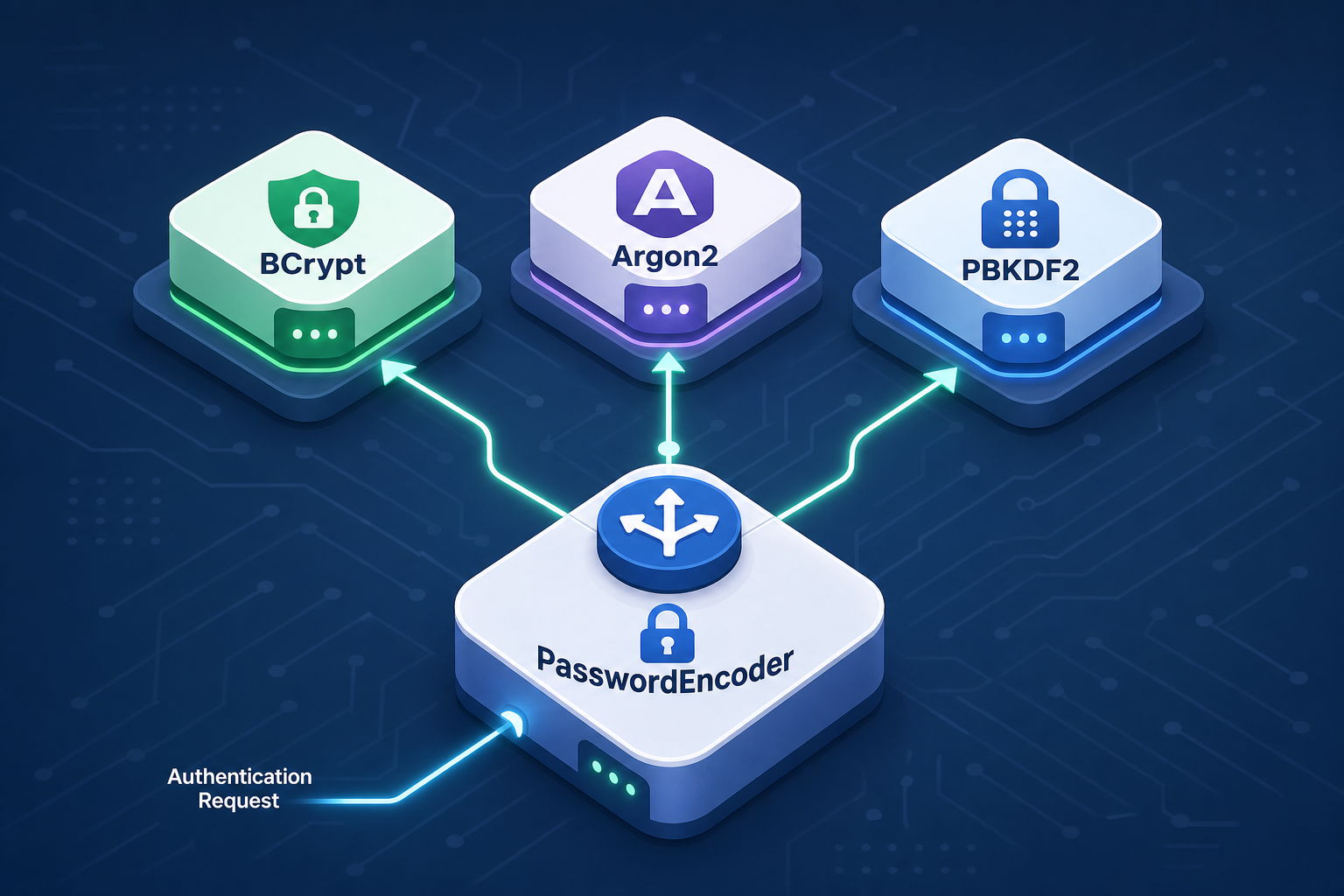
Spring Security's PasswordEncoder interface decouples the storage format from the verification logic. It mandates two methods: encode(CharSequence rawPassword) and matches(CharSequence rawPassword, String encodedPassword). The critical mechanism here is that the encode method returns a string containing the algorithm identifier, the salt, and the resulting hash in a single, self-describing blob.
During the matches phase, Spring Security parses this blob to determine which specific algorithm implementation to invoke. If the stored hash begins with $2a$, the system invokes the BCrypt logic; if it starts with $argon2id$, it invokes Argon2. This design prevents the "algorithm confusion" attack, where an attacker might attempt to verify a BCrypt hash using a faster, less secure algorithm.
BCrypt Mechanics and Cost Factors
The default recommendation for years has been BCrypt. Mechanistically, BCrypt is an iterative key derivation function based on the Exponential Blowfish cipher. When Spring Security initializes a BCrypt encoder, it accepts a cost factor, often denoted as rounds. This cost factor is not a direct multiplier but an exponent: the algorithm performs $2^$ rounds of the Blowfish key setup. For example, a cost of 10 means 1024 iterations.
The output string, starting with $2a$ (or $2y$ for compatibility), embeds the 128-bit random salt directly into the hash string. This salt is generated once per password change and ensures that even if two users have the password "password123", their stored hashes are completely different.
The security guarantee of BCrypt relies on the fact that it is CPU-intensive. While BCrypt is not memory-hard, allowing attackers to parallelize computation efficiently across GPU cores, the primary defense is increasing the cost factor. An attacker with a standard CPU can only compute a limited number of hashes per second, and raising the cost factor linearly increases the time required for each attempt, effectively throttling brute-force capabilities.

Argon2 Mechanics and Memory Hardness
To address the GPU vulnerability, the industry has shifted toward Argon2, the winner of the Password Hashing Competition. In Spring Security, implementing Argon2 involves using the Argon2PasswordEncoder class. The mechanism here is fundamentally different because Argon2 is memory-hard, not just CPU-hard. While BCrypt increases the time required to hash, Argon2 forces the algorithm to consume a specific amount of RAM (memory capacity) and perform memory access patterns that are difficult to parallelize efficiently.
When you configure an Argon2 encoder in Spring, you specify parameters like timeCost (iterations), memoryCost (RAM in kilobytes), and parallelism (threads). The algorithm divides the memory into a large grid and accesses it in a pseudo-random order. If an attacker tries to run this on a GPU, they are bottlenecked by the high latency of off-chip memory access required by the large memory footprint rather than the sheer number of cores. This makes the cost of hardware acceleration (ASICs or FPGAs) prohibitively expensive, as building a device with massive amounts of RAM is far more costly than building a device with many simple ALUs. The stored hash prefix $argon2id$ indicates the specific variant (ID is the most secure variant balancing time and memory hardness) used.
PBKDF2 Mechanics and Legacy Constraints
PBKDF2 (Password-Based Key Derivation Function 2) represents a different evolutionary stage. It is defined in RFC 8018 and is widely supported in legacy systems. Mechanistically, PBKDF2 applies a pseudorandom function (usually HMAC-SHA256) to the password and salt repeatedly. The configuration in Spring Security involves setting the iterations parameter. Unlike BCrypt or Argon2, PBKDF2 does not inherently use a salt within the hash structure in the same way; it requires the application to manage the salt separately or include it in the encoded string format.
The critical weakness of PBKDF2 in modern contexts is that it is not memory-hard. It is purely CPU-bound. While increasing the iteration count slows down the process, a GPU can still parallelize the computation of HMAC operations extremely efficiently. If you set the iteration count to 100,000 for BCrypt, it takes a noticeable amount of time. If you set PBKDF2 to 100,000 iterations, a GPU can still compute that in a fraction of the time it takes a CPU. Therefore, while PBKDF2 is acceptable for compliance in some legacy environments, it is generally considered inferior for new applications where BCrypt or Argon2 are available.
Common Pitfalls
Implementing password encoding introduces specific risks that often go unnoticed during development. Avoid these common errors to maintain security integrity:
- Hardcoding Salts: Never use a static salt value. The salt must be cryptographically random and unique for every password. A hardcoded salt renders the hashing useless against rainbow table attacks.
- Weak Iteration Counts: Do not rely on default iteration counts indefinitely. Parameters like
roundsfor BCrypt oriterationsfor PBKDF2 must be tuned to balance security and latency, and increased periodically as hardware becomes more powerful. - Ignoring Algorithm Confusion: Failing to use a
DelegatingPasswordEncoderor similar strategy can lead to "algorithm confusion" attacks, where an attacker tricks the system into verifying a hash with a weaker algorithm than the one originally used to generate it.
Configuration Strategy with DelegatingPasswordEncoder
A common point of confusion arises when migrating from an older system to a newer one. You cannot simply swap the encoder bean in your configuration and expect the old passwords to work. The DelegatingPasswordEncoder is the mechanism designed to solve this. It wraps multiple encoders and maintains a "default" algorithm for new passwords. When matches is called, it parses the first few characters of the stored hash to identify the algorithm prefix. If the stored hash is $2a$..., it delegates to the BCrypt encoder. If the stored hash is $pbkdf2$..., it delegates to the PBKDF2 encoder. This allows a system to have a mix of algorithms.
However, a critical operational step is the "migration" logic. After a successful matches check, the application should re-encode the password using the new, stronger algorithm (e.g., Argon2) and update the database. This is typically handled in the AuthenticationProvider or a custom UserDetailsManager implementation. Without this re-encoding step, the system remains stuck with the weaker algorithm for existing users.
@Bean
public PasswordEncoder passwordEncoder() {
    // Use DelegatingPasswordEncoder to handle mixed algorithm storage
    Map<String, PasswordEncoder> encoders = new HashMap<>();
    encoders.put("argon2", new Argon2PasswordEncoder());
    encoders.put("bcrypt", new BCryptPasswordEncoder());
    encoders.put("pbkdf2", new Pbkdf2PasswordEncoder());

    // Set 'argon2' as the default for new registrations
    return new DelegatingPasswordEncoder("argon2", encoders);
}
In this configuration, the DelegatingPasswordEncoder acts as a router. When a new user registers, the encode method uses the "argon2" key to generate a hash starting with $argon2id$. When an existing user logs in with a hash starting with $2a$, the router detects the prefix, looks up the corresponding BCryptPasswordEncoder in the map, and verifies the credentials. This decoupling is essential for long-term security maintenance. It ensures that the application can adopt stronger algorithms over time without forcing a global reset of all user passwords. The tradeoff is complexity: you must ensure the encoders map contains every algorithm that might exist in your database, or the system will throw an exception when encountering an unknown prefix.

Conclusion
The decision between BCrypt, Argon2, and PBKDF2 ultimately rests on the threat model. If you are targeting high-value assets where attackers possess specialized hardware, Argon2 is the superior choice due to its memory-hardness. If you need maximum compatibility with existing libraries or hardware, BCrypt remains a robust standard. PBKDF2 should be reserved for scenarios where you are constrained by legacy protocols or strict FIPS compliance that explicitly mandates it. In all cases, the mechanism of Spring Security ensures that the algorithm choice is transparent to the business logic but rigorous in its enforcement of the hashing parameters. The security of the system does not come from the obscurity of the code, but from the mathematical difficulty of reversing the specific transformation applied to the password salt.
Practical Takeaways
- Prioritize Memory Hardness: Select Argon2 for new applications to mitigate GPU-based brute-force attacks effectively.
- Leverage Delegating Encoders: Use
DelegatingPasswordEncoderto support multiple algorithms simultaneously during migration periods. - Enforce Re-encoding: Implement logic to automatically upgrade password hashes to stronger algorithms immediately after a successful login.
FAQ
Q: Can I use PBKDF2 if I don't have the hardware for Argon2? A: Yes, PBKDF2 is a valid choice if you cannot meet the memory requirements of Argon2, provided you configure a sufficiently high iteration count to compensate for the lack of memory hardness.
Q: How do I migrate from BCrypt to Argon2 without forcing a password reset?
A: Use a DelegatingPasswordEncoder configured to verify BCrypt hashes while re-encoding them with Argon2 upon successful authentication. Update the stored hash in the database during this process.
Q: Is the salt generated by Spring Security secure enough?
A: Yes, Spring Security's built-in encoders (like BCryptPasswordEncoder and Pbkdf2PasswordEncoder) automatically generate cryptographically strong, random salts for every password, eliminating the risk of weak or reused salts.
Related posts
RFC 9700: The Mandatory Guardrails for OAuth 2.0
An examination of RFC 9700, detailing OAuth 2.0 security best current practices, including mitigation of mix-up attacks and redirect URI validation.
Implementing Passwordless MFA with FIDO2 and WebAuthn in Spring Boot
A technical walkthrough on integrating passwordless MFA using FIDO2 and WebAuthn within a Spring Boot application.
Building a Custom Authentication Provider in Spring Security
This article covers the implementation of a custom authentication mechanism within Spring Security using a dedicated AuthenticationProvider.