Spring Security Method Security: @PreAuthorize, @Secured, and SpEL
An examination of Spring Security method security using @PreAuthorize, @Secured, and SpEL for implementing RBAC.
The Proxy Mechanism Behind Method Security
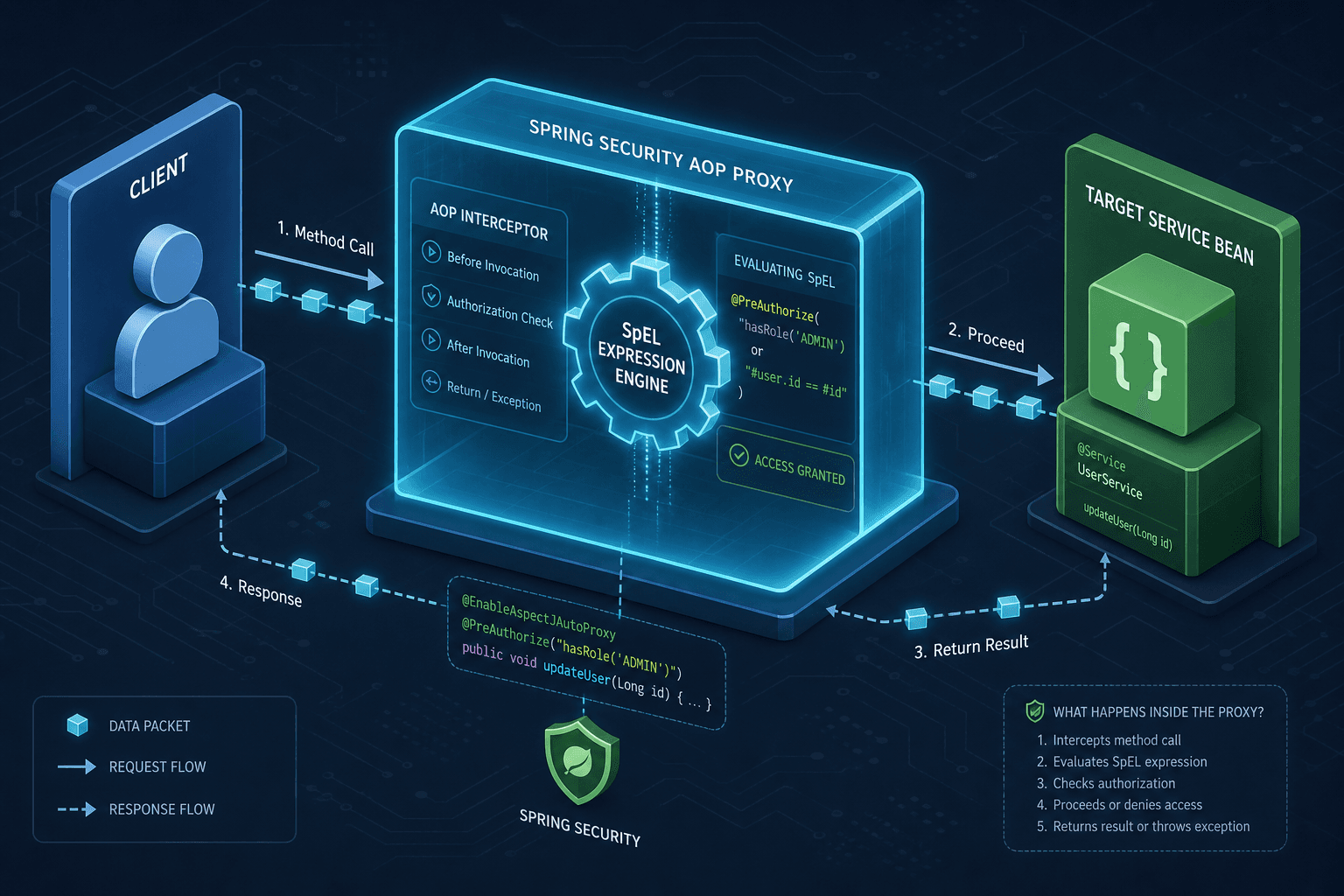
Spring Security’s method-level authorization relies on an Aspect-Oriented Programming (AOP) proxy layer between the caller and your bean. When you annotate a class with @EnableMethodSecurity, the framework registers a MethodSecurityPostProcessor that scans the application context for beans containing method security annotations. Without this proxy, calls to methods like processOrder() bypass security checks entirely.
The Legacy of @Secured
The @Secured annotation represents the earliest approach to method security in Spring. It relies on a static list of roles defined as strings, such as ROLE_ADMIN or ROLE_USER. Internally, the @Secured annotation triggers a RoleVoter. The voter compares the roles required by the annotation against the authorities granted to the current Authentication principal.
This mechanism is rigid. It cannot inspect method arguments. Imagine a scenario where a BankService has a method withdrawFunds(double amount). If you use @Secured("ROLE_TELLER"), the system checks if the user is a teller. It cannot, however, verify if the amount is within the teller's daily limit or if the target account belongs to the user. Furthermore, @Secured does not support the Spring Expression Language (SpEL) syntax for dynamic evaluation. It is essentially a static gatekeeper. While the Spring Security team discourages its use in favor of the more expressive @PreAuthorize, it remains supported for backward compatibility.
SpEL and the Power of @PreAuthorize
The modern standard is @PreAuthorize, which delegates the decision-making process to the Spring Expression Language (SpEL) engine. Unlike @Secured, SpEL allows you to reference the Authentication object and method arguments. Note that returnObject is only available in @PostAuthorize because the method has not executed yet when @PreAuthorize evaluates.
When the proxy encounters @PreAuthorize("hasRole('ADMIN')"), it constructs a SpEL context. This context includes:
- authentication: The current
Authenticationobject. - args: An array of method arguments.
- #variableName: Specific named arguments (if parameter names are compiled with
-parameters).
Consider a UserService method updateProfile(User user). A robust RBAC rule might look like this:
@PreAuthorize("#user.id == authentication.principal.id")
public void updateProfile(User user) {
    // Logic here
}
Here, the SpEL engine evaluates the expression before the method body runs. It accesses the user argument (the #user variable) and compares its id property against the id of the principal currently logged in (found in authentication.principal). If the IDs do not match, the SpEL engine returns false, and the proxy throws an exception. This mechanism enables fine-grained, context-aware authorization that static role lists cannot achieve.
A Worked Scenario: The Bank Transfer
Let’s trace the mechanism with a concrete scenario involving a BankAccount and a TransactionService. We have a User object with a balance and a Transaction object with a recipient and amount.
The TransactionService defines a method:
@PreAuthorize("#transaction.recipient == authentication.principal.username || hasRole('SUPER_ADMIN')")
public void executeTransfer(Transaction transaction) {
    // Perform bank logic
}
Step 1: The Call
A user alice calls executeTransfer with a transaction to transfer funds to bob. The proxy intercepts the call.
Step 2: Context Resolution
The proxy retrieves the Authentication object from thread-local storage via SecurityContextHolder. The SpEL engine then resolves the #principal property to the User object contained within that Authentication. The context is populated:
authentication.principalresolves toalice.transaction.recipientresolves tobob.
Step 3: Expression Evaluation
The SpEL engine evaluates the boolean expression: #transaction.recipient == authentication.principal.username.
- Left side:
bob. - Right side:
alice. - Result:
false.
Step 4: Fallback Logic
Since the first part of the OR condition failed, the engine evaluates hasRole('SUPER_ADMIN').
- If
aliceis not a super admin, the result isfalse. - The proxy throws an
AccessDeniedException.
If the transaction was to transfer funds to alice (self-transfer), the first part evaluates to true, the || short-circuits, and the method proceeds. This mechanism demonstrates how SpEL allows you to encode complex business rules directly into the security layer without cluttering the method body with if statements.
Strategic Tradeoffs and Implementation
Using @PreAuthorize shifts the complexity from the application code to the configuration layer. This is generally a positive tradeoff for RBAC systems, as it centralizes policy logic. However, it introduces a dependency on the compilation of method parameter names. If your Java code is compiled without the -parameters flag (common in some IDE settings or older configurations), the #variableName syntax will fail to resolve, falling back to generic names like arg0 or arg1. To ensure reliability, always compile with -parameters or use explicit naming conventions.
Additionally, SpEL expressions can become verbose. For very complex logic, consider creating custom beans and injecting them into the expression. For example, you could inject a PermissionEvaluator bean to handle intricate permission checks, keeping the annotation clean.
@PreAuthorize("@permissionEvaluator.canTransfer(#transaction, authentication)")
public void executeTransfer(Transaction transaction) { ... }
This approach maintains the separation of concerns while leveraging the full power of the SpEL engine. The proxy mechanism remains the same, but the evaluation logic becomes more modular. This pattern is essential for enterprise applications where authorization rules evolve rapidly and need to be decoupled from the core business logic.
In summary, while @Secured provides a quick way to lock down methods with static roles, @PreAuthorize with SpEL is the only mechanism capable of handling the dynamic, argument-aware requirements of modern RBAC. The proxy ensures these checks happen transparently, but the developer must understand the underlying context resolution to write effective, secure expressions.
Conclusion
Implementing robust method-level security in Spring requires understanding the AOP proxy mechanism and the capabilities of SpEL. By moving away from the static constraints of @Secured and embracing the dynamic evaluation of @PreAuthorize, developers can build flexible, secure, and maintainable RBAC systems that adapt to complex business requirements without polluting core logic.
Common Pitfalls
- Missing Parameter Names: Forgetting to compile with
-parameterscauses#variableNameto resolve toarg0, breaking logic that depends on specific argument names. - Null Pointer Exceptions: Failing to handle cases where
authentication.principalis null or the user object properties are missing can lead to runtime exceptions during expression evaluation. - Overcomplicating Expressions: Embedding complex business logic directly into SpEL strings makes debugging difficult; it is often better to delegate to a dedicated service bean.
Practical Takeaways
- Separation of Concerns: Keep business logic out of security annotations. Use custom beans for complex permission logic to keep expressions readable.
- Context Awareness: Leverage the
authenticationandargsobjects to make decisions based on both the user and the data being accessed. - Proxy Transparency: Remember that the AOP proxy handles the execution flow; if a check fails, the target method never runs, ensuring strict enforcement.
FAQ
Q: Can I use @PreAuthorize with null arguments?
A: Yes, but you must handle null checks explicitly within the SpEL expression (e.g., #user != null and #user.id == ...) to avoid NullPointerException.
Q: Is @Secured slower than @PreAuthorize?
A: The performance difference is negligible. The primary distinction is functionality; @PreAuthorize offers dynamic evaluation while @Secured is limited to static roles.
Q: How do I test method security annotations?
A: Use Spring Security's TestRestTemplate or MockMvc with a mock Authentication object in the request headers to simulate different user roles and contexts.
Related posts
Building a Custom Authentication Provider in Spring Security
This article covers the implementation of a custom authentication mechanism within Spring Security using a dedicated AuthenticationProvider.
Implementing Attribute-Based Access Control (ABAC) with Spring Security
A technical guide on implementing attribute-based access control (ABAC) using Spring Security and Open Policy Agent for dynamic policy enforcement.
Spring Security and GraphQL: Securing GraphQL APIs
A technical examination of securing GraphQL APIs using Spring Security, covering authorization, rate limiting, and API security best practices.