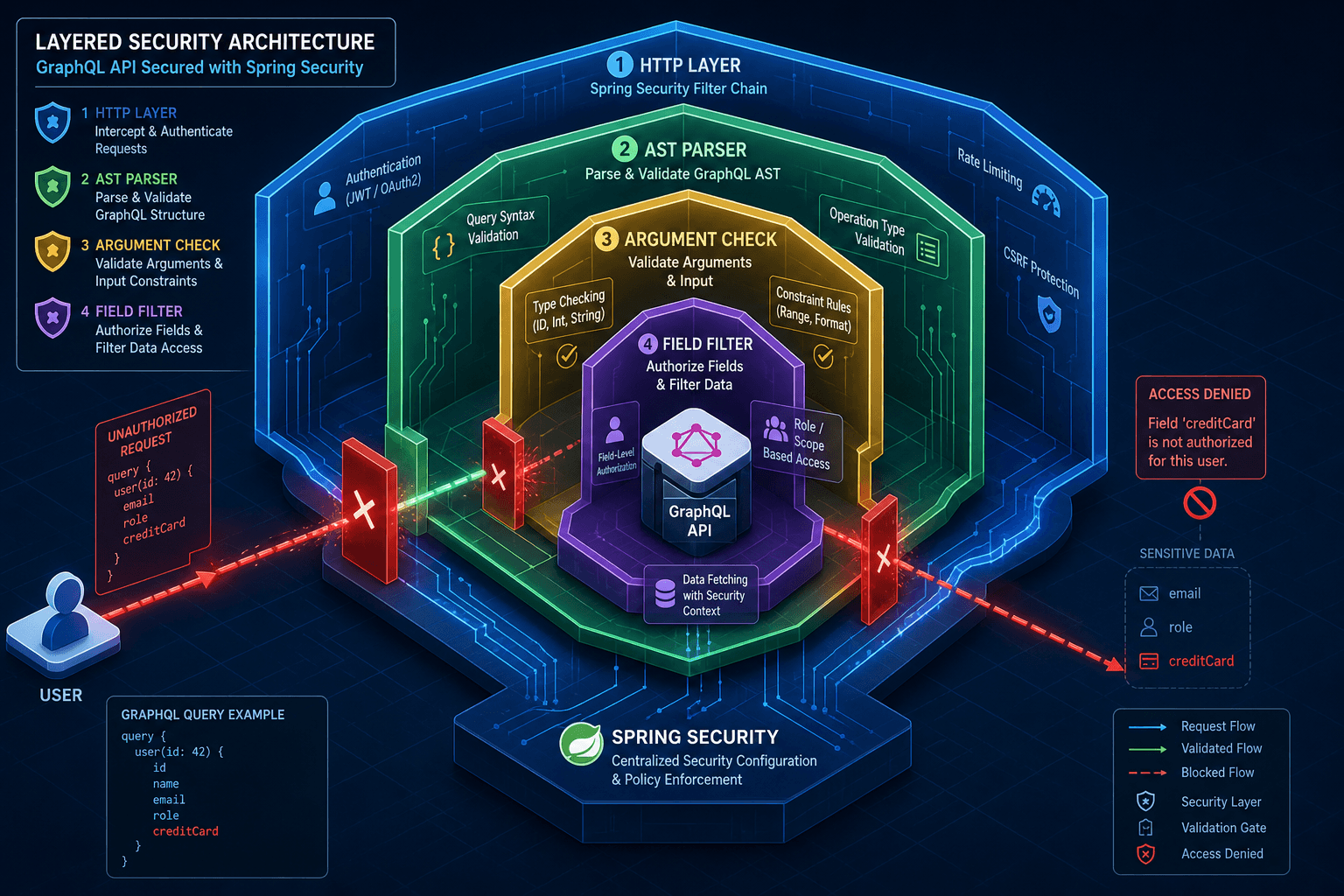
Spring Security and GraphQL: Securing GraphQL APIs
A technical examination of securing GraphQL APIs using Spring Security, covering authorization, rate limiting, and API security best practices.
Securing GraphQL with Spring Security requires a fundamental architectural shift from traditional URL-based path matching to argument-level and field-level authorization, combined with strict query complexity limits to prevent denial-of-service attacks. Unlike REST, where security boundaries are defined by distinct endpoints, GraphQL exposes a single entry point that accepts arbitrary data access patterns. Consequently, the security mechanism must migrate from the transport layer to the semantic layer of the query itself, validating user intent against the Abstract Syntax Tree (AST) before execution begins.
The HTTP Entry Point: Intercepting the Single Endpoint
Spring Security handles GraphQL differently than standard REST endpoints. In a typical Spring MVC application, SecurityFilterChain matches requests against URL patterns like /api/**. GraphQL breaks this model by exposing a single endpoint, typically /graphql, where every operation—regardless of data sensitivity—hits the same URI. Relying on standard MvcMatcher patterns is insufficient because they cannot distinguish between a benign read and a malicious enumeration attack.
Spring Security integrates via the graphql-java execution strategy or by configuring a SecurityWebFilterChain that matches on the /graphql path and delegates to the GraphQL execution filter chain. When an attacker sends a POST request to /graphql with a payload like { users { id name email } }, the standard security filter sees only the URI. If the configuration permits all traffic to /graphql, the request proceeds to the GraphQL execution engine, which parses the query and constructs the AST. The vulnerability lies in the timing: authorization checks happen too late, after the query has already been parsed and potentially executed.
To mitigate this, the security configuration must explicitly target the GraphQL execution path while delegating the actual authorization logic to the GraphQL pipeline. The SecurityFilterChain applies the Authentication object to the GraphQLContext before execution begins, allowing subsequent logic to access the current user's roles via SecurityContextHolder.
@Bean
public SecurityFilterChain filterChain(HttpSecurity http) throws Exception {
    http
        .csrf(csrf -> csrf.disable()) // GraphQL often uses POST, CSRF handling varies
        .authorizeHttpRequests(auth -> auth
            .requestMatchers("/graphql").permitAll() // Allow the endpoint itself
            .anyRequest().authenticated()
        )
        .oauth2ResourceServer(oauth2 -> oauth2.jwt());
    return http.build();
}
This configuration permits the HTTP request to reach the GraphQL handler but does not restrict what data can be fetched. The actual authorization logic must be embedded within the GraphQL execution pipeline to ensure semantic security.
Argument-Level Authorization: The First Line of Defense
Once the request passes the HTTP layer, the GraphQL engine parses the query into an AST. At this stage, we must ensure that the arguments provided in the query are valid for the authenticated user. In REST, you might check if a user has the ROLE_ADMIN permission to access /api/admin/users/{id}. In GraphQL, the ID is merely an argument within the query string, allowing a malicious actor to request data for any ID.
The mechanism for enforcing this is to intercept the input arguments before they reach the resolver. This is achieved using a custom GraphQLInputValueFactory or by leveraging the @SchemaDirective feature in graphql-java. It is important to note that @SchemaDirective is a graphql-java concept requiring manual wiring into the SchemaGenerator; it is not a native Spring Security annotation. Implementing this requires registering the directive class with the schema generation process, introducing necessary boilerplate to ensure the directive is active during execution.
Consider a User type with a field sensitiveData. A malicious query might look like:
query {
  user(id: "123") {
    sensitiveData
  }
}
If the user is not the owner of ID "123", this should fail. We implement an AuthorizationDirective that checks the id argument against the SecurityContext. If the user ID in the context does not match the argument, the directive throws an error, halting execution before any resolver logic runs.
@DirectiveWiring(name = "requireOwner")
public class RequireOwnerDirective implements SchemaDirectiveWiring {
    @Override
    public void onDirective(SchemaDirectiveWiringEnvironment environment) {
        DataFetcher<?> originalDataFetcher = environment.getDataFetcher();
        environment.setDataFetcher((env) -> {
            String requestedId = env.getArgument("id");
            Long currentUserId = SecurityContextHolder.getContext()
                .getAuthentication().getPrincipal() instanceof User ?
                ((User) SecurityContextHolder.getContext().getAuthentication().getPrincipal()).getId() : null;

            if (!requestedId.equals(String.valueOf(currentUserId))) {
                throw new UnauthorizedException("You can only access your own data");
            }
            return originalDataFetcher.get(env);
        });
    }
}
This approach moves the security boundary from the network perimeter to the data access logic. It ensures that even if a query is syntactically valid, it is semantically rejected if the arguments do not align with the user's permissions. This is critical because GraphQL allows dynamic queries; a user could theoretically craft a query to fetch data for every ID in the database if the argument validation is missing.
Query Complexity and Depth Limiting: Preventing DoS
The most significant threat to GraphQL APIs is not unauthorized access to specific fields, but the exhaustion of server resources through complex queries. In REST, a nested resource request might require multiple round-trips (e.g., GET /users, then GET /users/1/posts). In GraphQL, a single query can request deeply nested relationships:
query {
  users {
    posts {
      comments {
        author {
          posts { ... }
        }
      }
    }
  }
}
This single request could result in an N+1 query problem or a recursive traversal that crashes the database or CPU. Spring Security does not natively handle query complexity; this is a responsibility of the GraphQL execution engine configuration. We must integrate a complexity analyzer into the GraphQLQueryExecutor.
The mechanism here is static analysis of the AST. Before execution, a complexity analyzer traverses the tree, assigning a "cost" to each field based on its depth and estimated database cost. If the total cost exceeds a threshold defined in the complexity strategy, the query is rejected immediately.
// Conceptual example using graphql-java's ComplexityCalculator pattern
@Bean
public GraphQLQueryComplexityStrategy queryComplexityStrategy() {
    // Implementation depends on the specific library version used (e.g., graphql-java-query-complexity)
    // This demonstrates the pattern of calculating cost based on depth and field weights.
    return new GraphQLQueryComplexityStrategy(
        new DefaultGraphQLQueryComplexityStrategy(
            new GraphQLQueryDepth(5), // Max depth
            1000 // Max complexity score
        )
    );
}
By configuring the complexity strategy, we enforce a rate limit based on the structure of the query rather than the number of HTTP requests. An attacker sending 1000 simple queries might be blocked by a standard rate limiter, but a single query with a depth of 20 could be more destructive. The complexity strategy ensures that the server calculates the "weight" of the request and denies it if it exceeds the computational budget. This is a form of defense-in-depth that complements Spring Security's authentication.
Field-Level Authorization: Fine-Grained Control
Even with argument validation and complexity limits, we still need to restrict access to specific fields within a type. For example, a User object might have a salary field that is only visible to HR employees. In GraphQL, this is not a separate endpoint; it is a field within the User type.
The mechanism for this is to wrap the DataFetcher associated with the field. While Spring Security provides @AuthorizationRule annotations in some integrations, the most robust approach involves a custom DataFetcher wrapper that checks the GraphQLContext at the moment of field resolution.
When the GraphQL engine resolves the salary field, it calls the associated DataFetcher. We can inject a security check into this flow. If the current user's authorities do not include ROLE_HR, the DataFetcher returns null or throws a ForbiddenException.
@Component
public class SalaryDataFetcher implements DataFetcher<Object> {
    @Override
    public Object get(DataFetchingEnvironment env) {
        Authentication auth = SecurityContextHolder.getContext().getAuthentication();
        if (!auth.getAuthorities().contains(new SimpleGrantedAuthority("ROLE_HR"))) {
            throw new AccessDeniedException("HR only");
        }
        // Fetch and return salary
        return fetchSalaryFromDb(env.getArgument("id"));
    }
}
This pattern ensures that even if a user has access to the User object, they cannot access the salary field unless they possess the specific role. This is essential for compliance and data privacy. It prevents "over-fetching" where a client retrieves a large object just to access a small, sensitive piece of data.
Common Pitfalls
Securing GraphQL introduces specific challenges that differ from REST. Developers often fall into these traps:
- Over-fetching as a Security Risk: Even if you restrict fields at the resolver level, clients may still request large payloads containing many fields. If the complexity analyzer doesn't account for field count, a client can fetch a massive object structure that consumes memory and bandwidth, even if the data isn't fully utilized.
- Complexity Score Miscalculation: Assigning arbitrary costs to fields without understanding the underlying database cost can lead to either over-blocking (valid queries rejected) or under-protection (complex queries allowed). Always calibrate scores based on actual query execution time or resource usage in staging environments.
- Directive Wiring Errors: As noted with
@SchemaDirective, failing to register the directive class in theSchemaGeneratormeans the security logic is never invoked. The schema compiles successfully, but the authorization checks are effectively disabled, leaving the API vulnerable.
Practical Takeaways
To effectively secure GraphQL APIs, adopt these mental models:
- Trust No Input: Treat every argument, variable, and fragment as untrusted. Validation must occur at the AST level, not just at the database layer.
- Cost is Context: Complexity limits are not one-size-fits-all. A query fetching a list of users is cheaper than a query fetching users with their full transaction history. Adjust thresholds based on operation type.
- Defense in Depth: Relying on a single layer (e.g., only argument validation) is insufficient. Combine HTTP-level filtering, argument validation, complexity analysis, and field-level wrapping to create a resilient security posture.
FAQ
Q: Does Spring Security automatically handle GraphQL query complexity?
A: No. Spring Security manages authentication and authorization contexts but does not natively parse GraphQL ASTs for complexity. You must integrate a complexity analyzer library (like graphql-java-query-complexity) alongside Spring Security.
Q: Can I use Spring Security annotations like @PreAuthorize directly on GraphQL resolvers?
A: Not directly out of the box. While some community integrations exist, the standard approach involves injecting SecurityContextHolder into custom DataFetchers or directives to perform checks manually.
Q: How do I handle authentication for subscriptions in GraphQL? A: Subscriptions typically use WebSocket connections. You must configure the WebSocket handshake interceptor to validate the JWT or session token before establishing the subscription channel. If validation fails, the connection should be terminated immediately.
Conclusion: A Layered Approach
Securing GraphQL with Spring Security requires a layered approach. You cannot rely on the HTTP path alone because GraphQL collapses all endpoints into one. You must combine Spring Security's authentication capabilities with GraphQL-specific mechanisms: argument validation to ensure data access rights, complexity analysis to prevent resource exhaustion, and field-level wrapping to enforce fine-grained permissions.
The tradeoff is complexity. Implementing these checks adds overhead to the query execution pipeline. However, the alternative is exposing your data to arbitrary queries. The mechanism of checking the AST and the GraphQLContext at every step ensures that the security model scales with the flexibility of the GraphQL schema. As the schema evolves, the security rules must evolve with it, moving from URL-based constraints to semantic, data-driven authorization.
Related posts
Building a Custom Authentication Provider in Spring Security
This article covers the implementation of a custom authentication mechanism within Spring Security using a dedicated AuthenticationProvider.
Implementing Attribute-Based Access Control (ABAC) with Spring Security
A technical guide on implementing attribute-based access control (ABAC) using Spring Security and Open Policy Agent for dynamic policy enforcement.
GraphQL Security: Authentication and Authorization Patterns
An examination of GraphQL security patterns for authentication and authorization, including query complexity limits and API security best practices.