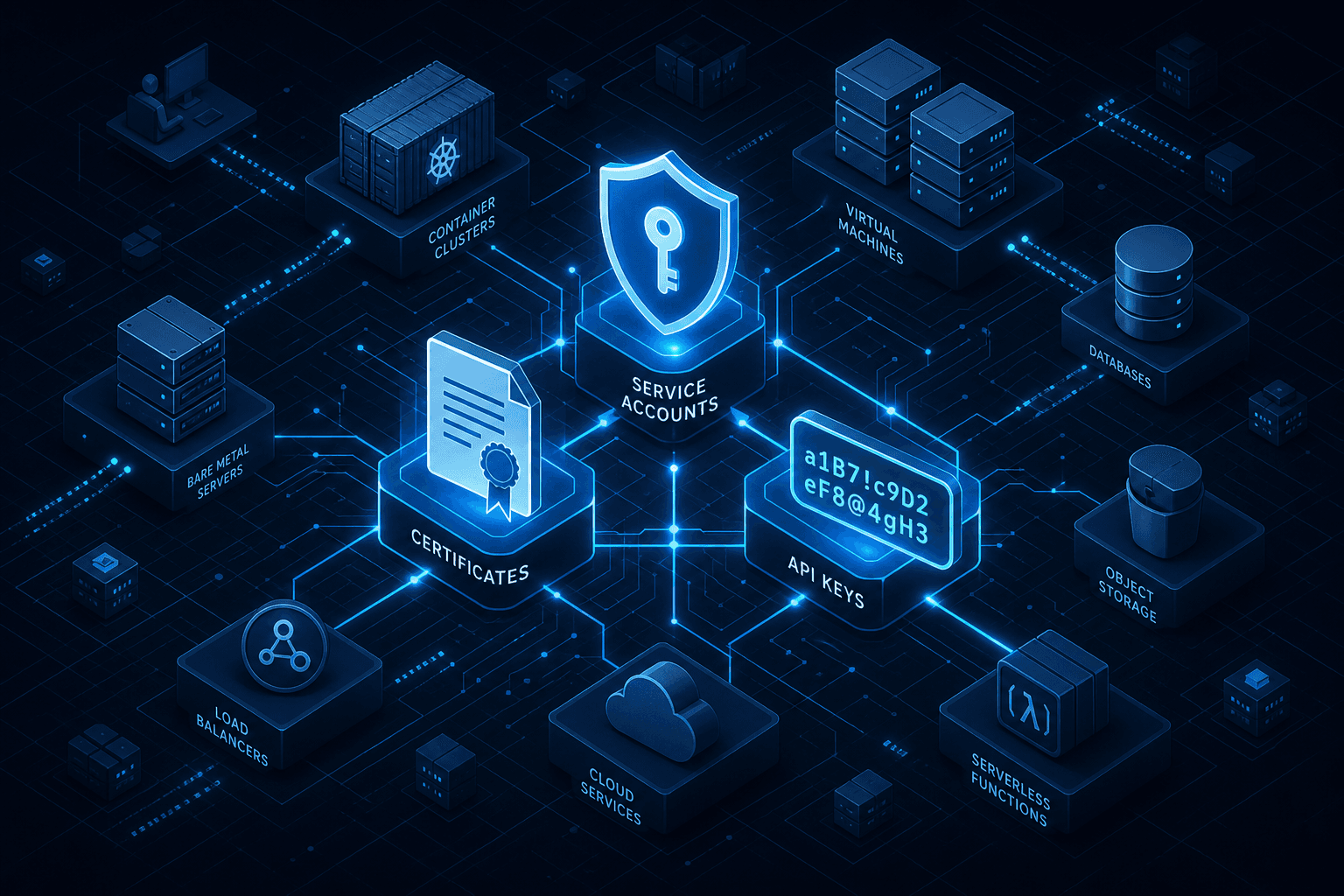
Machine Identity Management: The Hidden Attack Surface
An examination of machine identity management covering service account security, certificate management, and API key management as a critical attack surface.
Machine Identity Management: The Hidden Attack Surface
In modern infrastructure, the definition of "who" is accessing a resource has fundamentally shifted. It is no longer solely about human users authenticating with passwords and MFA. The vast majority of traffic in distributed systems flows between machines: containers communicating with databases, microservices invoking APIs, and pipelines fetching dependencies. These interactions rely on machine identities. Unlike human identities, which are frequently audited, rotated, and revoked, machine identities often persist indefinitely, creating a massive, overlooked attack surface. When mismanaged, they provide attackers with a direct path to lateral movement that bypasses traditional perimeter defenses. This article, Part 3 of the Machine Identity & DevSecOps Series, examines the mechanisms behind this vulnerability.
The Service Account Blindspot
Consider the mechanism of a Kubernetes Pod. When a developer deploys an application, the Pod is assigned a ServiceAccount. This ServiceAccount is not merely a label; it is a cryptographic identity bound to the Pod's namespace. The kubelet mounts a projected token into the Pod's filesystem at /var/run/secrets/kubernetes.io/serviceaccount/token. This token is a JSON Web Token (JWT) signed by the API server's private key.
Imagine a scenario where an attacker gains shell access to a container running a vulnerable application. The attacker does not need to guess a password or steal a user credential. They simply read the file at /var/run/secrets/kubernetes.io/serviceaccount/token. This token grants the permissions defined in the ServiceAccount's RoleBinding. If the developer configured the role with pods/exec or secrets:get permissions—a common default in many tutorials—the attacker can now execute commands inside other pods or steal database credentials stored as secrets.
This is the core failure: the lifecycle of this identity is tied to the Pod's existence, but the permissions are often granted statically. If the ServiceAccount has excessive permissions (the principle of least privilege is ignored), the compromise of a single low-privilege container escalates immediately to a cluster-level breach. The token does not expire based on user activity; it expires based on the Pod's restart policy or the token's specific TTL, which is often set to hours or days, giving attackers ample time to pivot.
Certificate Lifecycle Decay
TLS certificates are the second pillar of machine identity. They establish trust between two endpoints, verifying that the server is who it claims to be. The mechanism here relies on the X.509 standard, where a Certificate Authority (CA) signs a public key. In a zero-trust model, every service should present a certificate to its neighbors.
However, the failure mode here is "lifecycle decay." Organizations often generate self-signed certificates for internal services and leave them in place for years. Consider a legacy microservice running on an old VM. It holds a certificate valid for five years. An attacker compromises the build server that manages these certificates. Because the certificate management process is manual or poorly automated, the attacker can generate a new certificate for the same domain and install it on a rogue server.
More critically, consider the mechanism of Certificate Revocation Lists (CRLs) and OCSP. Many applications do not check these lists in real-time due to performance concerns or network latency. If a certificate is compromised, the CA revokes it, but the application continues to trust it because it never queried the revocation status. The attacker can then use the revoked certificate to perform a Man-in-the-Middle (MitM) attack. The application sees a valid signature from the CA, the attacker intercepts the traffic, and the human user or the downstream service remains oblivious. The identity exists, but its validity state is ignored.
API Key Entropy and Rotation
API keys represent the simplest form of machine identity, yet they are often the most dangerous. Unlike a certificate which requires a handshake and validates the server's private key, an API key is a shared secret. The mechanism is binary: if you have the key, you have access. There is no mutual authentication.
In a typical DevOps workflow, a developer needs to connect a local script to a cloud storage bucket. They generate an API key and paste it into their .env file. If this file is accidentally committed to a public GitHub repository, the key is instantly exposed. The mechanism of API key validation usually happens at the edge or the API gateway. Once the key is presented, the gateway validates it against the database and grants access to the underlying resources.
The critical vulnerability is the lack of rotation. Human passwords are changed regularly. API keys are often generated once and never changed until they stop working. An attacker who scrapes a public repo can use that key to exfiltrate terabytes of data before the legitimate owner notices the unusual traffic patterns. However, modern secret management solutions like AWS IAM Roles or HashiCorp Vault have evolved to mitigate this. While static shared secrets do require total invalidation upon compromise, dynamic implementations allow for scoped revocation or token replacement without invalidating all services. This enables secret rotation strategies that minimize downtime while maintaining security. Without these modern mechanisms, the tradeoff between availability and security often leads organizations to disable APIs entirely, creating a "break glass" scenario where the organization must disable the entire API temporarily.
The DevSecOps Gap
The root cause of these vulnerabilities is not the technology itself, but the workflow. In traditional IT, identity management was a manual, periodic audit. In cloud-native environments, identities are ephemeral and scale in the thousands. A human cannot manually rotate 50,000 API keys or validate 10,000 certificates daily.
The gap appears when developers treat machine identities as configuration files rather than dynamic security assets. They hardcode secrets in CI/CD pipelines, store them in unencrypted git repos, or rely on environment variables that are passed through logs. The solution requires a shift in the mechanism of provisioning. Identity must be provisioned dynamically. Instead of a static key, a service should request a short-lived token from an identity provider (like HashiCorp Vault or AWS IRSA) at startup.
This approach forces the identity to be short-lived. If a token is stolen, it expires in minutes. It also enforces context-aware policies. The token is only valid for the specific IP range and time window the service needs. This is the essence of zero trust for machines: never trust, always verify, and always limit the blast radius. Proper management of the identity lifecycle ensures that credentials are issued only when needed and revoked immediately after use.
Opinion: Treating machine identities as "set and forget" is a fundamental architectural error. Just as we would never deploy a human user account with admin privileges and never rotate it, we cannot deploy a service account with broad permissions and expect it to remain secure. The cost of implementing automated rotation and dynamic provisioning is high, but the cost of a breach driven by a stale certificate or a leaked API key is significantly higher.
Common Pitfalls
Organizations frequently stumble over specific patterns when implementing machine identity management. Recognizing these pitfalls is essential for avoiding catastrophic breaches.
- Hardcoded Secrets in CI/CD Pipelines: Developers often embed API keys or tokens directly into build scripts or configuration files. This exposes credentials to anyone with access to the pipeline logs or the source code repository. Even if the code is private, a compromised build agent can leak these secrets.
- Static Permissions on Service Accounts: A common mistake is assigning overly permissive roles to service accounts and never auditing them. Over time, these accounts accumulate permissions they no longer need, violating the principle of least privilege. When compromised, these accounts act as master keys for the entire environment.
- Lack of Certificate Rotation: Many teams rely on long-lived certificates (e.g., 5 years) and fail to automate rotation. When a private key is eventually leaked or a CA is compromised, the damage is magnified because the certificate remains valid and trusted across the infrastructure for years.
Practical Takeaways
To secure machine identities effectively, adopt these mental models and rules of thumb:
- Assume Compromise: Operate under the assumption that every service account, certificate, and API key will eventually be stolen. Design your architecture so that a single credential compromise does not lead to a full environment takeover.
- Short-Lived Tokens: Prioritize ephemeral identities over static secrets. Use dynamic token generation (like JWTs with short TTLs) so that stolen credentials expire rapidly, limiting the window of opportunity for attackers.
- Least Privilege by Default: Apply the principle of least privilege strictly. Service accounts should have only the exact permissions required for their specific task, nothing more. Regularly audit these permissions to remove unused access.
- Automate Everything: Human error is the weakest link. Automate the generation, rotation, and revocation of all machine identities. Manual processes cannot scale to the speed and volume of modern infrastructure.
FAQ
How do I rotate API keys without causing downtime? Modern secret management platforms allow for "blue-green" rotation. You can generate a new key, update the dependent services to use the new key, verify functionality, and then revoke the old key. This ensures a seamless transition without service interruption.
What is the difference between a service account and a user? A user identity represents a human being and is typically managed with MFA and session timeouts. A service account represents a non-human entity (like an application or script) and relies on cryptographic tokens or keys for authentication. Service accounts are designed for automation and machine-to-machine communication.
Why are certificates important for machine identity? Certificates provide mutual authentication and encryption. They verify the identity of both the client and the server, ensuring that data is transmitted securely and that services are communicating with the intended endpoints, preventing Man-in-the-Middle attacks.
Can I use the same API key across multiple environments? It is highly discouraged. Best practice dictates using distinct keys for development, staging, and production. This limits the blast radius if a key is leaked in a lower-security environment.
How often should I rotate machine identities? Ideally, machine identities should be short-lived and rotated automatically upon each session or on a very frequent schedule (e.g., every few hours or minutes) rather than relying on periodic manual rotation.
Related posts
API Key Management Best Practices: Design, Distribution, and Rotation
Understand the lifecycle of API keys with advanced strategies for entropy, secure distribution, and automated rotation.
Building an Identity Service Mesh: Integrating IAM with Istio
An examination of integrating Identity and Access Management with service mesh technologies like Istio using SPIFFE for secure service-to-service communication.
Implementing Smart Link Authentication: Phishing-Resistant Magic Links
An examination of smart link authentication and phishing-resistant magic links to enhance passwordless email security.