SPIFFE and SPIRE: Universal Identity for Services
An examination of SPIFFE and SPIRE for establishing workload and service identity in Kubernetes and multi-cluster environments.
In traditional Kubernetes clusters, service identity relies on static DNS names, IPs, and long-lived secrets. This model collapses when workloads become ephemeral; a new pod spawns with a different IP, orphaning static secrets. The framework solves this by defining machine identity bound to the execution context. The runtime implements this as a zero-trust authority, issuing and rotating identities automatically without manual intervention.
This article is Part 6 of the "Machine Identity & DevSecOps Series" series.
Mechanism: SPIFFE IDs Replace Static Secrets
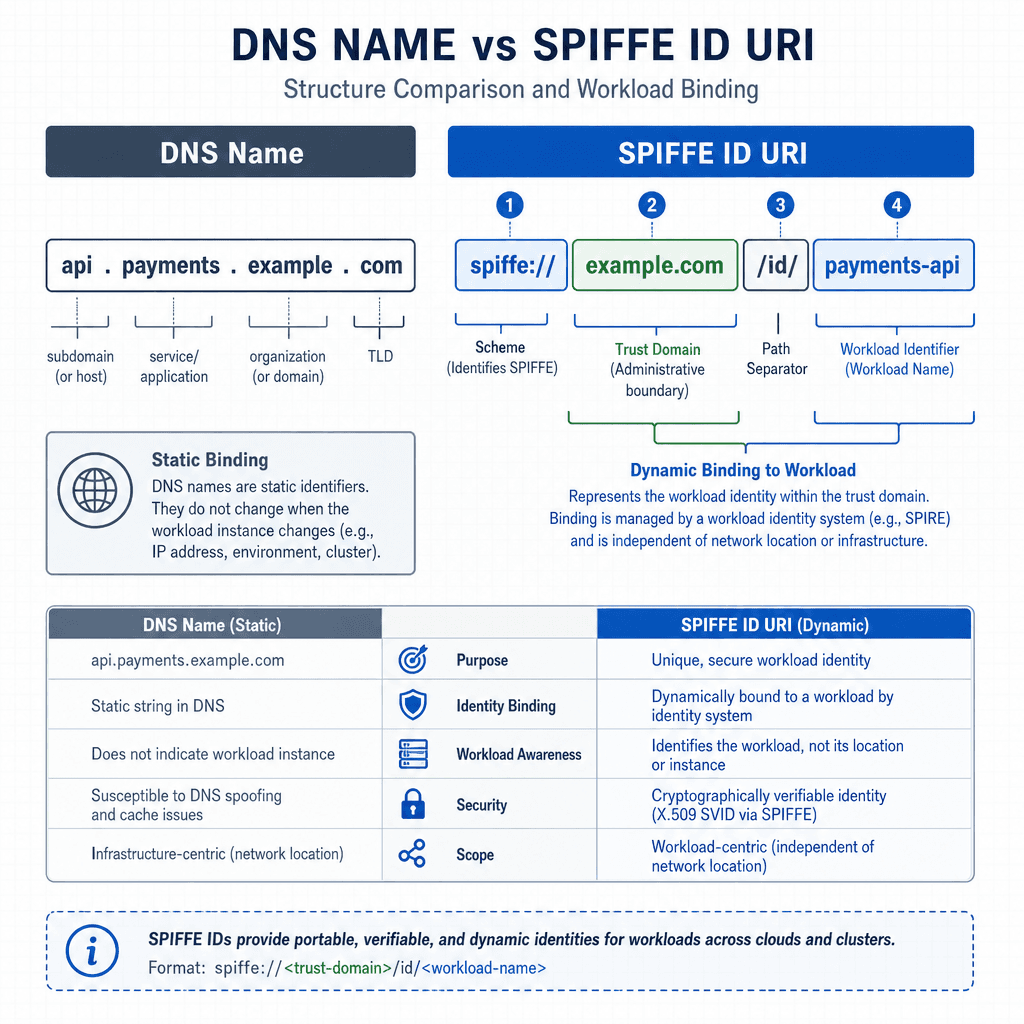
The core mechanism is the SPIFFE ID. Unlike a spoofable DNS name or static certificate common name, a SPIFFE ID is a URI uniquely identifying a workload within a trust domain. It follows the format spiffe://<trust-domain-id>/workload/<workload-name>. For example, spiffe://example.org/svc/frontend identifies the frontend service within the example.org trust domain. This ID is embedded into short-lived X.509 certificates or JSON Web Tokens (JWT). The critical distinction is that the certificate is issued only for the duration of the workload's life. If the pod terminates, the certificate becomes invalid immediately. This prevents an attacker from stealing a static secret and using it indefinitely. The identity is not "who you are" in a database sense, but "what you are running right now" in the cluster.
Architecture: The SPIRE Trust Chain
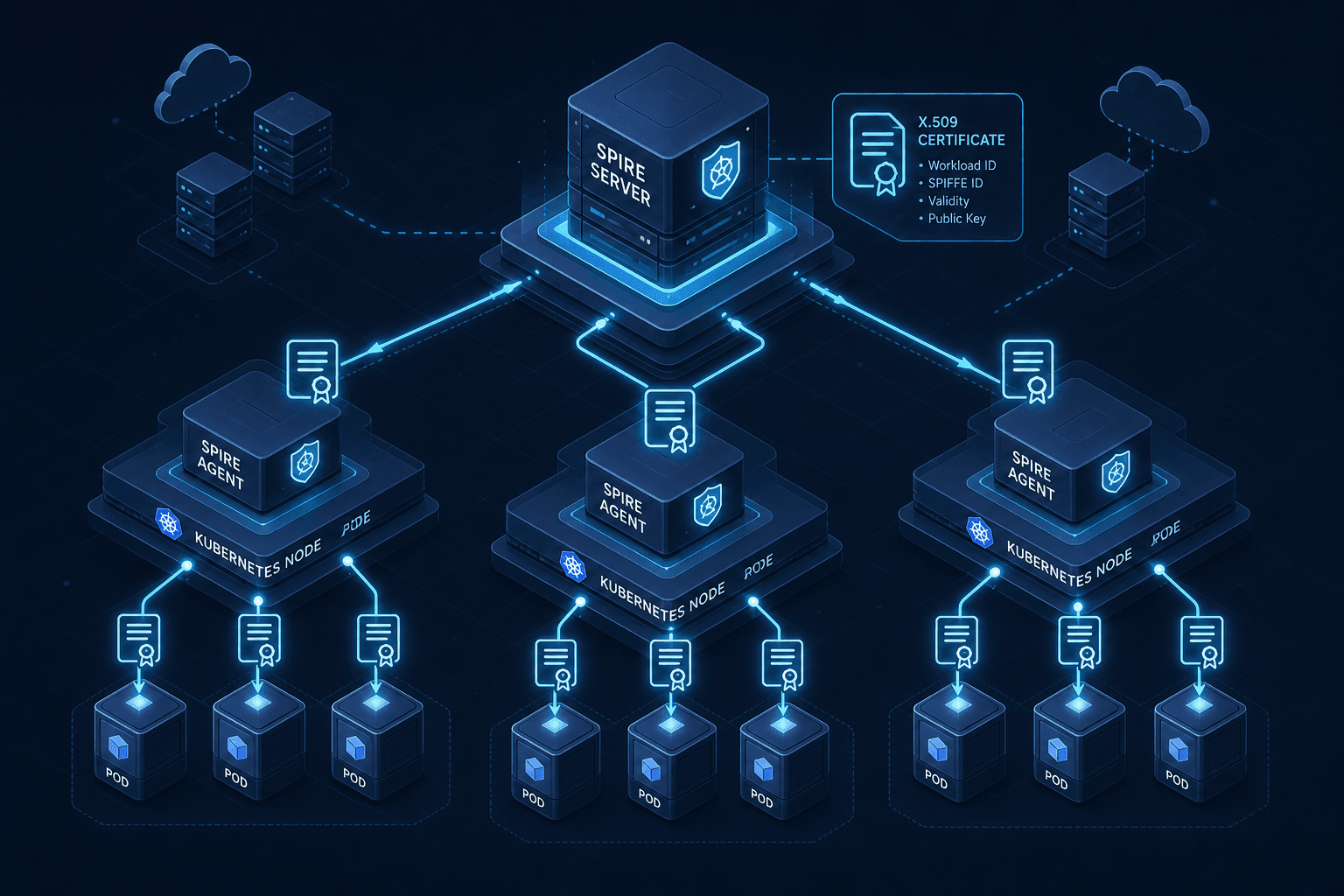
To make this mechanism operational, the runtime introduces a distributed architecture that decouples the authority from the workload. The architecture consists of three primary components: the SPIRE Server, the SPIRE Agent, and the Workload API. The SPIRE Server acts as the central Certificate Authority (CA), holding the private key for the trust domain and validating requests. The SPIRE Agent runs as a DaemonSet on every node. It communicates with the Server and manages local state. Crucially, the Agent does not hold the private keys for the workloads; it acts as a relay. When a pod starts, it contacts the local SPIRE Agent via the Workload API.
The Agent verifies the pod's identity specifically using the Kubernetes Workload Attestation plugin. This attestation data includes the service account name and namespace provided by the K8s plugin, ensuring the request comes from the correct context. If verification passes, the Agent proxies the request to the Server, which issues a new SVID. The Agent returns the certificate (SVID) to the pod, while the private key is generated and managed securely within the Agent's isolated environment or injected via the Workload API response without being exposed as a file mount to the application container. The application inside the pod then uses these credentials to initiate TLS connections. No human ever touched a secret. No static file was mounted. The identity is dynamic and tied to the specific pod instance.
# Example Workload API request flow
curl --unix-socket /run/spire/sockets/agent.sock \
     --request GET \
     --path /v1/workload/trustdomain
Common Pitfalls
Implementing the identity standard requires careful attention to avoid common configuration errors. First, Server HA Configuration is critical; if the Server is not deployed with high availability, it becomes a single point of failure that can halt all identity issuance. Second, RBAC Misconfiguration can lead to privilege escalation; overly permissive Kubernetes RBAC rules allow attackers to impersonate Service Accounts and request SVIDs for unauthorized identities. Third, Trust Bundle Rotation must be automated; failing to rotate trust bundles when the root CA rotates can leave the cluster unable to validate new certificates or maintain cross-cluster trust.
Multi-Cluster Flow: mTLS and Trust Boundaries
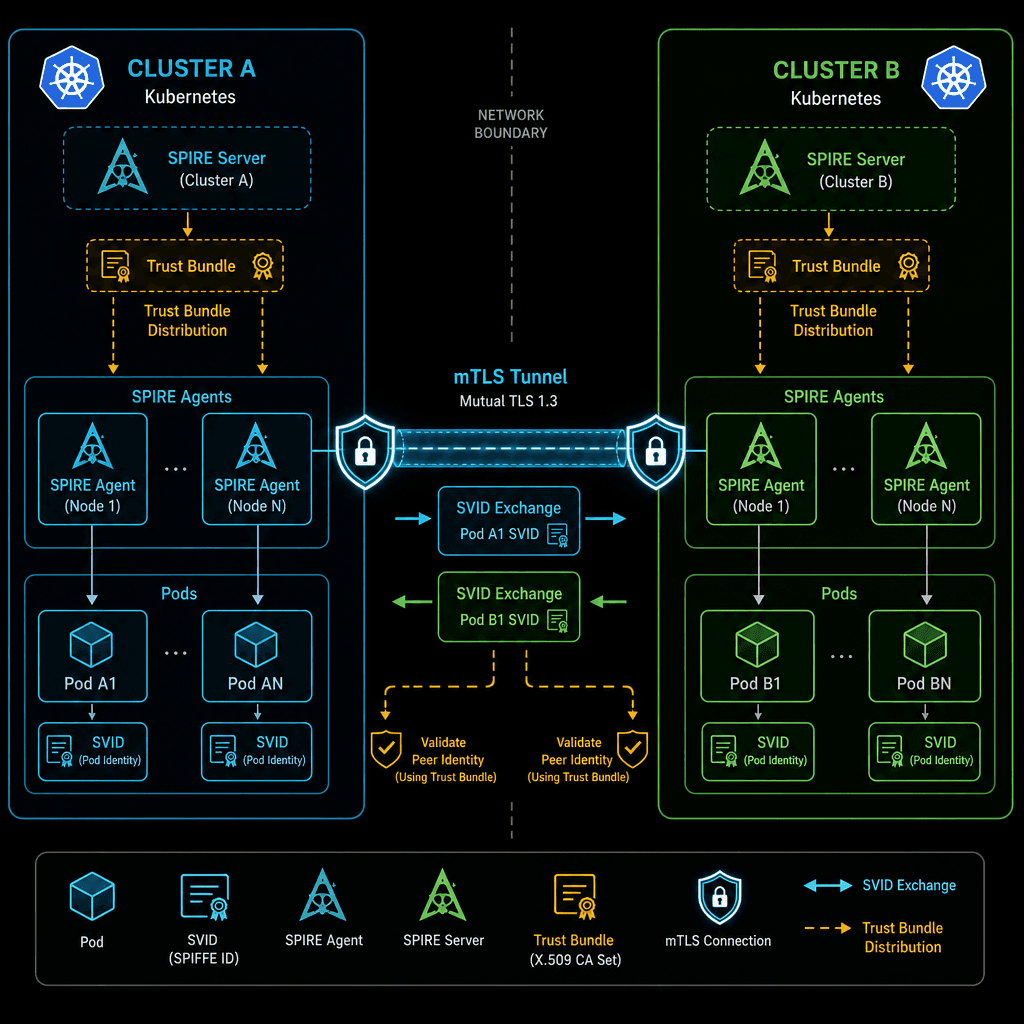
The true power of this system emerges in multi-cluster security. In a standard setup, connecting Cluster A to Cluster B requires complex network policies and shared secrets. With the framework and runtime, the trust boundary shifts from the network to the identity. Suppose frontend in Cluster A needs to call backend in Cluster B. The frontend pod obtains an SVID from its local Agent. When it initiates a connection to backend, it presents this SVID. The backend pod in Cluster B has its own Agent, which validates the incoming certificate. It checks the SPIFFE ID: spiffe://example.org/svc/frontend. It verifies that the issuer is the root CA of the example.org trust domain. If the IDs match and the certificate is valid, the connection is established. The backend service trusts the frontend service because the identity is cryptographically proven, not because the IP address is in a whitelist.
This mechanism relies on mutual TLS (mTLS). Every request between services is encrypted, and both parties present their SVIDs. The Server distributes the trust bundle (the public keys of all CAs) to all Agents. This ensures that any Agent in any cluster can validate an SVID from another cluster without a direct network handshake for trust establishment. The trust is transitive. If Cluster A and Cluster B both trust the same Server (or have cross-signed trust bundles), they automatically trust each other's workloads. This eliminates the need for manual certificate management across clusters.
Operational Reality: Complexity vs. Security
However, this architecture introduces complexity. The Server becomes a single point of failure if not highly available, and network latency between the pod and the local Agent adds a microsecond-level overhead to every identity request. Furthermore, the reliance on the Kubernetes Service Account means that the security of the workload identity is tied to the security of the Kubernetes RBAC configuration. If an attacker gains the ability to impersonate a Service Account, they can potentially request SVIDs for that identity. This is why policies are granular; they can restrict which Service Accounts can request SVIDs for specific SPIFFE IDs.
The tradeoff is clear: you are trading the operational simplicity of static secrets for the security rigor of dynamic, short-lived identities. In a DevSecOps environment, this shift is essential. Static secrets are the primary vector for lateral movement in compromised clusters. By removing them, you force attackers to compromise a running pod to get a valid SVID, and that SVID will expire quickly. The framework ensures that identity is never static, and the runtime ensures that this identity is always available, regardless of where the workload is running.
Conclusion
In summary, the framework provides the language for machine identity, and the runtime provides the engine to generate and manage it. Together, they transform Kubernetes security from a perimeter-based model to an identity-based model. The workflow is automatic: the pod starts, the Agent authenticates it, the Server issues a credential, and the service connects securely. This is the foundation for a truly zero-trust architecture in modern cloud-native environments.
Practical Takeaways
- Dynamic over Static: Replace long-lived secrets with short-lived SVIDs to limit the blast radius of a compromise.
- Automated Attestation: Leverage the Kubernetes Workload Attestation plugin to bind identities to specific namespaces and service accounts.
- Zero-Trust Networking: Use mTLS enforced by the identity standard to secure communication across multi-cluster boundaries without shared secrets.
FAQ
Q: Does SPIFFE require changes to existing applications? A: Generally, no. SPIFFE works transparently by injecting credentials into the pod's filesystem or memory via the Workload API. Most applications using standard TLS libraries will automatically use the provided SVID without code changes.
Q: How does SPIRE handle server failures? A: SPIRE supports high-availability configurations where multiple Server instances share a database backend. If one Server fails, others take over, ensuring continuous identity issuance.
Q: Can I use SPIFFE with non-Kubernetes environments? A: Yes. While the Kubernetes Workload Attestation plugin is popular, SPIRE supports attestation plugins for Docker, ECS, Nomad, and even bare-metal environments, making it a universal solution for machine identity.
Related posts
Building an Identity Service Mesh: Integrating IAM with Istio
An examination of integrating Identity and Access Management with service mesh technologies like Istio using SPIFFE for secure service-to-service communication.
The Role of Identity in DevSecOps: Integrating Security into the Pipeline
An examination of identity management within DevSecOps to ensure secure CI/CD pipelines through code signing and secure security integration.
SBOMs and Identity: From Inventory to Trust
An examination of Software Bills of Materials (SBOM) and identity mechanisms like SLSA and cosign for strengthening supply chain security.