API Key Management Best Practices: Design, Distribution, and Rotation
Understand the lifecycle of API keys with advanced strategies for entropy, secure distribution, and automated rotation.
API keys function as long-lived, static machine identities granting resource access without human session context. Unlike short-lived OAuth tokens, these credentials persist for months or years, creating high-value targets. If leaked, damage is proportional to their lifetime. Managing this risk requires treating the key lifecycle as a cryptographic protocol, not a configuration setting. This article explores three pillars: entropy in design, isolation in distribution, and atomicity in rotation.
Designing the Key: Entropy and Scope
The first line of defense is the generation mechanism itself. A common misconception is that a unique identifier combined with a hash of the client ID creates a secure key. This is a failure of entropy. If the key generation relies on a pseudo-random number generator (PRNG) that is not cryptographically secure, an attacker can predict future keys if they observe a sequence.
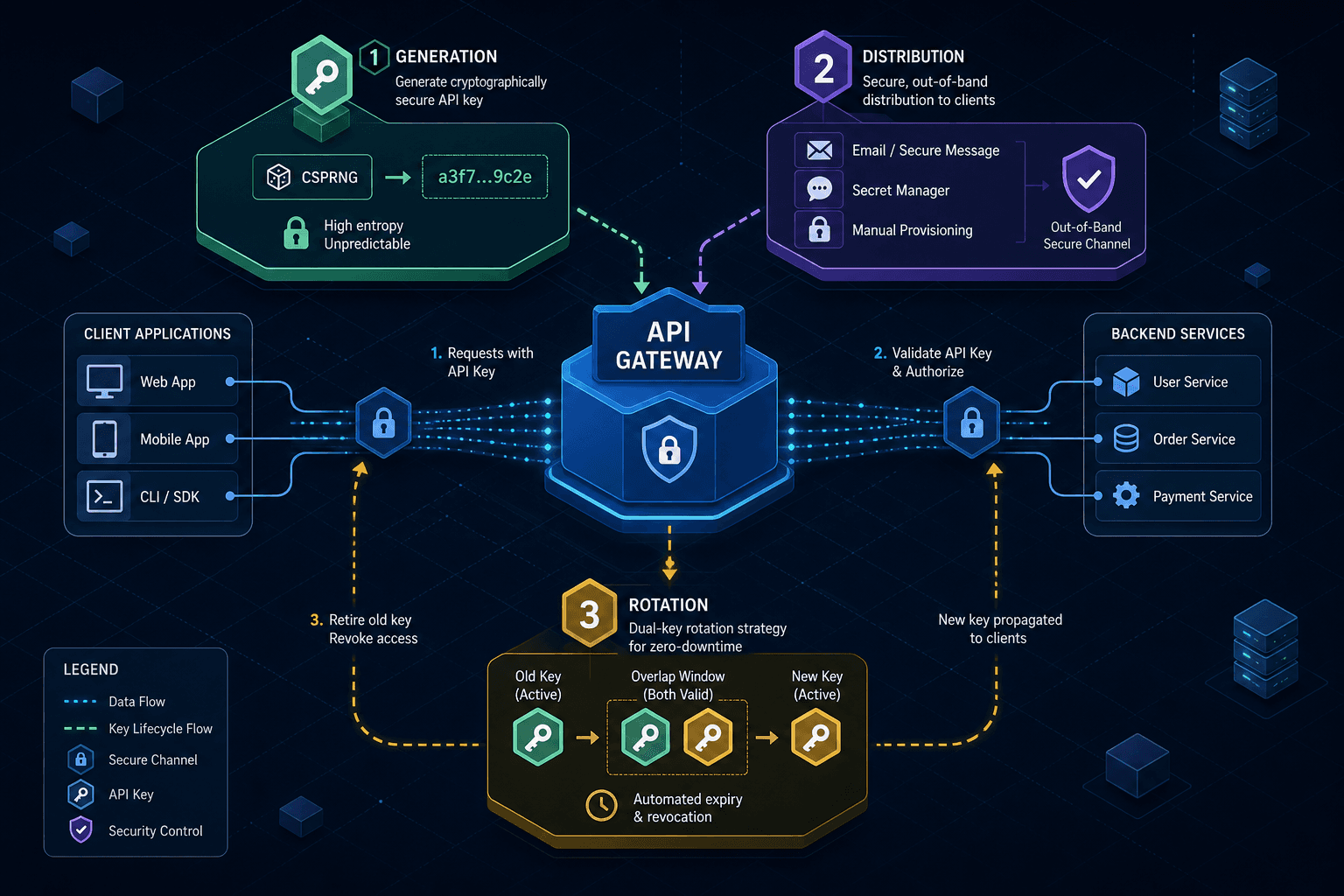
The mechanism requires a Cryptographically Secure Pseudo-Random Number Generator (CSPRNG). When generating a key, the system must draw random bytes directly from the operating system's entropy source, such as /dev/urandom on Linux or CryptGenRandom on Windows. The resulting byte string is then encoded, typically in Base64 or Hex.
Consider a scenario where a system generates a 256-bit key. If the system uses a standard rand() function, the output might be predictable. If it uses a CSPRNG, the output space is $2^$, making brute-force attacks computationally infeasible. The key must also encode the scope within the payload or the metadata stored by the API gateway, not just in the string itself.
For example, a key should not contain the secret value in plain text. Instead, the API gateway stores a hash of the key (using a fast, constant-time hash like SHA-256 with a unique salt, or HMAC) in the database. When a request arrives with an API key in the X-API-Key header, the gateway hashes the incoming key and compares it to the stored hash. This ensures that even if the database is compromised, the actual keys are not exposed.
The key structure should also include a namespace prefix to prevent collision across different environments (e.g., prod-, staging-). This allows for immediate revocation of an entire environment if a breach is suspected. The mechanism here is separation of concerns: the key string is the credential, while the metadata (scope, tenant, environment) dictates the policy.
Distribution: The Out-of-Band Channel
Once generated, the key must reach the client. The most critical failure point in API security is the distribution channel. Sending a key via email, embedding it in a URL query parameter, or placing it in a public repository is a violation of the principle of least privilege.
The mechanism for secure distribution is the "out-of-band" transfer or the "bootstrap token" pattern. In a bootstrap scenario, the developer authenticates via a human-centric method (like an OAuth login or a temporary one-time password) to receive a short-lived, single-use token. This short-lived token is then used to provision the long-lived API key.
Imagine a developer logging into a Developer Portal. The portal does not display the API key immediately. Instead, it issues a one-time provisioning token valid for 5 minutes. The developer's application sends this token to the provisioning endpoint. The server validates the token, generates the long-lived API key, and returns it once to the application. The provisioning token is then immediately invalidated.
This prevents the key from sitting in an email inbox or a chat log. It ensures that the key is only ever transmitted over a TLS-encrypted channel between two authenticated endpoints. Furthermore, the key should never appear in the URL. URLs are often logged by proxy servers, load balancers, and browser history, creating persistent copies of the secret.
If the key must be passed in the header, the primary defense is ensuring the transport layer (HTTPS) is strictly enforced. Additionally, configure logging infrastructure to redact sensitive headers (like Authorization or X-API-Key) regardless of their name, preventing accidental leakage in logs that might otherwise strip standard headers.
Rotation: The Dual-Key Mechanism
Rotating an API key is a non-trivial operation because the key is static. If you simply replace the old key with a new one, all clients using the old key will fail immediately, causing a service outage. The mechanism for safe rotation is the "dual-key" or "grace period" strategy.
In this workflow, the system accepts both the old key and the new key simultaneously for a defined window. The API gateway maintains a list of active keys. When a client presents the old key, the gateway processes the request but logs a deprecation warning. Simultaneously, the client updates its configuration to use the new key. Once the new key has been successfully used for a sufficient period (e.g., 24 hours), the old key is marked for revocation.
This mechanism requires the API gateway to support key versioning or a rolling whitelist. The rotation process should be automated. A cron job or a DevSecOps pipeline triggers the generation of the new key, updates the whitelist, and notifies the client systems via a secure channel (like a signed webhook or a secure message queue) to update their configuration.
Consider a scenario where a key is leaked. The rotation mechanism allows for immediate revocation of the compromised key without waiting for a manual update cycle. The system detects the leak, adds the compromised key to a "revoked" list, and the gateway immediately rejects requests with that key. The dual-key mechanism ensures that legitimate traffic continues to flow while the compromised key is being phased out.
Monitoring and Anomaly Detection
Even with perfect design and distribution, keys can be compromised. The final layer of defense is monitoring. A static key does not have a user session, so traditional session-based monitoring fails. Instead, we must monitor the behavior of the key.
The mechanism involves establishing a baseline of normal usage for each key. This includes the geographic location of the IP address, the time of day, the volume of requests per minute, and the specific endpoints accessed. If a key that usually makes 100 requests per hour suddenly makes 10,000 requests from a different country, the system should trigger an alert or automatically throttle the key.
This is not just about rate limiting; it is about behavioral analysis. If a key is used to access a resource it was never designed to access, or if the payload size is anomalous, the gateway should flag the request. The goal is to detect the usage of the key, not just the presence of the key.
Automated rotation can also be triggered by these anomalies. If a key is detected as being used from an unauthorized IP range, the system can automatically invalidate the key and notify the client to generate a replacement via the bootstrap channel, forcing the client to re-authenticate. This creates a self-healing security posture where the key lifecycle is dynamic rather than static.
Common Pitfalls
Despite robust mechanisms, implementation errors frequently undermine security. Three specific pitfalls must be avoided:
- Storing keys in client-side code: Embedding API keys directly into frontend JavaScript or mobile binary builds exposes them to anyone who can decompile or inspect the application. Keys must reside in server-side environments or secure vaults.
- Reusing keys across environments: Using the same key for production and staging environments eliminates the ability to isolate breaches. If a staging key leaks, the production environment is immediately compromised. Strict namespace separation is required.
- Ignoring header rotation in dual-key mode: During a dual-key rotation, clients must update their configuration to use the new key. Failing to enforce the removal of the old key from client configurations after the grace period leaves the system vulnerable to replay attacks using the decommissioned credential.
Practical Takeaways
To internalize these concepts, adopt these mental models:
- Keys are Credentials, Not Identifiers: Treat the key as a secret password, not just a user ID. The secrecy of the string is paramount.
- Zero Trust Distribution: Assume the network is hostile. Never transmit keys over unencrypted channels or store them in logs.
- Graceful Degradation: Design rotation to be invisible to the end-user. The dual-key strategy ensures continuity of service during security updates.
FAQ
Q: How often should I rotate API keys? A: Rotation frequency depends on your risk profile. For high-value keys, consider rotating quarterly or immediately upon any suspected compromise. For lower-risk keys, annual rotation is often sufficient, provided anomaly detection is active.
Q: Can I automate the entire key rotation process? A: Yes, but the final step of updating the client configuration usually requires human intervention or a trusted agent. Fully automated "blind" rotation without a bootstrap re-authentication channel is risky.
Q: What happens if a key is leaked but I haven't detected it yet? A: If you have implemented behavioral monitoring, the system should flag the anomaly (e.g., unusual volume or location). Upon detection, the key is revoked immediately, and the client is notified to re-authenticate via the bootstrap channel to generate a new key.
Conclusion
Managing API keys is not a one-time setup; it is a continuous operational discipline. The design must prioritize high-entropy generation and hashing. Distribution must rely on out-of-band or bootstrap mechanisms to avoid exposure. Rotation must use a dual-key strategy to ensure availability. Finally, monitoring must focus on behavioral anomalies rather than just key validity. By treating the API key as a living identity that requires active management, developers can significantly reduce the attack surface of their APIs. The cost of implementing these mechanisms is minimal compared to the cost of a data breach.
Related posts
Machine Identity Management: The Hidden Attack Surface
An examination of machine identity management covering service account security, certificate management, and API key management as a critical attack surface.
Understanding JWKS: Rotating Signing Keys Gracefully
An examination of JSON Web Key Set (JWKS) mechanisms for securely rotating signing keys and verifying JWTs without service interruption.
Building an Identity-Aware API Gateway with Kong and OIDC
A guide to configuring Kong Gateway with OpenID Connect for secure API authentication using JWT tokens.