AWS Secrets Manager vs Certificate Manager: A Mechanism-Level Comparison
Compare AWS Secrets Manager and Certificate Manager for secure credential and TLS certificate management in cloud infrastructure.
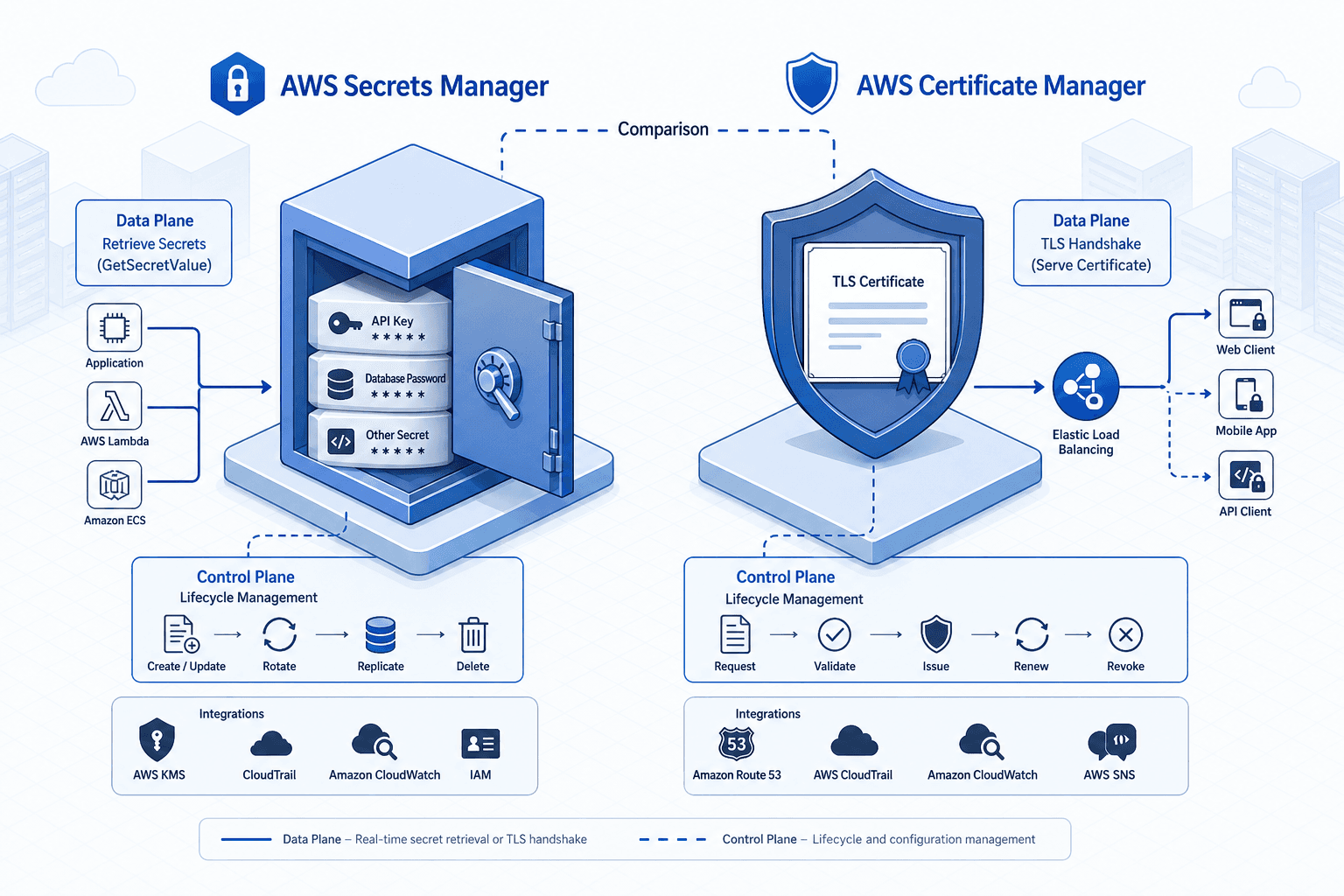
Cloud engineers often conflate AWS Secrets Manager and AWS Certificate Manager (ACM) because both deal with "secrets" in the broad sense of protected data. However, treating them as interchangeable leads to architectural flaws. ACM is a specialized lifecycle manager for X.509 certificates, heavily integrated with AWS load balancers and CloudFront. Secrets Manager is a general-purpose secure storage vault for arbitrary sensitive strings, designed for programmatic retrieval by applications.
This article dissects the mechanisms behind both services to clarify where each belongs in your infrastructure.
The Core Mechanism: Managed Lifecycle vs. Managed Storage
The fundamental difference lies in the scope of management and access to cryptographic material.
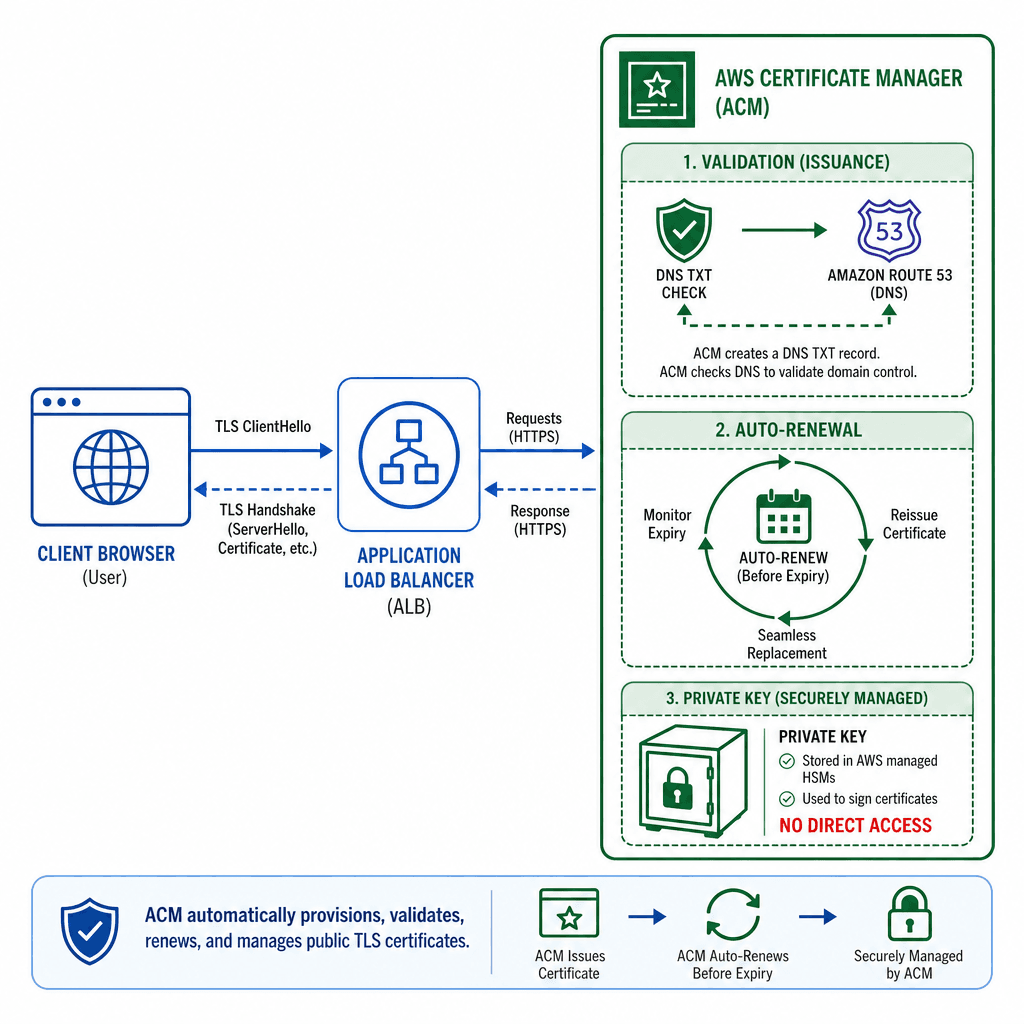
AWS Certificate Manager (ACM) is a managed certificate lifecycle service. When you request a public certificate, ACM orchestrates the validation process with a Certificate Authority (CA). Crucially, for public certificates, you do not have direct access to the private key. ACM stores it in a secure, managed environment. You can only reference the certificate by ARN in AWS services like Elastic Load Balancing (ELB) or CloudFront. The mechanism here is automation: ACM detects expiring certificates and renews them automatically, provided the validation method (DNS or Email) remains valid.
AWS Secrets Manager is a managed secret storage service. It stores encrypted values (strings, JSON, or binary blobs) and provides an API (GetSecretValue) to retrieve them. You retain full ownership of the data stored. If you store a database password, an API key, or a private CA private key, you can retrieve it programmatically via SDKs or CLI. The mechanism here is secure, auditable retrieval with rotation capabilities.
| Feature | AWS Certificate Manager (ACM) | AWS Secrets Manager |
|---|---|---|
| Primary Purpose | TLS Certificate Lifecycle Management | Secure Storage of Arbitrary Secrets |
| Private Key Access | No (for public certs); Managed | Yes (via API) |
| Integration | ELB, CloudFront, API Gateway | EC2, Lambda, RDS, ECS, EKS |
| Rotation | Automatic (Public CAs) | Configurable (Lambda/Secrets Manager) |
| Encryption | KMS-managed (Opaque) | KMS-managed (Transparent) |
Public vs. Private Certificate Lifecycles
Public Certificates: ACM’s Domain
For public-facing services, ACM is the default choice. When you request a certificate for example.com, ACM contacts Amazon's own trusted certificate authority infrastructure (Amazon Trust Services). The CA challenges ownership via DNS TXT records or email. Once validated, ACM provisions the certificate.
The mechanism of renewal is passive. ACM monitors expiration dates. If the DNS record is still valid, it renews the certificate in the background. You never see the private key. This design prevents accidental exposure of keys in logs or code repositories.
Private Certificates: The Hybrid Approach
When managing internal services (e.g., internal.corp), you cannot rely on public CAs. You need a Private Certificate Authority (Private CA). Here, the roles split:
- AWS Private CA: Issues the certificates. It can be hosted directly in ACM or on an EC2 instance running software like OpenSSL or Windows Server CA.
- Secrets Manager: Stores the private key of the Private CA root or intermediate certificates if you need to distribute them or use them for signing.
If you use ACM Private CA (a fully managed Private CA within ACM), ACM manages the certificate lifecycle, and the CA's own private key remains inside the managed HSM environment — it is never exportable. However, for certificates issued through ACM using that private CA, ACM's ExportCertificate API lets you export the certificate, certificate chain, and an encrypted private key for that specific certificate, subject to IAM permissions. This allows you to use those certificate keys in non-AWS services if required.
In contrast, if you run a Private CA on EC2, you might store the CA’s private key in Secrets Manager. This allows your application to retrieve the key securely for signing operations. This is a critical distinction: ACM manages the certificate (public key + metadata), while Secrets Manager can manage the private key material.
Operational Integration Scenarios
Scenario 1: HTTPS Termination on an Application Load Balancer (ALB)
Mechanism: You attach an ACM certificate ARN to an HTTPS listener on an ALB. Flow:
- Client sends
TLS ClientHello. - ALB retrieves the certificate from ACM.
- ALB performs TLS handshake using the private key managed by ACM.
- Traffic is decrypted and forwarded to targets.
You never interact with the certificate file. You cannot inject a custom certificate into the ALB without ACM. ACM is the sole enabler here.
Scenario 2: Database Credential Injection
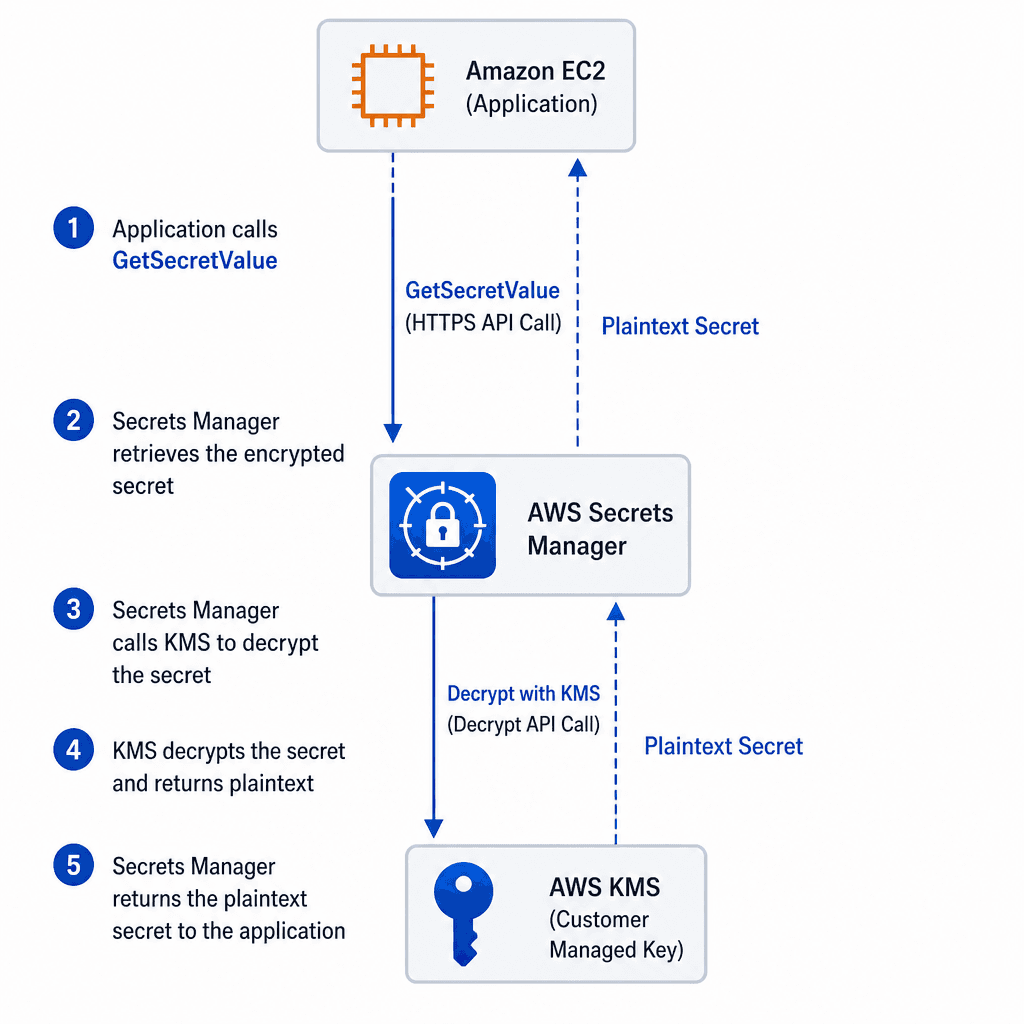
Mechanism: An application running on EC2 or ECS needs to connect to RDS. Flow:
- Application starts up.
- Application calls
secretsmanager:GetSecretValueAPI. - Secrets Manager decrypts the secret using a KMS key.
- Application receives the plaintext username/password.
- Application connects to RDS.
Here, ACM is irrelevant. Secrets Manager provides the dynamic retrieval needed for credential rotation. If you rotate the password in Secrets Manager, the next API call returns the new value. ACM has no concept of "passwords."
Scenario 3: Internal Service Mesh with Private CA
Mechanism: A Kubernetes cluster (EKS) needs mTLS for internal services. Flow:
- A Private CA (hosted on EC2 or via ACM Private CA) issues certificates.
- If using ACM Private CA, the certificates are stored in ACM.
- Certificates are typically injected into the cluster via CSI drivers, cert-manager, or manual mounting, rather than direct SDK integration which requires significant custom configuration.
- The sidecar proxy (e.g., Istio) uses the mounted certificate for mTLS.
If the Private CA’s private key needs to be rotated, and you are using ACM Private CA, AWS handles the key rotation internally. You do not retrieve the key. If you are using a self-managed CA, you might store the CA key in Secrets Manager and have a script retrieve it to sign new certificates.
Key Management and Compliance
Both services integrate with AWS Key Management Service (KMS), but the interaction differs.
ACM: When you create a certificate, ACM encrypts the private key with a KMS key. This key is opaque to the user; you cannot decrypt the private key file. The KMS key is used solely for ACM’s internal storage. This ensures that even AWS support cannot access your private key.
Secrets Manager: You specify a KMS key to encrypt the secret value. You have full control over the KMS key policy. You can grant IAM permissions to specific principals to Decrypt the secret. This transparency is necessary for applications that need to read the secret.
Compliance Considerations
For compliance frameworks like PCI-DSS or HIPAA, the handling of private keys is scrutinized. ACM’s "no direct key access" model reduces the attack surface for public certificates, making it easier to audit. For private keys, storing them in Secrets Manager requires rigorous IAM policies and audit trails (via CloudTrail) to ensure only authorized entities can retrieve them.
Conclusion: When to Use Which
Use AWS Certificate Manager when:
- You need TLS certificates for public-facing AWS services (ALB, CloudFront, API Gateway).
- You want automated renewal without managing certificate files.
- You are using ACM Private CA and do not need direct access to the private key for signing operations outside ACM.
Use AWS Secrets Manager when:
- You need to store and retrieve database passwords, API keys, or encryption keys.
- You require programmatic access to the secret value in your application code.
- You need to rotate secrets automatically and have applications consume the new values automatically.
- You are managing a Private CA key that must be extracted for use in non-ACM contexts.
In a well-designed architecture, both services coexist. ACM secures the transport layer (TLS), while Secrets Manager secures the application layer (credentials). Understanding their distinct mechanisms ensures you don’t force a square peg into a round hole, leading to more secure and maintainable infrastructure.
Related posts
Migrating Between Parameter Store and Secrets Manager
A practical guide for cloud engineers on migrating from AWS Parameter Store to Secrets Manager, covering IAM policies, cutover strategies, and abstraction layers.
Automatic Secret Rotation With Lambda
Learn how to implement automatic secret rotation using AWS Lambda and Secrets Manager to enhance security for database credentials.
KMS vs Secrets Manager: Different Jobs
Understand the distinct roles of AWS KMS and Secrets Manager for secure key management and secret storage in cloud infrastructure.
