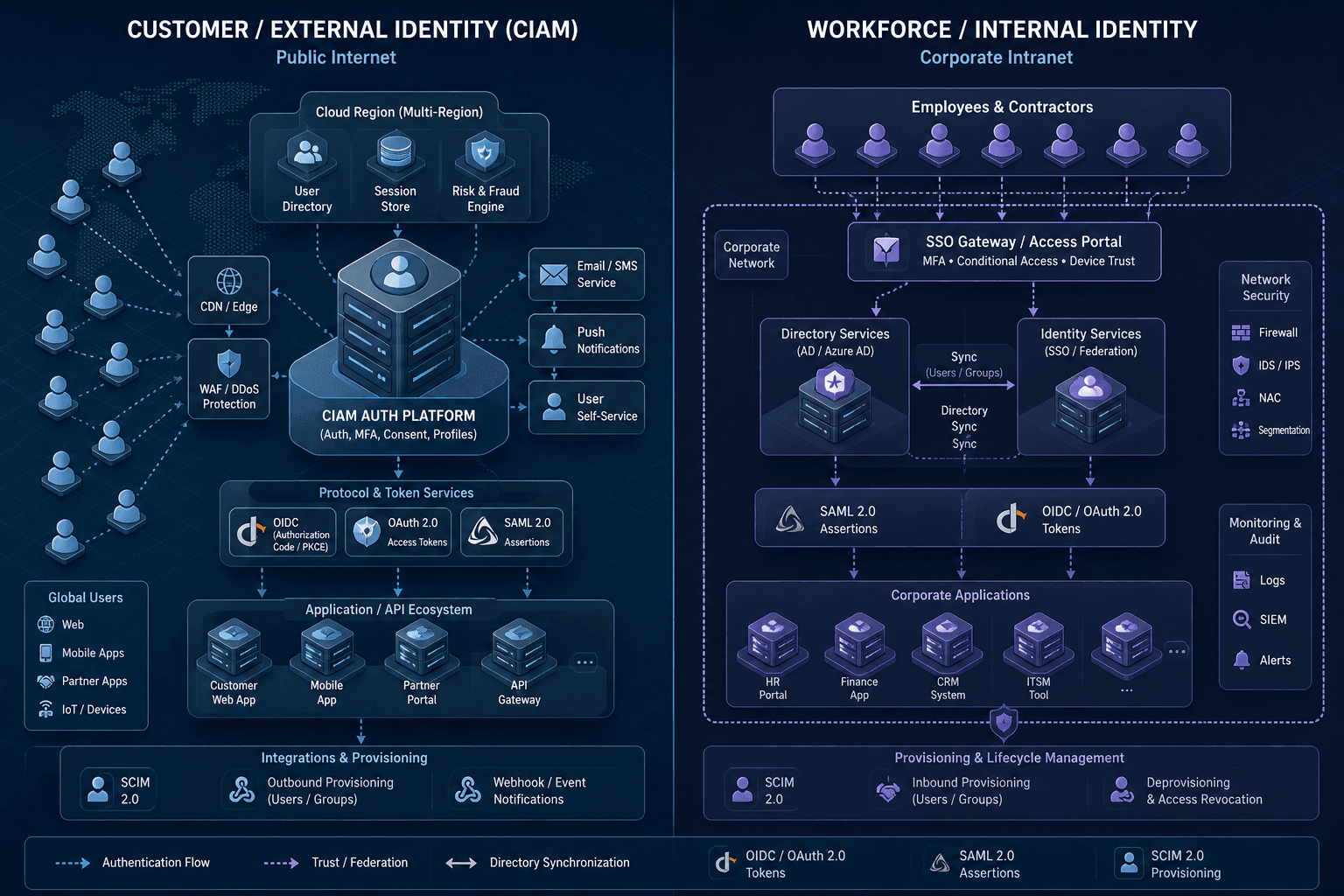
CIAM vs Workforce Identity Management: Architectural Divergence
A technical comparison of CIAM and workforce identity management, outlining distinct requirements for architects and product engineers.
In enterprise architecture, treating Customer Identity and Access Management (CIAM) and Workforce Identity Management as variations of the same system is a common failure mode. While both rely on OpenID Connect (OIDC) and SAML under the hood, their operational mechanics, threat models, and scaling requirements are distinct. Architects must choose between systems optimized for consumer acquisition and frictionless onboarding (CIAM) and systems optimized for internal security, compliance, and device trust (Workforce).
The Trust Boundary Mechanism
The fundamental difference lies in the assumed trust boundary. When evaluating CIAM vs workforce identity solutions, architects must first understand that workforce identity systems operate within an enterprise-controlled perimeter. The assumption is that the user is an employee, the device is managed (MDM/JAMF), and the network is monitored. Identity here is a credential to access resources, tightly coupled with HR lifecycle events (hire, transfer, fire).
CIAM operates in an untrusted, public-facing environment. The user is an anonymous consumer until they register. The primary goal is to lower the barrier to entry while preventing abuse. The trust boundary is the application server itself, meaning every request must be authenticated from scratch without relying on internal network context.
Scale and Performance: Burst vs. Consistent Load
CIAM systems must handle massive scale with high variability. A flash sale or viral marketing campaign can cause a 100x spike in authentication requests in seconds. Workforce systems, by contrast, have predictable load profiles tied to business hours.
CIAM architectures prioritize read-heavy operations and aggressive caching. When a user logs in, the system must validate credentials against a database of millions, but the resulting session token is used for thousands of subsequent API calls. To achieve this, CIAM providers often use distributed caching layers (like Redis) for user profiles and session data, decoupling the authentication event from the profile lookup.
Workforce identity systems prioritize write consistency and immediate propagation. When an employee is disabled in the HR system, that change must propagate to all connected SaaS applications (e.g., Slack, AWS, GitHub) within minutes, not hours. This requires robust SCIM (System for Cross-domain Identity Management) connectors and synchronous provisioning workflows that meeting workforce identity requirements for immediate propagation, which CIAM systems typically lack.
# Example: SCIM Provisioning (Workforce)
# Deleting a user from IdP should immediately revoke access in target apps
DELETE /scim/v2/Users/00141000005r5qk
Data Privacy: Consumer Rights vs. Audit Integrity
The data handling mechanisms diverge sharply due to regulatory frameworks. CIAM is governed by GDPR, CCPA, and other privacy laws that grant users the "right to be forgotten." This requires mechanisms for data deletion that propagate across third-party integrations. CIAM systems must support data portability and minimize data collection at the point of entry.
Workforce identity is governed by compliance standards like SOC 2, HIPAA, and PCI-DSS, which demand immutable audit trails. Every access event, privilege escalation, and data modification must be logged for forensic analysis. A key aspect of any identity architecture comparison is recognizing that CIAM systems often omit detailed audit logs for individual consumer actions to preserve performance and storage costs, whereas workforce systems treat logging as a first-class feature critical for security and compliance.
Integration Patterns: OIDC vs. SAML/SCIM
The integration protocols reflect the user journey. CIAM relies heavily on OIDC and OAuth 2.0 for modern web and mobile applications. These protocols are designed for stateless, token-based authentication, allowing customers to use social logins (Google, Apple, Facebook) to reduce friction. Core CIAM requirements include support for social logins, which allows the identity provider to act as an intermediary, passing claims about the user to the application without exposing credentials.
Workforce identity often still relies on SAML 2.0 for legacy enterprise applications and single sign-on (SSO) experiences. SAML is XML-based and heavier but provides strong assertion capabilities for enterprise resource planning (ERP) and CRM systems. Additionally, workforce systems require deep integration with directory services like Active Directory or LDAP, which CIAM systems generally do not support natively, shaping modern identity architecture by enforcing strict separation between consumer and employee access patterns.
Conclusion
Choosing between CIAM and Workforce Identity Management is not a matter of preference but of architectural fit. If your system serves external customers, you need a CIAM solution that handles scale, social login integration, and privacy compliance. If your system serves employees, you need a Workforce Identity solution that ensures secure access, automated provisioning, and rigorous audit trails. Mixing these concerns leads to security vulnerabilities, poor user experience, and operational overhead.
Related posts
Workforce vs Customer Identity (CIAM): Implementation Guide
This article examines the distinction between workforce identity and customer identity (CIAM) to guide proper implementation strategies for B2B and B2C environments.
Identity Architecture Patterns for Micro-Frontends and Multi-Platform
An examination of identity architecture patterns for micro-frontends and multi-platform environments, covering BFF, cross-platform SSO, and unified identity strategies.
Designing a Centralized Identity Platform: Lessons Learned
This article examines practical lessons in building a centralized identity platform, covering IAM evaluation and architecture strategies.
