Designing a Centralized Identity Platform: Lessons Learned
This article examines practical lessons in building a centralized identity platform, covering IAM evaluation and architecture strategies.
Designing a Centralized Identity Platform: Lessons from the Trenches
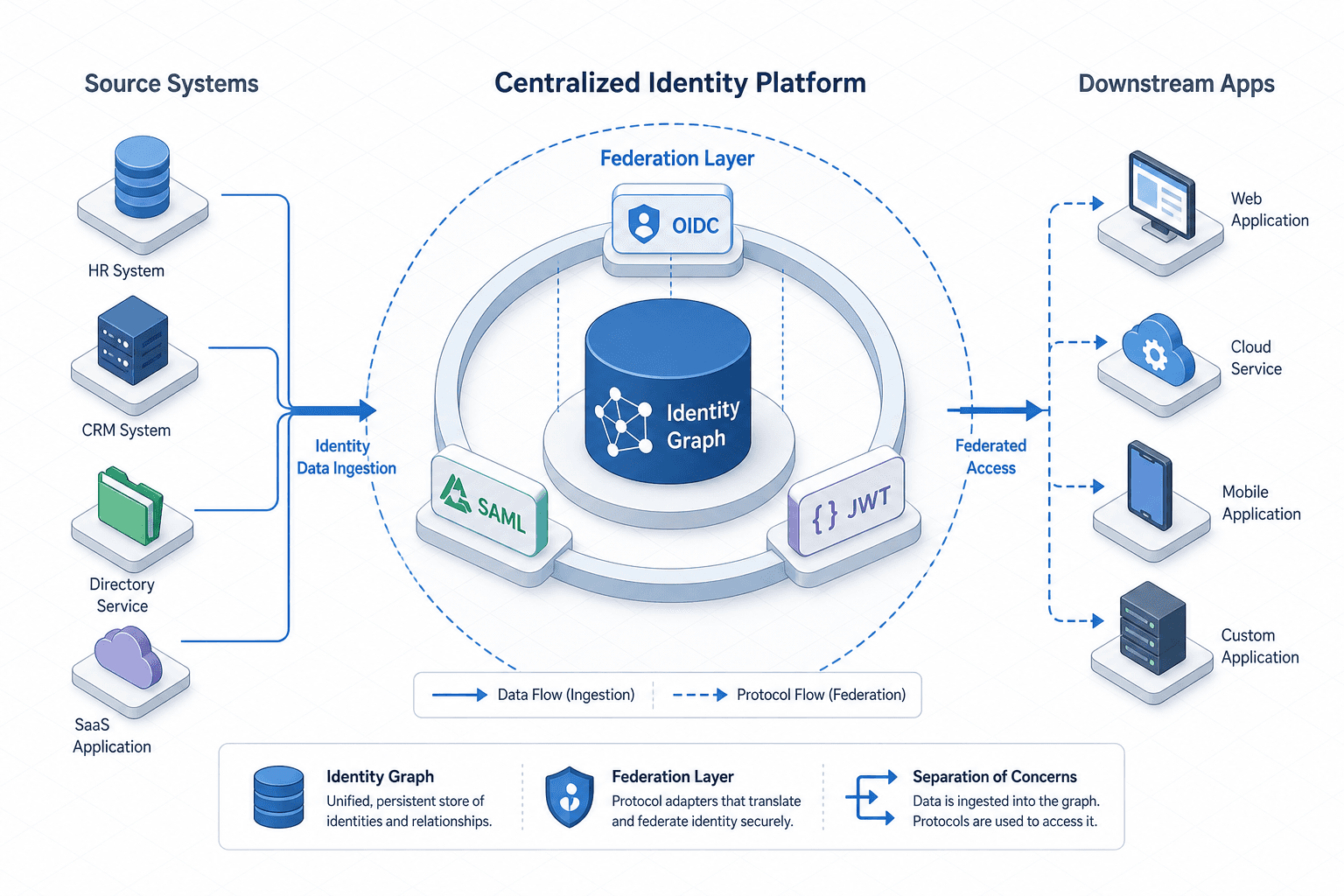
The most common failure mode in building a centralized identity platform is not security; it is architectural rigidity. Engineers often approach this problem by trying to build a "single source of truth" that directly handles every login request. This creates a bottleneck where the platform becomes the authentication engine for the entire enterprise. When the platform slows down, the entire organization stops working. The correct mechanism is to treat the identity platform as a high-fidelity data distribution layer, not a transactional gateway. The platform must model the subject (the user) independently from the protocol (the method of login).
The Data Plane Trap
Consider a scenario involving "Acme Corp," a company migrating from three disparate systems: an on-premises Active Directory (AD), a cloud HR system (Workday), and a legacy CRM. Acme attempts to build a centralized identity platform (CIP) by forcing all three systems to authenticate directly against a new central IdP. They configure the CIP to accept LDAP binds from the AD and SAML assertions from Workday simultaneously. Within weeks, the system fails. Why? Because the CIP is now trying to resolve conflicting attribute schemas in real-time during the authentication handshake. The AD user jdoe has a department attribute that conflicts with the Workday cost_center. The CIP attempts to merge these on the fly, introducing latency and race conditions. The mechanism failed because the platform treated the identity object as a mutable state that needed to be resolved at the moment of access, rather than a static graph that applications query via standard protocols.
Protocol Decoupling Mechanism
The solution lies in strict protocol decoupling. A sound CIP architecture separates the Identity Graph from the Federation Layer. The Identity Graph is a read-only (mostly) store of subjects, attributes, and relationships. It does not care if a user logs in via password, biometrics, or a hardware token. The Federation Layer is the adapter that translates the user's intent into a specific protocol like OIDC (OpenID Connect) or SAML 2.0. In the Acme scenario, the CIP should ingest data from AD and Workday into a unified subject graph (e.g., user:jdoe). The Federation Layer then validates the credentials against the source of truth (AD for password, Workday for SSO) as a distinct authentication event. Only after successful validation does the layer issue a standardized OIDC or SAML token containing the merged attributes. This ensures that the authentication flow is asynchronous to the data model. The token is just a signed assertion of the current state of the graph, not a live query to the graph.

The Evaluation Matrix
When evaluating potential IAM vendors for this architecture, stop looking at the feature list and start looking at the schema extensibility and eventing mechanisms. Many platforms claim "centralization" but force a rigid schema that requires custom coding to handle enterprise-specific attributes. The evaluation metric should be: "Can I push a custom attribute change to the platform and have it propagate to downstream apps via webhook or event stream without a restart?" If the vendor requires a manual sync job or a full deployment cycle to update user attributes, the platform is too slow for modern distributed systems. Look for platforms that expose a robust API for managing the subject graph and an event bus for real-time propagation. The goal is to make the platform a passive data source where applications pull updates via event streams, rather than an active gatekeeper that applications must constantly negotiate with during every request.
Operational State & Drift
The final lesson concerns operational state and drift. In a centralized model, downstream applications (microservices, legacy apps) rely on the CIP to validate tokens. If the CIP updates a user's role or revokes access, the downstream app must know immediately. This is where eventual consistency becomes a critical failure point. If the CIP uses a database with replication lag, a user might be revoked in the central system but still have a valid JWT cached in a downstream service for its full lifetime (e.g., 1 hour). To prevent this, the platform must implement short-lived access tokens paired with long-lived refresh tokens as the primary mitigation. For revocation, use opaque introspection endpoints or revocation lists rather than relying on cache-based approaches that introduce a window of inconsistency. While synchronous introspection blocks the request to ensure immediate state visibility, it does not solve underlying replication lag if the cache is stale. Without these mechanisms, the centralization provides a false sense of security; the revocation is delayed, and the attacker retains access longer than the policy allows.
Common Pitfalls
Based on real-world implementations, three specific pitfalls frequently derail centralized identity projects:
- Schema Conflicts at Runtime: Attempting to merge conflicting attribute schemas (e.g.,
departmentvs.cost_center) during the authentication handshake creates race conditions and latency. The platform must resolve these conflicts during data ingestion, not at the moment of login. - Replication Lag Blindness: Relying on eventual consistency for critical security states like access revocation leads to "zombie access" where revoked users retain valid tokens due to downstream caching delays.
- Architectural Rigidity: Treating the platform as a transactional gateway rather than a data distribution layer creates a single point of failure. If the platform becomes the authentication engine for everything, any performance degradation halts the entire organization.
Practical Takeaways
To navigate these challenges, apply these mental models to your architecture:
- Subject vs. Protocol: Always model the who (subject) separately from the how (protocol). The data model should be universal, while adapters handle specific authentication methods.
- Passive Data Source: Design the platform to push state changes via events. Applications should consume these events to update their local context rather than querying the central system for every operation.
- Short-Lived Tokens: Treat tokens as ephemeral credentials. The lifetime of a token should be short enough that any revocation takes effect quickly, minimizing the impact of replication lag.
FAQ
Q: Can I use a centralized database for token validation instead of introspection? A: You can, but be aware that a centralized database query introduces network latency and a single point of failure. Introspection endpoints are generally preferred for their stateless nature, provided they are backed by a highly available cache or database.
Q: How do I handle schema differences between an on-prem AD and a cloud HR system? A: Do not attempt to merge schemas in real-time. Ingest data from both sources into a canonical Identity Graph where conflicts are resolved during the ETL process. The Federation Layer should only serve the resolved, canonical view.
Q: What is the best way to handle token revocation in a microservices environment? A: Implement short-lived access tokens (e.g., 5-15 minutes) combined with a revocation list or an opaque introspection endpoint. This ensures that even if a token is stolen, its window of utility is minimal, and revocation propagates quickly.
Conclusion
Building a centralized identity platform is an exercise in managing complexity through separation of concerns. It requires resisting the urge to make the platform do everything. Instead, focus on making the data model universal and the protocol adapters flexible. The platform should be the nervous system, transmitting signals, not the muscle, performing the action. By modeling the subject separately from the credential, and by ensuring that state changes propagate instantly, you avoid the pitfalls of the "monolithic IdP" trap.
Related posts
Identity Architecture Patterns for Micro-Frontends and Multi-Platform
An examination of identity architecture patterns for micro-frontends and multi-platform environments, covering BFF, cross-platform SSO, and unified identity strategies.
Angular OAuth2/OIDC: loadDiscoveryDocumentAndTryLogin
Learn how to use loadDiscoveryDocumentAndTryLogin and strict discovery document validation in Angular for secure OAuth2/OIDC authentication.
The AuthConfig Reference: Every Property That Matters
A complete reference for Angular-OAuth2-OIDC AuthConfig properties, covering requireHttps, remoteOnly, and nonceStateSeparator for secure Angular authentication.