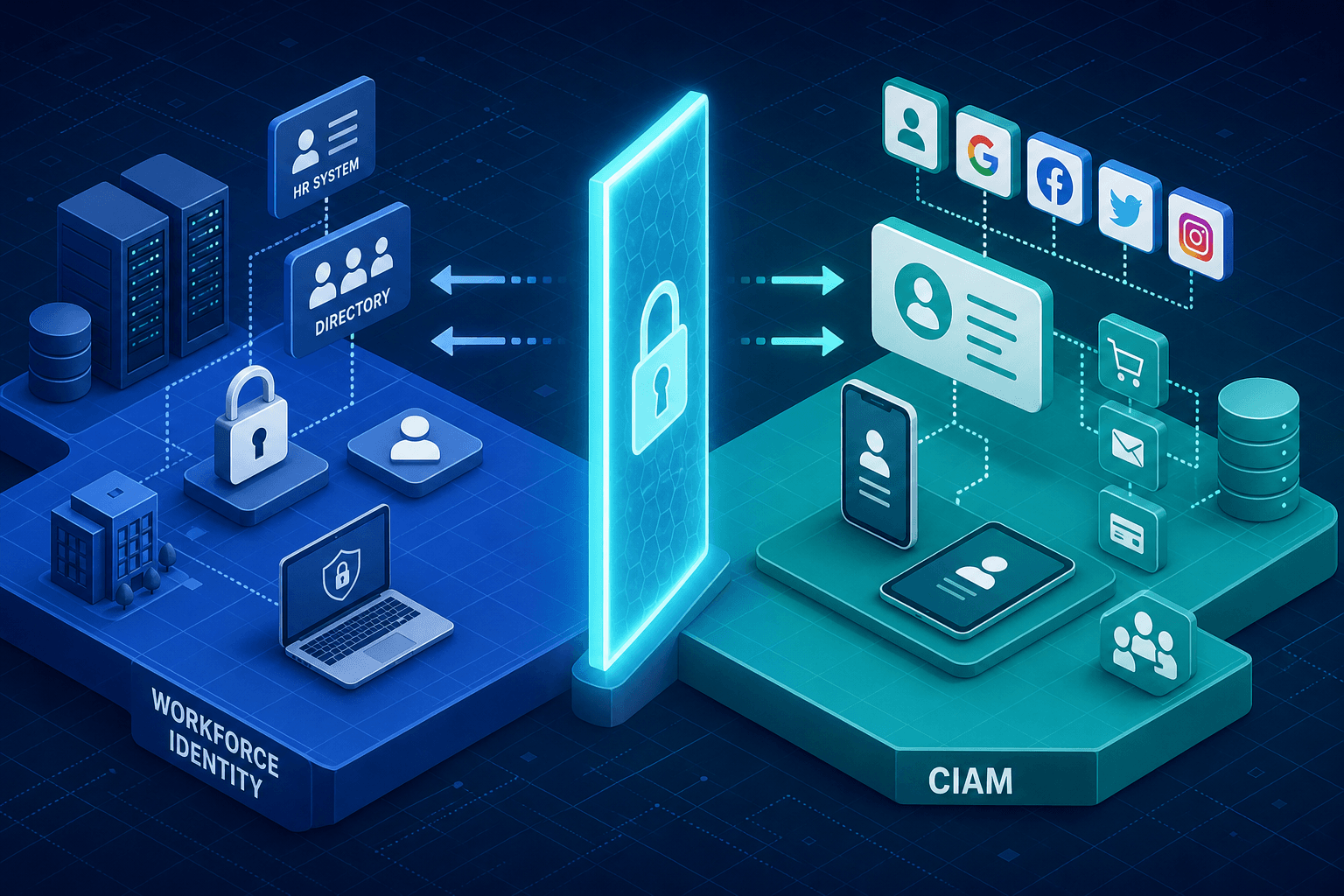
Workforce vs Customer Identity (CIAM): Implementation Guide
This article examines the distinction between workforce identity and customer identity (CIAM) to guide proper implementation strategies for B2B and B2C environments.
You are building a platform that serves internal employees, enterprise partners, and public consumers. The instinct is to build one identity system to rule them all. This is a structural failure. Workforce Identity and Customer Identity (CIAM) operate on fundamentally different trust models. When you merge them, you force a high-security, low-latency internal system to handle high-volume, low-trust external traffic, or you force a high-volume consumer system to enforce strict, rigid organizational policies it was not designed to hold.
The mechanism at play here is the Trust Boundary. In workforce identity, the boundary is the organization's network perimeter. An identity is an asset granted by the organization. If an employee leaves, the organization revokes access immediately. In CIAM, the boundary is the individual user. The identity is a liability; if it is compromised, the user suffers, not the platform. Consequently, the implementation strategy for B2B (Workforce) prioritizes strict control and auditability, while B2B2C (CIAM) prioritizes conversion, friction reduction, and privacy compliance.
Let's look at the data flow for a credential validation event. In a workforce scenario, we distinguish between Internal Workforce (platform employees) and External Workforce (employees of B2B customers).
For Internal Workforce, the system assumes the device and network are part of a controlled environment. The threat model assumes a malicious insider or a stolen corporate laptop. The mechanism involves verifying a certificate chain or a device posture token alongside the password.
Consider a platform employee logging into a CRM. The system checks:
Identity Provider (IdP): Is this user in the corporate directory (e.g., Entra ID/Active Directory)?
Device State: Is the laptop BitLocker encrypted and joined to the domain?
Context: Is the IP address within the corporate subnet?
This is a deterministic check. If any condition fails, access is denied. The data flow is tight, often using SAML or OIDC with strict claim mapping.
For External Workforce (B2B partners), the platform does not manage their identities directly. Instead, the platform integrates with the customer's IdP. The threat model assumes the user might be on a public Wi-Fi, using a personal phone, or sharing credentials. The system cannot assume device trust. The mechanism shifts to Risk-Based Authentication and federation trust. The system checks:
Identity Provider: Is this a Google, Apple, or Facebook account? Or a simple email/password?
Behavioral Analysis: Does the login pattern match historical data?
Friction: If risk is low, skip MFA. If risk is high, trigger a push notification or SMS.
If you implement these using the same schema, you face a contradiction. A workforce system requires a unique, immutable user ID linked to a specific HR record. A CIAM system requires a mutable, anonymizable ID that allows for "Sign in with Google" where the email might change or the user might want to remain pseudonymous. Merging them forces you to store sensitive HR data (salary, role, manager) in a schema designed for social tokens, or to strip necessary context from the internal system, breaking the B2B workflow.
The second critical divergence is the lifecycle of the identity itself. Workforce identities have a hard start and a hard stop. They are tied to employment contracts. When an employee is terminated, the identity is disabled globally within minutes. The data retention policy is driven by HR compliance and legal discovery.
Customer identities are probabilistic. They start with a click and end with a churn or a data deletion request. The data retention policy is driven by privacy laws like GDPR and CCPA.
Imagine a scenario where you use a single database for both.
Scenario: A customer requests "Right to be Forgotten" (GDPR).
Problem: The system must delete all PII. However, if that customer was also a "partner" in a B2B contract, their identity might be linked to an invoice, a legal agreement, or a shared workspace with other employees.
Result: You cannot delete the data without breaking the B2B contract, violating the law, or creating a data inconsistency.
In a proper separation, the Workforce Identity Store (e.g., Entra ID) holds the employee record. The CIAM Store (e.g., Auth0, Okta Identity Cloud) holds the customer record. They might share a "link" via a custom attribute if the user is both an employee and a customer, but the core data lives in separate silos.
The data flow for retention looks different:
Workforce:DELETE command triggers an immediate DISABLE action on all resources. Audit logs are retained for 7+ years.
CIAM:DELETE command triggers a REDACT action on PII, but transactional data (orders) might be anonymized rather than deleted.
Let's construct a concrete scenario: A SaaS platform called "Nexus" that sells project management software. Nexus has internal employees (Workforce), enterprise clients who pay for seats (B2B), and free-tier users (B2C).
The Flawed Approach:
You create one Users table. You add a column is_employee.
Employee login uses LDAP.
Customer login uses OAuth.
You try to enforce MFA for everyone.
Failure: The free-tier users abandon the signup flow because they don't want to set up an authenticator app. The enterprise clients are angry because their employees can't use Single Sign-On (SSO) with their corporate IdP because the system is mixing consumer OAuth flows with enterprise SAML flows.
The Correct Approach:
You deploy two distinct identity planes.
Protocol: SAML 2.0 or OIDC with Enterprise Configuration.
Source of Truth: Corporate Active Directory or Entra ID.
Mechanism: When an Enterprise Client logs in, they use their corporate credentials. The system acts as a Service Provider (SP). It trusts the IdP's assertion that the user is an employee.
Code Example (SAML Assertion):
<saml:Attribute Name="urn:oasis:names:tc:SAML:attribute:emailAddress"> <saml:AttributeValue>user@enterprise-client.com</saml:AttributeValue></saml:Attribute><!-- Custom Attribute for Employee ID --><saml:Attribute Name="employeeID"> <saml:AttributeValue>EMP-9921</saml:AttributeValue></saml:Attribute><saml:Attribute Name="department"> <saml:AttributeValue>Engineering</saml:AttributeValue></saml:Attribute>
This allows you to map department directly to permission sets without storing the department in your app database.
The Bridge:
How do they interact? If an enterprise client wants to buy a "Pro" plan, they might use their corporate account to pay.
Step 1: The Enterprise User logs in via Plane A (Workforce).
Step 2: The system checks if this user has an associated customer_id in Plane B.
Step 3: If not, the system prompts them to link the accounts. This is a "Cross-Platform Identity Linking" event.
Step 4: The system creates a link in a separate identity_links table.
INSERT INTO identity_links (workforce_id, customer_id, relationship)VALUES ('EMP-9921', 'cust_abc123', 'admin');
This separation ensures that if the CIAM provider has a breach (common in B2C), the attacker only gets customer data, not the employee directory structure. If the workforce identity is compromised, the attacker only gets internal access, not the ability to mass-scam customers.
The decision to separate Workforce and Customer identity is not just about convenience; it is about risk containment. Workforce identity is about control. Customer identity is about conversion.
When you implement them together, you force the control mechanisms of the workforce onto the consumer, increasing friction and lowering conversion rates. Conversely, you expose the internal directory to the public-facing APIs, increasing the attack surface.
For a B2B environment, the priority is strict access control and audit trails. For a B2C environment, the priority is speed and privacy. By treating them as distinct data planes with a controlled bridge, you ensure that the security of the workforce does not hinder the growth of the customer base, and the flexibility of the customer base does not compromise the integrity of the organization.
Even with a clear strategy, implementation often stumbles on specific pitfalls when conflating identity types:
GDPR Compliance Conflicts: Attempting to apply "Right to be Forgotten" requests to B2B enterprise accounts often leads to legal violations. Deleting a customer's PII might sever the link to a valid B2B contract or invoice record that the enterprise partner requires for auditing.
HR Data Leakage: Designing a CIAM schema that inadvertently exposes internal HR attributes (like job titles or department IDs) to the public API layer can lead to data leakage. External attackers scraping public profiles could infer organizational structures.
SSO Friction: Forcing B2B enterprise users to adopt consumer-style "Sign in with Google" flows disrupts their internal security policies. Enterprise clients expect SSO integration with their existing corporate IdPs (SAML/OIDC), and forcing alternative methods creates significant adoption barriers.
To successfully architect a dual-identity platform, keep these key takeaways in mind:
Isolate Data Stores: Maintain separate databases or logical silos for Workforce and Customer identities. Use a lightweight linking table only for specific cross-platform scenarios.
Differentiate Protocols: Leverage SAML for enterprise workforce integration where strict assertions are needed, and use OIDC with social providers for customer-facing flows to maximize conversion.
Align Policies with Purpose: Configure retention and deletion policies to match the specific legal and operational requirements of each user type (HR compliance vs. Privacy laws).
Q: Can I use the same database for both workforce and customer identities?
A: While technically possible, it is strongly discouraged. Mixing the schemas creates significant risks for data leakage and compliance violations. It is best practice to use separate stores with a dedicated linking mechanism for users who exist in both roles.
Q: How do I handle MFA for enterprise clients without frustrating their employees?
A: Do not enforce MFA at the application level for B2B users if their corporate IdP already handles it. Rely on the IdP's assertion of MFA success (via SAML/OIDC claims) and configure conditional access policies based on the source of the authentication.
Q: What happens if a customer becomes an employee of the platform?
A: This is a "Cross-Platform Identity Linking" event. The user should retain their customer ID for billing history but be assigned a new Workforce ID for internal access. The two identities are linked in a separate metadata table, ensuring data integrity for both roles.
Audit your current identity architecture today to determine if you are inadvertently merging workforce and customer data planes. Review your SAML configurations for enterprise clients and ensure your CIAM provider supports the granular privacy controls required for B2C compliance. Separating these concerns now will save significant technical debt and legal risk down the road.