Privacy-Enhancing Technologies for Privacy Identity Management
An examination of privacy-enhancing technologies like zero-knowledge proofs and anonymous credentials for secure identity management and GDPR compliance.
The Mechanism of Verification Without Exposure
Current identity management relies on a flawed premise: to prove who you are, you must hand over your identity. In a standard OAuth flow or a simple login, a client sends a username and password to a server. The server hashes the password, compares it to a stored hash, and if they match, issues a session token. This model requires the server to store sensitive data. If the server is breached, the attacker gains the entire database of user credentials. This is the "collect-and-store" vulnerability.
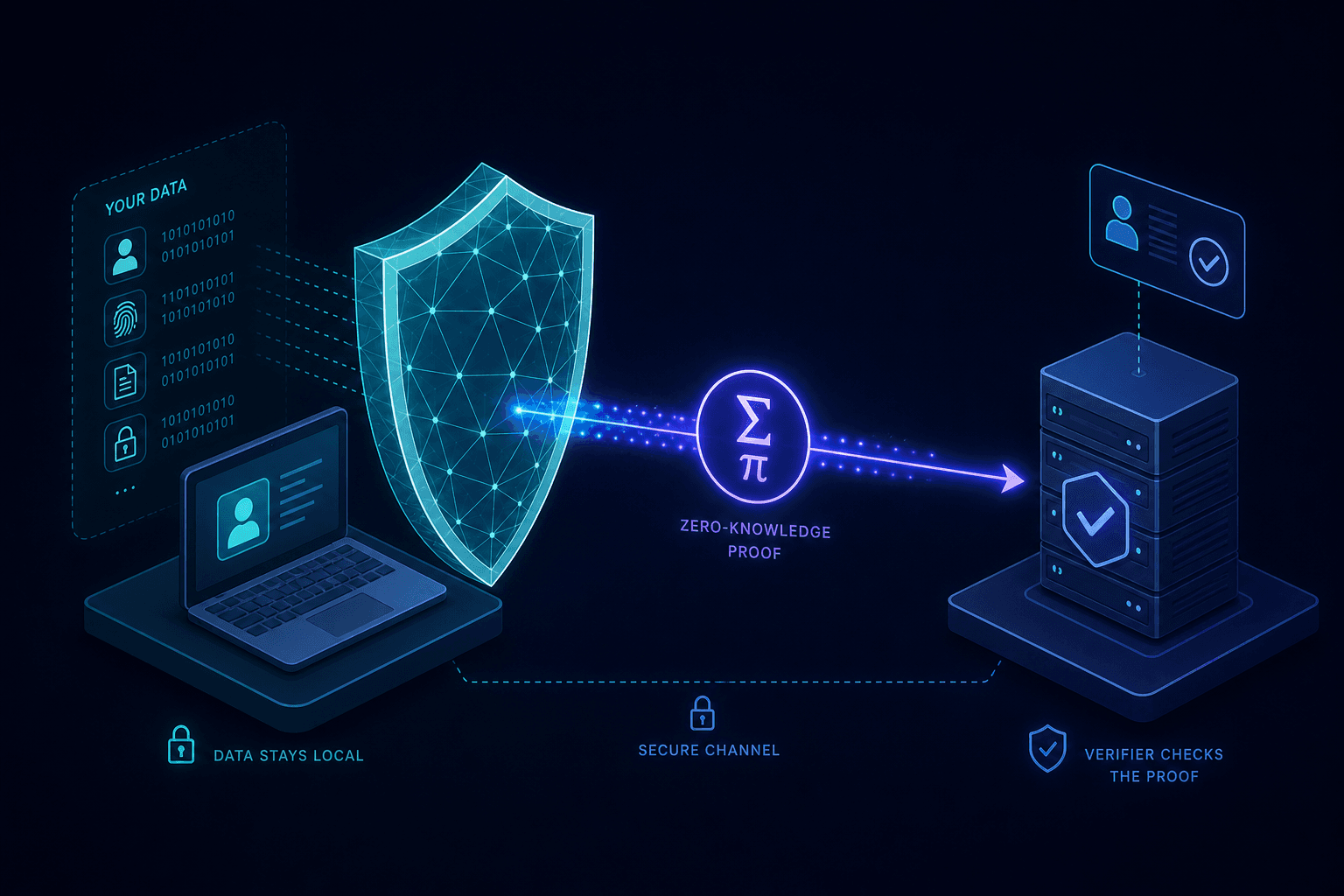
Privacy-Enhancing Technologies (PETs) invert this logic. They do not replace the need for trust; they replace the need for data transfer. The core mechanism here is cryptographic proof. Instead of sending the password, the user generates a mathematical proof that they know the password without ever transmitting the password itself.
Consider a scenario involving Alice, a user, and Bob, an Identity Provider (IdP). In a traditional system, Alice sends her password P to Bob. Bob checks Hash(P) against StoredHash. In a Zero-Knowledge Proof (ZKP) system, Alice runs a protocol where she inputs P locally. She outputs a proof string π. Bob receives π and runs a verification algorithm Verify(π, PublicStatement). If π is valid, Bob knows Alice knows P, but Bob has never seen P, nor has he stored it. The data minimization is absolute: the verifier learns nothing other than the truth of the statement being proved.
This mechanism is not theoretical magic; it is grounded in computational complexity theory. Specifically, ZKPs allow a prover to convince a verifier of the truth of a statement without revealing any information beyond the validity of the statement itself. Modern implementations like zk-SNARKs (Succinct Non-Interactive Arguments of Knowledge), as defined in the seminal work by Groth et al. (2016) and implemented in libraries like snarkjs or Circom, allow this verification to happen in milliseconds with small proof sizes, making them viable for web-scale authentication.
Anonymous Credentials and Attribute Disclosure
While ZKPs prove knowledge, Anonymous Credentials (ACs) handle attribute disclosure. This is critical for real-world identity management where we need to prove specific facts (e.g., "I am over 18") rather than just identity. The mechanism relies on a digital signature scheme that supports blinding and unblinding, often based on the Camenisch-Lysyanskaya (CL) signature scheme (Camenisch & Lysyanskaya, 2001).
Imagine a scenario where Alice needs to rent a car. The rental agency (Verifier) requires proof that Alice is at least 18 years old and has a valid license. In a centralized model, Alice uploads her driver's license image. The agency stores it. If the agency is hacked, the image is stolen.
With ACs, the process changes:
- Issuance: Alice's government (Issuer) issues a signed credential containing her birthdate and license status. This credential is blinded before signing to ensure the Issuer cannot link the credential to Alice's specific interaction later.
- Storage: Alice stores this signed credential on her device. The Issuer never sees the credential after issuance.
- Presentation: When renting the car, Alice uses a ZKP protocol to generate a proof that "the birthdate in my credential is > 18" and "the license status is valid." She sends this proof to the rental agency.
- Verification: The rental agency verifies the signature on the credential and the validity of the proof. The agency learns only that Alice is eligible. It learns nothing about her name, address, or exact birthdate.
This mechanism ensures unlinkability. Even if the rental agency logs the transaction, they cannot link it to Alice's previous transaction at a different venue, because each proof is generated with fresh randomization. This prevents the creation of a surveillance trail across different services. The W3C Verifiable Credentials standard (W3C, 2022) formalizes this flow, allowing these cryptographic primitives to be used in a decentralized identity framework.
Mapping Cryptography to GDPR Compliance
The European Union's General Data Protection Regulation (GDPR) mandates "data minimization" (Article 5(1)(c)) and "privacy by design" (Article 25). Traditional identity systems struggle to comply because they inherently require the collection and retention of Personally Identifiable Information (PII) to function. PETs solve this at the protocol level.
Under GDPR, a data controller (the service provider) is liable for the data it holds. If a service provider uses a ZKP-based login, they hold no PII. They only hold a boolean result (True/False) regarding the user's eligibility. Since no PII is processed or stored, the GDPR obligations regarding data retention, right to erasure, and data portability are significantly reduced or eliminated for that specific data point.
For example, consider the "Right to be Forgotten" (Article 17). In a centralized database, a user must request deletion, and the administrator must execute a delete command. In a PET system, the user simply deletes the credential from their local device. The verifier never had the data to begin with, so there is nothing to delete. This aligns perfectly with the principle that data should only be kept as long as necessary.
However, this is not a silver bullet. The mechanism assumes the cryptographic assumptions hold. If a ZK-SNARK scheme is broken, or if the user's private key is compromised, the privacy guarantee fails. Furthermore, GDPR Article 6 requires a lawful basis for processing. While PETs minimize data, the act of generating a proof might still constitute processing if metadata is leaked. Therefore, the implementation must ensure that no side-channel information (like timing attacks or network metadata) leaks identity information.
Engineering Tradeoffs and Key Management
Implementing PETs introduces specific engineering constraints. The primary tradeoff is computational cost. Generating a Zero-Knowledge proof is computationally expensive compared to a simple hash check. While a password hash takes less than 1ms, generating a zk-SNARK proof involves complex polynomial commitments and pairing operations that introduce significantly higher latency than hash checks, often requiring hardware acceleration or off-chain computation for mobile clients.
Furthermore, the key management burden shifts from the server to the user. In traditional systems, the server manages the password database. In a ZKP system, the user must securely store their private keys or seed phrases. If a user loses their key, they lose their identity permanently. There is no "forgot password" reset button that works in the same way, because the server never held the secret to reset. This requires robust recovery mechanisms, such as social recovery or multi-party computation (MPC), which add architectural complexity.
There is also the issue of interoperability. The ecosystem is fragmented between different ZK libraries (e.g., Circom, SnarkJS, Halo2) and different identity standards (DID, VC). A service built on one stack may not easily interoperate with another. This fragmentation creates a "walled garden" risk, where users are locked into specific identity providers to maintain their credential compatibility.
Common Pitfalls
In my experience implementing these systems, several pitfalls frequently derail projects before they reach production.
- Key Recovery Complexity: The most common failure point is user experience around lost keys. Unlike a password reset flow, ZKP recovery often requires complex multi-signature setups or social recovery protocols. If not designed intuitively, users will simply abandon the system rather than navigate the recovery steps.
- Browser Performance Bottlenecks: While proof verification is fast, proof generation can be CPU-intensive. Running heavy ZK circuits directly in a browser thread can freeze the UI or cause the device to throttle, leading to a poor user experience. Developers often underestimate the need for WebAssembly optimizations or offloading computation to a backend enclave.
- Regulatory Interpretation Risks: Just because a system is technically "zero-knowledge" doesn't mean it is automatically GDPR compliant. Regulators may still view the metadata (IP addresses, timestamps, proof sizes) as PII if it can be linked to an individual. Organizations often fail to audit their non-cryptographic side channels, assuming the math covers all bases.
Practical Takeaways
To successfully deploy Privacy-Enhancing Technologies, I recommend adopting these three mental models:
- Trust Math, Not Infrastructure: Stop designing systems where the security relies on the server being "honest" or "secure." Design systems where the security relies on the mathematical impossibility of breaking the proof, even if the server is compromised.
- Data Minimization as Default: Do not collect PII and then try to encrypt it. Assume the data should never leave the user's device unless absolutely necessary for the transaction. If the data isn't needed for the proof, it shouldn't be transmitted.
- Recovery is a Feature, Not a Bug: Treat key recovery as a first-class citizen in your architecture. If users cannot recover their identity, the system is unusable. Invest in MPC or social recovery early, rather than retrofitting it later.
FAQ
Are ZKPs ready for production?
Yes, but with caveats. For high-value, low-frequency transactions (like identity verification or access control), ZKPs are production-ready using mature libraries like snarkjs and circom. For high-frequency, low-latency needs (like real-time trading), the overhead may still be prohibitive without specialized hardware.
How does this handle password resets? It doesn't use the traditional reset model. Instead, identity is tied to a cryptographic key pair. If a user loses their key, they must rely on a pre-configured recovery scheme, such as a multi-party computation (MPC) threshold signature or a social recovery group. The server cannot reset the key because it never possessed the secret.
Do these technologies work with legacy systems? They can, but usually via a hybrid approach. Legacy systems can be wrapped with a "ZK gateway" that translates traditional credentials into zero-knowledge proofs before passing them to the core logic. However, full integration requires updating the backend to support the verification algorithms, which may require significant refactoring.
Conclusion
The transition to Privacy-Enhancing Technologies in identity management is a shift from trusting the infrastructure to trusting the mathematics. By moving the verification logic to the edge and keeping the raw data local, systems can achieve a level of privacy that is mathematically provable rather than procedurally assumed.
For organizations, adopting ZKPs and Anonymous Credentials is not just a security upgrade; it is a compliance strategy. It directly addresses GDPR's data minimization requirements by ensuring that PII is never exposed to the verifier. While the computational overhead and key management challenges are real, they are engineering problems that can be solved with better hardware acceleration and user experience design. The future of identity is not about storing more data, but about proving more with less.
Related posts
Decoding client_secret_basic Default in RFC 8414
An examination of the token_endpoint_auth_methods_supported metadata field in RFC 8414 and why client_secret_basic remains the default authentication method.
Identity in Serverless Architectures: Authentication Patterns for Lambda and Cloud Functions
An examination of identity management patterns for Lambda and cloud functions, focusing on Cognito authorizers and serverless security.
Identity Data Security: Encrypting and Tokenizing PII in Identity Stores
An examination of identity data security strategies focusing on encrypting and tokenizing personally identifiable information within identity stores.