Contextual Retrieval: Chunk Prefixing, Implemented
An implementation of contextual retrieval using chunk prefixing to enhance indexing and recall improvement for ML engineers.
Retrieval-Augmented Generation (RAG) is often sold as a simple pipe: ingest documents, split them into chunks, embed them, and query. In practice, this naive approach breaks when a question requires information that spans multiple sentences or relies on implicit context present in the surrounding paragraphs but absent from the specific chunk. This is the "context gap."
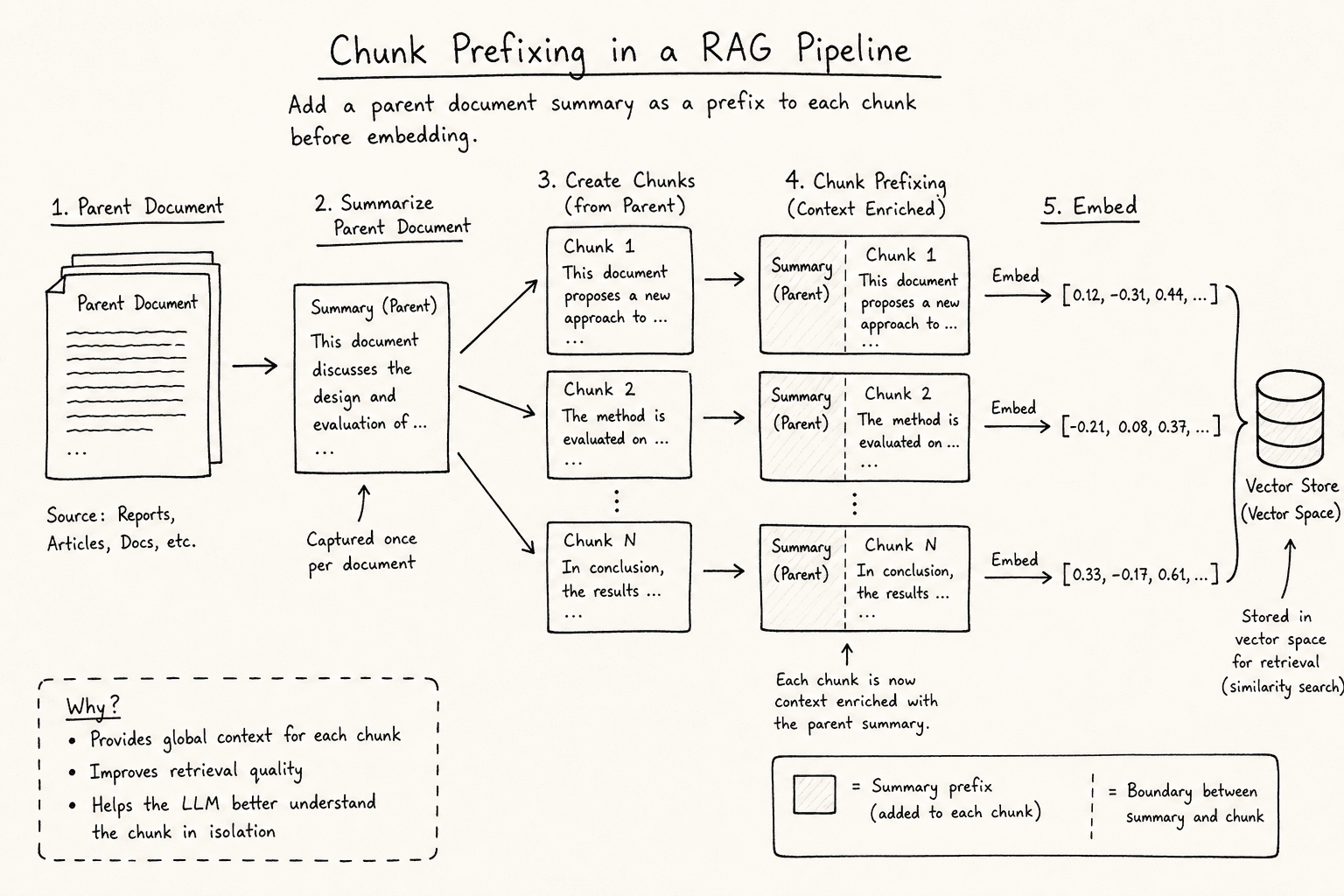
Standard solutions like Parent-Document Retrieval (retrieving the chunk, then fetching the full parent document) add latency and complexity to the query path. A more elegant solution, adopted in production systems, is Chunk Prefixing. This technique moves context into the index itself. By prepending a condensed summary of the parent document to every chunk before embedding, we ensure that every vector stored in the database is self-contained.
This article details the mechanism of chunk prefixing, its implementation in Python, and the trade-offs involved in indexing efficiency versus recall accuracy.
The Context Problem in Isolated Chunks
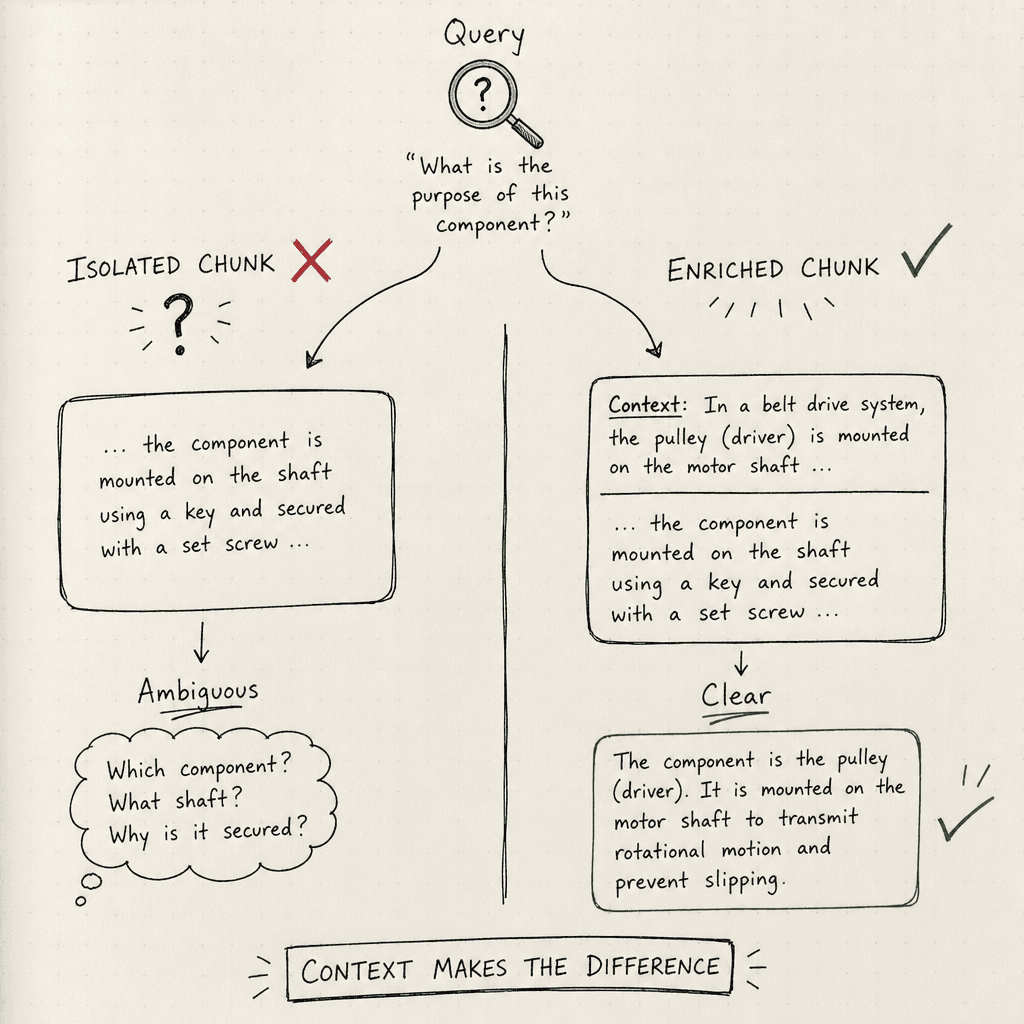
To understand why chunk prefixing works, we must first look at why standard chunking fails. When a vector database embeds a text chunk, it creates a mathematical representation of that specific string of tokens. If the chunk is:
"The server crashed at 3 AM due to a memory leak in the authentication module."
And the user asks: "Why did the system fail?", the embedding captures the concept of a crash and a module. However, if the chunk had been split such that the previous sentence was lost:
"The authentication module failed to release handles."
The vector for this second chunk lacks the temporal context ("3 AM") and the causal link ("memory leak") which might have been in the preceding text. The model retrieves relevant vectors, but the retrieved text is ambiguous.
In larger documents, this fragmentation is severe. A chunk containing only a pronoun reference ("It was caused by...") is useless for retrieval unless the antecedent is included. Parent-Document Retrieval solves this by retrieving the whole paragraph, but this bloats the context window sent to the LLM, increasing cost and potentially introducing noise.
Chunk prefixing offers a middle ground. It provides just enough context to disambiguate the chunk without flooding the LLM with irrelevant text from the entire parent document.
The Mechanism: How Chunk Prefixing Works
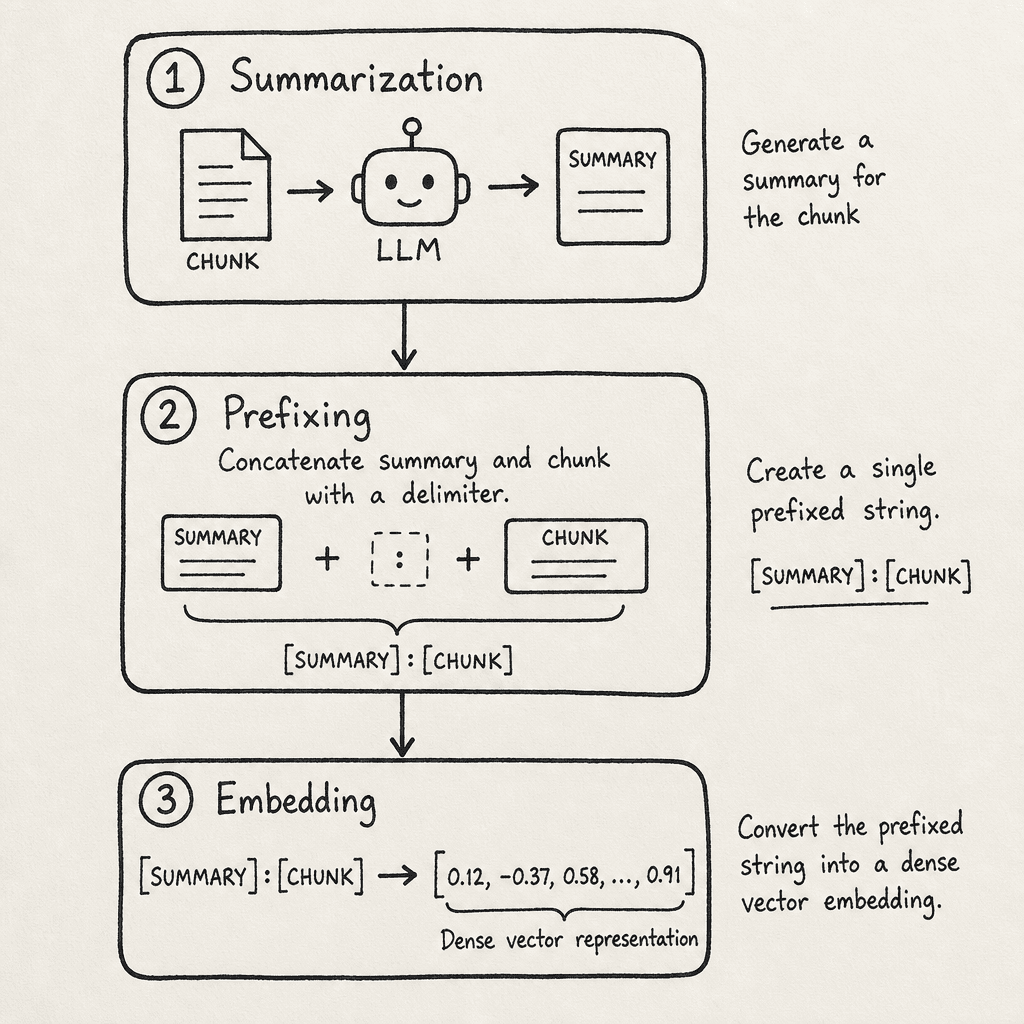
The mechanism operates during the indexing phase, not the query phase. It transforms the indexing pipeline from a flat list of chunks into a list of "context-enriched chunks."
The algorithm follows three steps:
- Summarization: For each parent document (e.g., a PDF page or a markdown section), generate a concise summary. This summary acts as the "prefix."
- Prefixing: Concatenate the summary and the original chunk with a separator.
- Format:
[SUMMARY]: [CHUNK]
- Format:
- Embedding: Embed this combined string. The vector now represents both the specific details of the chunk and the broader context of the document.
When a query is made, the system retrieves the enriched chunk. The LLM receives the summary first, which grounds the specific chunk details. The retrieval is faster than fetching the full parent document because the vector search happens on the smaller, enriched chunk, and the LLM only sees the necessary context.
Implementation Workflow
We will implement this using Python, LangChain for orchestration, and OpenAI for embeddings and summarization. This approach is agnostic to the vector database, though we will assume a generic VectorStore interface.
Step 1: Define the Summarizer
First, we need a function to generate the prefix. We use a lightweight LLM call to summarize the parent document.
import os
from langchain_openai import ChatOpenAI
from langchain_core.messages import HumanMessage, SystemMessage

def generate_summary(text: str) -> str:
    """Generate a concise summary of the parent document."""
    llm = ChatOpenAI(model="gpt-4o-mini", temperature=0)

    response = llm.invoke([
        SystemMessage(content="You are an expert summarizer. Provide a concise, factual summary of the following text in 2-3 sentences. Focus on key entities and events."),
        HumanMessage(content=text)
    ])
    return response.content
Step 2: Chunking and Enrichment
Next, we split the document and apply the prefix. We use RecursiveCharacterTextSplitter to ensure logical boundaries.
from langchain.text_splitter import RecursiveCharacterTextSplitter

def create_enriched_chunks(documents: list[str]) -> list[dict]:
    """
    Split documents into chunks and prepend a summary of the parent document.
    Returns a list of dicts with 'text' and 'metadata'.
    """
    enriched_chunks = []
    splitter = RecursiveCharacterTextSplitter(
        chunk_size=500,
        chunk_overlap=50,
        separators=["\n\n", "\n", " ", ""]
    )

    for doc_text in documents:
        # 1. Generate the prefix (summary)
        summary = generate_summary(doc_text)

        # 2. Split the parent document
        chunks = splitter.split_text(doc_text)

        # 3. Prepend summary to each chunk
        for chunk in chunks:
            # Create the enriched text
            enriched_text = f"Context: {summary}\n\nChunk: {chunk}"

            enriched_chunks.append({
                "page_content": enriched_text,
                "metadata": {"source": "parent_doc_id"}
            })

    return enriched_chunks
Step 3: Indexing
Finally, we embed these enriched chunks. The key insight here is that the vector space now aligns "Context: X... Chunk: Y" together. A query about "X" will naturally retrieve chunks where "X" is mentioned in the prefix, even if the specific detail "Y" is far away in the original document structure.
from langchain_community.vectorstores import Chroma
from langchain_openai import OpenAIEmbeddings
from langchain_core.documents import Document

def index_enriched_chunks(chunks: list[dict]):
    embeddings = OpenAIEmbeddings()

    # Convert dicts to LangChain Document objects
    docs = [
        Document(page_content=c['page_content'], metadata=c['metadata'])
        for c in chunks
    ]

    vectorstore = Chroma.from_documents(
        documents=docs,
        embedding=embeddings,
        persist_directory="./chroma_db_chunk_prefixing"
    )
    return vectorstore
Trade-offs: Cost, Storage, and Prompt Caching
Implementing chunk prefixing introduces specific engineering trade-offs that must be managed.
1. Indexing Latency and Cost
The primary cost in a RAG pipeline is typically the embedding generation, not the summarization step. Summarization adds a minor overhead, as summaries are short (2-3 sentences). While this adds an extra API call per document, the cost is negligible compared to the embedding cost of the full text and the subsequent retrieval operations.
Opinion: The marginal cost of summarization is worth the improvement in recall. A significant increase in recall reduces the need for re-querying or fallback mechanisms, saving money in the long run.
2. Vector Database Storage
Each chunk now contains the summary. If the summary is 100 tokens and the chunk is 500 tokens, the indexed text is 600 tokens. This increases the storage footprint by ~20%. For most vector databases, this is acceptable because the vectors themselves (the numerical arrays) do not change size; only the metadata/text payload grows.
3. Prompt Caching Optimization
A critical optimization for production systems is Prompt Caching. When you use the same summary prefix for multiple chunks from the same document, you should leverage client-side caching to avoid redundant API calls.
Ensure that the system caches the generate_summary result for each unique parent document ID. Do not regenerate the summary for every chunk. Note that while LLM providers like OpenAI offer prompt caching for generation, the embedding API does not currently support prompt caching in the same way. Therefore, client-side caching of the summary generation result is the primary method to reduce cost and latency here.
# Pseudo-code for caching
summary_cache = {}

def get_summary(doc_id: str, doc_text: str) -> str:
    if doc_id in summary_cache:
        return summary_cache[doc_id]

    summary = generate_summary(doc_text)
    summary_cache[doc_id] = summary
    return summary
4. Query-Time Noise
While chunk prefixing improves recall, it can introduce noise if the summary is too broad. If the summary mentions five different topics, and the chunk is about only one, the vector might still be relevant to unrelated queries about the other four topics. Mitigate this by keeping summaries tight and focused on the specific domain of the document.
Conclusion
Chunk prefixing is a straightforward and effective mechanism for solving the context gap in RAG systems. By moving context into the index, we enable self-contained retrieval that is both fast and accurate. The implementation is straightforward: summarize, prepend, and embed. The trade-offs in storage and indexing latency are minor compared to the gains in recall quality. For ML engineers building production RAG pipelines, chunk prefixing should be considered a standard optimization over naive chunking.
Related posts
Unsloth: Fine-Tuning 2x Faster on One GPU
Learn how Unsloth accelerates fine-tuning by 2x using Triton kernels and LoRA, enabling efficient model training on a single GPU.
OWASP Top 10 for LLM Applications, Applied
A practical examination of the OWASP Top 10 for LLM Applications, covering security checklists, mitigations, and appsec review processes for developers.
Zero-Downtime Model Rollouts: Strategies for Continuous ML Availability
Explore strategies for zero-downtime model rollouts, including blue-green deployments, rolling updates, and readiness probes to ensure continuous availability.
