GDPR for Identity Systems
A technical examination of implementing GDPR compliance in identity systems, covering data minimization, right to erasure, and audit retention.
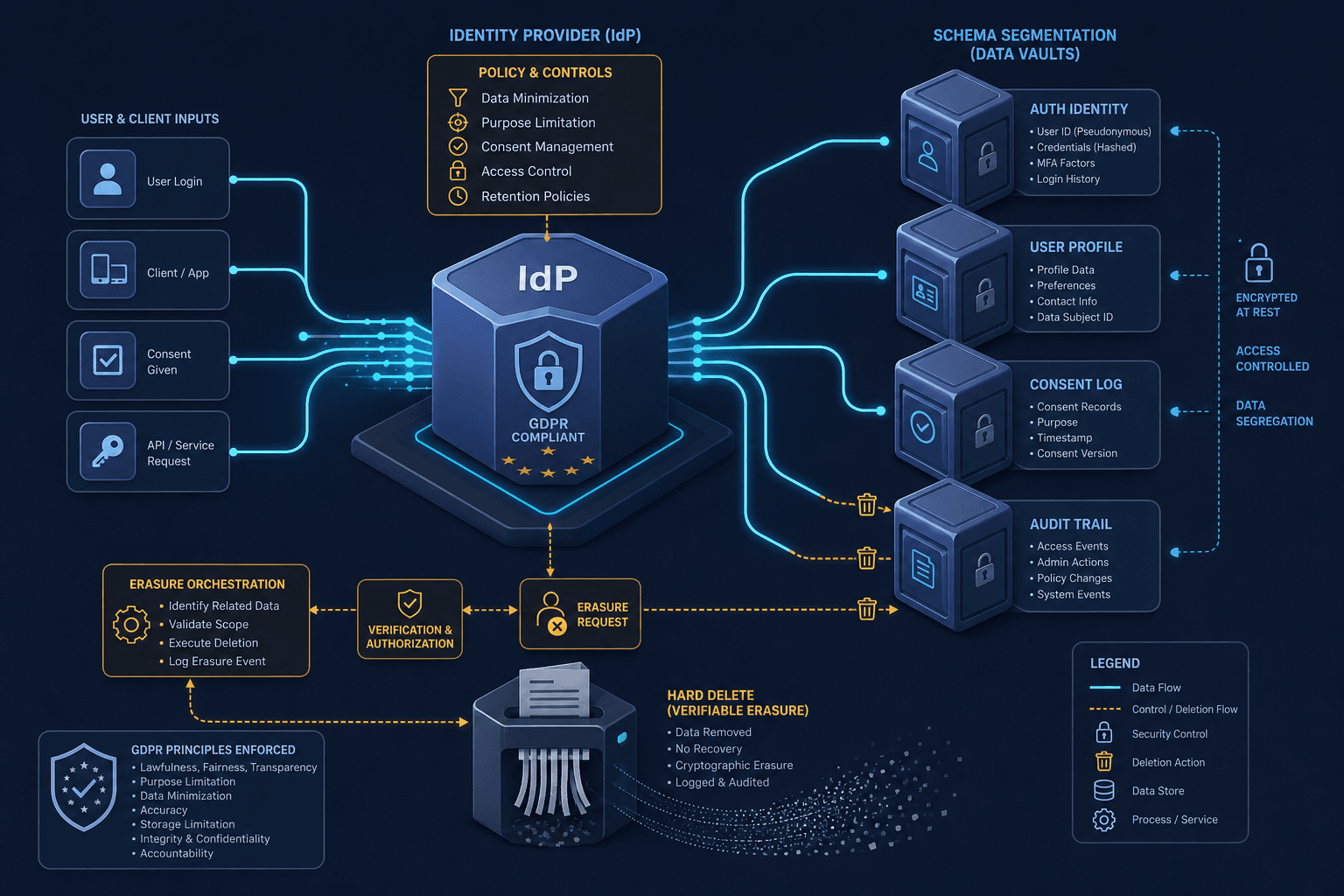
Implementing the General Data Protection Regulation (GDPR) in a gdpr identity system is often mistaken for a legal review. It is not. It is a systems engineering problem involving data flow, schema design, and lifecycle management. Identity systems are the gatekeepers of personal data; therefore, they must be architected to enforce data minimization, support irreversible erasure, and maintain auditability without retaining unnecessary personal identifiers. As noted in the Official GDPR Text (Article 5) and guidance from the Information Commissioner's Office (ICO), this requires a technical-first approach to data governance.
This guide details the mechanism-level implementation of GDPR requirements within an identity provider (IdP) or user management service.
Data Minimization as Schema Constraint
Article 5(1)(c) of the GDPR mandates that personal data must be "adequate, relevant and limited to what is necessary in relation to the purposes for which they are processed."
In practice, this means your database schema cannot be a dumping ground for every attribute a user might provide. You must distinguish between authentication attributes (required for security) and profiling attributes (used for marketing or analytics).
Implementation Mechanism
-
Schema Segmentation: Separate user profiles into distinct tables or collections.
auth_identity: email_hash, password_hash, mfa_keys.user_profile: name, address, preferences.marketing_consent: boolean flags, timestamps, source_ip.
-
Default-Null Enforcement: Configure the database to reject null values only where strictly necessary for authentication. All other fields should default to
NULLor empty strings. This prevents accidental accumulation of unused data. -
Ingestion Validation: Implement middleware that rejects incoming registration payloads containing fields not explicitly mapped to a defined purpose. For example, if a login endpoint does not require a phone number, the API should ignore or reject it, rather than storing it "just in case."
# Example: Strict schema validation on user creation
def create_user(payload):
    allowed_fields = {'email', 'password_hash', 'mfa_secret'}
    # Reject any extra data to enforce minimization
    if not set(payload.keys()).issubset(allowed_fields):
        raise ValidationError("Data minimization violation: unexpected fields")

    user = User(**payload)
    db.save(user)
    return user
The Right to Erasure (Article 17)
The "Right to be Forgotten" (Article 17) requires that upon request, an organization must delete personal data without undue delay.
The most common failure mode in identity systems is the use of soft deletes (setting is_deleted = true). Soft deletes retain the data in the database, making it technically possible to re-identify the user. This violates GDPR unless the data is fully anonymized.
It is critical to distinguish between hard delete and anonymization. A hard delete removes the data rows entirely, achieving erasure. Anonymization transforms data so that the subject is no longer identifiable. Soft deletes achieve neither; they retain PII in a hidden state. To comply, you must either perform a hard delete or apply robust anonymization techniques that render re-identification impossible.
Implementation Mechanism
-
Hard Delete with Cascade: When a user requests erasure, the system must execute a cascade delete across all related tables (
auth_identity,user_profile,marketing_consent). -
Handling Backups: GDPR acknowledges that immediate deletion from backups may be impractical. However, you must ensure that data in backups is not processed.
- Mechanism: Tag backup records with a "do-not-process" flag. Ensure that backup restoration processes automatically skip or anonymize records flagged for erasure.
-
Third-Party Processors: You are responsible for ensuring your vendors delete data.
- Mechanism: Implement a
delete_user_data(user_id)API call that is propagated to all connected services (e.g., analytics, CRM) via event-driven architecture (e.g., Kafka topicuser.erased).
- Mechanism: Implement a
-- Example: Hard delete with referential integrity
BEGIN TRANSACTION;
DELETE FROM marketing_consent WHERE user_id = 'u_123';
DELETE FROM user_profile WHERE user_id = 'u_123';
DELETE FROM auth_identity WHERE id = 'u_123';
COMMIT;
Consent Management
Consent must be "freely given, specific, informed and unambiguous."
Identity systems must track not just if consent was given, but when, how, and what version of the privacy policy was active.
Implementation Mechanism
-
Immutable Consent Logs: Store every consent action as an immutable record. Do not update existing consent records; append new ones. This creates an audit trail of the user’s evolving choices.
-
Granularity: Consent must be separated by purpose. A user can consent to marketing but not to data sharing with third-party advertisers.
-
Withdrawal Mechanism: Withdrawal must be as easy as giving consent. Typically, this is a single-click option in the user profile settings. Upon withdrawal, the system must trigger the erasure process for data processed solely on the basis of that consent.
{
  "consent_log": [
    {
      "timestamp": "2023-10-01T12:00:00Z",
      "policy_version": "v1.2",
      "purpose": "marketing",
      "status": "granted",
      "ip_address": "192.168.1.1"
    },
    {
      "timestamp": "2023-12-15T09:30:00Z",
      "policy_version": "v1.3",
      "purpose": "marketing",
      "status": "withdrawn",
      "ip_address": "192.168.1.1"
    }
  ]
}
Audit Retention vs. Data Minimization
A critical tension exists between GDPR’s erasure requirement and other regulations (like PCI-DSS or SOX) that require audit logs to be retained for years.
GDPR does not require you to erase audit logs. It requires you to erase personal data. Therefore, the solution is anonymization within audit trails.
Implementation Mechanism
-
Separation of Concerns: Audit logs should record that an action occurred, but not necessarily who did it, if the identity is not strictly necessary for the audit.
-
Pseudonymization: If the audit log must reference a user, replace the user’s identifier with a pseudonym or hash that cannot be reversed without a separate, highly controlled key.
-
Retention Policy: Apply a retention policy to audit logs that is independent of user data retention. For example, keep audit logs for 7 years, but after 30 days, remove the user’s name and email from the log, retaining only the hashed ID.
def log_audit_event(user_id, action, details):
    # Hash user ID for audit trail to minimize PII exposure
    anonymized_user_id = hash(user_id, salt="audit_salt")

    audit_entry = {
        "timestamp": now(),
        "action": action,
        "details": details,
        "user_hash": anonymized_user_id  # Not directly identifiable
    }
    db.audit_logs.insert(audit_entry)
Common Pitfalls
Even with robust architectures, developers often fall into traps that compromise compliance.
- Confusing Soft Deletes with Erasure: As discussed, setting
is_deleted = trueretains PII. This is not erasure. It is merely hiding data, which violates the spirit and letter of Article 17 unless accompanied by immediate anonymization. - Failing to Anonymize Audit Logs: Retaining full names and emails in audit logs for years is a common violation. Always pseudonymize or hash identifiers in long-term storage.
- Ignoring Data Export Rights (Article 20): While erasure is critical, the Right to Data Portability is equally mandatory. Failing to provide a machine-readable export of user data upon request is a separate compliance failure.
Practical Takeaways
To ensure your identity system remains compliant, follow these core implementation steps:
- Segment Schemas: Keep authentication data separate from profiling data to limit exposure during breaches and simplify erasure.
- Cascade Deletes: Implement automated, hard delete cascades for user erasure requests to prevent orphaned PII.
- Anonymize Audits: Apply retention policies that strip direct identifiers from audit logs after a short grace period, keeping only hashed IDs.
- Support Data Export: Build efficient endpoints for Article 20 data exports to complement your erasure workflows.
FAQ
How do I handle backups when a user requests erasure? GDPR recognizes that deleting from backups immediately is often technically impossible. Instead, you must ensure that backed-up data is not processed. Implement a "do-not-process" flag on backup records for erased users, and ensure restoration procedures skip or anonymize these records.
What is the difference between erasure and anonymization? Erasure (Hard Delete) removes the data row entirely, making it unrecoverable. Anonymization transforms data (e.g., hashing, masking) so that the individual can no longer be identified, even if the data remains stored. Both satisfy GDPR, but in different contexts (e.g., erasure for primary storage, anonymization for long-term audit logs).
Can I keep user data if they withdraw consent? Only if you have another lawful basis for processing (e.g., contractual necessity or legal obligation). If consent was the sole basis, you must erase the data or anonymize it upon withdrawal.
Conclusion
GDPR compliance in identity systems is achieved through architectural discipline. By enforcing data minimization at the schema level, implementing hard deletes with cascade policies, maintaining immutable consent logs, and anonymizing audit trails, developers can build systems that are both secure and compliant. The key is to treat personal data as a liability that must be managed throughout its entire lifecycle, from ingestion to erasure. Furthermore, a robust gdpr identity architecture must also support data export (Article 20) as a complementary right to erasure, ensuring users have full control over their digital footprint.
Related posts
Keycloak Audit Logging for GDPR Compliance
Implement Keycloak audit logging to capture admin events and user activity, ensuring GDPR compliance and providing evidence for security audits.
Keycloak Event Logging and Auditing for Compliance
A guide to configuring Keycloak event logging and auditing to meet compliance requirements like GDPR and SOC2.
Building a PII Redaction Layer for LLM Logs
Implement a PII redaction layer for LLM logs to ensure GDPR compliance and protect sensitive data during tokenization and retention.
