Replacing Legacy IGA: A Migration Checklist
A practical checklist for migrating legacy Identity Governance and Administration (IGA) systems, covering connectors, entitlements, and certification.
Migrating a legacy Identity Governance and Administration (IGA) system is rarely a simple data export/import exercise. It is a fundamental re-architecture of how an organization defines, enforces, and audits trust. Legacy IGA platforms often suffer from "connector debt," where integration logic is hardcoded into proprietary adapters, and "entitlement bloat," where access rights are stored as flat, unscoped attributes rather than dynamic policy evaluations.
For identity engineers and engineering managers, the goal is not just to move data but to improve the signal-to-noise ratio in access governance. This checklist outlines the technical mechanisms required to migrate connectors, re-model entitlements, and restructure certification workflows.
1. Connector Architecture: From Polling to Events
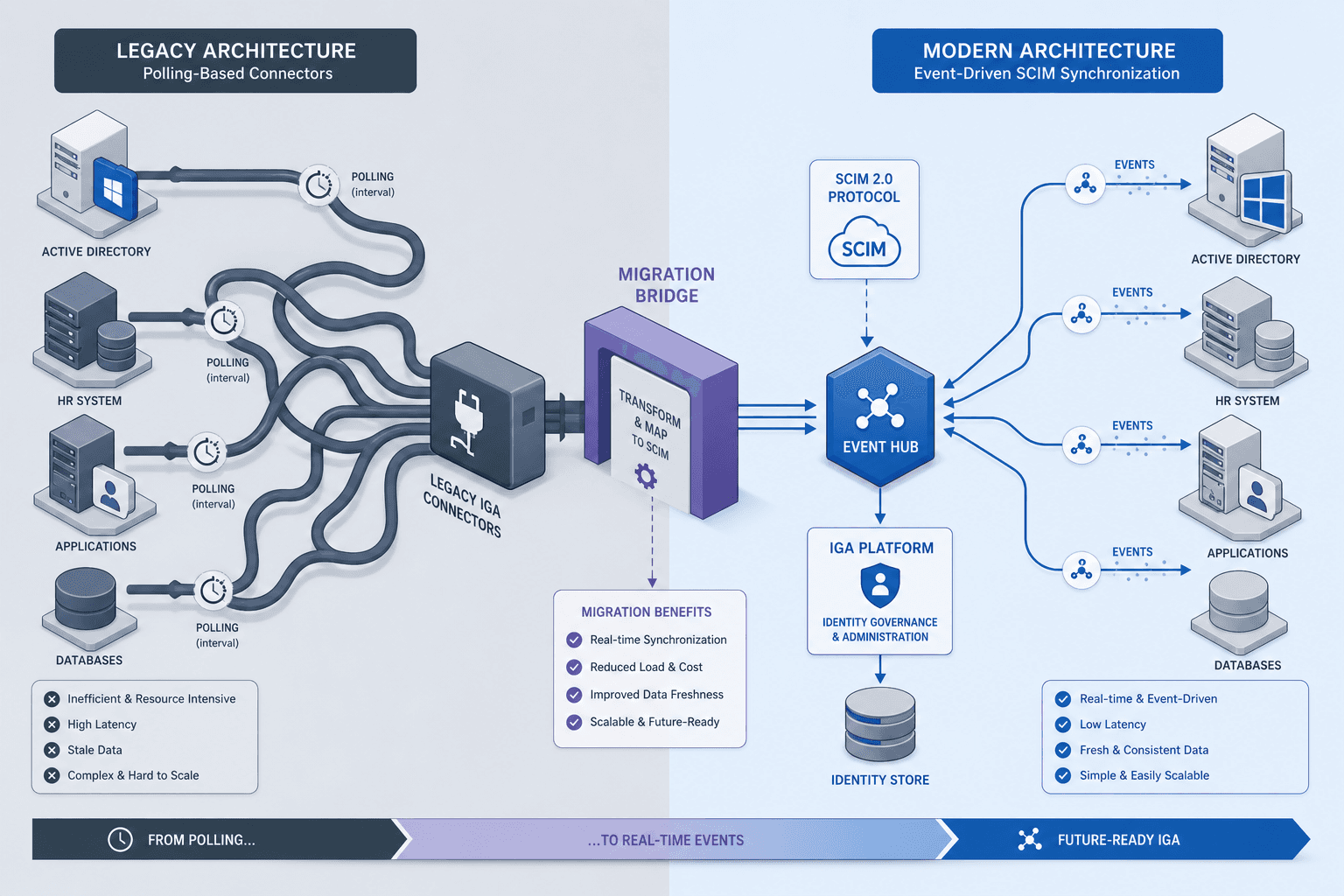
Legacy IGA systems typically rely on scheduled polling jobs to sync user attributes and access rights. This introduces latency and reconciliation gaps. The migration mechanism must prioritize event-driven synchronization or standardized protocols.
Checklist Items:
- Audit Connector Latency: Identify all connectors that rely on full-database pulls. Replace these with webhook-based triggers or CDC (Change Data Capture) listeners where the target system supports them.
- Standardize on SCIM: For cloud SaaS applications, enforce SCIM 2.0 (RFC 7643) for user provisioning. Legacy connectors often use custom REST wrappers that break when the SaaS provider updates their API. SCIM provides a consistent schema for
User,Group, andEnterpriseextensions. - Decouple Sync Logic from Business Rules: Ensure the connector layer only handles transport and transformation. Business logic (e.g., "if department = Finance, grant access to X") must reside in the central policy engine, not in the connector code.
Mechanism Example: Instead of a nightly job that queries an Active Directory group, configure Azure AD Connect or a similar bridge to emit events via Azure Event Hubs. The new IGA system subscribes to these events, processing them in real-time. This reduces the window of access drift from 24 hours to seconds. This approach also facilitates the eventual decommission of legacy polling connectors by reducing their reliance on scheduled jobs.
2. Entitlement Modeling: From Flat Lists to Scoped Rights
Legacy systems often store entitlements as simple strings (e.g., "Access to ERP"). This lacks context. The migration mechanism requires mapping these flat entitlements to a scoped model that distinguishes between role, privilege, and resource context.
Checklist Items:
- Map Legacy Roles to Modern FGAC: Legacy Role-Based Access Control (RBAC) is often too coarse. Map these to Fine-Grained Access Control (FGAC) by defining attributes such as
resource_type,action, andscope. - Identify Orphaned Entitlements: Run a query to find entitlements granted to users who have no active job function. These are often "zombie" access rights accumulated over years.
- Define Entitlement Hierarchy: Establish a parent-child relationship between entitlements. For example, "Admin Access" might inherit "Read" and "Write" permissions. This reduces redundancy in the new system.
Worked Scenario: In the legacy system, User A has an entitlement called "SAP Financials." In the new system, this is decomposed into:
Resource: SAP Financials ModuleAction:POST(Create Invoice)Scope:Department_ID = 101Condition:User_MFA_Status == Verified
This granularity allows for dynamic policy enforcement rather than static assignment. Once mapped, legacy roles that have no equivalent in the new model should be flagged for decommissioning to reduce clutter.
3. Certification Re-engineering: From Periodic to Continuous
Legacy certification campaigns are typically annual or quarterly, involving email reminders and manual manager approvals. This process is noisy, error-prone, and fails to address immediate risks. The migration mechanism shifts certification to a continuous, risk-based model.
Checklist Items:
- Implement Risk Scoring: Assign a risk score to each access right based on sensitivity, frequency of use, and user role. High-risk accesses require immediate review upon assignment.
- Automate Evidence Collection: Integrate with audit logs (e.g., AWS CloudTrail, Azure Monitor) to automatically verify if an access right is actually being used. Unused high-risk access should trigger an automatic revocation workflow.
- Reduce Certification Fatigue: Instead of asking managers to review all access, use machine learning or heuristic rules to highlight only anomalous access patterns. For example, flag access granted to a user in a different country than their usual location.
Mechanism Example: When a user is granted "Admin" access to a production database, the new IGA system immediately creates a "High-Priority" certification task for the data owner. If the owner does not respond within 24 hours, the access is automatically suspended pending further review. This contrasts with the legacy model where such access might remain active for months until the next quarterly review. Automated suspension workflows ensure that decommissioned users or roles do not retain active access rights.
4. Decommissioning and Data Hygiene
The final phase of decommissioning the legacy system requires more than just turning it off; it involves ensuring data lineage and proving that no access was lost or incorrectly migrated.
Checklist Items:
- Run Parallel Systems (Shadow Mode): Deploy the new IGA system alongside the legacy system for at least one full certification cycle. Do not enforce policies in the new system yet; only log decisions. During shadow mode, monitor the decommissioning of legacy access rights to ensure no critical permissions are lost.
- Compare Access Grants: Generate a diff report between the legacy and new IGA systems. Investigate discrepancies in decommissioned user access to ensure no orphaned rights remain.
- Prove Lineage: Document the mapping rules used to transform legacy entitlements into the new model. This is critical for compliance audits (e.g., SOX, GDPR) that require evidence of how access rights were migrated. Maintain a registry of all decommissioned entitlements and their migration paths for audit trails. Document the decommissioning process for all legacy systems involved in the migration.
- Plan the Cutover: Schedule the cutover during a low-activity window. Have a rollback plan that includes restoring the legacy connectors if critical failures occur. Ensure all decommissioned connectors are archived and their configurations backed up before the final switch-over. Verify that all decommissioned systems are properly shut down and their data archived.
Conclusion
Replacing a legacy IGA system is a technical challenge that requires a shift from static data management to dynamic policy enforcement. By focusing on event-driven connectors, scoped entitlements, and continuous certification, organizations can reduce access drift and improve security posture. The migration checklist above provides a mechanism-level approach to ensure that the new system is not just a copy of the old one, but an improvement in how trust is managed.
Related posts
Implementing Conditional Access Policies with Keycloak and ForgeRock
A technical examination of implementing conditional access policies using Keycloak and ForgeRock for context-aware access control.
Multi Cloud Identity Management Framework: A Reference Architecture
A reference framework for cross-cloud IAM that addresses multi-cloud identity management, entitlements, and reference architecture for architects.
Implementing Identity Governance with Custom Policy Engines
An examination of implementing identity governance using custom policy engines like OPA, Cedar, and XACML for policy-as-code.
