GraphRAG: When Relationships Beat Similarity
Explore how GraphRAG leverages knowledge graphs and entity extraction to improve global search over vector similarity alone.
This is Part 4 of the Agentic RAG Patterns series.
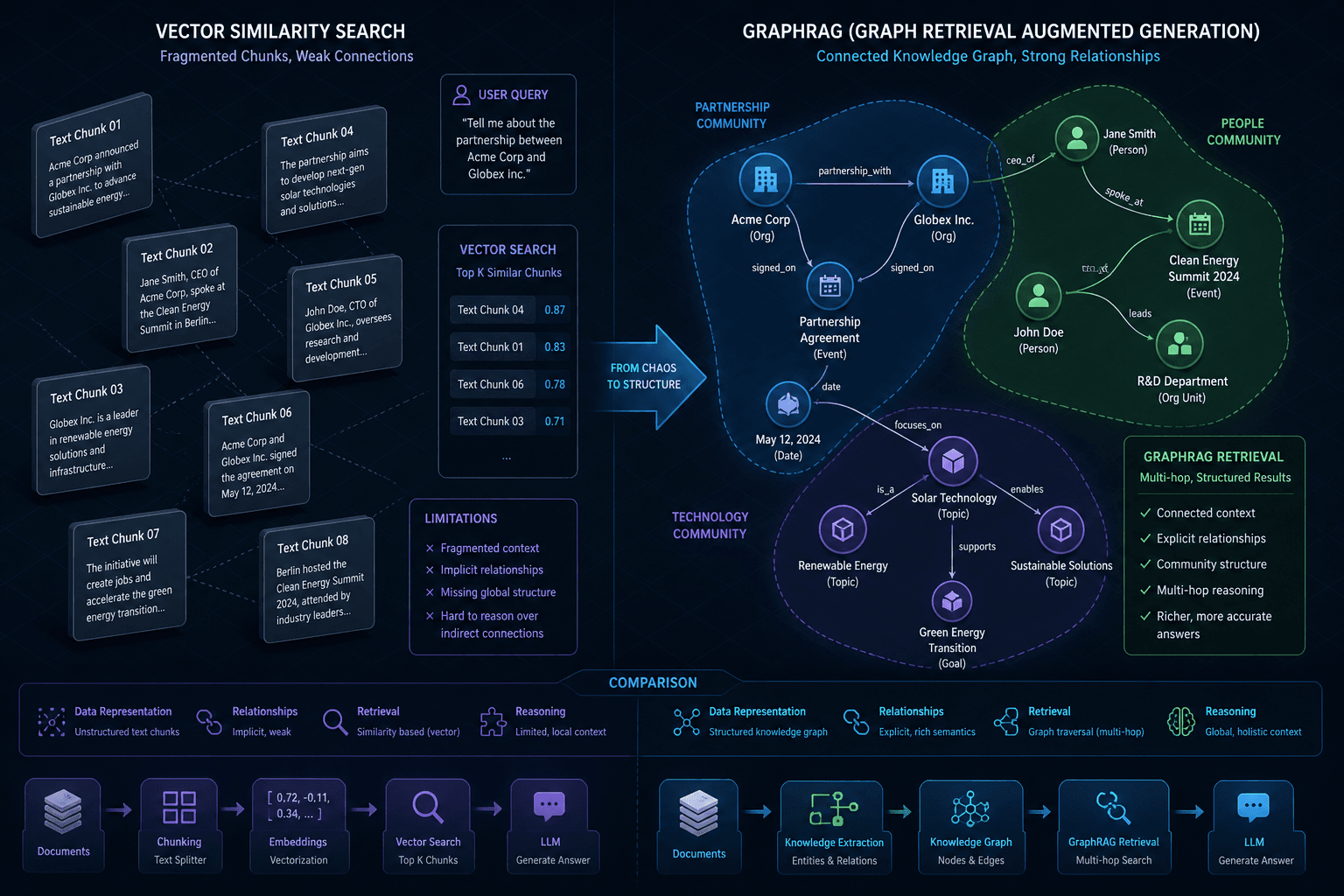
GraphRAG (Graph-based Retrieval-Augmented Generation) has emerged as a critical architectural pattern for organizations grappling with complex, interconnected datasets where standard vector search falls short. While traditional RAG excels at answering local, factual questions within specific documents, it struggles with global inquiries that require synthesizing information across an entire corpus—such as identifying supply chain vulnerabilities in legal discovery or mapping conflict networks in academic research. GraphRAG addresses this limitation by shifting from similarity-based retrieval to structure-based retrieval. It leverages knowledge graphs to map explicit relationships between entities, enabling superior community detection and global context retrieval. By treating documents not as isolated text blocks but as nodes in a connected network, GraphRAG preserves the relational topology that defines meaning, offering a more robust solution for complex knowledge bases.
The Mechanism of Failure in Vector Search
To understand why GraphRAG is necessary, we must first understand the mechanism of vector search failure. In a standard RAG pipeline, documents are chunked and embedded into high-dimensional vectors. Retrieval happens by finding vectors with the highest cosine similarity to the query embedding.
Consider a scenario where you have two documents: one discussing "Apple" the fruit and another discussing "Apple" the tech company. If a user asks, "How does the price of Apple impact the market?", a vector search might retrieve chunks from both documents if the semantic embeddings overlap slightly. More critically, if the answer requires synthesizing information from five different documents that all mention "Apple" but never discuss it in the same chunk, vector search cannot connect them. Each chunk is an island. The vector space preserves local semantic proximity but loses global relational connectivity. This is known as the "needle in a haystack" problem, where the needle is not just hidden, but fragmented across multiple non-similar vectors.
Constructing the Knowledge Graph
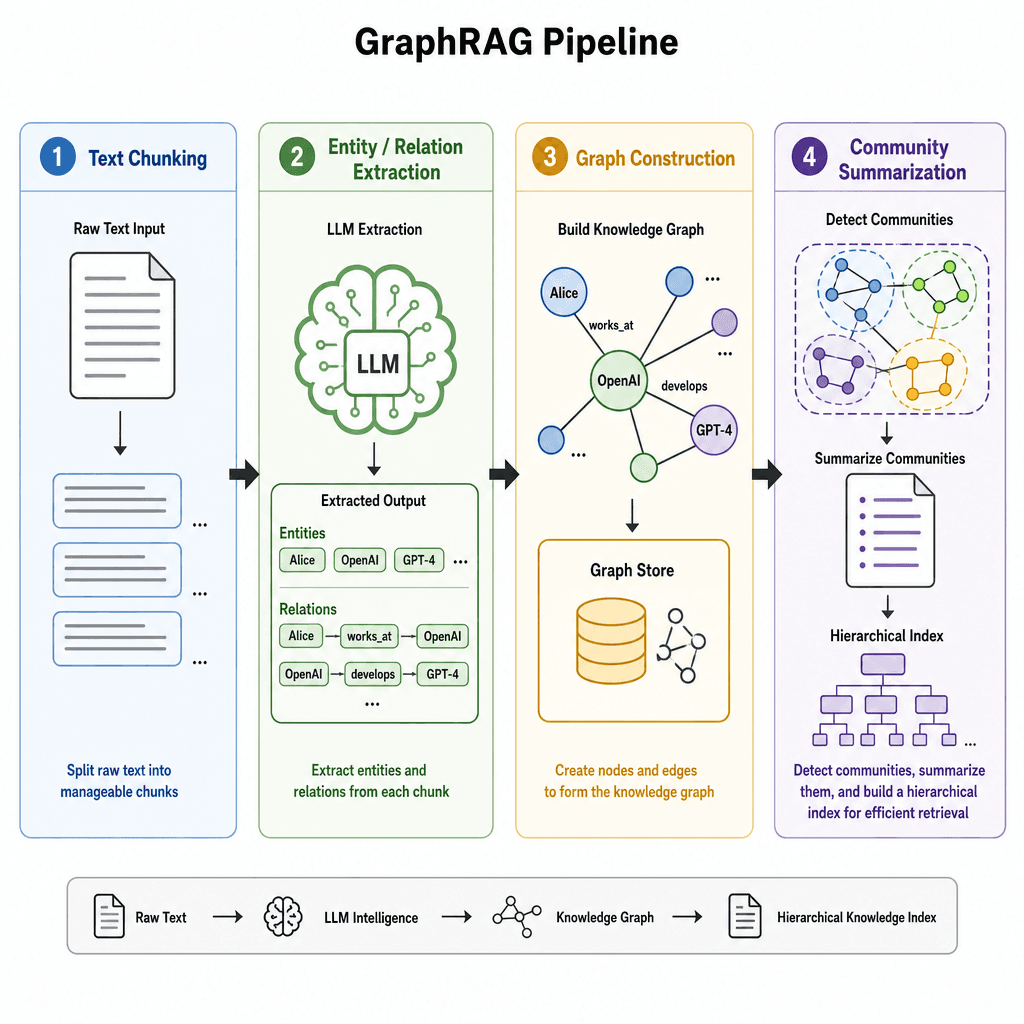
GraphRAG introduces a knowledge graph as a secondary index layer. This graph is not manually curated; it is extracted automatically from the raw text using Large Language Models (LLMs) acting as information extractors. The process involves two distinct steps: Named Entity Recognition (NER) and Relation Extraction. This phase is computationally intensive because it requires parsing natural language to identify structured facts, often involving multiple LLM calls per document to handle ambiguity and context.
- Entity Extraction: The system identifies named entities such as organizations, people, locations, and dates. These become the nodes in the graph. A significant challenge here is handling ambiguous entities (e.g., distinguishing between "Jaguar" the car and the animal) and resolving coreference (linking "he," "she," or "it" back to the correct entity). Advanced implementations use disambiguation strategies or external knowledge bases to ensure node uniqueness.
- Relation Extraction: The system identifies how these entities interact. These interactions become the edges. This step often relies on specific LLM prompts designed to output structured triples (Subject, Predicate, Object). For example, a prompt might ask the LLM to "Extract all relationships between organizations mentioned in this text and classify their nature."
Let’s look at a concrete example. Suppose we have a document describing a merger: "Microsoft acquired Activision Blizzard in October 2023."
The extraction process generates:
- Node:
Microsoft(Type: Organization) - Node:
Activision Blizzard(Type: Organization) - Node:
October 2023(Type: Date) - Edge:
(Microsoft) --[acquired]--> (Activision Blizzard) - Edge:
(Microsoft) --[acquisition_date]--> (October 2023)
Critically, if another document mentions "Microsoft" and "Activision Blizzard" in a completely different context (e.g., a lawsuit), the graph links them again, but with a different edge type (e.g., --[defendant_in_lawsuit]-->). The vector search sees these as separate, potentially unrelated chunks. The graph sees them as part of the same connected component. This allows the system to traverse relationships across document boundaries, aggregating context that would otherwise be lost in vector fragmentation. The computational cost of this step is high, as it requires generating and parsing structured data for every document, but it creates a rich semantic index that enables deeper reasoning later.
Community Detection and Summarization
The true power of GraphRAG lies in its ability to perform community detection. Once the graph is built, the system applies algorithms such as Leiden or Louvain to cluster nodes into communities. Leiden is often preferred in modern GraphRAG implementations (like Microsoft's) because it guarantees well-connected communities and improves upon Louvain's tendency to produce poorly connected or internally disconnected communities. A community is a group of densely connected entities that are sparsely connected to the rest of the graph.
In our example, if Microsoft, Activision Blizzard, Xbox, and Sony form a tight cluster due to frequent co-occurrence and relational links, they form a "Gaming Industry" community. The system then uses an LLM to generate a summary of this entire community. This summary is not a summary of a single document, but a synthesized overview of all information related to that cluster. The LLM ingests the subgraph data—including nodes, edges, and associated text chunks—and generates a narrative description of the community's key themes, relationships, and dynamics.
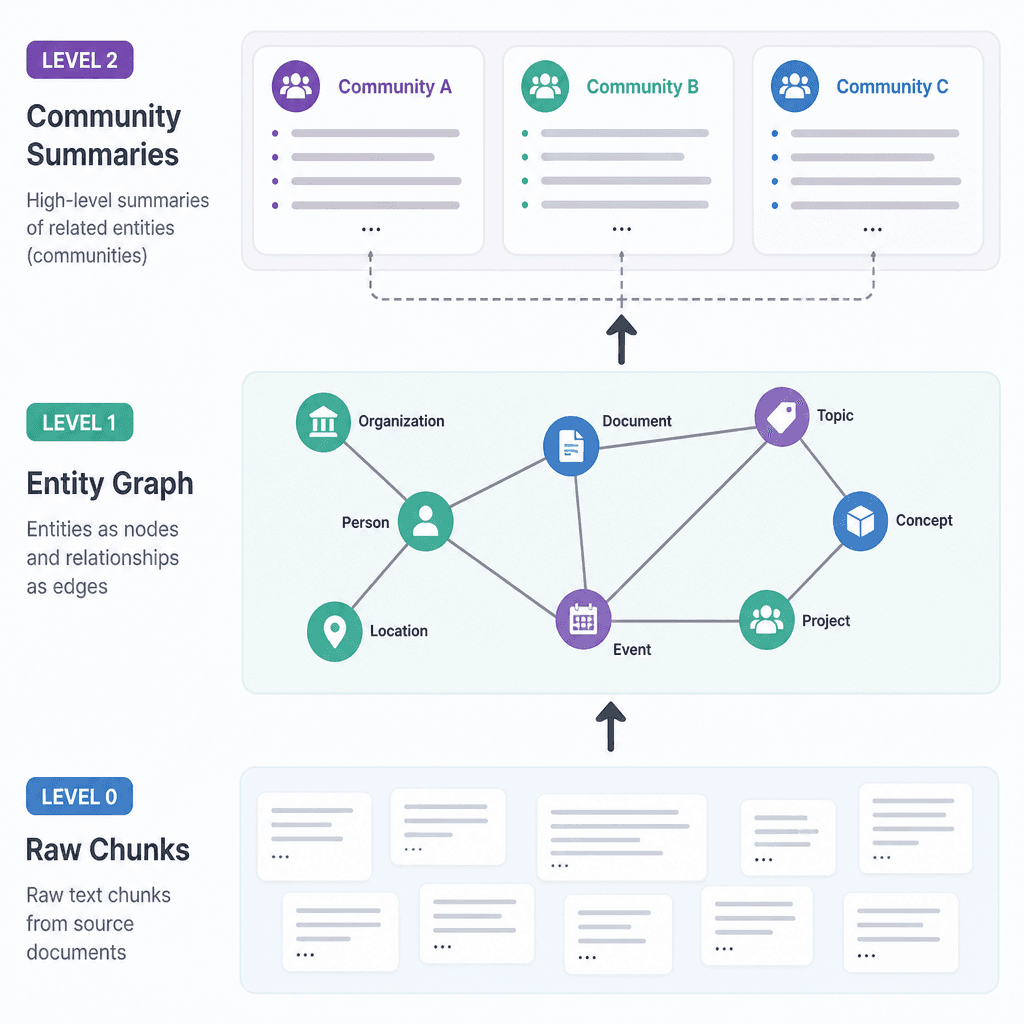
This creates a hierarchical index:
- Level 0: Raw text chunks (vector index).
- Level 1: Entity-Relation Graph (structure index).
- Level 2: Community Summaries (semantic index of relationships).
When a user asks a global question, the system first searches the community summaries. If the answer is found there, it returns the synthesized context. If not, it drills down into the specific entities within the most relevant communities. This mechanism ensures that the retrieval step has access to global context without having to re-scan every raw document chunk. Pre-computing these summaries allows for instant response times on complex queries that would otherwise require traversing thousands of individual document chunks.
The Retrieval Trade-off
Adopting GraphRAG is not a free upgrade; it introduces significant computational trade-offs. The primary cost is in the indexing phase. Building the knowledge graph requires multiple LLM calls for extraction and summarization, which is orders of magnitude more expensive and slower than generating vector embeddings. For a corpus of 10,000 documents, vector indexing might take minutes, while GraphRAG indexing could take hours or even days, depending on the graph size and LLM throughput.
However, the query phase can be faster and more accurate for global questions. Because the system retrieves from pre-summarized communities, it reduces the amount of text passed to the final LLM for generation, potentially lowering latency and token costs for complex queries. Additionally, the storage overhead for GraphRAG is higher. You are storing not just vectors, but the full graph structure (nodes and edges) and the generated community summaries. This can increase database size by 20-30% compared to a vector-only index.
When to Use GraphRAG
- Use GraphRAG when your dataset contains complex inter-entity relationships and you need to answer questions that require synthesizing information across multiple documents. Common use cases include legal discovery (mapping connections between parties), supply chain analysis (tracing dependencies across vendors), and academic research synthesis. In these scenarios, the operational complexity of maintaining the graph index is justified by the need for high-accuracy, multi-hop reasoning.
- Use Standard Vector RAG when your questions are local to specific documents or when you need low-latency, low-cost retrieval for simple factual lookups. If your corpus is small (<1,000 documents) and questions are straightforward, the overhead of GraphRAG may not be worth it.
The choice is not binary. Many production systems use a hybrid approach, using vector search for local precision and graph traversal for global context. But as datasets grow in complexity, the relational structure of knowledge becomes more valuable than the semantic similarity of text alone. GraphRAG makes that structure explicit, searchable, and actionable.
Pitfalls
Implementing GraphRAG is not without its challenges. One common pitfall is over-indexing, where the graph becomes too large and dense to traverse efficiently. If the entity extraction is too broad, creating nodes for every noun phrase, the graph becomes noisy, and community detection fails to identify meaningful clusters. To mitigate this, strict schema definitions and filtering rules should be applied during the extraction phase.
Another significant risk is poor entity resolution. If the system fails to recognize that "Bob Smith" and "Robert Smith" are the same person, the graph will fragment, leading to incomplete answers. This requires robust normalization strategies, such as matching against known identity databases or using advanced LLM prompting to enforce consistency. Finally, maintaining the graph index as new data arrives can be operationally complex. Incremental updates to the graph structure are harder to manage than appending new vector embeddings, requiring careful pipeline design to ensure consistency.
Conclusion
GraphRAG represents a paradigm shift from treating documents as isolated data points to viewing them as nodes in a connected network. By leveraging entity extraction and community detection, it solves the fragmentation problem inherent in standard vector search. While the indexing costs are higher, the ability to answer global, multi-hop questions with high accuracy makes it an essential tool for complex knowledge bases. As RAG systems evolve, understanding the trade-off between semantic similarity and relational structure will be critical for designing effective retrieval architectures.
Call to Action
Ready to implement GraphRAG in your organization? Start by auditing your current RAG pipeline for global query failures. Identify cases where vector search returns fragmented or irrelevant results, and evaluate if a knowledge graph approach could provide the necessary context. Explore our GraphRAG implementation guide to get started with building your first hierarchical index.
Related posts
Caching Strategies for RAG Pipelines
Explore effective caching strategies for RAG pipelines, including embedding and retrieval caches, to improve hit rates and reduce latency, while managing invalidation effectively.
RAG Hallucination Detection with Groundedness Scoring
Explore methods for detecting hallucinations in RAG systems using groundedness scoring and natural language inference to improve faithfulness.
Evaluating Agentic RAG: Trajectory, Ragas & Metrics
A technical examination of evaluating agentic RAG systems using trajectory evaluation, Ragas, and stage-specific metrics for ML engineers.
