Query Planning and Decomposition in Agentic RAG
Explore query planning and decomposition techniques for Agentic RAG systems, including sub-questions and fan-out strategies to improve retrieval accuracy.
When an end-user asks a simple factual question like "What is the capital of France?", a standard Retrieval-Augmented Generation (RAG) pipeline works efficiently. The system embeds the query, searches a vector store, retrieves the top-k relevant documents, and feeds them to a Large Language Model (LLM) for generation. However, this linear flow collapses under the weight of complexity. Consider a query such as: "Compare the environmental impact of electric vehicles versus hydrogen fuel cells in Germany, specifically focusing on battery recycling infrastructure and carbon footprint during production."
A naive RAG approach fails here because the single embedding vector cannot simultaneously capture the semantic nuance of "battery recycling," "carbon footprint," and "Germany." The retrieval mechanism returns a noisy mix of general EV articles and specific hydrogen studies, leading the LLM to hallucinate connections or provide a shallow summary. Agentic RAG solves this through query planning and decomposition, treating the retrieval process as a multi-step reasoning task rather than a single lookup. This approach aligns with early agentic frameworks like MRKL (Modular Reasoning, Knowledge, and Language) which demonstrated that modular decomposition improves performance on complex multi-hop questions.
The Mechanism of Decomposition
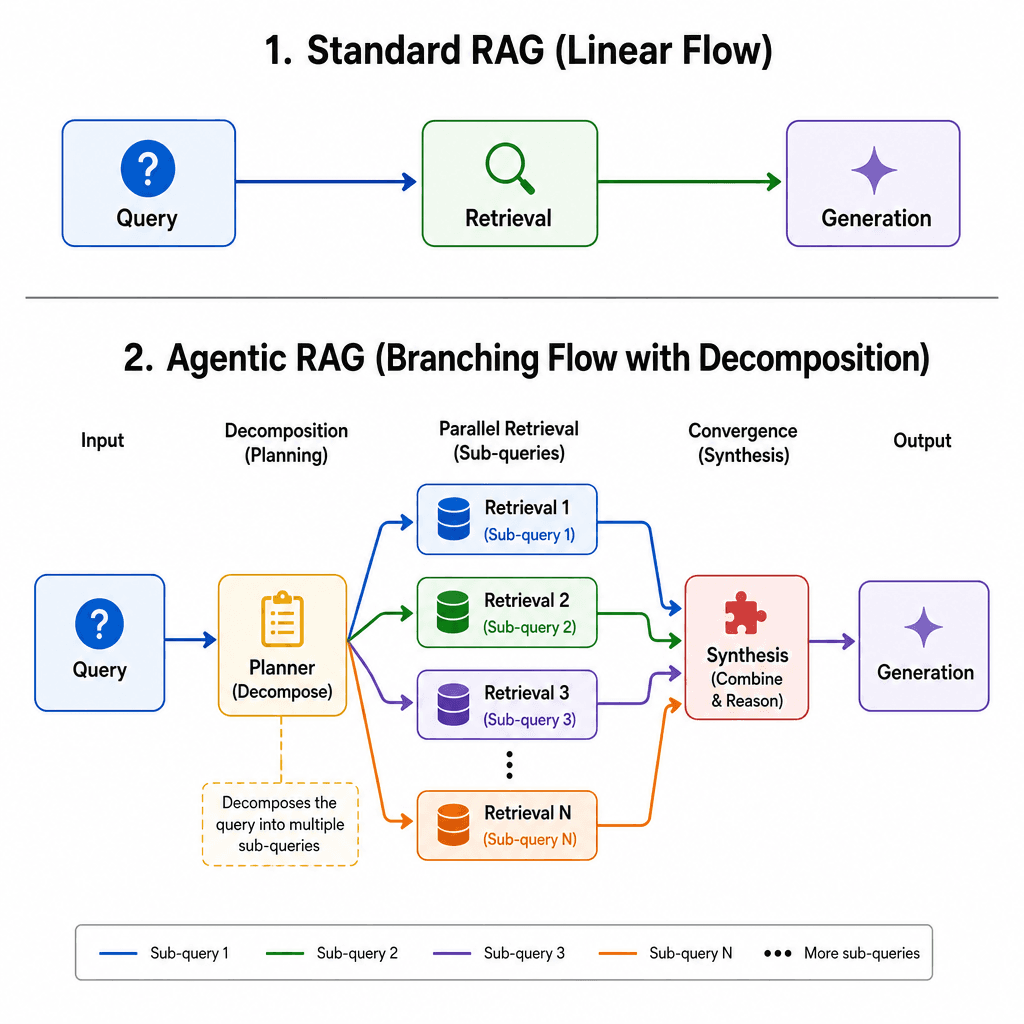
Query decomposition is the act of breaking a complex, multi-factoid question into a set of independent, atomic sub-questions. This process shifts the burden of complexity from the retrieval engine to the planning agent.
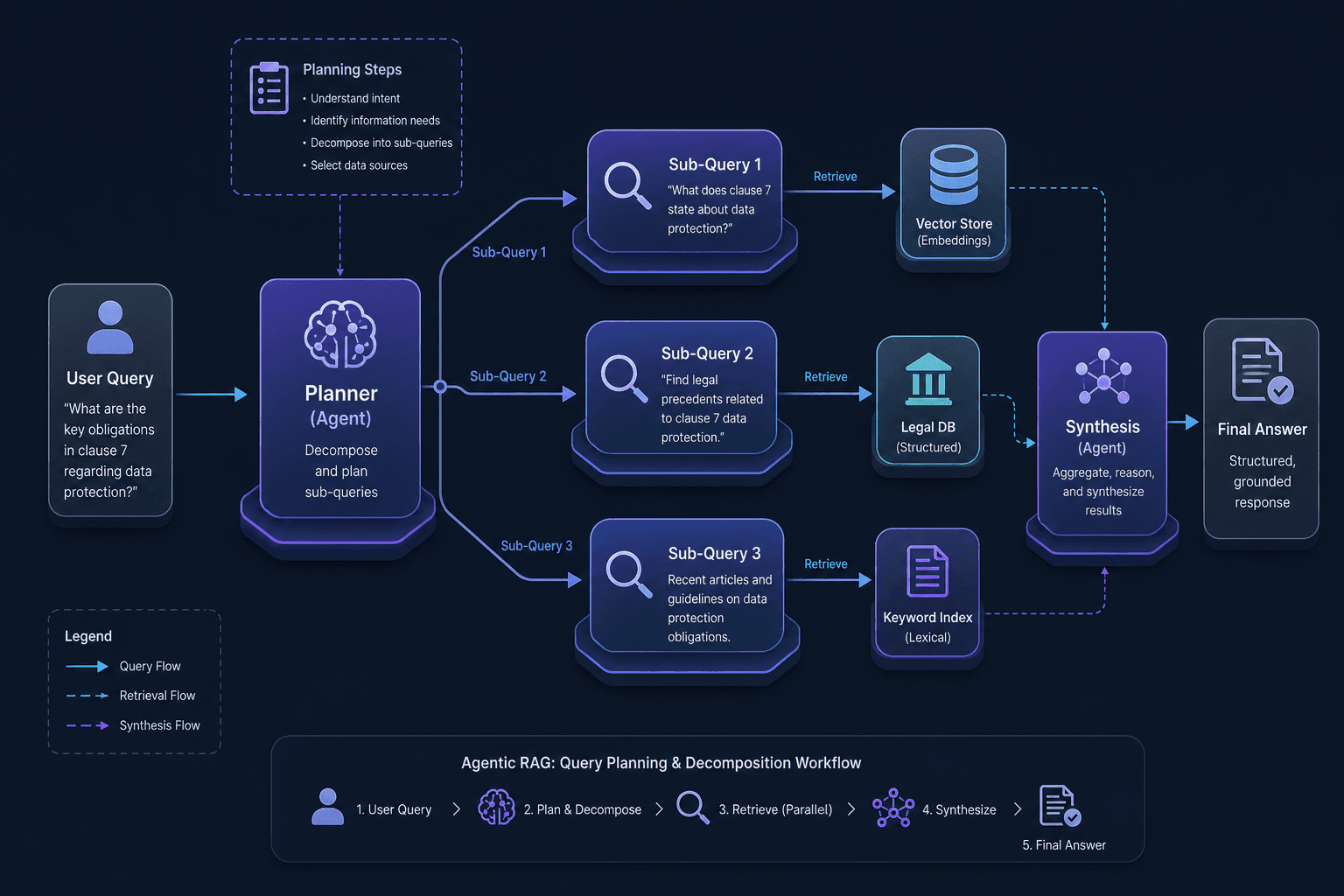
Consider the previous example. An Agentic RAG system does not send the full prompt to the vector store immediately. Instead, it first invokes a planning LLM with a specific instruction set. The planner analyzes the user's intent and generates a structured list of sub-queries. For our example, the planner might generate:
- "What is the current status of EV battery recycling infrastructure in Germany?"
- "What is the carbon footprint of producing hydrogen fuel cells compared to EV batteries?"
- "What are the environmental regulations for automotive waste disposal in Germany?"
These sub-questions are independent. They do not rely on the output of one another to be executed, which allows for parallel processing. This independence is critical. If the questions were dependent (e.g., "Find X, then find Y related to X"), the system would need to execute them sequentially, introducing latency. Decomposition aims for maximal parallelism where possible.
To achieve robust decomposition, engineers often employ chain-of-thought (CoT) prompting or few-shot examples in the planner's system prompt. By providing the LLM with examples of complex queries alongside their decomposed counterparts, we guide the model to recognize distinct entities and relationships. For instance, a failed decomposition might occur if the planner splits "How does climate change affect coffee prices in Brazil?" into "What is climate change?" and "What are coffee prices in Brazil?" This splits the causal relationship, rendering the sub-questions useless for answering the original intent. A successful decomposition, inspired by techniques like Self-Ask, would instead ask: "What are the primary climatic changes in Brazil over the last decade?" and "How have these specific climatic changes impacted coffee yield and price indices in Brazil?" This ensures each sub-question contributes directly to the final answer.
Fan-Out Retrieval Strategies
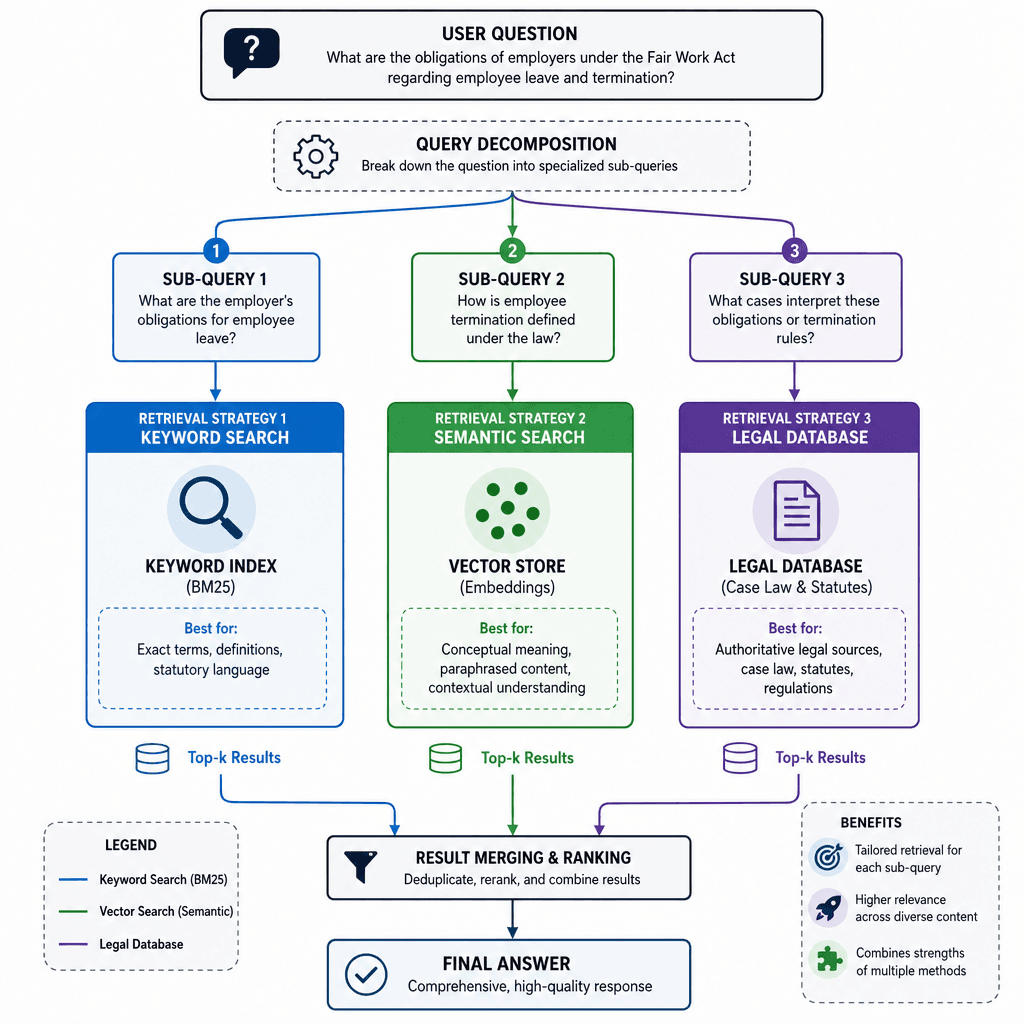
Once the sub-questions are defined, the system enters the "fan-out" phase. Each sub-question is treated as a distinct retrieval task. This is where Agentic RAG diverges significantly from basic RAG. In a basic system, you run one search. In an agentic system, you run N searches, potentially using different strategies for each.
For sub-question 1, the system might use a keyword-based search (BM25) because "battery recycling infrastructure" is a specific technical term. For sub-question 2, it might use dense vector search because the comparison involves abstract concepts like "carbon footprint." For sub-question 3, it might query a legal database or a specific policy document store rather than a general knowledge base.
This fan-out strategy increases recall. By targeting specific aspects of the query with tailored retrieval methods, the system avoids the "average embedding" problem where a single vector representation dilutes the importance of specific details. The retrieval results are then returned to the orchestrator, tagged with their corresponding sub-question ID.
In practice, this involves a multi query retrieval pattern where the system sends parallel requests to various backends. The orchestrator acts as a router, selecting the appropriate retrieval strategies based on the metadata and content type of each sub-query. For example, numeric or fact-based sub-queries might be routed to a SQL database or a sparse vector index, while conceptual queries go to dense vector stores. This fan out distribution ensures that each part of the user's intent is addressed by the most suitable data source, maximizing the relevance of the retrieved context.
Synthesis and Recomposition
The final step is recomposition. The orchestrator collects the retrieved chunks for each sub-question and feeds them back to the LLM. The prompt structure here is crucial. The LLM is not asked to "answer the question." It is asked to "synthesize the findings from the following retrieved contexts to answer the original user query."
The LLM receives:
- Original Query: "Compare the environmental impact..."
- Context A (from sub-query 1): Details on recycling plants.
- Context B (from sub-query 2): Carbon emission data.
- Context C (from sub-query 3): Regulatory constraints.
The LLM now has a structured view of the evidence. It can explicitly state: "Based on the recycling infrastructure data, Germany has X... However, the carbon footprint analysis shows Y..." This structured synthesis reduces hallucination because the LLM is constrained by the specific retrieved facts for each sub-topic. It forces the model to address each facet of the original compound question, ensuring completeness.
Common Pitfalls
Implementing query decomposition is not without its challenges. Engineers frequently encounter several pitfalls that can degrade system performance:
- Over-Decomposition: The planner may split a simple question into too many trivial sub-questions. For example, splitting "What is the weather in London?" into "What is the temperature in London?" and "What is the humidity in London?" adds unnecessary overhead without improving accuracy.
- Latency Spikes: Since decomposition involves multiple LLM calls (planning) and multiple retrieval operations, the total response time can increase significantly. Without caching or parallel execution, users may experience unacceptable delays.
- Planner Hallucination: The planning LLM itself can hallucinate sub-questions that are irrelevant or factually impossible to answer. If the planner invents a sub-question about "non-existent regulations," the retrieval step will fail, and the synthesis step will be forced to handle missing information, potentially leading to a confused final answer.
Practical Takeaways
To effectively implement query planning and decomposition in your Agentic RAG systems, consider these actionable steps:
- Implement a Query Classifier: Do not decompose every query. Use a lightweight classifier to distinguish between atomic queries (which should use standard RAG) and compound queries (which trigger the decomposition pipeline). This saves cost and latency for simple interactions.
- Enforce Independence: Design your planner to prioritize independent sub-questions. Parallel execution is key to maintaining low latency. If sub-questions are dependent, consider using a sequential agent pattern instead.
- Monitor and Iterate: Track metrics such as decomposition success rate, retrieval recall per sub-question, and final answer coherence. Use these metrics to refine your planning prompts and retrieval strategies over time.
Trade-offs and Implementation Considerations
While decomposition improves accuracy, it introduces latency and cost. Each sub-query requires an API call to the vector store and potentially multiple LLM calls (planning, retrieval, synthesis). For simple queries, this overhead is unjustified. Therefore, effective Agentic RAG systems include a classifier at the entry point. A lightweight model or a heuristic check determines if the query is atomic or compound. If atomic, it bypasses decomposition and uses standard RAG. If compound, it triggers the planning pipeline.
Furthermore, the quality of decomposition depends entirely on the planning prompt. If the planner fails to identify independent sub-questions, the system may generate redundant queries, wasting resources. If it splits the question too granularly, the synthesis step may struggle to connect disparate facts. Tuning the planner requires careful evaluation of both retrieval recall and final answer coherence.
FAQ
When should I use query decomposition? Use decomposition for complex, multi-faceted queries that require information from multiple distinct sources or perspectives. Simple factual questions or single-concept queries are better served by standard RAG to avoid unnecessary overhead.
What are the cost implications of decomposition? Decomposition increases costs because it involves multiple LLM inference steps (planning and synthesis) and multiple retrieval operations. However, this cost is often justified by the higher quality and accuracy of the final answer for complex tasks, reducing the need for user re-queries.
How does decomposition impact latency? Decomposition inherently increases latency due to the sequential nature of planning and the parallel nature of retrieval. However, by executing sub-queries in parallel and optimizing the planner's efficiency, you can mitigate some of this delay. Caching frequent sub-queries can also help reduce latency for recurring complex questions.
Conclusion
In conclusion, query planning and decomposition transform RAG from a passive retrieval system into an active reasoning agent. By breaking down complexity, leveraging parallel fan-out retrieval, and synthesizing structured evidence, Agentic RAG delivers higher accuracy for complex, multi-faceted queries. This pattern is essential for building systems that move beyond simple fact lookup to genuine analytical assistance.
Related posts
Evaluating Agentic RAG: Trajectory, Ragas & Metrics
A technical examination of evaluating agentic RAG systems using trajectory evaluation, Ragas, and stage-specific metrics for ML engineers.
Reranking: The Cheapest Quality Win in RAG
Reranking is the most cost-effective way to boost RAG accuracy. Learn how to implement cross-encoders like Cohere and BGE for better retrieval results.
What RAG Actually Solves (and What It Doesn't)
An examination of Retrieval Augmented Generation (RAG), clarifying how it reduces hallucination through grounding while identifying its architectural limitations.
