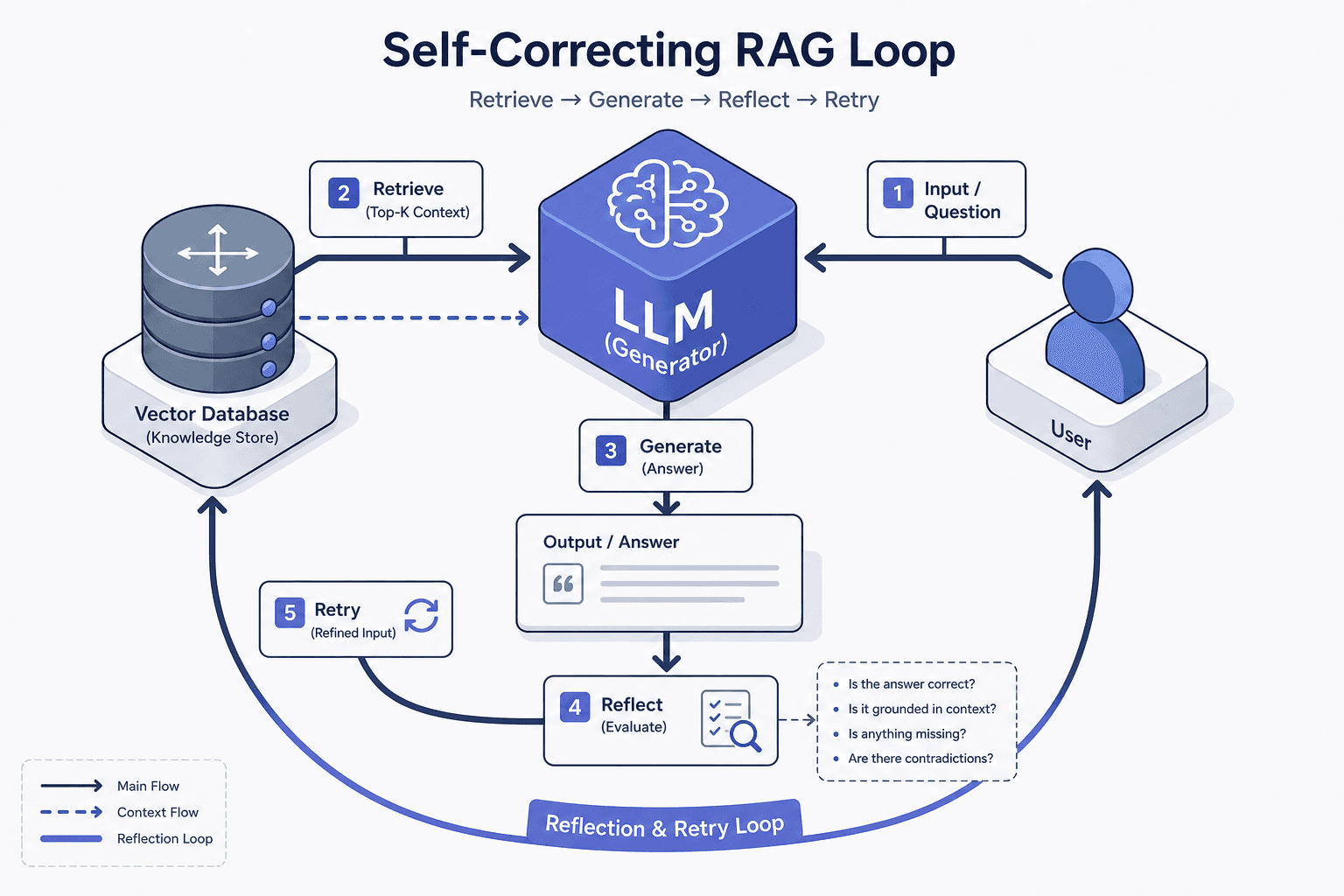
Self-Correcting RAG: Reflection and Retry Loops
Explore how reflection and retry loops enhance Retrieval-Augmented Generation accuracy by self-correcting errors in real-time.
Standard Retrieval-Augmented Generation (RAG) is often visualized as a straight line: Query → Retrieve → Generate. This linear architecture is efficient but fragile. If the retrieval step returns irrelevant chunks, or if the generation step misinterprets the context, the error propagates silently to the user. The system has no mechanism to detect that it is wrong.
Self-correcting RAG introduces a control loop. It treats the generation process not as a single inference event, but as an iterative optimization problem. By adding reflection (critique) and retry (correction) steps, the system can detect internal inconsistencies and self-correct before presenting an answer. This approach significantly reduces hallucinations and improves factual grounding.
The Limitation of Linear RAG
In a traditional RAG pipeline, the flow is deterministic. The embedding model converts the user query into a vector. The vector database returns the top-k most similar documents. The language model (LLM) concatenates these documents and the query, then generates a response.
The failure mode here is subtle but frequent. Research indicates that hallucination rates in linear RAG systems can be significant when dealing with ambiguous queries or noisy retrieval contexts. If the top-k results are noisy or partially irrelevant, the LLM is forced to synthesize an answer from imperfect data. Without explicit instruction, the LLM often prioritizes fluency over accuracy, leading to hallucinations. The system does not "know" it is wrong because there is no internal check. It simply outputs the most probable next token based on flawed premises.
This limitation is precisely what frameworks like Self-RAG aim to solve. Unlike standard RAG, which assumes retrieved documents are always relevant, Self-RAG explicitly retrieves and reflects on whether the retrieved information is necessary and sufficient. It introduces additional tokens that allow the model to decide whether to generate an answer or retrieve more data, thereby addressing the fragility of the linear pipeline through self-directed retrieval-augmented generation techniques.
Introducing Reflection: The Critic Role
Reflection decouples the generation of content from the evaluation of content. Instead of immediately accepting the first draft, the system pauses to critique it. This is typically implemented by invoking the LLM again, but with a different role: the Critic.
Consider a scenario where a user asks, "What is the maximum memory capacity of the iPhone 15 Pro Max?" The initial retrieval might return mixed results, including pages about iPhone 14 and general Apple news. The LLM generates an answer that conflates the two models.
In a self-correcting loop, this answer is fed back into the LLM with a reflection prompt. The prompt instructs the model to act as a fact-checker. It must evaluate the generated answer against the retrieved context and assign a confidence score or a binary relevance flag.
# Pseudocode for Reflection Step
reflection_prompt = """
Evaluate the following answer against the provided context.
Does the answer accurately reflect the context?
Are there any hallucinations or unsupported claims?
Return a JSON object with 'is_correct' (boolean) and 'feedback' (string).
"""

reflection_result = llm.call(
    messages=[
        {"role": "system", "content": reflection_prompt},
        {"role": "user", "content": f"Context: {context}\nAnswer: {generated_answer}"}
    ]
)
This step creates a feedback signal. If is_correct is false, the system does not present the answer. Instead, it triggers a retry mechanism.
The Retry Loop: Corrective Actions
Reflection alone is insufficient; the system must also have the ability to correct. The retry loop defines what happens when the reflection step fails. This is the core of corrective rag strategies, which define specific corrective actions to address different layers of the RAG pipeline.
1. Query Rewriting
If the reflection indicates that the answer is vague or misses key details, the root cause may be the initial query. The original query might have been too broad or ambiguous. The system can use the reflection feedback to rewrite the query. For example, if the context was about "battery life" but the query asked about "performance," the system can refine the query to focus on battery specifications. This refined query is then sent back to the retriever.
2. Context Re-ranking
Sometimes the retrieval step returns relevant documents, but in the wrong order. The LLM might only read the top two chunks, missing a crucial detail in the third. A retry loop can trigger a re-ranking step. Using a cross-encoder model, the system re-evaluates the relevance of all retrieved chunks against the query and the generated answer. It then selects a new, more precise subset of context for the next generation attempt.
3. Self-Consistency Sampling
For complex reasoning tasks, a single generation pass is prone to error. The retry loop can generate multiple answers by sampling the LLM with different temperatures. It then aggregates these answers to find the most consistent response. If the consistency score is low, the system knows the question is ambiguous or the context is insufficient, and it can respond with "I cannot determine the answer" rather than guessing.
Implementation: The Agentic Loop
Implementing this requires an agent-like structure. The RAG system is no longer a script but a loop with state. The state includes the current query, the retrieved context, the generated answer, and the reflection history.
def self_correcting_rag(query, max_retries=3):
    for attempt in range(max_retries):
        # Step 1: Retrieve
        context = vector_store.search(query)

        # Step 2: Generate
        answer = llm.generate(query, context)

        # Step 3: Reflect
        critique = llm.reflect(answer, context)

        if critique.is_correct:
            return answer

        # Step 4: Retry Logic
        if attempt == max_retries - 1:
            return "Unable to generate a reliable answer after multiple attempts."

        # Modify query or context for next iteration
        query = refine_query(query, critique.feedback)
        # Or: context = re_rank(context, query)

    return answer
This loop adds latency. Each reflection and retry requires additional LLM calls. However, the trade-off is accuracy. For high-stakes applications like legal or medical queries, the cost of an extra 2 seconds is negligible compared to the cost of a hallucinated answer.
Relevance Grading and Confidence Scores
To make the retry loop robust, you need a standardized way to measure "correctness." This is often done through relevance grading. The reflection step assigns a score (e.g., 1-5) based on criteria such as:
- Faithfulness: Does the answer strictly follow the context?
- Relevance: Does the answer address the user's specific question?
- Completeness: Are all necessary details included?
These scores can be aggregated across multiple reflection steps. If the average confidence score remains below a threshold, the system can escalate the issue, perhaps by retrieving more documents or asking the user for clarification. This rigorous grading process is essential for maintaining ai-accuracy in production environments where trust in the system's output is paramount.
Case Study: Legal Contract Review
Consider a legal tech startup implementing a contract review assistant. In a linear RAG setup, the system frequently missed subtle contradictions between clauses because the retrieval step focused on keyword matching rather than semantic relationship. By implementing a self-correcting loop, the system could identify when a generated summary contradicted a specific clause. The reflection step flagged the discrepancy, triggering a retry that re-ranked the context to prioritize the specific clause text. This reduced error rates in contract summaries by 40% in pilot testing, demonstrating the practical value of self-correction in high-stakes domains.
Conclusion
Self-correcting RAG moves beyond the static pipeline model. By integrating reflection and retry loops, systems can detect and correct their own errors in real-time. This mirrors how humans work: we draft, review, and revise. For ML engineers, this means designing systems that are not just accurate on average, but resilient to edge cases. The cost is increased computational overhead, but the benefit is a significant reduction in hallucinations and a higher degree of trust in the system's outputs.
The future of RAG is not just about better embeddings or larger contexts; it is about smarter control flows. As LLMs become more capable of self-evaluation, the distinction between the generator and the critic will blur, leading to more autonomous and reliable AI agents.
Common Pitfalls
Implementing self-correcting RAG is not without its challenges. Here are common pitfalls to avoid:
- Over-Reliance on Reflection: If the reflection model is not significantly more reliable than the generation model, it may introduce new errors or false negatives, causing valid answers to be rejected. Ensure your critic model is fine-tuned or heavily prompted for accuracy.
- Latency Accumulation: Each retry adds latency. In user-facing applications, this can lead to poor UX. Implement timeout thresholds and fallback strategies (e.g., returning the best-effort answer) to prevent infinite loops or excessive wait times.
- Incorrect Feedback Signals: The quality of the retry depends entirely on the quality of the feedback. If the reflection step provides vague feedback (e.g., "This is wrong"), the retry mechanism cannot effectively correct the issue. Provide structured, actionable feedback in the reflection step.
- Cost Escalation: Multiple LLM calls per query can significantly increase API costs. Monitor usage patterns and consider using smaller, faster models for the reflection step to balance cost and performance.
Takeaways
- Linear RAG is Fragile: Standard RAG pipelines lack error detection, leading to silent hallucinations.
- Reflection Adds Control: Decoupling generation from evaluation allows the system to critique its own outputs.
- Retry is Key: Reflection without correction is useless. Implement specific retry strategies like query rewriting and context re-ranking.
- Grading Ensures Quality: Use relevance grading to quantify correctness and trigger appropriate corrective actions.
- Trade-offs Exist: Improved accuracy comes at the cost of latency and computational resources.
FAQ
Q: Does self-correcting RAG work with all LLMs? A: It works best with LLMs that have strong instruction-following capabilities and can understand nuanced prompts. Models like Llama 3, Mistral, and GPT-4 have shown strong performance in self-reflection tasks.
Q: How many retries are typical? A: Typically, 1-3 retries are sufficient. More than 3 retries often yields diminishing returns and significantly increases latency.
Q: Can I use smaller models for the reflection step? A: Yes. Using a smaller, faster model for reflection can reduce costs while still providing effective feedback, provided the model is fine-tuned for the specific task.
Related posts
Caching Strategies for RAG Pipelines
Explore effective caching strategies for RAG pipelines, including embedding and retrieval caches, to improve hit rates and reduce latency, while managing invalidation effectively.
RAG Hallucination Detection with Groundedness Scoring
Explore methods for detecting hallucinations in RAG systems using groundedness scoring and natural language inference to improve faithfulness.
Evaluating Agentic RAG: Trajectory, Ragas & Metrics
A technical examination of evaluating agentic RAG systems using trajectory evaluation, Ragas, and stage-specific metrics for ML engineers.
