Identity Federation Patterns: Multi-Cloud Identity Management
Examines identity federation patterns for multi-cloud identity management across AWS, Azure, and GCP to enhance cross-cloud security.
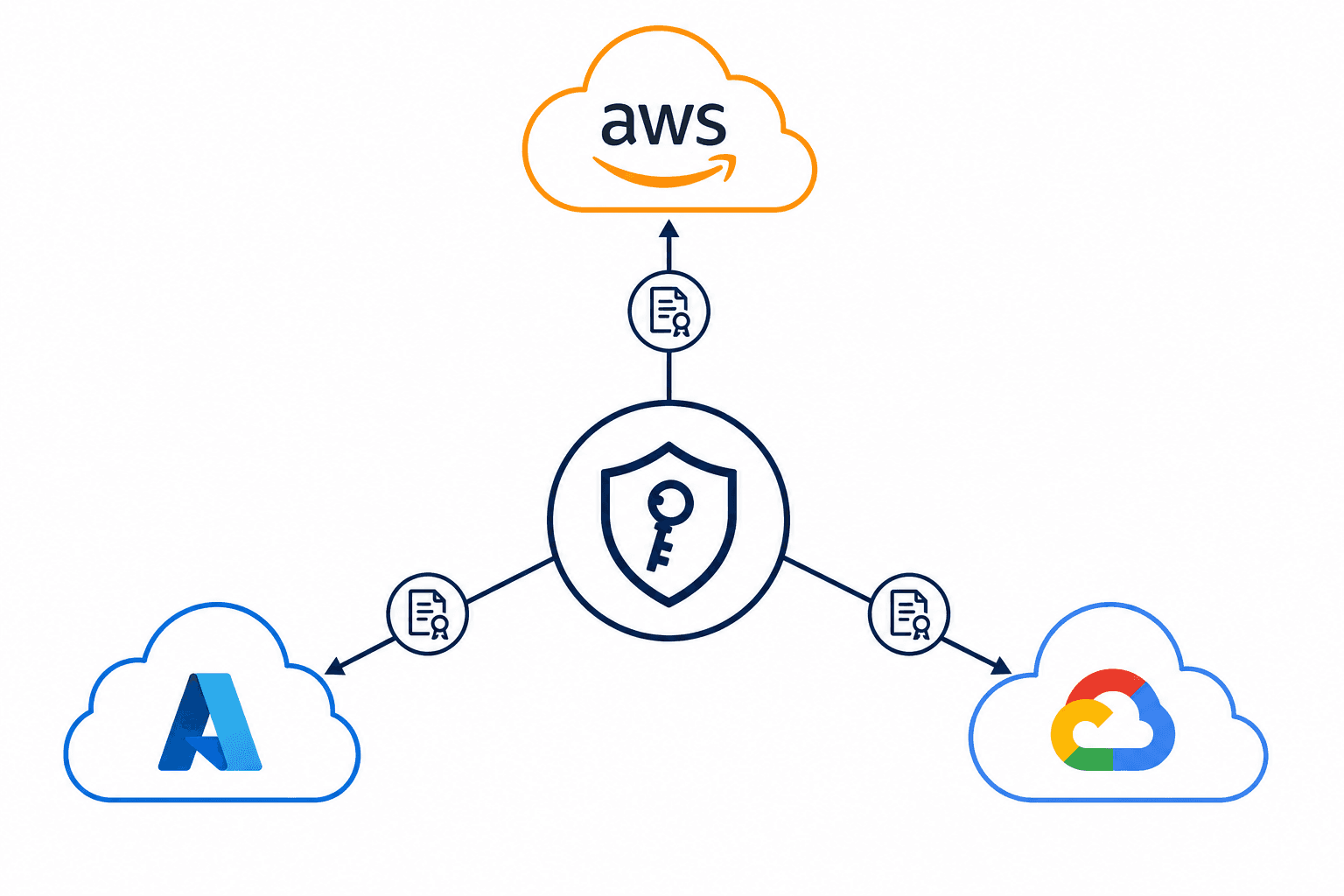
In a multi-cloud environment spanning AWS, Azure, and GCP, the fundamental security challenge is the fragmentation of trust. When an engineer configures separate connections between an on-premises Active Directory and each cloud provider, they create distinct trust boundaries that increase operational overhead. The solution is Identity Federation, where a single Identity Provider (IdP) acts as the root of trust and all cloud providers act as Relying Parties (RPs). This approach shifts the authentication burden to the IdP, ensuring that credential leakage in the cloud infrastructure does not grant persistent access.
The core mechanism of federation relies on the exchange of signed assertions rather than password verification. Consider an actor named "Alex," a senior developer, who logs into the corporate IdP (e.g., Okta or Microsoft Entra ID). The IdP validates Alex's credentials using the organization's directory. Once validated, the IdP does not send a password to the cloud. Instead, it constructs a signed token—either a SAML 2.0 assertion or an OpenID Connect (OIDC) ID token—and transmits it to the cloud provider's endpoint. The cloud provider, acting as the RP, receives this token and performs a cryptographic signature verification using a pre-shared public key or a dynamically fetched JWKS URI. If the signature is valid and the token has not expired, the cloud provider trusts the identity claims contained within.
This mechanism decouples identity storage from identity consumption. In AWS, for example, the process involves the Security Token Service (STS). The IdP posts the SAML assertion to the AWS STS endpoint. AWS processes this request, invoking the AssumeRoleWithSAML logic internally, and returns temporary credentials. These credentials are ephemeral and rotate automatically upon expiration.
{
  "Credentials": {
    "AccessKeyId": "ASIAIOSFODNN7EXAMPLE",
    "SecretAccessKey": "wJalrXUtnFEMI/K7MDENG/bPxRfiCYEXAMPLEKEY",
    "SessionToken": "AQoDYXdzEJr...<example token>",
    "Expiration": "2024-05-21T12:00:00Z"
  }
}
The critical failure point in multi-cloud architectures is the attribute mapping mechanism. Different cloud providers expect different attribute schemas to grant permissions. An IdP might send a claim named groups containing a list of strings like ["DevOps", "Security"]. AWS requires these to map to IAM Roles defined by ARNs (Amazon Resource Names). Azure expects these to map to Role Assignments within a specific tenant scope. GCP expects these to map to Service Account impersonation or specific IAM roles bound to a project. If the IdP sends a generic group claim, the cloud provider cannot infer the necessary permission boundary without explicit configuration.
Consider a scenario where the IdP sends a claim role: "admin". In Azure, this might be mapped to the Owner role, granting full control over the subscription. In AWS, if the same claim is mapped to an IAM Role named AdminAccess, it grants * permissions on all resources. In GCP, a claim named admin might map to the roles/owner role. The mechanism here is rigid: the IdP must be configured with specific transformation rules to translate the universal identity claim into the specific resource identifier required by each cloud vendor. Without this granular mapping, you risk either denying access to legitimate users or, worse, granting excessive privileges due to schema ambiguity.
A more sophisticated pattern for multi-cloud scenarios involves the use of OIDC with dynamic audience claims. Unlike SAML, which is XML-based and often requires manual certificate rotation, OIDC uses JSON Web Tokens (JWTs). In this pattern, the IdP issues a token with an aud (audience) claim that matches the specific cloud provider's identifier. For instance, the token issued for AWS will have aud: "sts.amazonaws.com", while the token for Azure AD (Entra ID) OIDC typically matches the Application ID (Client ID) of the target application. This ensures that a token stolen from one context cannot be replayed in another. The cloud provider validates the aud claim against its own registered issuer URL. This mechanism prevents token replay attacks across the multi-cloud boundary.
However, relying solely on federation introduces a dependency on the IdP's availability. If the corporate IdP goes offline, the federation handshake fails, and no new sessions can be established. To mitigate this, advanced patterns implement a "break-glass" mechanism. This involves creating a separate, non-federated administrative account in each cloud provider, secured by MFA and stored in a hardware security module (HSM) or a dedicated secrets manager. This account is never used for daily operations but is reserved for emergency recovery when the federation trust chain is broken. This is an opinionated architectural decision: while federation reduces credential sprawl, it creates a single point of failure that must be architecturally compensated for with out-of-band recovery paths.
The token lifecycle management is another mechanism that differs significantly between clouds. In AWS, temporary credentials are short-lived. In Azure, the behavior depends on whether the token is a B2C token or an Entra ID token. GCP, particularly with Workload Identity Federation, allows Kubernetes pods to assume GCP service accounts without any static keys. The pod presents a JWT issued by the Kubernetes API server. GCP validates this JWT against the public keys of the Kubernetes cluster, establishing trust in the pod identity. For this to work, the pod's service account token must be a signed JWT with the correct aud claim (the GCP service account email) and sub claim (the Kubernetes Service Account), creating a zero-trust loop where the cloud provider trusts the node, and the node trusts the pod.
# Example: GCP Workload Identity Federation command
gcloud auth print-identity-token --impersonate-service-account=service-account@project.iam.gserviceaccount.com \
  --scope="https://www.googleapis.com/auth/cloud-platform"
For the multi-cloud administrator, the strategy is to treat the IdP as the source of truth and the cloud providers as stateless validators. The flow is: User -> IdP (AuthN) -> Signed Token -> Cloud RP (AuthZ). The cloud RP validates the signature, checks the aud claim, parses the attributes, and maps them to a local role. The role is then assumed, and temporary credentials are issued. This pattern ensures that if a user leaves the organization, the IdP disables the account, and the next time the user tries to authenticate, the IdP rejects the request. The cloud provider immediately stops issuing new temporary credentials, effectively revoking access across all three clouds simultaneously. This is the mechanism that provides true cross-cloud security: centralized control over distributed access.
In practice, implementing this requires careful orchestration of metadata. Each cloud provider needs to know the IdP's metadata endpoint (XML for SAML, JSON for OIDC) to fetch the signing keys. This metadata endpoint must be publicly accessible or reachable via a private network link. The configuration must be consistent. If AWS is configured to trust the IdP's certificate cert-A, but Azure is configured to trust cert-B, a certificate rotation at the IdP could break one cloud while leaving the other functional, leading to inconsistent access states. The mechanism of metadata synchronization is often the most overlooked part of the architecture.
Ultimately, the goal of multi-cloud identity federation is not just to avoid typing passwords into three different consoles. It is to enforce a unified policy engine. By routing all authentication through a single IdP, you can enforce policies like "No access after 6 PM" or "Require MFA for production access" once, and have those policies applied consistently across AWS, Azure, and GCP. The cloud providers simply enforce the result of that policy, not the policy itself. This separation of concerns is the only scalable way to manage identity in a distributed environment. Any deviation from this pattern—such as creating local users in AWS for Azure users—introduces technical debt that compounds over time, making the system brittle and insecure.
Conclusion
Multi-cloud identity management fails when treated as a collection of isolated SAML/OIDC connections; it succeeds only when modeled as a centralized trust graph where a single Identity Provider (IdP) acts as the root of trust. By rigorously applying attribute mapping constraints, enforcing token lifecycle controls, and preparing for IdP unavailability through break-glass procedures, organizations can achieve a strong cross-cloud security posture. The mechanism of federation transforms identity from a distributed liability into a centralized asset, ensuring that access is granted based on verified claims rather than stored secrets.
FAQ
What happens if the IdP goes down? If the central Identity Provider becomes unavailable, new federation sessions cannot be established. To handle this, you must have a "break-glass" procedure in place, utilizing non-federated emergency accounts stored securely (e.g., in an HSM) to restore access until the IdP is recovered.
How do I rotate certificates? Certificate rotation requires updating the metadata endpoint for the IdP and synchronizing the new public keys across all cloud providers (AWS, Azure, GCP) simultaneously. A staggered update can lead to inconsistent access states where some clouds reject valid tokens while others accept them.
Can I use the same IdP for all clouds? Yes, using a single IdP is the recommended pattern for multi-cloud environments. It allows you to enforce a unified policy engine, ensuring that authentication and authorization rules are consistent regardless of which cloud provider is being accessed.
Related posts
Keycloak Identity Provider Federation: Bridging Multiple IdPs
An examination of Keycloak identity provider federation and how to bridge multiple SAML and OIDC brokers for unified access.
Building Resilient Multi-Region IAM with Keycloak and AWS Global Accelerator
This guide covers designing a resilient multi-region IAM architecture using Keycloak and AWS Global Accelerator for high availability and disaster recovery.
AWS KMS and Encryption: Data Protection Strategy
Explore AWS KMS, envelope encryption, and CloudHSM for a comprehensive data protection strategy.