Why Identity Precedes Connectivity in IoT Security
Examines the intersection of IoT security and identity management for connected devices, covering MQTT authentication and AWS IoT strategies.
The Cryptographic Root: Why Identity Precedes Connectivity in IoT
In the architecture of Internet of Things (IoT) systems, the concept of "identity" is frequently misunderstood as a username, a serial number, or a label in a database. From a mechanism-level perspective, this is incorrect. Identity is the cryptographic root of trust that enables the transport layer to function securely. Without a verified identity, a device cannot distinguish the legitimate message broker from an adversary attempting to intercept or inject traffic. The entire security posture of a connected ecosystem collapses if the initial handshake does not cryptographically bind the device to a specific, immutable identity.
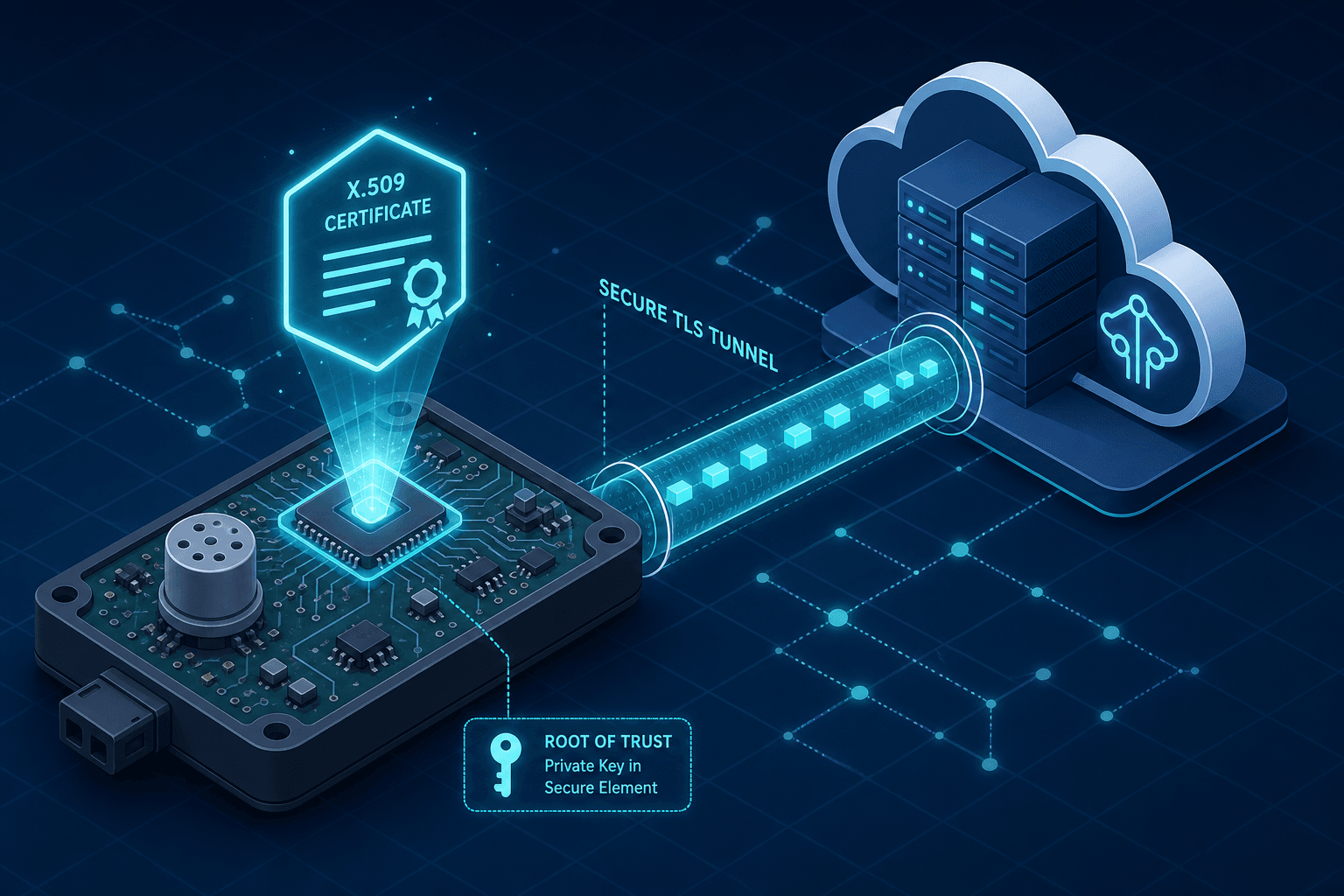
Consider a smart thermostat in a home automation network. If the thermostat connects using a shared static password (a "shared secret"), the security model relies on the secrecy of that string. If an attacker captures the traffic, they can replay the password to impersonate the thermostat. In contrast, a robust IoT identity model uses X.509 certificates. Here, the device holds a private key that never leaves the secure hardware, and the broker holds the corresponding public key or a Certificate Authority (CA) certificate. The connection is not established by "knowing" a secret; it is established by "proving" possession of a private key that mathematically corresponds to a public identity.
This mechanism is defined by the Public Key Infrastructure (PKI). When a device attempts to connect, it initiates a TLS handshake. The device sends its certificate to the broker. The broker then verifies the certificate chain up to a trusted root CA. If the chain is valid and the certificate has not been revoked, the broker knows exactly which device is speaking. This is the fundamental mechanism of IoT identity: the binding of a physical entity to a cryptographic key pair.
The PKI Mechanism: Establishing Trust Before Data Exchange
Device identity in IoT is not a metadata tag but a cryptographic root of trust. Without mutual authentication at the transport layer (TLS) and application layer (MQTT), the device cannot distinguish between a legitimate broker and a man-in-the-middle, rendering all downstream IoT access control useless.
The mechanism of device identity via X.509 certificates explains how the CA hierarchy establishes trust before a single byte of application data is exchanged. This contrasts sharply with shared secrets. In a shared secret model, the security relies on the secrecy of the string itself. If the string is captured, the attacker gains full access. In the X.509 model, the device holds a private key that never leaves the secure hardware, and the broker holds the corresponding public key or a CA certificate.
{
  "certificate": {
    "version": 3,
    "serialNumber": "04:00:00:00:00:01:2A:3B",
    "subject": {
      "CN": "sensor-floor-3",
      "O": "HomeAutomation",
      "OU": "Production"
    },
    "issuer": {
      "CN": "AWS IoT Root CA",
      "O": "Amazon"
    },
    "publicKey": {
      "algorithm": "rsaEncryption",
      "keySize": 2048
    }
  }
}
When a device attempts to connect, it initiates a TLS handshake. The device sends its certificate to the broker. The broker then verifies the certificate chain up to a trusted root CA. If the chain is valid and the certificate has not been revoked, the broker knows exactly which device is speaking. This is the fundamental mechanism of IoT identity: the binding of a physical entity to a cryptographic key pair.
The MQTT Handshake: Enforcing Identity at the Application Layer
Once the transport layer (TLS) establishes a secure channel, the MQTT protocol takes over to enforce granular access control. MQTT is a publish-subscribe protocol, meaning the broker acts as a central nervous system, routing messages between publishers and subscribers. The critical security mechanism here is the verification of the client certificate during the MQTT CONNECT packet exchange.
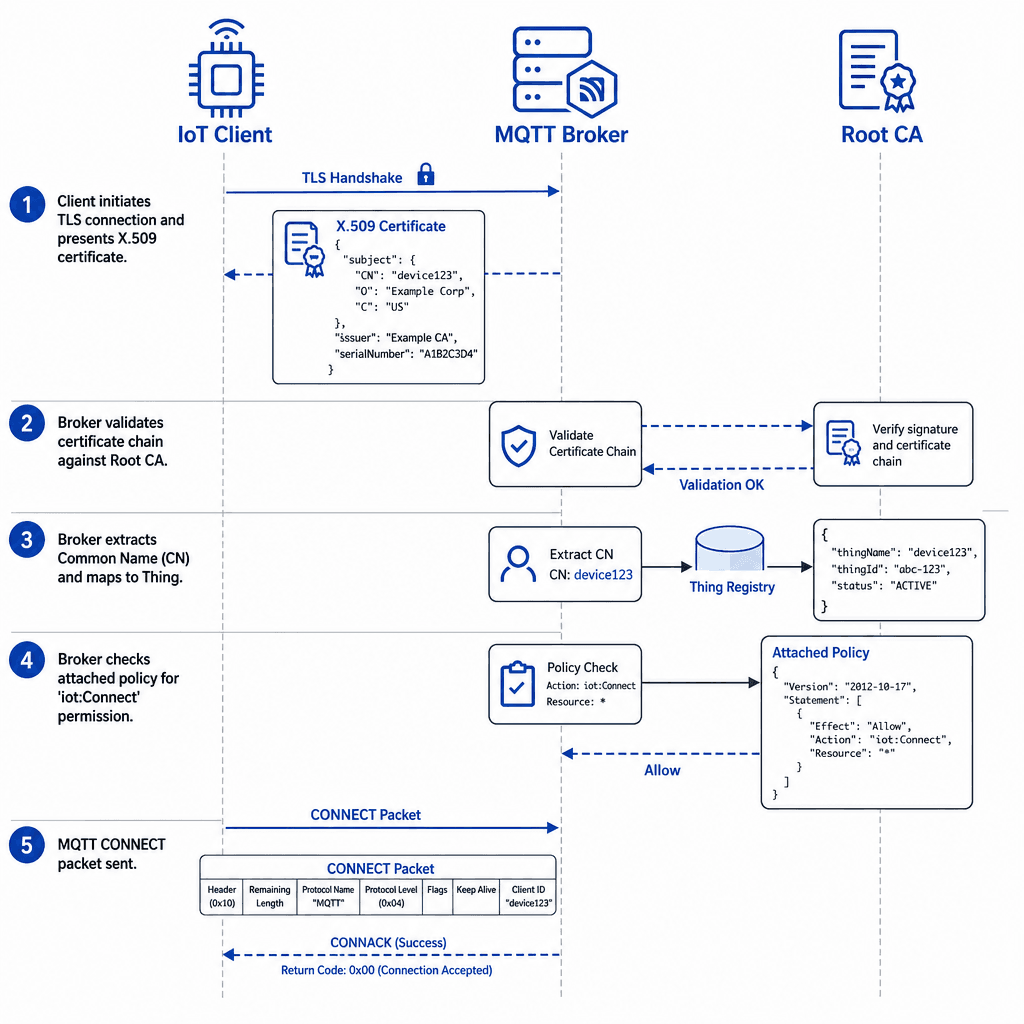
In a typical scenario, a sensor node named sensor-floor-3 initiates a connection to an AWS IoT Core broker. The sensor presents its X.509 certificate during the TLS handshake prior to sending the MQTT CONNECT packet. The broker then extracts the identity from the certificate to map to the Thing. The broker receives this packet and performs two distinct checks. First, it validates the TLS certificate chain to ensure the connection is encrypted and the client is who they claim to be. Second, and more importantly for identity management, the broker extracts the unique identifier from the certificate (often the Common Name or Subject Alternative Name) and maps it to a specific "Thing" in the AWS IoT registry.
This mapping is not automatic; it requires a pre-configured policy. The broker does not grant access based on the fact that the connection is encrypted. It grants access based on the identity presented within the encrypted tunnel. If the certificate presented by sensor-floor-3 does not have an attached policy allowing the action iot:Connect, the broker will terminate the connection immediately, even if the TLS handshake succeeded. This separation of transport security and application-layer authorization is the core mechanism of secure MQTT.
The MQTT specification (v5.0) explicitly supports this by allowing the broker to reject connections based on the client ID or certificate attributes, but in practice, cloud providers like AWS implement this via their policy engine. The policy acts as a filter. It defines what an identity can do. For example, a policy might allow sensor-floor-3 to publish to the topic home/floor3/temperature but deny access to home/floor3/hvac/control. This ensures that even if the device is compromised, the attacker cannot pivot to other parts of the network because the identity-based policy restricts the scope of the connection.
AWS IoT Strategies: The Thing Shadow and Policy Enforcement
The operational realization of these mechanisms in the AWS ecosystem revolves around the "Thing" resource. In AWS IoT Core, a Thing is a logical representation of a physical device. It serves as the container for the device's identity, configuration, and state. The security strategy hinges on the one-to-one relationship between a certificate and a Thing.
When a new device is provisioned, an administrator generates a certificate signed by the AWS IoT CA. This certificate is then registered as a Thing. The critical step that often fails in production is the attachment of the IoT Policy. An IoT Policy is a JSON document that defines the permissions for the certificate. The policy must explicitly list the actions (e.g., iot:Connect, iot:Publish, iot:Receive) and the resources (topics) the identity is allowed to access.
Consider a deployment where a fleet of 10,000 temperature sensors needs to be onboarded. A naive approach might create a single policy allowing all devices to publish to all topics. This violates the principle of least privilege. The correct mechanism involves creating a policy template that binds the specific certificate's Common Name (CN) to a specific topic pattern. For instance, the policy might use a variable substitution like ${iot:Connection.CertCommonName} to dynamically map the certificate's identity to the topic path.
{
  "Version": "2012-10-17",
  "Statement": [
    {
      "Sid": "AllowConnect",
      "Effect": "Allow",
      "Action": "iot:Connect",
      "Resource": "arn:aws:iot:region:account-id:client/${iot:Connection.CertCommonName}"
    },
    {
      "Sid": "AllowPublish",
      "Effect": "Allow",
      "Action": "iot:Publish",
      "Resource": "arn:aws:iot:region:account-id:topic/home/${iot:Connection.CertCommonName}/#"
    },
    {
      "Sid": "AllowReceive",
      "Effect": "Allow",
      "Action": "iot:Receive",
      "Resource": "arn:aws:iot:region:account-id:topic/sensor/${iot:Connection.CertCommonName}/#"
    }
  ]
}
This dynamic mapping ensures that even if a certificate is stolen, the attacker can only publish to the topic associated with that specific certificate's name, not the entire fleet. This is the mechanism of identity-based access control (IBAC). Furthermore, AWS IoT maintains a "Shadow" for each Thing. The Shadow is a digital twin stored in the cloud that holds the desired state of the device. When a device connects, it syncs its local state with the Shadow. If a user wants to change a setting, they update the Shadow, and the device, identified by its certificate, receives the update. The Shadow ensures that the device's identity remains consistent across reboots and network interruptions, providing a persistent anchor for cloud device management.
The security of this system relies on the lifecycle management of these certificates. A certificate that is no longer needed must be revoked. In AWS, this is handled through the internal Certificate Manager or a configured CRL/OCSP endpoint. AWS IoT Core brokers verify certificate status against these sources before accepting the TLS handshake. Connections for revoked certificates are rejected immediately during the handshake verification, ensuring that zombie devices cannot linger in the network.
Conclusion: Identity as the Primary Defense
The intersection of IoT security and identity management is not a matter of adding a password to a device; it is about establishing a cryptographic chain of trust that persists from the hardware up through the cloud. The mechanism of X.509 certificates provides the root of trust, while the MQTT handshake enforces the identity at the application layer. AWS IoT strategies leverage these mechanisms by binding certificates to Things and enforcing granular policies based on those identities.
Without this rigorous identity management, the IoT landscape is vulnerable to replay attacks, unauthorized access, and lateral movement by attackers. The device identity is the key that unlocks the door; if the key is weak, shared, or unverified, the entire building is insecure. Implementing robust identity management is not an optional layer of security; it is the foundational mechanism upon which all other IoT security controls depend.
While shared secrets are easier to implement for very low-cost devices, they fail the 'cryptographic root of trust' definition established in the intro because they rely on secrecy rather than proof of possession. In any production environment where the cost of a breach exceeds the cost of hardware complexity, the X.509 certificate model is the only defensible choice. The overhead of managing PKI is negligible compared to the risk of a compromised device acting as a gateway for a broader network attack.
CTA: Secure Your Fleet Today
To ensure your IoT infrastructure is resilient, start by auditing your current rotation policies and reviewing your Thing policies for least-privilege adherence. Implementing secure device onboarding processes that automatically generate and bind certificates to specific devices is the first step toward a hardened architecture.
FAQ
What happens if a certificate is compromised? If a certificate is compromised, the administrator must immediately revoke it in the AWS IoT Console or via API. The broker will reject any connection attempt using that certificate during the TLS handshake verification, effectively isolating the compromised identity from the network.
Can I use shared secrets for low-cost devices? While shared secrets are easier to implement for extremely low-cost devices, they fail to provide a cryptographic root of trust. They rely on secrecy rather than proof of possession, making them vulnerable to replay attacks and credential stuffing. For production environments, X.509 certificates are strongly recommended.
How does AWS IoT handle certificate revocation? AWS IoT Core brokers verify certificate status against the internal Certificate Manager or a configured CRL/OCSP endpoint before accepting the TLS handshake. If a certificate is revoked, the connection is rejected immediately, preventing the device from communicating even if the cryptographic key is valid.
Practical Takeaways
- Identity Precedes Connectivity: Always establish a verified cryptographic identity (X.509) before allowing any data exchange.
- Least Privilege is Mandatory: Never grant broad access; bind every certificate to a specific policy that limits actions to only what is necessary.
- Automate Lifecycle Management: Rely on automated cloud device management tools to handle provisioning, rotation, and revocation to prevent human error.
Common Pitfalls
- Relying on Shared Secrets: Using static passwords instead of certificates creates a single point of failure that scales poorly and lacks non-repudiation.
- Misconfiguring CRL Endpoints: Failing to configure the correct CRL or OCSP endpoints can lead to false positives (blocking valid devices) or false negatives (allowing revoked ones).
- Ignoring Embedded Security Protocols: Neglecting to store private keys in secure hardware (HSM/TEE) renders the certificate useless, as the key can be extracted and cloned.
Related posts
The Complete Guide to TLS 1.3: Changes & Importance
An examination of TLS 1.3 protocol security changes, configuration strategies for Spring Boot, and the importance of HTTPS in modern transport layer security.
OAuth2 Device Grant: IoT & CLI Auth (RFC 8628)
This article explains the OAuth2 Device Authorization Grant for securing IoT devices and CLI tools using RFC 8628.
AWS Network Security: VPC, SG, NACLs & IAM Integration
An examination of AWS VPC, security groups, and NACLs with IAM integration for advanced network security.