Machine Identity Is the Bigger Problem
An examination of why machine identity management is a critical security challenge for platform and security engineers, focusing on workload authentication and inventory.
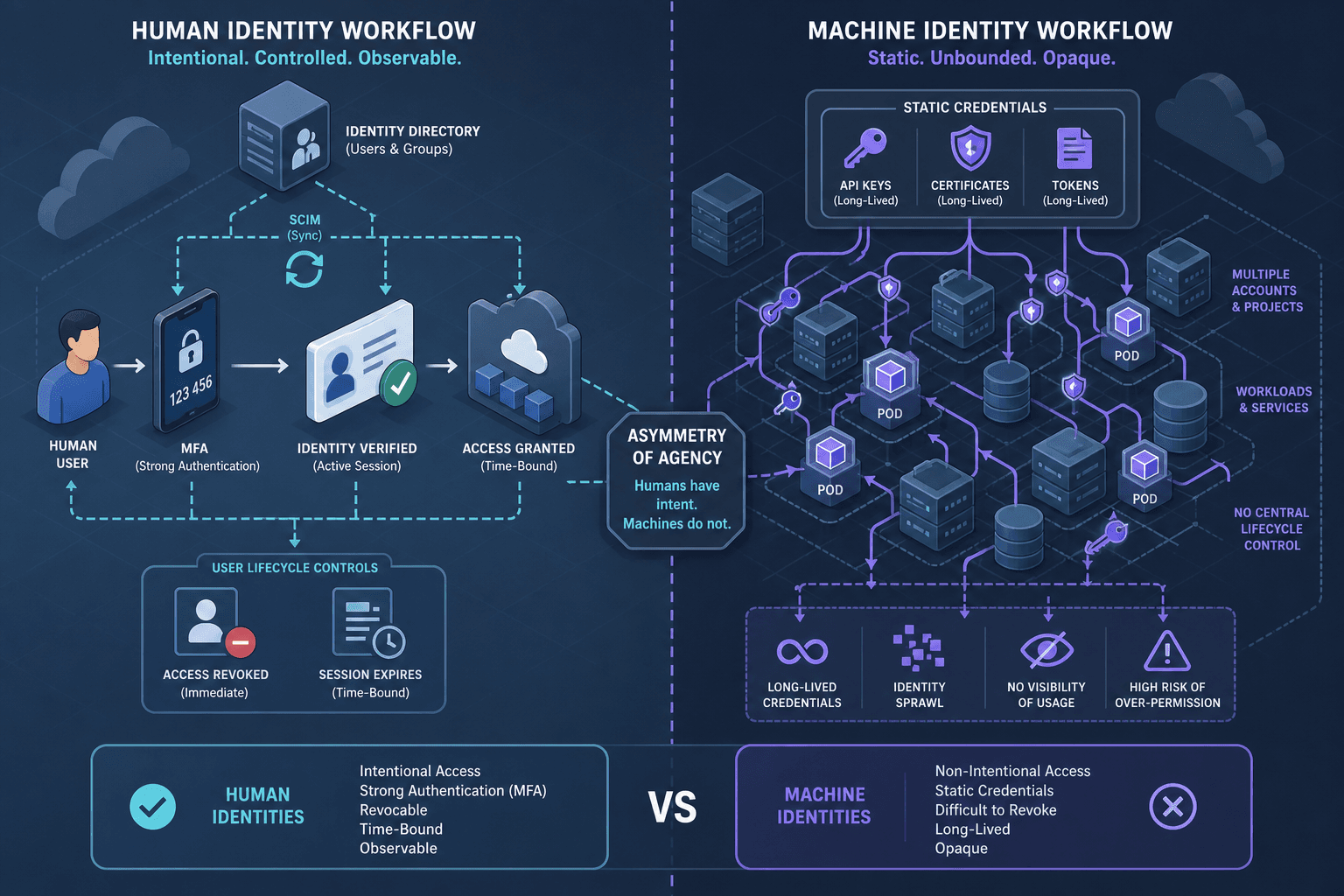
Human identity management is mature. We have Multi-Factor Authentication (MFA), Single Sign-On (SSO), and automated provisioning via SCIM. When an employee leaves, we revoke their access, and the risk is contained. Machine identity—service accounts, API keys, workload certificates—lacks this maturity. Machines do not have intent. They cannot say "no" when asked to perform an action outside their scope. They only execute what they are allowed to do. If the permission is too broad, the machine will execute it without hesitation. This asymmetry makes machine identity the primary attack surface in modern cloud-native architectures.
The Asymmetry of Agency
Human security relies on the assumption that a user can be reasoned with. If a phishing attempt occurs, the user can be trained to recognize it. If a session is compromised, the password can be rotated. Machine identity operates on a different mechanical principle: static credentialing. A service account does not log in; it presents a credential (a key, a certificate, or a token) to prove its identity.
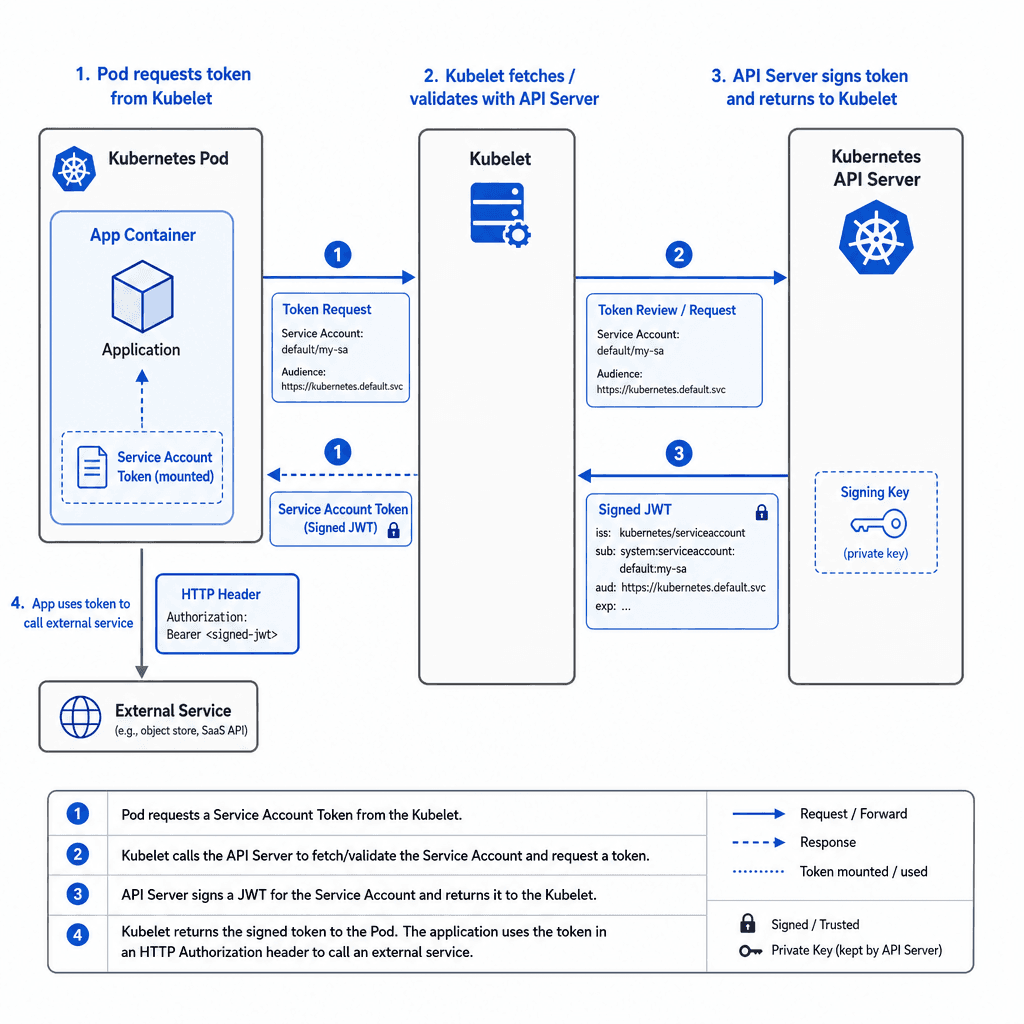
Consider a Kubernetes pod running a web application. To access a database, the pod uses a Service Account Token. This token is injected into the pod’s filesystem by the kubelet, as documented in the Kubernetes Service Accounts documentation. The application code reads this token and includes it in HTTP headers when calling the database API. The database validates the token against the API server. If the token is valid, the request proceeds. There is no second factor. There is no prompt for confirmation. The machine is either authenticated or it is not.
This static nature means that once a credential is stolen, it is indistinguishable from legitimate use. Unlike a human password, which might be changed if compromised, machine credentials are often long-lived and embedded in configuration files, environment variables, or container images. Rotating these credentials requires redeploying the workload, introducing operational friction that teams often avoid.
The Inventory Gap
The core challenge in machine identity is not authentication—it is inventory. You cannot secure what you cannot see. In monolithic applications, services were deployed on known servers with static IP addresses. Identity was tied to the host. In cloud-native environments, identities are ephemeral. A container might run for five minutes, process a request, and terminate. A serverless function might spin up, execute, and vanish.
This dynamism creates "identity sprawl." Teams create service accounts for specific tasks, but rarely delete them. Over time, the IAM policy grows into a tangled web of permissions. A service account originally created for a logging agent might still have write access to S3 buckets after the logging pipeline was migrated. This is a "shadow identity"—an active credential with unknown or excessive privileges. As noted in CNCF reports on cloud-native security and AWS IAM best practices, the accumulation of unused permissions significantly increases the attack surface.
Without an accurate inventory, engineers cannot apply the principle of least privilege. They must grant broad permissions to ensure availability, fearing that restricting access will break production. This leads to a culture of "just give it admin" or "give it read/write" because the alternative is debugging opaque permission errors. The result is a landscape where every workload has more power than it needs, creating a massive blast radius if any single identity is compromised.
Authentication Mechanisms and Scope Creep
Let’s examine the mechanism of workload authentication in a typical cloud environment. When a virtual machine (VM) starts, it contacts the Instance Metadata Service (IMDS) to retrieve temporary credentials. These credentials are short-lived and rotated automatically, a process detailed in AWS IAM documentation regarding IMDS. The VM uses these credentials to call other cloud services.
However, the scope of these credentials is defined at creation. If the IAM role attached to the VM allows s3:* actions, the VM can read, write, and delete any bucket. The IMDS does not check if the specific operation is necessary. It only checks if the role permits it. This is where the disconnect between authentication and authorization becomes critical. Authentication verifies the VM’s identity; authorization grants it broad powers.
In Kubernetes, the mechanism is similar but more complex. Service Account Tokens are signed by the API server’s private key. Other services verify the signature using the public key. The token contains claims about the service account’s identity and namespace. However, the RBAC policies in Kubernetes are often configured with cluster-wide roles rather than namespace-specific roles. As highlighted in Kubernetes RBAC documentation, a developer deploying an app might inadvertently bind it to a cluster-admin role, giving it access to all namespaces and all resources.
The problem is compounded by the fact that these tokens are often cached or stored in configuration management tools like Ansible or Terraform. If a developer checks a token into version control, it becomes a permanent secret. While Service Account Tokens are technically short-lived, caching them in static configuration files creates long-lived static secrets that defeat the purpose of ephemeral runtime tokens. This lack of hygiene is a common source of credential exposure, as discussed in security guidelines regarding secret management in CI/CD pipelines.
# Example of exposing a token in version control
# Note: kubectl get sa ... retrieves the secret reference, not the token itself.
# A better example of exposure is caching the output of:
# kubectl create token my-sa > /tmp/token.txt
echo "TOKEN=$(kubectl create token my-sa)" >> .env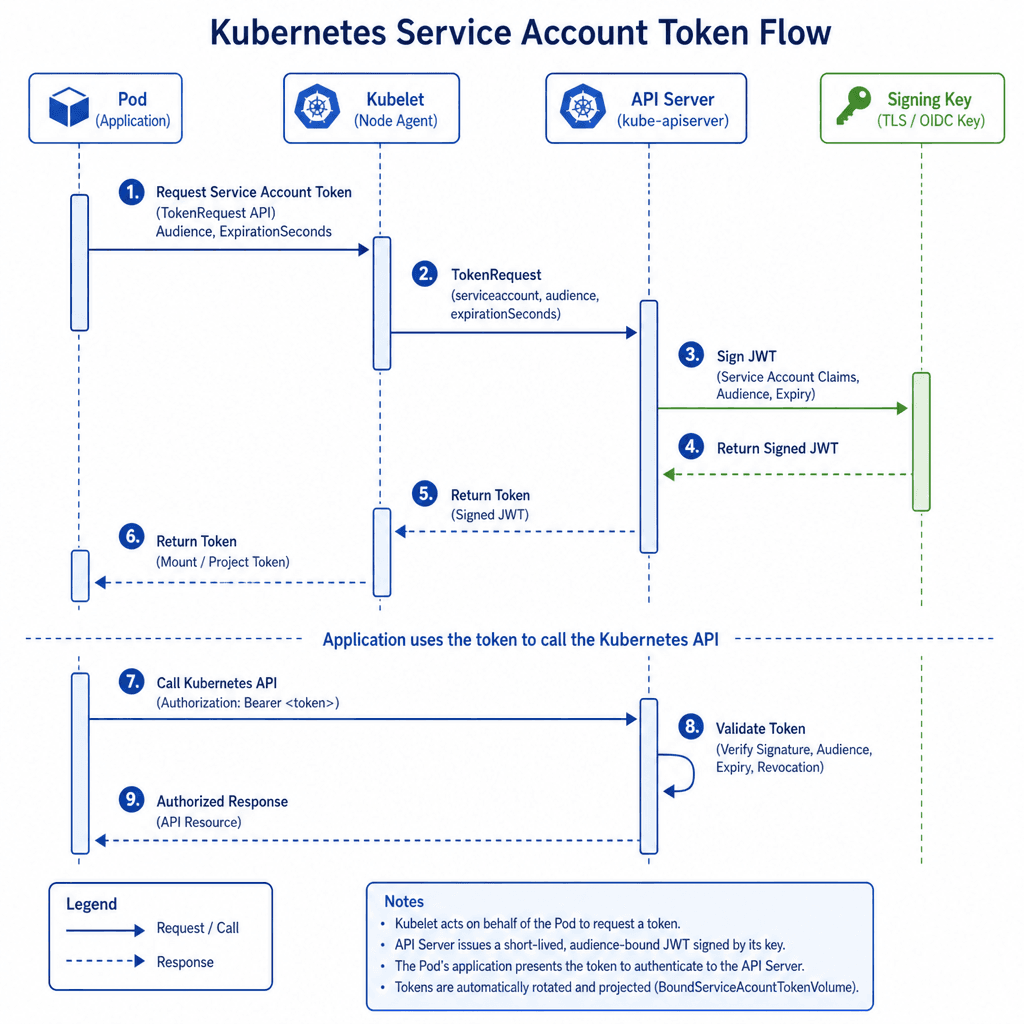
The Path Forward
Solving machine identity requires a shift from static credentialing to dynamic, just-in-time access. Instead of long-lived API keys, workloads should request short-lived credentials on demand. Tools like SPIFFE/SPIRE provide a standardized way to issue workload identities using X.509 certificates, enabling mutual TLS (mTLS) between services. This ensures that only authenticated workloads can communicate, and the certificates are short-lived and rotated automatically, as described in the SPIFFE/SPIRE documentation.
Inventory is equally important. Engineers must adopt a "zero trust" approach to identity, assuming that any workload could be compromised. This means continuously auditing IAM policies, removing unused permissions, and enforcing least privilege through automated tools. Policy-as-code frameworks like OPA (Open Policy Agent) can enforce constraints on IAM roles, preventing developers from granting excessive permissions. For more on policy-as-code, see the OPA documentation.
Machine identity is not just a technical detail; it is a fundamental security challenge. As infrastructure becomes more dynamic, the ability to manage and audit machine identities will determine the resilience of an organization. The focus must shift from securing the perimeter to securing every workload, every service account, and every credential. Without this shift, the complexity of modern systems will remain a liability rather than an asset.
Conclusion
Machine identity management is the critical failure point in modern security because it lacks the agency and revocation mechanisms inherent in human identity. The asymmetry between static machine credentials and dynamic human intent creates significant risks. By addressing the inventory gap and implementing dynamic, just-in-time access controls, organizations can mitigate these risks and build more resilient cloud-native architectures.
Related posts
Multi Cloud Identity Management Framework: A Reference Architecture
A reference framework for cross-cloud IAM that addresses multi-cloud identity management, entitlements, and reference architecture for architects.
API Keys: Rotation, Storage, and Monitoring
A practical guide to API key rotation, secure storage, and monitoring for backend developers and platform engineers.
Short-Lived Credentials Over Long-Lived Secrets
Explore why short-lived credentials reduce risk compared to long-lived secrets, addressing secret sprawl and improving security for platform and engineering teams.