Short-Lived Credentials Over Long-Lived Secrets
Explore why short-lived credentials reduce risk compared to long-lived secrets, addressing secret sprawl and improving security for platform and engineering teams.
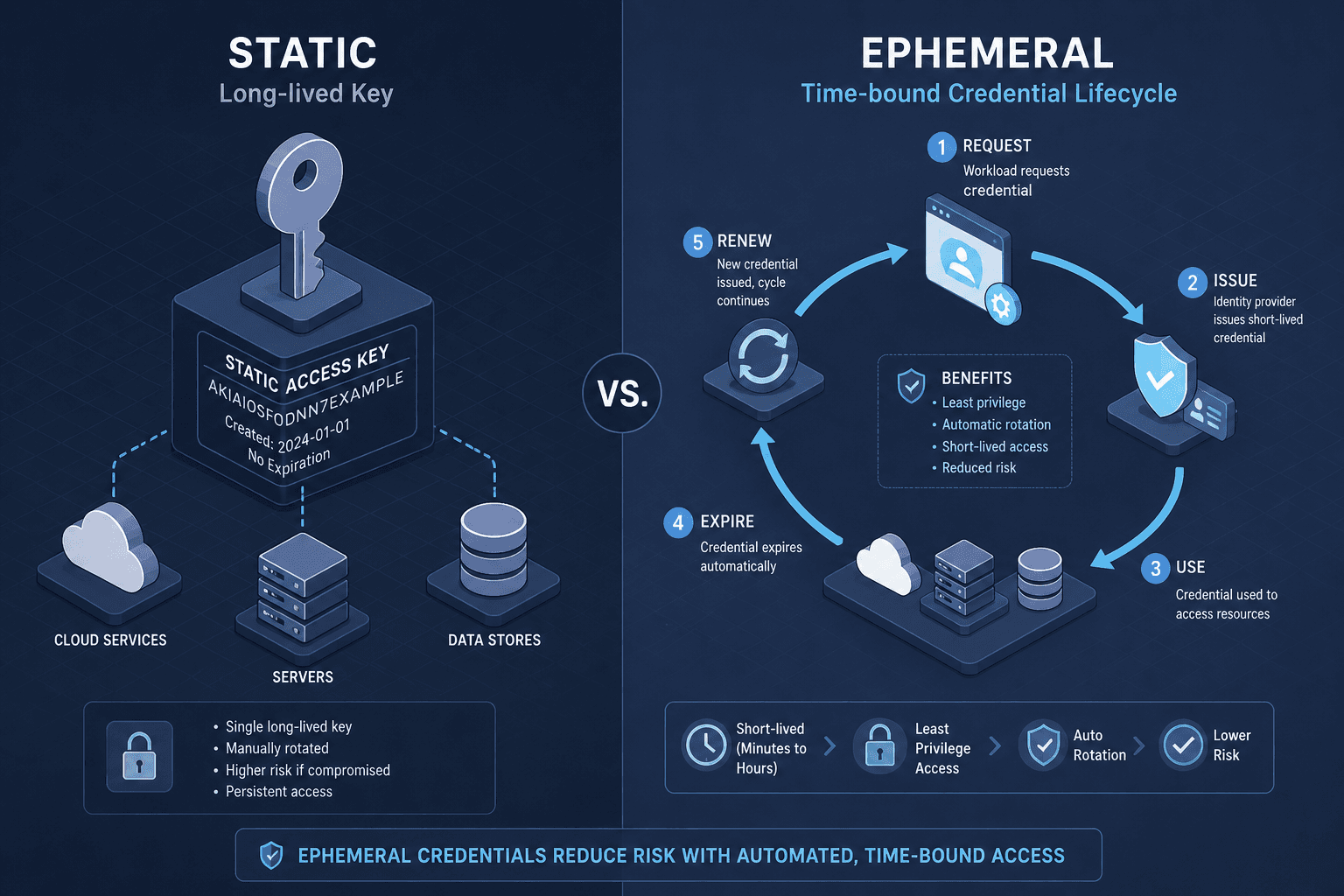
For platform engineers, the most dangerous artifact in a repository is not a vulnerability in the code, but a static access key or password. Long-lived secrets—credentials that remain valid indefinitely until manually rotated—represent a fundamental architectural flaw. They create a permanent attack surface where a single compromise leads to persistent unauthorized access.
This article is Part 4 of the Machine Identity and Workload Auth series.
The solution is not better storage for these secrets, but their elimination. By shifting to short-lived, ephemeral credentials, teams reduce risk by design. This shift moves security from "hiding a shared secret" to "verifying a transient identity."
The Failure Mode of Static Secrets
Static secrets operate on a "trust once, trust forever" model. When an application needs to access an AWS S3 bucket, it typically stores an AWS_ACCESS_KEY_ID and AWS_SECRET_ACCESS_KEY in environment variables or a .env file. These keys do not expire.
This creates two critical problems: Secret Sprawl and High-Value Targets.
Secret Sprawl
Because static keys do not expire, they accumulate. Developers copy-paste credentials across environments (dev, staging, prod). CI/CD pipelines hardcode them. Legacy services retain them long after the original team has departed. This sprawl makes auditing impossible. You cannot track who used a key if the key is shared across five different services and has no unique identifier tied to a specific workload instance.
The Exfiltration Window
If an attacker exfiltrates a static key from a GitHub repository or a compromised server, they have indefinite access. The only mitigation is detection and rotation—a reactive process that often takes days or weeks. During that window, the attacker can move laterally, exfiltrate data, or deploy ransomware.
Opinion: Storing static secrets in any version-controlled system, even encrypted, is a failure of abstraction. Encryption adds complexity without solving the root problem: the secret is still static and long-lived.

The Mechanism of Ephemeral Credentials
Short-lived credentials solve this by binding identity to time. Instead of sharing a secret, the workload proves its identity to an Identity Provider (IdP) and receives a temporary token. This token has a limited Time To Live (TTL), typically ranging from 15 minutes to 24 hours.
While a vault can securely store static secrets, it does not solve the fundamental risk of long-lived access. A vault merely moves the needle from "exposed key" to "locked box," but if the key inside is valid forever, the blast radius remains massive if the vault is breached or the key is extracted by a privileged insider. Ephemeral credentials remove the need to store these secrets entirely.
How It Works: The OIDC Flow
Consider a modern CI/CD pipeline running on GitHub Actions. Instead of storing AWS credentials in GitHub Secrets, the workflow uses OpenID Connect (OIDC) federation.
- Identity Assertion: The GitHub Actions runner generates a JWT (JSON Web Token) containing claims about the workflow (repository, branch, job ID).
- Token Exchange: The runner sends this JWT to the cloud provider’s STS (Security Token Service) endpoint.
- Validation: The cloud provider validates the JWT’s signature against GitHub’s public keys. It checks the claims (e.g.,
repo: myorg/myrepo,ref: refs/heads/main). - Issuance: If valid, the STS issues temporary AWS IAM credentials (Access Key, Secret Key, Session Token) with a short TTL (e.g., 1 hour).
# Example: AWS CLI assuming a role via OIDC
aws sts assume-role-with-web-identity \
  --role-arn arn:aws:iam::123456789012:role/GitHubActionsRole \
  --role-session-name GitHubActions \
  --web-identity-token file://token.txt
The resulting credentials are only valid for the duration of the TTL. Once expired, they are useless. Even if an attacker steals them during the brief window, they cannot be reused after expiration.
Automated Renewal and Lifecycle Management
The biggest objection to short-lived credentials is operational friction: "How do I handle expiration?"
The answer is automation. Machine identities do not need human intervention to renew credentials. They can automatically refresh tokens before they expire, creating a seamless experience for developers while maintaining security. This approach is widely recognized as a best practice for maintaining security hygiene in cloud-native environments.
The Refresh Loop
A workload configured with short-lived credentials runs a background process or uses a library that handles renewal:
- Check Expiry: The application checks the expiration timestamp of the current token.
- Renew Early: If the token is less than 10% from expiry, it requests a new token from the IdP. Common industry practice suggests refreshing tokens well before expiration to account for clock skew and network latency.
- Swap Atomically: The new credentials replace the old ones in memory without restarting the service.
This loop continues indefinitely. The workload never holds a static secret. It only holds transient tokens that are valid for a short period.
Benefits of Automated Renewal
- Zero Downtime: Users never notice credential rotation.
- Auditability: Each token issuance is logged by the IdP, providing a clear audit trail of which workload accessed which resource and when.
- Reduced Blast Radius: If a token is compromised, the attacker’s access is limited to the remaining TTL (minutes or hours), not months or years.
Common Pitfalls
Implementing short-lived credentials introduces new operational considerations. Misconfiguration here can lead to outages or security gaps.
- Misconfigured TTLs: Setting the TTL too short may cause frequent rotation overhead and increased load on the IdP. Setting it too long defeats the purpose of short-lived credentials. Aim for the shortest TTL that satisfies your application's operational requirements.
- Failing to Handle Refresh Errors: If the token refresh fails (e.g., due to network issues or IdP unavailability), the application must handle this gracefully. Simply continuing with an expired token creates a security gap, while crashing the service creates availability issues. Implement exponential backoff and circuit breakers for refresh operations.
- Caching Stale Tokens: Some libraries or proxies may cache credentials aggressively. Ensure that caching mechanisms are aware of the TTL and invalidate cached credentials before they expire.
Practical Takeaways
- Eliminate static keys from repositories and infrastructure-as-code.
- Use OIDC federation to exchange identity assertions for temporary cloud credentials.
- Automate token renewal in applications to maintain continuous access without human intervention.
- Audit your current rotation policy and migrate high-risk static secrets first.
FAQ
Q: Can I use short-lived credentials with legacy applications that don't support dynamic token refresh? A: Yes. You can use sidecar containers or proxy agents (like HashiCorp Vault Agent or AWS IAM Roles Anywhere) that handle the credential refresh and inject the credentials into the legacy application via environment variables or files.
Q: How does this impact performance? A: The overhead of fetching and rotating short-lived credentials is minimal, typically adding milliseconds to the initial connection. Subsequent requests use the cached token in memory, so there is no significant performance impact on runtime traffic.
Q: What happens if the Identity Provider goes down? A: If the IdP is unavailable, new tokens cannot be issued. Existing valid tokens will continue to work until they expire. If a refresh is attempted during an outage, the application should fall back to a safe state (e.g., queueing requests or failing gracefully) rather than using stale credentials.
Conclusion
Long-lived secrets are a liability because they assume perfect security forever. In practice, breaches are inevitable. Short-lived credentials acknowledge this reality by limiting the impact of any single breach.
For platform engineers, the migration path is clear:
- Identify all static keys in repositories and infrastructure-as-code.
- Implement OIDC federation or IAM roles for workloads.
- Automate credential renewal in applications.
- Retire static secrets.
This shift reduces secret sprawl, strengthens workload authentication, and aligns security with the dynamic nature of modern cloud infrastructure. The goal is not to hide secrets better, but to make them irrelevant through temporality. Start by auditing your current rotation policy and identifying the top 5 most critical static secrets to replace.
Related posts
Automatic Secret Rotation With Lambda
Learn how to implement automatic secret rotation using AWS Lambda and Secrets Manager to enhance security for database credentials.
Machine Identity Is the Bigger Problem
An examination of why machine identity management is a critical security challenge for platform and security engineers, focusing on workload authentication and inventory.
KMS vs Secrets Manager: Different Jobs
Understand the distinct roles of AWS KMS and Secrets Manager for secure key management and secret storage in cloud infrastructure.